- Dutch
- Frisian
- Saterfrisian
- Afrikaans
-
- Syntax
- Preface and acknowledgements
- Verbs and Verb Phrases
- 1 Verbs: Characterization and classification
- 2 Projection of verb phrases I: Argument structure
- 3 Projection of verb phrases IIIa: Selected clauses/verb phrases (introduction)
- 1.0. Introduction
- 1.1. Main types of verb-frame alternation
- 1.2. Alternations involving the external argument
- 1.3. Alternations of noun phrases and PPs
- 1.4. Some apparent cases of verb-frame alternation
- 1.5. Bibliographical notes
- 4 Projection of verb phrases IIIa: Selected clauses/verb phrases (introduction)
- 4.0. Introduction
- 4.1. Semantic types of finite argument clauses
- 4.2. Finite and infinitival argument clauses
- 4.3. Control properties of verbs selecting an infinitival clause
- 4.4. Three main types of infinitival argument clauses
- 4.5. Non-main verbs
- 4.6. The distinction between main and non-main verbs
- 4.7. Bibliographical notes
- 5 Projection of verb phrases IIIb: Argument and complementive clauses
- 5.0. Introduction
- 5.1. Finite argument clauses
- 5.2. Infinitival argument clauses
- 5.3. Complementive clauses
- 5.4. Bibliographical notes
- 6 Projection of verb phrases IIIc: Complements of non-main verbs
- 7 Projection of verb phrases IIId: Verb clustering
- 8 Projection of verb phrases IV: Adverbial modification
- 9 Word order in the clause I: General introduction
- 10 Word order in the clause II: Position of the finite verb (verb-first/second)
- 11 Word order in the clause III:Clause-initial position (wh-movement)
- 11.0. Introduction
- 11.1. The formation of V1 and V2-clauses
- 11.2. Clause-initial position remains (phonetically) empty
- 11.3. Clause-initial position is filled
- 11.4. Bibliographical notes
- 12 Word order in the clause IV: Postverbal field (extraposition)
- 13 Word order in the clause V: Middle field (scrambling)
- Nouns and Noun Phrases
- 14 Characterization and classification
- 15 Projection of noun phrases I: Complementation
- 15.0. Introduction
- 15.1. General observations
- 15.2. Prepositional and nominal complements
- 15.3. Clausal complements
- 15.4. Bibliographical notes
- 16 Projection of noun phrases II: Modification
- 16.0. Introduction
- 16.1. Restrictive and non-restrictive modifiers
- 16.2. Premodification
- 16.3. Postmodification
- 16.3.1. Adpositional phrases
- 16.3.2. Relative clauses
- 16.3.3. Infinitival clauses
- 16.3.4. A special case: clauses referring to a proposition
- 16.3.5. Adjectival phrases
- 16.3.6. Adverbial postmodification
- 16.4. Bibliographical notes
- 17 Projection of noun phrases III: Binominal constructions
- 17.0. Introduction
- 17.1. Binominal constructions without a preposition
- 17.2. Binominal constructions with a preposition
- 17.3. Bibliographical notes
- 18 Determiners: Articles and pronouns
- 18.0. Introduction
- 18.1. Articles
- 18.2. Pronouns
- 18.3. Bibliographical notes
- 19 Numerals and quantifiers
- 19.0. Introduction
- 19.1. Numerals
- 19.2. Quantifiers
- 19.2.1. Introduction
- 19.2.2. Universal quantifiers: ieder/elk ‘every’ and alle ‘all’
- 19.2.3. Existential quantifiers: sommige ‘some’ and enkele ‘some’
- 19.2.4. Degree quantifiers: veel ‘many/much’ and weinig ‘few/little’
- 19.2.5. Modification of quantifiers
- 19.2.6. A note on the adverbial use of degree quantifiers
- 19.3. Quantitative er constructions
- 19.4. Partitive and pseudo-partitive constructions
- 19.5. Bibliographical notes
- 20 Predeterminers
- 20.0. Introduction
- 20.1. The universal quantifier al ‘all’ and its alternants
- 20.2. The predeterminer heel ‘all/whole’
- 20.3. A note on focus particles
- 20.4. Bibliographical notes
- 21 Syntactic uses of noun phrases
- 22 Referential dependencies (binding)
- Adjectives and Adjective Phrases
- 23 Characteristics and classification
- 24 Projection of adjective phrases I: Complementation
- 25 Projection of adjective phrases II: Modification
- 26 Projection of adjective phrases III: Comparison
- 27 Attributive use of the adjective phrase
- 28 Predicative use of the adjective phrase
- 29 The partitive genitive construction
- 30 Adverbial use of the adjective phrase
- 31 Participles and infinitives: their adjectival use
- Adpositions and adpositional phrases
- 32 Characteristics and classification
- 32.0. Introduction
- 32.1. Characterization of the category adposition
- 32.2. A syntactic classification of adpositional phrases
- 32.3. A semantic classification of adpositional phrases
- 32.4. Borderline cases
- 32.5. Bibliographical notes
- 33 Projection of adpositional phrases: Complementation
- 34 Projection of adpositional phrases: Modification
- 35 Syntactic uses of adpositional phrases
- 36 R-pronominalization and R-words
- 32 Characteristics and classification
- Coordination and Ellipsis
- Syntax
-
- General
-
- General
- Morphology
- Morphology
- 1 Word formation
- 1.1 Compounding
- 1.1.1 Compounds and their heads
- 1.1.2 Special types of compounds
- 1.1.2.1 Affixoids
- 1.1.2.2 Coordinative compounds
- 1.1.2.3 Synthetic compounds and complex pseudo-participles
- 1.1.2.4 Reduplicative compounds
- 1.1.2.5 Phrase-based compounds
- 1.1.2.6 Elative compounds
- 1.1.2.7 Exocentric compounds
- 1.1.2.8 Linking elements
- 1.1.2.9 Separable Complex Verbs and Particle Verbs
- 1.1.2.10 Noun Incorporation Verbs
- 1.1.2.11 Gapping
- 1.2 Derivation
- 1.3 Minor patterns of word formation
- 1.1 Compounding
- 2 Inflection
- 1 Word formation
- Morphology
- Syntax
- Adjectives and adjective phrases (APs)
- 0 Introduction to the AP
- 1 Characteristics and classification of APs
- 2 Complementation of APs
- 3 Modification and degree quantification of APs
- 4 Comparison by comparative, superlative and equative
- 5 Attribution of APs
- 6 Predication of APs
- 7 The partitive adjective construction
- 8 Adverbial use of APs
- 9 Participles and infinitives as APs
- Nouns and Noun Phrases (NPs)
- 0 Introduction to the NP
- 1 Characteristics and Classification of NPs
- 2 Complementation of NPs
- 3 Modification of NPs
- 3.1 Modification of NP by Determiners and APs
- 3.2 Modification of NP by PP
- 3.3 Modification of NP by adverbial clauses
- 3.4 Modification of NP by possessors
- 3.5 Modification of NP by relative clauses
- 3.6 Modification of NP in a cleft construction
- 3.7 Free relative clauses and selected interrogative clauses
- 4 Partitive noun constructions and constructions related to them
- 4.1 The referential partitive construction
- 4.2 The partitive construction of abstract quantity
- 4.3 The numerical partitive construction
- 4.4 The partitive interrogative construction
- 4.5 Adjectival, nominal and nominalised partitive quantifiers
- 4.6 Kind partitives
- 4.7 Partitive predication with a preposition
- 4.8 Bare nominal attribution
- 5 Articles and names
- 6 Pronouns
- 7 Quantifiers, determiners and predeterminers
- 8 Interrogative pronouns
- 9 R-pronouns and the indefinite expletive
- 10 Syntactic functions of Noun Phrases
- Adpositions and Adpositional Phrases (PPs)
- 0 Introduction to the PP
- 1 Characteristics and classification of PPs
- 2 Complementation of PPs
- 3 Modification of PPs
- 4 Bare (intransitive) adpositions
- 5 Predication of PPs
- 6 Form and distribution of adpositions with respect to staticity and construction type
- 7 Adpositional complements and adverbials
- Verbs and Verb Phrases (VPs)
- 0 Introduction to the VP in Saterland Frisian
- 1 Characteristics and classification of verbs
- 2 Unergative and unaccusative subjects and the auxiliary of the perfect
- 3 Evidentiality in relation to perception and epistemicity
- 4 Types of to-infinitival constituents
- 5 Predication
- 5.1 The auxiliary of being and its selection restrictions
- 5.2 The auxiliary of going and its selection restrictions
- 5.3 The auxiliary of continuation and its selection restrictions
- 5.4 The auxiliary of coming and its selection restrictions
- 5.5 Modal auxiliaries and their selection restrictions
- 5.6 Auxiliaries of body posture and aspect and their selection restrictions
- 5.7 Transitive verbs of predication
- 5.8 The auxiliary of doing used as a semantically empty finite auxiliary
- 5.9 Supplementive predication
- 6 The verbal paradigm, irregularity and suppletion
- 7 Verb Second and the word order in main and embedded clauses
- 8 Various aspects of clause structure
- Adjectives and adjective phrases (APs)
Weak (phonetically reduced) proforms usually occur in the left periphery of the middle field of the clause, with the exception of weak subject pronouns, which can also occur in clause-initial position; cf. Section 9.3. We can distinguish the three groups of weak elements in (183), all of which have strong counterparts, with the exception of expletive and quantitative er.
| a. | Referential personal pronouns; ie/ze ‘he/she’, ʼm/ʼr ‘him/her’, etc. |
| b. | Reflexive personal pronouns: me ‘myself’, je ‘yourself’, zich ‘him/herself’, etc. |
| c. | R-words: expletive, locational, prepositional and quantitative er |
The set of elements in (183) closely resembles the set of clitics found in French; cf. the lemma in Wikipedia for a brief overview. We will see that the relative order of the weak proforms also has a number of similarities with the French clitics, which may justify the claim that the Dutch weak proforms are also clitics; cf. Huybregts (1991), Zwart (1993/1996), as well as Haegeman (1993a/1993b) on West Flemish. However, Dutch proforms differ from French clitics in that they do not need a verbal host: while French clitics always cluster around a main or auxiliary verb, Dutch proforms do not require this. In order not to prejudge the discussion, we will refer to the movement that places weak proforms in the left periphery of the middle field as weak proform shift. Subsection I begins with a discussion of weak referential personal pronouns, Subsection II discusses weak (or simplex) reflexive pronouns, and Subsection III concludes with the various uses of the weak R-word er.
Table 2 shows the classification of referential personal pronouns, which will be discussed in more detail in Section N18.2.1. The discussion here focuses on the distribution of the weak forms.
| singular | plural | ||||||||
| subject | object | subject | object | ||||||
| strong | weak | strong | weak | strong | weak | strong | weak | ||
| 1st person | ik | ’k | mij | me | wij | we | ons | — | |
| 2nd person | regular | jij | je | jou | je | jullie | — | jullie | — |
| polite | u | u | u | u | |||||
| 3rd person | masculine | hij | -ie | hem | ’m | zij | ze | henacc hundat | ze |
| feminine | zij | ze | haar | (d)’r | |||||
| neuter | ?het | ’t | *?het | ’t | |||||
In embedded clauses, weak subject pronouns are right-adjacent to the complementizer (if present), and in main clauses they immediately precede or follow the finite verb in second position; cf. Paardekooper (1961). This is illustrated in (184) with the 3rd person singular feminine pronoun zeher.
| a. | dat | ze | waarschijnlijk | morgen | komt. | embedded clause | |
| that | she | probably | tomorrow | comes | |||
| 'that she is probably coming tomorrow.' | |||||||
| b. | Ze | komt | waarschijnlijk | morgen. | subject-initial main clause | |
| she | comes | probably | tomorrow | |||
| 'She is probably coming tomorrow.' | ||||||
| b'. | Waarschijnlijk | komt | ze | morgen. | other main clauses | |
| probably | comes | she | tomorrow | |||
| 'Probably she is coming tomorrow.' | ||||||
The examples in (185) show that subject pronouns can only occur in positions further to the right when they are strong and carry a contrastive focus accent. The question mark in example (185b) is used to indicate that even then it is often preferred to strengthen the pronoun with a focus particle.
| a. | * | dat | waarschijnlijk | ze | morgen | komt. |
| that | probably | she | tomorrow | comes |
| b. | dat | waarschijnlijk | ?(zelfs) | morgen | komt. | |
| that | probably | even she | tomorrow | comes | ||
| 'that even she is probably coming tomorrow.' | ||||||
The examples in (186) show that the singular third-person masculine subject pronoun iehe is exceptional in that it cannot occur in clause-initial position: it is a true enclitic pronoun in that it necessarily follows the complementizer or the finite verb in the second position.
| a. | dat-ie | waarschijnlijk | morgen | komt. | embedded clause | |
| that-he | probably | tomorrow | comes | |||
| 'that he is probably coming tomorrow.' | ||||||
| b. | Hij/*Ie | komt | waarschijnlijk | morgen. | subject-initial main clause | |
| he/he | comes | probably | tomorrow | |||
| 'He is probably coming tomorrow.' | ||||||
| b'. | Waarschijnlijk | komt-ie | morgen. | other main clauses | |
| probably | comes-he | tomorrow | |||
| 'Probably he is coming tomorrow.' | |||||
Example (187) shows that weak subject pronouns are conspicuously different from weak object pronouns in that the latter cannot occur in main-clause initial position.
| a. | Gisteren | heeft | Jan het boek/ʼt | gelezen. | clause-internal | |
| yesterday | has | Jan the book/it | read | |||
| 'Yesterday Jan read the book/it.' | ||||||
| b. | Het boek/*ʼt | heeft | Jan gisteren | gelezen. | clause-initial | |
| the book/it | has | Jan yesterday | read |
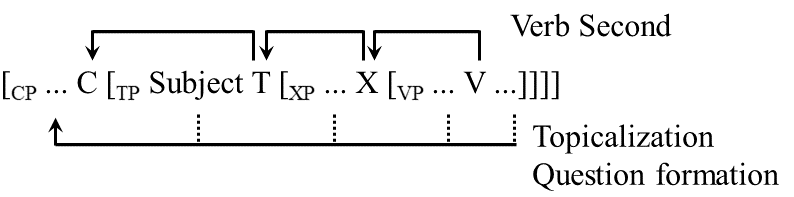
This fact motivated the claim in (188) that subject-initial sentences are not CPs but TPs; cf. Section 9.3 for a detailed discussion. This hypothesis makes it possible to account for this difference in the distribution of subject and object pronouns, while maintaining the generalization that weak pronouns cannot be topicalized, i.e. wh-moved into the specifier of CP.
| a. | Subject-initial sentence |
 |
| b. | Topicalization and question formation |
 |
This subsection discusses weak proform shift of object pronouns: we will consider the placement of weak object pronouns with respect to subjects, the relative order of weak direct and indirect object pronouns, and the relative order of weak object pronouns with respect to accusative subjects of AcI-constructions.
Example (187) above has already shown that weak object pronouns cannot occur in main-clause initial position, but must occupy a position in the middle field of the clause. The examples in (189) further show that they immediately follow the subject when the latter is not in main-clause initial position; cf. Huybregts (1991). This is true not only when the subject is in the regular subject position, as in the primeless examples, but also when it is contrastively focused and can be assumed to be located in the specifier of FocP lower in the clause, as in the primed examples; cf. Section 13.3.2.
| a. | dat | <*ʼt> | Jan/ie <ʼt> | waarschijnlijk <*ʼt> | niet | gelezen | heeft | |
| that | it | Jan/he | probably | not | read | has | ||
| 'that Jan/he probably has not read it.' | ||||||||
| a'. | dat | <*ʼt> | waarschijnlijk | zelfs <ʼt> | niet | gelezen | heeft. | |
| that | it | probably | even Jan | not | read | has | ||
| 'that even Jan probably has not read it.' | ||||||||
| b. | dat | <*ʼm> | Marie/ze <ʼm> | waarschijnlijk <*ʼm> | goede raad | wil | geven. | |
| that | him | Marie/she | probably | good advice | wants | give | ||
| 'that Marie/she probably wants to give him good advice.' | ||||||||
| b'. | dat | <*ʼm> | waarschijnlijk | zelfs <ʼm> | goede raad | wil | geven. | |
| that | him | probably | even Marie | good advice | wants | give | ||
| 'that even Marie probably wants to give him good advice.' | ||||||||
In subject-initial main clauses, weak object pronouns immediately follow the finite verb in second position. This is illustrated in (190) by showing that modal adverbials cannot precede the object pronoun, but this holds for other constituents as well.
| a. | Jan heeft | <ʼt> | waarschijnlijk <*ʼt> | niet | gelezen. | |
| Jan has | it | probably | not | read | ||
| 'Jan probably has not read it.' | ||||||
| b. | Marie wil | <ʼm> | waarschijnlijk <*ʼm> | goede raad | geven. | |
| Marie wants | him | probably | good advice | give | ||
| 'Marie probably wants to give him good advice.' | ||||||
Note that this correctly implies that the weak object pronoun cannot occur between the modal adverbial waarschijnlijk and the contrastively focused subject in the primed examples in (189) either.
The previous subsection has shown that weak proform shift cannot affect the unmarked order of the subject and the objects. This is different when it comes to the relative order of direct and indirect objects: while direct objects usually follow nominal indirect objects under a neutral (i.e. non-contrastive) intonation pattern, weak pronominal direct objects usually precede them. The examples in (191) show that this is true regardless of whether the indirect object is non-pronominal or pronominal. Note that it also holds when the two object pronouns have the same form: the first object pronoun in dat Peter ʼm ʼm aanboodthat Peter offered it to him is interpreted as the direct object.
| a. | dat | Peter | <*de auto> | Marie | <de auto> | aanbood. | |
| that | Peter | the car | Marie | the car | prt.-offered | ||
| 'that Peter offered Marie the car.' | |||||||
| b. | dat | Peter | <ʼm> | Marie/ʼr <??ʼm> | aanbood. | |
| that | Peter | him | Marie/her | prt.-offered | ||
| 'that Peter offered it to Marie/her.' | ||||||
Weak direct and indirect object pronouns cluster together, which may be related to the fact, illustrated in the previous subsection, that they must both be adjacent to the finite verb, or to the subject if it is not in clause-initial position; the only novelty is that this restriction applies not only to individual pronouns, but to the whole cluster. Haegeman (1993a) has further observed for West Flemish that the inversion of indirect and direct object requires scrambling of the indirect object. Example (192a) shows that the same is true for Dutch under a neutral intonation pattern; the degraded order improves when the indirect object is given a contrastive accent. For completeness’ sake, it should be noted that weak pronoun shift of the object is possible with a prepositional indirect object, as in (192b); this way of expressing the intended meaning may in fact be the preferred way for some speakers.
| a. | dat | Jan | ʼt | <Marie> | waarschijnlijk <*?Marie> | gegeven | heeft. | |
| that | Jan | it | Marie | probably | given | has | ||
| 'that Jan has probably given it to Marie.' | ||||||||
| b. | dat | Jan | ʼt | waarschijnlijk | aan Marie | gegeven | heeft. | |
| that | Jan | it | probably | to Marie | given | has | ||
| 'that Jan has probably given it to Marie.' | ||||||||
Reversal of direct and indirect objects is only possible with reduced direct objects. However, it is not easy to demonstrate reversal for strong referential personal pronouns, because they are not normally used to refer to inanimate entities. The examples in (193) therefore illustrate this restriction on object reversal with the demonstrative pronoun diethat one; again, the marked order in (193a) improves when the indirect object is given a contrastive accent.
| a. | dat | Peter | <??die> | Marie <die> | aanbood. | |
| that | Peter | dem | Marie | prt.-offered | ||
| 'that Peter offered Marie that one.' | ||||||
| b. | dat | Peter | <*die> | ʼr <die> | aanbood. | |
| that | Peter | dem | her | prt.-offered | ||
| 'that Peter offered her that one.' | ||||||
The fact that object pronouns can be inverted while non-pronominal nominal arguments cannot has led to the hypothesis that they do not occupy the same position in the middle field of the clause, i.e. that only weak pronouns undergo weak proform shift; cf. Zwart (1996). Furthermore, if we assume that weak proform shift is similar to clitic movement in languages like French, this hypothesis can be supported by the fact that third-person direct and indirect object clitics appear in the same order in French as in Dutch: Jean leDO luiIO donnera Jean will give it to him/her. The fact discussed earlier that weak object pronouns cluster together provides additional support for the hypothesis that they are clitic-like.
Subjects and direct objects of infinitival complement clauses in AcI-constructions are morphologically indistinguishable: this holds not only for referential noun phrases, but also for their pronominalized counterparts, both of which appear as object pronouns. Nevertheless, the examples in (194a&b) show that weak proform shift of an embedded object can optionally cross the subject of the infinitival clause; cf. Zwart (1996). Example (194c) further shows that this is in fact the preferred option when the subject of the infinitival clause is also realized as a weak pronoun. The acceptability of the inversion shows that the restriction established above, namely that weak proform shift of objects cannot affect the unmarked order of subjects and objects, only holds when the subject is assigned nominative case.
| a. | Jan zag/liet | <*het boektheme> | Marieagent < het boektheme> | lezen. | |
| Jan saw/let | the book | Marie | read | ||
| 'Jan saw/let Marie read the book.' | |||||
| b. | Jan zag/liet | <ʼttheme> | Marieagent <ʼttheme> | lezen. | |
| Jan saw/let | it | Marie | read |
| c. | Jan zag/liet | <ʼttheme> | ʼragent <??ʼttheme> | lezen. | |
| Jan saw/let | it | her | read |
The examples in (195) show that weak proform shift of an embedded direct object can also cross the subject when the infinitival clause is ditransitive: the direct object pronoun must cross the indirect object and can optionally cross the embedded subject.
| a. | Jan zag/liet | <*het boektheme> | Elsagent | Petergoal <het boektheme> | aanbieden. | |
| Jan saw/let | the book | Els | Peter | prt. offer | ||
| 'Jan saw/let Els offer Peter the book.' | ||||||
| b. | Jan zag/liet | <ʼttheme> | Elsagent <ʼttheme> Petergoal | <??ttheme> | aanbieden. | |
| Jan saw/let | it | Els | Peter | prt.-offer |
However, it seems that embedded weak indirect object pronouns cannot cross the subject of the infinitival clause: according to us, (196b) can only be interpreted with the pronoun ʼm as the agent and Els as the goal. It seems plausible that the fact that (196b) cannot express the intended reading is related to the fact that the agent and the goal are both [+human].
| a. | Jan zag/liet | <*Petergoal> | Elsagent <Petergoal> | het boektheme | aanbieden. | |
| Jan saw/let | Peter | Els | the book | prt. offer | ||
| 'Jan saw/let Els offer Peter the book.' | ||||||
| b. | * | Jan zag/liet | <ʼmgoal> | Elsagent <ʼmgoal> | het boektheme | aanbieden. |
| Jan saw/let | him | Els | the book | prt. offer | ||
| 'Jan saw/let Els offer him the book.' | ||||||
Something similar holds for cases in which both the direct and the indirect object appear as weak pronouns: examples such as (197b), which are given as perfectly acceptable in Zwart (1993/1996), are acceptable to us only if the pronoun ʼm is interpreted as the agent and Els as the goal. The unacceptability of (197c) deserves special mention, as it is unexpected in view of the fact that (194c) is perfectly acceptable; that the weak object pronouns apparently have to be adjacent may follow from the fact that they are clitic-like in the sense that they are obligatorily clustered.
| a. | Jan zag/liet | Elsagent | ʼttheme | ʼmgoal | aanbieden. | |
| Jan saw/let | Els | it | him | prt. offer | ||
| 'Jan saw/let Els offer it to him.' | ||||||
| b. | * | Jan zag/liet | ʼttheme | ʼmgoal | Elsagent | aanbieden. |
| Jan saw/let | it | him | Els | prt. offer |
| c. | * | Jan zag/liet | ʼttheme | Elsagent | ʼmgoal | aanbieden. |
| Jan saw/let | it | Els | him | prt. offer |
Example (198a) shows that if all the arguments of a ditransitive infinitival clause appear as weak pronouns, they must occur in the order agent > theme > goal. Note, however, that some speakers find a sequence of three weak pronouns difficult to pronounce and therefore prefer the version in (198b) with a prepositional indirect object; as in (194c), the theme then preferably precedes the agent.
| a. | Jan zag/liet | ʼragent | ʼttheme | ʼmgoal | aanbieden. | |
| Jan saw/let | her | it | him | prt. offer | ||
| 'Jan saw/let her offer him the book.' | ||||||
| b. | Jan zag/liet | <ʼttheme> | ʼragent <??ʼttheme> | aan ʼmgoal | aanbieden. | |
| Jan saw/let | it | her | to him | prt. offer | ||
| 'Jan saw/let her offer it to him.' | ||||||
Finally, example (199) may suggest that weak proform shift can feed binding: while non-pronominal direct objects cannot bind a reciprocal indirect object, shifted direct object pronouns can. Since feeding of binding is generally considered to be a hallmark of A-movement, this may lead to the conclusion that weak proform shift is A-movement.
| dat | Marie | <zetheme> | elkaargoal | <*de jongenstheme> | voorgesteld | heeft. | ||
| that | Marie | them | each.other | the boys | prt.-introduced | has | ||
| 'that Marie has introduced them to each other.' | ||||||||
However, since weak proform shift can be preceded by A-scrambling (i.e. nominal argument shift), it is more likely that this preceding movement is responsible for feeding binding; cf. Haegeman (1993a/1993b). We conclude that weak proform shift of arguments is A'-movement, which Subsection III will support by showing that weak proforms that do not function as arguments can undergo a similar shift.
Section 2.1.2 has shown that derived (theme) subjects can either precede or follow an indirect object; this is illustrated again in (200a) with the passive counterpart of the ditransitive construction dat Jan Peter/ʼm de baan aanboodthat Jan offered Peter/him the job. Example (200b) shows that the weak subject pronoun must precede the indirect object, which is not very surprising because Section 13.2, sub IB, has already shown that strong subject pronouns are obligatorily moved into the regular subject position by nominal argument object shift.
| a. | dat | <de baan> | Peter/ʼm <de baan> | aangeboden | werd. | |
| that | the job | Peter/him | prt.-offered | was | ||
| 'that the job was offered to Peter/him.' | ||||||
| b. | dat | <ie> | Peter/ʼm | <*ie> | aangeboden | werd. | |
| that | he | Peter/him | he | prt.-offered | was | ||
| 'that it was offered to Peter/him.' | |||||||
The examples in (201) show the same for the dyadic unaccusative (nom-dat) verb bevallento please.
| a. | dat | <de film> | Peter/ʼm <de film> | bevallen | is. | |
| that | the movie | Peter/him | pleased | is | ||
| 'that the movie has pleased Peter/him.' | ||||||
| b. | dat | <ie> | Peter/ʼm | <*ie> | bevallen | is. | |
| that | he | Peter/him | he | pleased | is | ||
| 'that it has pleased Peter/him.' | |||||||
This subsection has shown that under a non-contrastive intonation pattern, weak object pronouns cannot be moved across nominative subjects. At first glance, this would suggest that weak proform shift cannot affect the unmarked order of nominal arguments (agent > goal > theme), but this turns out not to be true, as can be seen from the fact that weak direct object pronouns preferably precede nominal indirect objects, and that they can also be moved across an embedded subject in an AcI-construction. The fact that weak proform shift can affect the unmarked order of nominal arguments shows that weak pronouns can occupy positions in the clause that are inaccessible to their non-pronominal counterparts, which in turn supports the hypothesis that they are clitic-like. This hypothesis is also supported by the fact that weak object pronouns obligatorily cluster together.
Weak subject and object pronouns exhibit several properties often ascribed to clitics, e.g. the fact that they obligatorily cluster together. The examples in (202) also show that they cannot be used as independent utterances and cannot be topicalized or coordinated; cf. Haegeman (1993b) for a relevant discussion. On the other hand, Zwart (1996) notes that these properties also apply to the reduced pronouns in English, which behave syntactically like regular pronouns, and he concludes that they are not defining characteristics of clitics, but simply follow from the fact that weak pronouns cannot be accented.
| a. | Wie | heb | je | gezien? | Hem/*ʼm. | |
| who | have | you | seen | him/him |
| b. | Hem/*ʼm | heb | ik | niet | gezien. | |
| him/him | have | I | not | seen | ||
| 'Him, I have not seen.' | ||||||
| c. | [hem | en | haar]/ | *[ʼm | en | ʼr] | |
| him | and | her | him | and | her |
One problem with the claim that Dutch weak pronouns are clitics is that they differ from undisputed clitics (as in e.g. French) in that they are not hosted by a verb. A related problem is that they can occur in PPs: bij ʼmwith him; cf. Haegeman (1993b). The hypothesis that Dutch weak pronouns are clitics thus requires that there be some (possibly phonetically empty) functional head to which they can cliticize. At present there seems to be no generally accepted analysis, but the tentative proposals in Haegeman (1993a/1993b) and Zwart (1993/1996) do agree that the prospective functional head(s) have nominal (i.e. case or agreement) features. We leave this claim for future research.
Dutch has two types of reflexive pronouns: simplex reflexive pronouns such as third-person zich and complex ones such as third-person zichzelfhim/herself/themselves. Simplex reflexive pronouns differ from complex ones in that they must precede modal adverbials such as waarschijnlijkprobably; cf. Huybregts (1991). For a more detailed discussion of these two forms, see Chapter N22.
| a. | Marie heeft | <zichzelf> | waarschijnlijk <zichzelf> | aan Jan | voorgesteld. | |
| Marie has | herself | probably | to Jan | prt.-introduced | ||
| 'Marie has probably introduced herself to Jan' | ||||||
| b. | Marie heeft | <zich> | waarschijnlijk <*zich> | voorgesteld | aan Jan. | |
| Marie has | refl | probably | prt.-introduced | to Jan | ||
| 'Marie has probably introduced herself to Jan.' | ||||||
Simplex reflexive pronouns behave like object pronouns in that they cannot precede subject pronouns. We illustrate this in (204) with a number of strong singular referential personal pronouns; the judgments do not change if we replace the strong subject pronouns with their weak counterparts.
| a. | dat | <*me> | ik <me> | nog | niet | heb | voorgesteld. | |
| that | refl | I | yet | not | have | prt.-introduced | ||
| 'that I have not introduced myself yet.' | ||||||||
| b. | dat | <*je> | jij <je> | nog | niet | hebt | voorgesteld. | |
| that | refl | you | yet | not | have | prt.-introduced | ||
| 'that you have not introduced yourself yet.' | ||||||||
| c. | dat | <*zich> | zij <zich> | nog | niet | heeft | voorgesteld. | |
| that | refl | she | yet | not | has | prt.-introduced | ||
| 'that she has not introduced herself yet.' | ||||||||
However, simplex reflexive pronouns are special in that they usually precede non-specific indefinite and negative subject pronouns, which we illustrate in (205) by means of expletive constructions; cf. Haeseryn et al. (1997:1314). They differ crucially in this respect from object pronouns, which can never be moved across the subject of their clause, but instead push the subject up into the regular subject position: cf. Section 13.2, sub IC1, for discussion.
| a. | dat | er | <zich> | drie vaten bier <*zich> | in de kelder bevinden. | |
| that | there | refl | three barrels [of] beer | in the cellar are.located | ||
| 'There are three barrels of beer in the cellar.' | ||||||
| b. | dat | er | <zich> | een meisje <*zich> | in de kelder | opgehangen | heeft. | |
| that | there | refl | a girl | in the cellar | prt.-hanged | has | ||
| 'that a girl has hanged herself in the cellar.' | ||||||||
With respect to specific indefinite and generic subject pronouns, simplex reflexive pronouns again behave like object pronouns in that they follow them; cf. Haeseryn et al. (1997:1314).
| a. | dat | <*zich> | een vriendin van hem <zich> | in de kelder | opgehangen | heeft. | |
| that | refl | a friend of him | in the cellar | prt.-hanged | has | ||
| 'that a lady friend of his has hanged herself in the cellar.' | |||||||
| b. | dat | <*zich> | een puber <zich> | nu | eenmaal | zo | gedraagt. | |
| that | refl | an adolescent | prt | prt | like.that | behaves | ||
| 'that an adolescent simply behaves in this way.' | ||||||||
The ordering with respect to definite subjects seems to be relatively free, as can be seen in example (207b). The placement of the subject in this example is determined by the information structure of the clause: it follows the reflexive when it is part of the focus (new information) of the clause, while it precedes the reflexive when it is part of the presupposition; cf. Haeseryn et al. (1997:1315).
| a. | dat | er | zich | hier | een drama | heeft | afgespeeld. | |
| that | there | refl | here | a tragedy | has | prt.-played | ||
| 'that a tragedy took place here.' | ||||||||
| b. | dat <dat drama> zich | hier <dat drama> | afgespeeld | heeft. | |
| that that tragedy refl | here | prt.-played | has | ||
| 'that that tragedy took place here.' | |||||
This is consistent with the observation in Haeseryn et al. that the order reflexive–subject is found especially with inherently reflexive predicates denoting a process of appearing or coming into existence. Some examples are given in (208).
| a. | In de verte | verhieven | zich | de Alpen. | |
| in the distance | rose | refl | the Alps | ||
| 'In the distance rose the Alps.' | |||||
| b. | Er | dienen | zich | twee problemen | aan. | |
| there | present | refl | two problems | prt. | ||
| 'Two problems present themselves.' | ||||||
| c. | Er | tekende | zich | een kleine meerderheid | af. | |
| there | silhouetted | refl | a small majority | prt. | ||
| 'A small majority became apparent.' | ||||||
The ordering relative to negative subjects also has a semantic effect: while (209a) expresses that there are no registrations at all, example (209b) does not necessarily imply this, but can also be used to express that no individual from a contextually defined set has registered; cf. Haeseryn et al. (1997:1315).
| a. | dat | zich | nog | niemand | heeft | aangemeld. | |
| that | refl | yet | nobody | has | prt.-registered | ||
| 'that nobody has registered yet.' | |||||||
| b. | dat | niemand | zich | nog | heeft | aangemeld. | |
| that | nobody | refl | yet | has | prt.-registered | ||
| 'that nobody has registered yet.' | |||||||
In some cases it is practically impossible for the reflexive pronoun to precede the subject; in (210) the simplex reflexive must follow the negative subject, even if this means that it cannot be shifted across the modal adverb; cf. example (203b). The indicated contrast in acceptability is confirmed by the fact that a Google search (July 29, 2024) for the string [zich niemand herinnert] yielded only a few relevant examples from the 19th century, while the alternative order yielded almost 200 hits. It is not yet clear what exactly determines whether the order reflexive pronoun–subject is possible or not, although it is striking that all the examples given in Haeseryn et al. (1997) are intransitive inherently reflexive verbs.
| a. | dat | (waarschijnlijk) | niemand | zich | die man | herinnert. | |
| that | probably | nobody | refl | that man | remembers | ||
| 'that probably nobody remembers that man.' | |||||||
| b. | ?? | dat | zich | (waarschijnlijk) | niemand | die man | herinnert. |
| that | refl | probably | nobody | that man | remembers |
In transitive constructions, the relative order of weak object and simplex reflexive pronouns seems to be relatively free, although there seems to be a preference for the object pronoun to precede the reflexive. We checked this for the pronoun hetit, which is almost always weak in speech, by doing Google searches on the search strings [het zich (niet) herinnert] and [zich het (niet) herinnert].
| a. | dat | Jan | ʼt | zich | (niet) | herinnert. | ±350 hits | |
| that | Jan | it | refl | not | remembers | |||
| 'that Jan remembers it/that Jan does not remember it.' | ||||||||
| b. | dat | Jan | zich | ʼt | (niet) | herinnert. | ±100 hits | |
| that | Jan | refl | it | not | remembers | |||
| 'that Jan remembers it/that Jan does not remember it.' | ||||||||
For completeness’ sake, note that the preferred Dutch order differs from that found in French, where the reflexive clitic precedes the object clitic: cf. Il se le rappelleHe remembers it.
The phonetically weak R-word er has the four distinctive functions illustrated in (212). Expletive er usually introduces an indefinite subject (cf. Section N21.1.2) but also occurs in impersonal passives (cf. Section 3.2.1.2), locational er refers to a contextually defined location, prepositional er represents the nominal part of a pronominalized PP (cf. Chapter P36), and quantitative er is associated with an interpretive gap [e] in a quantified noun phrase (cf. Section N19.3). Sometimes a single occurrence of er expresses more than one function, but this is ignored here; cf. Section P36.5 for a detailed discussion.
| a. | dat | <er> | waarschijnlijk <*er> | iemand | ziek | is. | expletive | |
| that | there | probably | someone | ill | is | |||
| 'that there is probably someone ill.' | ||||||||
| b. | dat | Jan | <er> | waarschijnlijk <*er> | geweest | is. | locational | |
| that | Jan | there | probably | been | is | |||
| 'that Jan has probably been there.' | ||||||||
| c. | dat | Jan <er> | waarschijnlijk <?er> | over | wil | praten. | prepositional | |
| that | Jan there | probably | about | wants | talk | |||
| 'that Jan probably wants to talk about it.' | ||||||||
| d. | dat | Jan <eri> | waarschijnlijk <*eri> | [twee/veel [ei]] | heeft. | quantitative | |
| that | Jan there | probably | two/many | has | |||
| 'that Jan probably has two/many of them.' | |||||||
This subsection will focus on the distribution of the different types within the clause. The examples in (212) already show that all types resemble weak pronouns in that they usually precede modal adverbials such as waarschijnlijkprobably. Details about their placement will be discussed in separate subsections.
The distribution of the expletive er is identical to that of (weak) subject pronouns: in main clauses it immediately precedes or follows the finite verb and in embedded clauses it immediately follows the complementizer (if overtly realized). It is therefore not surprising that expletive er is often assumed to be in the regular subject position, the specifier of TP. Leaving aside cases in which expletive er occupies the sentence-initial position, this correctly predicts that it is always the leftmost element in the middle field of the clause.
| a. | Er | komt | morgen | waarschijnlijk | een vriend van hem | op visite. | |
| there | comes | tomorrow | probably | a friend of his | on visit | ||
| 'There is probably a friend of his coming to visit us tomorrow.' | |||||||
| a'. | Morgen | komt | er | waarschijnlijk | een vriend van hem | op visite. | |
| tomorrow | comes | there | probably | a friend of his | on visit | ||
| 'Tomorrow there is probably a friend of his coming to visit us.' | |||||||
| b. | dat | er | morgen | waarschijnlijk | een vriend van hem | op visite | komt. | |
| that | there | tomorrow | probably | a friend of his | on visit | comes | ||
| 'that there is probably a friend of his coming to visit us tomorrow.' | ||||||||
Locational er differs from other locational proforms in that it must precede the modal adverbials. The (a)-examples in (214) illustrate this for an adverbial phrase, and the (b)-examples for a complementive. Note that the locational R-word daar can also be moved across the modal adverb; we return to this in Subsection C.
| a. | dat | Jan waarschijnlijk | in de speeltuin | speelt. | adverbial | |
| that | Jan probably | in the playground | plays | |||
| 'that Jan is probably playing in the playground.' | ||||||
| a'. | dat | Jan <daar/er> | waarschijnlijk <daar/*er> | speelt. | |
| that | Jan there/there | probably | plays | ||
| 'that Jan is probably playing there.' | |||||
| b. | dat | Jan waarschijnlijk | in de speeltuin | geweest | is. | complementive | |
| that | Jan probably | in the playground | been | is | |||
| 'that Jan has probably been in the playground.' | |||||||
| b'. | dat | Jan <daar/er> | waarschijnlijk <daar/*er> | geweest | is. | |
| that | Jan there/there | probably | been | is | ||
| 'that Jan has probably been there.' | ||||||
The examples in (215) show that locational er resembles the French locative clitic y in that it follows weak object pronouns: cf. Je les y ai vusI have seen them there.
| a. | dat | ik | ze | er | gezien heb. | |
| that | I | them | there | seen have | ||
| 'that I have seen them there.' | ||||||
| b. | * | dat | ik | er | ze | gezien | heb. |
| that | I | there | them | seen | have |
Pronominal PPs acting as an argument of the verb can be split; movement of heavier R-words such as daar is optional, while movement of the weak form er is strongly preferred. The two parts of the pronominal PP are italicized.
| a. | dat | Jan waarschijnlijk | over dat probleem | wil | praten. | |
| that | Jan probably | about that problem | wants | talk | ||
| 'that Jan probably wants to talk about that problem.' | ||||||
| b. | dat | Jan | <daar> | waarschijnlijk [PP <daar> | over] | wil | praten. | |
| that | Jan | there | probably | about | wants | talk | ||
| 'that Jan probably wants to talk about that.' | ||||||||
| c. | dat | Jan <er> | waarschijnlijk [PP <?er> | over] | wil | praten. | |
| that | Jan there | probably | about | wants | talk | ||
| 'that Jan probably wants to talk about it.' | |||||||
The fact that daar and er can both be moved leftward, which was also observed for locational proforms in the previous subsection, can perhaps be taken as evidence against the claim that er is clitic-like, assuming that the ability to undergo leftward movement is simply a more general property of R-words. Indeed, it has been suggested that there is a designated [+R]-position in the functional domain of the clause that serves as a landing site for R-words; cf. Van Riemsdijk (1978). However, the examples in (217) show that it is possible to shift two R-words in a single clause as long as they are not both weak or both strong.
| a. | dat | Jan | erweak | hierstrong | waarschijnlijk | niet | over | wil praten. | |
| that | Jan | there | here | probably | not | about | wants talk | ||
| 'that Jan probably does not want to talk about it here.' | |||||||||
| b. | * | dat | Jan | erweak | erweak | waarschijnlijk | niet | over | wil praten |
| that | Jan | there | there | probably | not | about | wants talk | ||
| 'that Jan probably does not want to talk about it here.' | |||||||||
| c. | ?? | dat | Jan | daarstrong | hierstrong | waarschijnlijk | niet | over | wil | praten. |
| that | Jan | there | here | probably | not | about | wants | talk | ||
| 'that Jan probably does not want to talk about it here.' | ||||||||||
Huybregts (1991) concluded from this that there are in fact two [+R]-positions, one of which is accessible only to weak R-words. If this is correct, it shows that it is possible to identify a designated position for the weak R-word er after all, as required by the hypothesis that er is clitic-like. We will not digress on it here, but refer the reader to Section P36.5 for a detailed discussion of Huybregts’ proposal.
The examples in (218) show that while prepositional er is able to precede non-pronominal objects, it must follow weak object pronouns.
| a. | Jan heeft | zijn kinderen | tegen | ongewenste invloeden | beschermd. | |
| Jan has | his children | against | undesirable influences | protected | ||
| 'Jan has protected his children against undesirable influences.' | ||||||
| a'. | Jan heeft | <er> zijn kinderen <er> | tegen | beschermd. | |
| Jan has | there his children | against | protected | ||
| 'Jan has protected his children against them.' | |||||
| a''. | Jan heeft | <*er> | ze <er> | tegen beschermd. | |
| Jan has | there | them | against protected |
| b. | Marie heeft | Peter | tot | diefstal | gedwongen. | |
| Marie has | Peter | to | theft | forced | ||
| 'Marie has forced Peter to steal.' | ||||||
| b'. | Marie heeft | <er> | Peter <er> | toe | gedwongen. | |
| Marie has | there | Peter | to | forced | ||
| 'Marie has forced Peter to do it.' | ||||||
| b''. | Marie heeft | <*er> | ʼm <er> | toe | gedwongen. | |
| Marie has | there | him | to | forced |
Quantitative er is associated with an interpretive gap within a quantified nominal argument which can be filled based on contextual information. While Peter is looking for a pan, the speaker can tell him how to get one by using the utterances in (219a&b). Example (219c) also implies that there is a contextually defined set of persons (say, students) who are given a book.
| a. | Er | staan | eri | waarschijnlijk [NP | twee [ei]] | in de keuken. | subject | |
| there | stand | there | probably | two | in the kitchen | |||
| 'There are probably two [pans] in the kitchen.' | ||||||||
| b. | Jan heeft | eri | waarschijnlijk [NP | drie [ei]] | op tafel | gezet. | direct object | |
| Jan has | there | probably | three | on table | put | |||
| 'Jan has put three [pans] on the table.' | ||||||||
| c. | Jan gaf | eri | waarschijnlijk [NP | één [ei]] | een boek. | indirect object | |
| Jan gave | there | probably | one | a book | |||
| 'Jan probably gave one [student] a book.' | |||||||
The examples in (219) show that quantitative er is obligatorily placed before the modal adverb and follows the finite verb in subject-initial clauses. When the subject is in the middle field, as in (220), quantitative er follows the subject even when the subject follows a modal adverb.
| a. | dat | Jan eri | waarschijnlijk [NP | één [ei]] | heeft. | |
| that | Jan there | probably | one | has | ||
| 'that Jan probably has one.' | ||||||
| b. | dat | waarschijnlijk | niemand | eri [NP | één [ei]] | heeft. | |
| that | probably | nobody | there | one | has | ||
| 'that probably nobody has one.' | |||||||
When considering the relative order of quantitative er and weak object pronouns, there are at least three cases to distinguish, which will be discussed in the following subsections.
If the associate of quantitative er is a subject, a weak direct object pronoun must follow the associate, and even then the result is somewhat marked, which we indicate here by a question mark. This is shown in (221b) on the basis of the clause dat vier studenten het boek gelezen hebbenthat four students have read the book.
| a. | dat | eri [NP | vier [ei]] | het boek | gelezen | hebben. | |
| that | there | four | the book | read | have |
| b. | dat | <*ʼt> | eri <*ʼt> [NP | vier [ei]] < ?ʼt> | gelezen | hebben. | |
| that | it | there | four | read | have |
Example (222b) shows that the same applies to weak indirect object pronouns, on the basis of the clause dat twee studenten Peter het boek aangeboden hebbenthat two students have offered Peter the book. For completeness’ sake, the (c)-examples show that both the direct and the indirect object pronoun must follow the associate; although the primeless (c)-example itself is somewhat marked, the contrast with the primed ones is quite sharp.
| a. | dat | eri [NP | twee [ei]] | Peter | het boek | aangeboden | hebben. | |
| that | there | two | Peter | the book | prt.-offered | have |
| b. | dat | eri | <*ʼm> [NP | twee [ei]] < ?ʼm> | het boek | aangeboden | hebben. | |
| that | there | him | two | the book | prt.-offered | have |
| c. | ? | dat | eri [NP | twee [ei]] | ʼt | ʼm | aangeboden | hebben. |
| that | there | two | it | him | prt.-offered | have |
| c'. | * | dat | eri | ʼt [NP | twee [ei]] | ʼm | aangeboden | hebben. |
| that | there | it | two | him | prt.-offered | have |
| c''. | * | dat | eri | ʼt | ʼm [NP | twee [ei]] | aangeboden | hebben. |
| that | there | it | him | two | prt.-offered | have |
Example (223a) shows that if the associate of quantitative er is a direct object, quantitative er can either precede or follow the indirect object. This is not entirely optional, however, as the (b)-examples show that the choice is partly determined by the surface position of the indirect object. Example (223b) shows that if the indirect object appears after the modal verb, then the shift of quantitative er is indeed optional, although it should be noted that the shift must cross the modal adverb. Example (223c) shows that if the indirect object has undergone nominal argument shift, then weak proform shift must also apply, although it can end either before or after the indirect object.
| a. | Marie heeft | <eri> | Jan <eri> [NP | één [ei]] | gegeven. | |
| Marie has | there | Jan | one | given | ||
| 'Marie has given Jan one.' | ||||||
| b. | Marie heeft | <eri> | waarschijnlijk <*eri> | Jan <eri> [NP | één [ei]] | gegeven. | |
| Marie has | there | probably | Jan | one | given |
| c. | Marie heeft | <eri> | Jan <eri> | waarschijnlijk <*eri> [NP | één [ei]] | gegeven. | |
| Marie has | there | Jan | probably | one | given |
While the examples in (223) show that quantitative er can either precede or follow a non-pronominal indirect object, there may be a preference for it to follow weak indirect object pronouns, although Haeseryn et al. (1997:1321) considers both orders perfectly acceptable; note that the /d/ in (224b) is a linking sound inserted to break the sequence of two schwa’s. If the order preference is indeed significant, we should conclude that quantitative er behaves in this respect similarly to the French quantitative clitic en: cf. Je lui en ai donné uneI have given him one.
| a. | Jan heeft | <?eri> | ʼm <eri> [NP | één [ei]] | gegeven. | |
| Jan has | there | him | one | given | ||
| 'Jan has given him one.' | ||||||
| b. | Ik | heb | <?eri> | ze <(d)eri> [NP | een paar [ei]] | gegeven. | |
| I | have | there | them | a couple | given | ||
| 'I have given them a couple.' | |||||||
We conclude with cases in which the associate of quantitative er is an indirect object: constructing acceptable examples with a weak direct object pronoun is difficult, but it seems that the pronoun prefers to precede quantitative er. We illustrate this in (225) for the sentence dat ik twee studenten het boek heb aangebodenthat I have offered the book to two students.
| a. | dat | ik | eri [NP | twee [ei]] | het boek | heb | aangeboden | |
| that | I | there | two | the book | have | prt.-offered |
| b. | ?? | dat | ik | eri [NP | twee [ei]] | ʼt | heb | aangeboden. |
| that | I | there | two | it | have | prt.-offered |
| b'. | * | dat | ik | eri | ʼt [NP | twee [ei]] | heb | aangeboden. |
| that | I | there | it | two | have | prt.-offered |
| b''. | ? | dat | ik | ʼt | eri [NP | twee [ei]] | heb | aangeboden. |
| that | I | it | there | two | have | prt.-offered |
The previous subsections have shown that there are reasons to assume that weak proforms are clitic-like. The first and foremost reason is that weak proforms are like clitics in that they cluster together. Furthermore, there are certain similarities in the relative order of weak proforms and e.g. French clitics. This is especially true for weak object pronouns. First, weak proform shift reverses the order of third-person indirect and direct objects, just like clitic placement in French. Second, weak object pronouns precede most other weak proforms, as do object clitics in French. The only difference concerns reflexive forms: reflexive clitics precede object clitics, while simplex reflexive zich tends to follow weak object pronouns. Another reason, not yet mentioned, is that weak proform shift is clause-bound: it is impossible to move a weak proform out of its minimal finite clause (Huybregts 1991). A striking difference between clitics and weak proforms is that the former are usually attached to a verbal host, while the latter are not: with the exception of the simplex reflexive zich, Dutch proforms must follow the (nominative) subject. Note that the position of the subject (in the regular subject position or further to the right) is irrelevant:
| a. | dat | Jan ʼt | waarschijnlijk | gekocht | heeft. | |
| that | Jan it | probably | bought | has | ||
| 'that Jan has probably bought it.' | ||||||
| b. | dat | <*ʼt> | waarschijnlijk | Jan <ʼt> | gekocht | heeft | |
| that | it | probably | Jan | bought | has | ||
| 'that Jan has probably bought it.' | |||||||
| b'. | dat | <*ʼt> | waarschijnlijk | niemand <ʼt> | gekocht | heeft | |
| that | it | probably | nobody | bought | has | ||
| 'that probably nobody has bought it.' | |||||||
If we accept the conclusions from Sections 13.2 and 13.3.1 that the subjects in the examples in (226) occupy different positions, then we must conclude that there is no fixed target position for weak proform shift either, which may be a possible problem for the claim that weak proform shift and clitic placement are virtually the same operation. We leave this issue for future research.
