- Dutch
- Frisian
- Saterfrisian
- Afrikaans
-
- Syntax
- Preface and acknowledgements
- Verbs and Verb Phrases
- 1 Verbs: Characterization and classification
- 2 Projection of verb phrases I: Argument structure
- 3 Projection of verb phrases IIIa: Selected clauses/verb phrases (introduction)
- 1.0. Introduction
- 1.1. Main types of verb-frame alternation
- 1.2. Alternations involving the external argument
- 1.3. Alternations of noun phrases and PPs
- 1.4. Some apparent cases of verb-frame alternation
- 1.5. Bibliographical notes
- 4 Projection of verb phrases IIIa: Selected clauses/verb phrases (introduction)
- 4.0. Introduction
- 4.1. Semantic types of finite argument clauses
- 4.2. Finite and infinitival argument clauses
- 4.3. Control properties of verbs selecting an infinitival clause
- 4.4. Three main types of infinitival argument clauses
- 4.5. Non-main verbs
- 4.6. The distinction between main and non-main verbs
- 4.7. Bibliographical notes
- 5 Projection of verb phrases IIIb: Argument and complementive clauses
- 5.0. Introduction
- 5.1. Finite argument clauses
- 5.2. Infinitival argument clauses
- 5.3. Complementive clauses
- 5.4. Bibliographical notes
- 6 Projection of verb phrases IIIc: Complements of non-main verbs
- 7 Projection of verb phrases IIId: Verb clustering
- 8 Projection of verb phrases IV: Adverbial modification
- 9 Word order in the clause I: General introduction
- 10 Word order in the clause II: Position of the finite verb (verb-first/second)
- 11 Word order in the clause III:Clause-initial position (wh-movement)
- 11.0. Introduction
- 11.1. The formation of V1 and V2-clauses
- 11.2. Clause-initial position remains (phonetically) empty
- 11.3. Clause-initial position is filled
- 11.4. Bibliographical notes
- 12 Word order in the clause IV: Postverbal field (extraposition)
- 13 Word order in the clause V: Middle field (scrambling)
- Nouns and Noun Phrases
- 14 Characterization and classification
- 15 Projection of noun phrases I: Complementation
- 15.0. Introduction
- 15.1. General observations
- 15.2. Prepositional and nominal complements
- 15.3. Clausal complements
- 15.4. Bibliographical notes
- 16 Projection of noun phrases II: Modification
- 16.0. Introduction
- 16.1. Restrictive and non-restrictive modifiers
- 16.2. Premodification
- 16.3. Postmodification
- 16.3.1. Adpositional phrases
- 16.3.2. Relative clauses
- 16.3.3. Infinitival clauses
- 16.3.4. A special case: clauses referring to a proposition
- 16.3.5. Adjectival phrases
- 16.3.6. Adverbial postmodification
- 16.4. Bibliographical notes
- 17 Projection of noun phrases III: Binominal constructions
- 17.0. Introduction
- 17.1. Binominal constructions without a preposition
- 17.2. Binominal constructions with a preposition
- 17.3. Bibliographical notes
- 18 Determiners: Articles and pronouns
- 18.0. Introduction
- 18.1. Articles
- 18.2. Pronouns
- 18.3. Bibliographical notes
- 19 Numerals and quantifiers
- 19.0. Introduction
- 19.1. Numerals
- 19.2. Quantifiers
- 19.2.1. Introduction
- 19.2.2. Universal quantifiers: ieder/elk ‘every’ and alle ‘all’
- 19.2.3. Existential quantifiers: sommige ‘some’ and enkele ‘some’
- 19.2.4. Degree quantifiers: veel ‘many/much’ and weinig ‘few/little’
- 19.2.5. Modification of quantifiers
- 19.2.6. A note on the adverbial use of degree quantifiers
- 19.3. Quantitative er constructions
- 19.4. Partitive and pseudo-partitive constructions
- 19.5. Bibliographical notes
- 20 Predeterminers
- 20.0. Introduction
- 20.1. The universal quantifier al ‘all’ and its alternants
- 20.2. The predeterminer heel ‘all/whole’
- 20.3. A note on focus particles
- 20.4. Bibliographical notes
- 21 Syntactic uses of noun phrases
- 22 Referential dependencies (binding)
- Adjectives and Adjective Phrases
- 23 Characteristics and classification
- 24 Projection of adjective phrases I: Complementation
- 25 Projection of adjective phrases II: Modification
- 26 Projection of adjective phrases III: Comparison
- 27 Attributive use of the adjective phrase
- 28 Predicative use of the adjective phrase
- 29 The partitive genitive construction
- 30 Adverbial use of the adjective phrase
- 31 Participles and infinitives: their adjectival use
- Adpositions and adpositional phrases
- 32 Characteristics and classification
- 32.0. Introduction
- 32.1. Characterization of the category adposition
- 32.2. A syntactic classification of adpositional phrases
- 32.3. A semantic classification of adpositional phrases
- 32.4. Borderline cases
- 32.5. Bibliographical notes
- 33 Projection of adpositional phrases: Complementation
- 34 Projection of adpositional phrases: Modification
- 35 Syntactic uses of adpositional phrases
- 36 R-pronominalization and R-words
- 32 Characteristics and classification
- Coordination and Ellipsis
- Syntax
-
- General
-
- General
- Morphology
- Morphology
- 1 Word formation
- 1.1 Compounding
- 1.1.1 Compounds and their heads
- 1.1.2 Special types of compounds
- 1.1.2.1 Affixoids
- 1.1.2.2 Coordinative compounds
- 1.1.2.3 Synthetic compounds and complex pseudo-participles
- 1.1.2.4 Reduplicative compounds
- 1.1.2.5 Phrase-based compounds
- 1.1.2.6 Elative compounds
- 1.1.2.7 Exocentric compounds
- 1.1.2.8 Linking elements
- 1.1.2.9 Separable Complex Verbs and Particle Verbs
- 1.1.2.10 Noun Incorporation Verbs
- 1.1.2.11 Gapping
- 1.2 Derivation
- 1.3 Minor patterns of word formation
- 1.1 Compounding
- 2 Inflection
- 1 Word formation
- Morphology
- Syntax
- Adjectives and adjective phrases (APs)
- 0 Introduction to the AP
- 1 Characteristics and classification of APs
- 2 Complementation of APs
- 3 Modification and degree quantification of APs
- 4 Comparison by comparative, superlative and equative
- 5 Attribution of APs
- 6 Predication of APs
- 7 The partitive adjective construction
- 8 Adverbial use of APs
- 9 Participles and infinitives as APs
- Nouns and Noun Phrases (NPs)
- 0 Introduction to the NP
- 1 Characteristics and Classification of NPs
- 2 Complementation of NPs
- 3 Modification of NPs
- 3.1 Modification of NP by Determiners and APs
- 3.2 Modification of NP by PP
- 3.3 Modification of NP by adverbial clauses
- 3.4 Modification of NP by possessors
- 3.5 Modification of NP by relative clauses
- 3.6 Modification of NP in a cleft construction
- 3.7 Free relative clauses and selected interrogative clauses
- 4 Partitive noun constructions and constructions related to them
- 4.1 The referential partitive construction
- 4.2 The partitive construction of abstract quantity
- 4.3 The numerical partitive construction
- 4.4 The partitive interrogative construction
- 4.5 Adjectival, nominal and nominalised partitive quantifiers
- 4.6 Kind partitives
- 4.7 Partitive predication with a preposition
- 4.8 Bare nominal attribution
- 5 Articles and names
- 6 Pronouns
- 7 Quantifiers, determiners and predeterminers
- 8 Interrogative pronouns
- 9 R-pronouns and the indefinite expletive
- 10 Syntactic functions of Noun Phrases
- Adpositions and Adpositional Phrases (PPs)
- 0 Introduction to the PP
- 1 Characteristics and classification of PPs
- 2 Complementation of PPs
- 3 Modification of PPs
- 4 Bare (intransitive) adpositions
- 5 Predication of PPs
- 6 Form and distribution of adpositions with respect to staticity and construction type
- 7 Adpositional complements and adverbials
- Verbs and Verb Phrases (VPs)
- 0 Introduction to the VP in Saterland Frisian
- 1 Characteristics and classification of verbs
- 2 Unergative and unaccusative subjects and the auxiliary of the perfect
- 3 Evidentiality in relation to perception and epistemicity
- 4 Types of to-infinitival constituents
- 5 Predication
- 5.1 The auxiliary of being and its selection restrictions
- 5.2 The auxiliary of going and its selection restrictions
- 5.3 The auxiliary of continuation and its selection restrictions
- 5.4 The auxiliary of coming and its selection restrictions
- 5.5 Modal auxiliaries and their selection restrictions
- 5.6 Auxiliaries of body posture and aspect and their selection restrictions
- 5.7 Transitive verbs of predication
- 5.8 The auxiliary of doing used as a semantically empty finite auxiliary
- 5.9 Supplementive predication
- 6 The verbal paradigm, irregularity and suppletion
- 7 Verb Second and the word order in main and embedded clauses
- 8 Various aspects of clause structure
- Adjectives and adjective phrases (APs)
This section discusses some of the semantic classifications of main verbs that have been proposed over the past seventy years. The discussion begins with Vendler’s (1957) distinction between states, activities, achievements, and accomplishments, which has been the starting point for most of the later semantic classifications. One problem with Vendler’s classification, which quickly became apparent, is that it is not a classification of main verbs, but of events expressed by larger structures headed by these verbs. For example, one of the features Vendler uses in his classification (and which is adopted in one form or another in most later classifications) is whether the event denoted by the verb has a logically implied endpoint. However, the examples in (52) show that this need not be an inherent property of the verb itself, but can be (partially) determined e.g. by its internal argument: a singular indefinite object headed by a count noun introduces an inherent endpoint of the event denoted by the verb etento eat (the event ends when the roll in question is fully consumed), whereas a plural indefinite object does not (the endpoint depends on the number of rolls that Jan will consume).
| a. | Jan | eet | een broodje | met kaas. | |
| Jan | eats | a roll | with cheese | ||
| 'Jan is eating a role with cheese.' | |||||
| b. | Jan eet | broodjes | met kaas. | |
| Jan eats | rolls | with cheese | ||
| 'Jan is eating rolls with cheese.' | ||||
Another problem in the discussion of the semantic classifications that have been proposed since Vendler (1957) is that they often involve different dividing lines between categories, so that in the different proposals certain verbs may be categorized differently. Nevertheless, it is useful to discuss some specific proposals, since the tradition that began with Vendler (1957) is still very much alive and continues to play an important role in contemporary linguistics. Furthermore, we will see that a number of more recent proposals are formulated in such a way that it is possible to relate the semantic classification to the syntactic classification proposed in Section 1.2.2.
Verbs are often classified according to the Aktionsart (sometimes called inner aspect) they express. The term Aktionsart refers to the internal temporal organization of the event denoted by the verb and thus involves questions like (i) whether the event is understood as occurring at a single point in time (momentaneous aspect) or as unfolding over time (durative aspect); (ii) whether the event is inherently bounded in time and, if so, whether it is bounded at the beginning (inchoative aspect), at the end (terminative aspect), or both; (iii) whether the verb expresses a single event or a series of iterated events; cf. Lehmann (1999) for further distinctions and a more detailed discussion.
| a. | Momentaneous aspect: exploderen ‘to explode’, botsen ‘to collide’ |
| b. | Durative aspect: lachen ‘to laugh’, wandelen ‘to walk/hike’, zitten ‘to sit’ |
| c. | Inchoative aspect: ontbranden ‘to ignite’, ontkiemen ‘to germinate’ |
| d. | Terminative aspect: doven ‘to extinguish’, smelten ‘to melt’, vullen ‘to fill’ |
| e. | Iterative aspect: bibberen ‘to shiver’, stuiteren ‘to bounce repeatedly’ |
The Aktionsarts in (53) do not necessarily define mutually exclusive verb classes. For example, the bounded events expressed by the inchoative and terminative verbs in (53c&d) also evolve over time and are therefore also durative. So, it is not surprising that there have been attempts at developing a more sophisticated semantic classification based on the aspectual properties of verbs.
Probably the best known and most influential classification of main verbs is the one developed in Vendler (1957), which distinguishes the four aspectual classes in (54).
| a. | Activities: bibberen ‘to shiver’, denken (over) ‘to think (about)’, dragen ‘to carry’, duwen ‘to push’, hopen ‘to hope’, eten (intr.) ‘to eat’, lachen ‘to laugh’, lezen (intr.) ‘to read’, luisteren ‘to listen’, praten ‘to talk’, rennen ‘to run’, schrijven (intr.) ‘to write’, sterven ‘to die’, wachten (op) ‘to wait (for)’, wandelen ‘to walk’, zitten ‘to sit’ |
| b. | Accomplishments: bouwen ‘to build’, eten (tr.) ‘to eat’, koken (tr.) ‘to cook’, lezen (tr.) ‘to read’, opeten ‘to eat up’, schrijven (tr.) ‘to write’, oversteken ‘to cross’, verbergen ‘to hide’, verorberen ‘to consume’, zingen (tr.) ‘to sing’ |
| c. | States: begrijpen ‘to understand’, bezitten ‘to own’, haten ‘to hate’, hebben ‘to have’, horen ‘to hear’, geloven ‘to believe’, houden van ‘to love’, kennen ‘to know’, leven ‘to live’, verlangen ‘to desire’, weten ‘to know’ |
| d. | Achievements: arriveren ‘to arrive’, beginnen ‘to start’, bereiken ‘to reach’, botsen ‘to collide’, herkennen ‘to recognize’, ontploffen ‘to explode’, ontvangen ‘to receive’, overlijden ‘to die’, zich realiseren ‘to realize’, stoppen ‘to stop’, opgroeien ‘to grow up’, vinden ‘to find’, winnen ‘to win’, zeggen ‘to say’ |
Vendler argues that activities and accomplishments can be grouped together as processes and that states and achievements can be grouped together as non-processes, as shown in Figure 2.
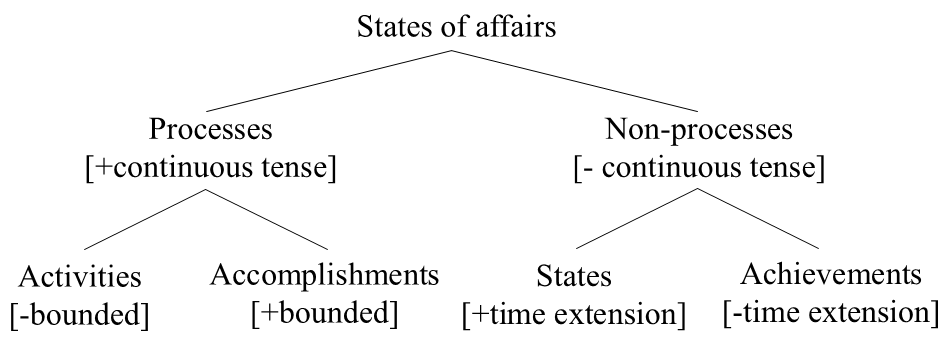
The distinctions shown in Figure 2 are based on a number of semantic properties, which will be discussed in the following subsections.
Vendler claims that verbs occupy two supercategories, which he labels process and non-process. Process verbs denote events that involve a specific internal dynamism over time and are characterized by the fact that they can be used to answer interrogative, progressive aan het + infinitive constructions such as Wat is Marie aan het doen?What is Marie doing?; cf. also Booij (2010: §6).
| a. | Marie | is naar Peter | aan | het | luisteren. | activity | |
| Marie | is to Peter | aan | het | listen | |||
| 'Marie is listening to Peter.' | |||||||
| b. | Marie | is haar boterham | aan | het | opeten. | accomplishment | |
| Marie | is her sandwich | aan | het | prt.-eat | |||
| 'Marie is eating her sandwich.' | |||||||
| c. | * | Marie | is van spinazie | aan | het | houden. | state |
| Marie | is of spinach | aan | het | like | |||
| Compare: '*Marie is liking spinach.' | |||||||
| d. | * | Marie | is aan | het | arriveren. | achievement |
| Marie | is aan | het | prt.-arrive |
Vendler divides processes into activities and accomplishments, based on whether or not the event has a logically implied endpoint. Activities such as luisterento listen are open-ended: the event referred to in (55a) has no natural termination point and can, at least in principle, go on indefinitely. Accomplishments such as opetento eat up, on the other hand, have an inherent endpoint: the event referred to in (55b) is completed when the sandwich to which the object refers is fully consumed.
This difference can be made clearer by considering the validity of the entailments in (56). If we observe at a given point in time that the present-tense example in (56a) is true, we can conclude that its perfect counterpart in (56a') is also true, but the same does not hold for the (b)-examples. This shows that in the case of an activity such as luisterento listen, it is sufficient for the use of the perfect tense that the subject of the clause has been involved in the process, but not in the case of an accomplishment such as opetento eat up, which additionally requires that the process has reached its logically implied endpoint. This shows that the logically implied endpoint is a crucial part of the meaning of accomplishments.
| a. | Marie | is naar Peter | aan | het | luisteren. | activity | |
| Marie | is to Peter | aan | het | listen | |||
| 'Marie is listening to Peter.' | |||||||
| a'. | ⊨ | Marie heeft | naar Peter | geluisterd. | |
| ⊨ | Marie has | to Peter | listened | ||
| 'Marie has listened to Peter.' | |||||
| b. | Marie | is haar boterham | aan | het | opeten. | accomplishment | |
| Marie | is her sandwich | aan | het | prt.-eat | |||
| 'Marie is finishing her sandwich.' | |||||||
| b'. | ⊭ | Marie heeft | haar boterham | opgegeten. | |
| ⊭ | Marie has | her sandwich | prt.-eaten | ||
| 'Marie has finished her sandwich.' | |||||
The same point can be illustrated by question-answer pairs like those in (57), which show that accomplishments can be used in interrogatives of the form Hoe lang kostte het [om ... te Vinf]? How long did it take to V ...?, which inquire into the time it took to reach the logically implied endpoint; activities cannot be used in this way. The primed examples provide the corresponding answers to the questions.
| a. | * | Hoe lang | kostte | het | [om | naar je leraar | te luisteren]? | activity |
| how long | took | it | comp | to your teacher | to listen | |||
| Compare: '*How long did it take to listen to your teacher?' | ||||||||
| a'. | * | Het | kostte | een uur | [om | naar mijn leraar | te luisteren]. |
| it | cost | an hour | comp | to my teacher | to listen | ||
| Compare: '*It took an hour to listen to my teacher.' | |||||||
| b. | Hoe lang | kostte | het | [om | je maaltijd | op | te eten]? | accomplishment | |
| how long | took | it | comp | your meal | prt. | to eat | |||
| 'How long did it take to finish your meal?' | |||||||||
| b'. | Het | kostte | 10 minuten | [om | mijn maaltijd | op | te eten]. | |
| it | cost | 10 minutes | comp | my meal | prt. | to eat | ||
| 'It took 10 minutes to finish my meal.' | ||||||||
The question-answer pairs in (58) show that the opposite holds for interrogatives of the form Hoe lang auxfinite ... Vpart? For how long did ... V ...?, which simply inquire about the period of time during which the process took place; such pairs can be used with verbs denoting activities, but not with verbs denoting accomplishments.
| a. | Hoe lang | heb | je | naar je leraar | geluisterd? | activity | |
| how long | have | you | to your teacher | listened | |||
| 'For how long did you listen to your teacher?' | |||||||
| a'. | Ik | heb | een uur | (lang) | naar mijn leraar | geluisterd. | |
| I | have | an hour | long | to my teacher | listened | ||
| 'I have listened to my teacher for an hour.' | |||||||
| b. | * | Hoe lang | heb | je | je maaltijd | opgegeten? | accomplishment |
| how long | have | you | your meal | prt.-eaten |
| b'. | * | Ik | heb | een uur | (lang) | mijn maaltijd | opgegeten. |
| I | have | an hour | long | my meal | prt.-eaten |
Another, but essentially identical, test that is often used to distinguish between activities and accomplishments is the addition of certain types of temporal adverbial phrases: adverbial phrases like gedurende een uurduring an hour or een uur langfor an hour, which refer to the period of time during which the event denoted by the verb takes place, are typically used with activities; adverbial phrases such as binnen een uurwithin an hour, which refer to the time needed to reach the logically implied endpoint, are typically used with accomplishments.
| a. | Jan luisterde | gedurende/*binnen een uur | naar zijn leraar. | activity | |
| Jan listened | during/within an hour | to his teacher | |||
| 'Jan listened to his teacher for an hour.' | |||||
| b. | Jan at | zijn maaltijd | binnen/*gedurende | vijf minuten | op. | accomplishment | |
| Jan ate | his meal | within/during | five minutes | prt. | |||
| 'Jan finished his meal in an hour.' | |||||||
The (in)validity of the inferences in (56) and the selection restrictions on adverbial phrases in (59) are related to the fact that activities can usually be divided into shorter subevents, which in turn can be characterized as activities: if Marie has listened to Peter for an hour, she has also listened to him for the first five minutes of that hour, the second five minutes of that hour, and so on. This does not hold for accomplishments, as they crucially refer to the implied endpoint of the event: if Jan finished his meal within five minutes, it does not necessarily follow that he finished his meal within the first, second, third, or fourth minute of that time interval; cf. Dowty (1979: §3).
Vendler claims that states differ from achievements in that the former have a temporal extension, whereas the latter do not. This can be made clear by using the questions Hoe lang Vfinite Subject ... al ...? ‘How long has Subject already Vpart ...?’; the examples in (60) show that verbs denoting states are easily possible in such question-answer pairs, whereas verbs denoting achievements are not.
| a. | Hoe lang | weet | Jan | al | wie | de dader | is? | state | |
| how long | knows | Jan | already | who | the perpetrator | is | |||
| 'How long has Jan known who the perpetrator is?' | |||||||||
| a'. | Jan weet | al | een paar weken | wie | de dader | is. | |
| Jan know | already | a couple of weeks | who | the perpetrator | is | ||
| 'Jan has known for a couple of weeks who the perpetrator is.' | |||||||
| b. | *? | Hoe lang | herkent | Peter de dader | al? | achievement |
| how long | recognizes | Peter the perpetrator | already |
| b'. | *? | Jan | herkent | de dader | al | een paar weken. |
| Jan | recognizes | the perpetrator | already | a couple of weeks |
Verbs denoting achievements occur in question-answer pairs that inquire about the actual time at which the event occurred, as evidenced by the fact that they can easily be used in questions such Hoe laat Vfinite Subject ...? At what time did Subject V ...?. The answers in the primed examples provide a time adverbial referring to a specific time.
| a. | Hoe laat | herkende | Peter de dader? | achievement | |
| how late | recognized | Peter the perpetrator | |||
| 'At what time did Peter recognize the perpetrator?' | |||||
| a'. | Peter herkende | de dader | om drie uur. | |
| Peter recognized | the perpetrator | at three o’clock |
| b. | Hoe laat | ontplofte de bom? | achievement | |
| how late | exploded the bomb | |||
| 'At what time did the bomb explode?' | ||||
| b'. | De bom | ontplofte | om middernacht. | |
| the bomb | exploded | at midnight |
Verbs denoting states do not easily enter questions of this type, as shown in (62a). When they do, the answer to the question refers to some moment when something happens that results in the attainment of the state denoted by the verb; for example, the addressee of (62b) may have information about the time when he will be informed of the results of his exams.
| a. | *? | Hoe laat | houd | je | van Jan? | state |
| how late | love | you | of Jan | |||
| 'At what time do you love Jan?' | ||||||
| b. | Hoe laat | weet | je | of | je | geslaagd | bent? | state | |
| how late | know | you | whether | you | passed | are | |||
| 'At what time do you know whether you passed the exam/get the results of the exams?' | |||||||||
We have labeled the top node in Figure 2, which is repeated below for convenience, not verbs but states of affairs. The reason for this is that, although Vendler seems to have set out to develop a classification of verbs, he actually came up with a classification of states of affairs; cf. e.g. Verkuyl (1972) and Dowty (1979).
For example, it seems impossible to classify the verb schrijvento write without additional information about its syntactic environment. The judgments on the use of the adverbial phrases of time in example (63) show that schrijven functions as an activity when it is used as an intransitive verb, but as an accomplishment when it is used as a transitive verb.
| a. | Jan | schreef | gedurende/*binnen | een uur. | activity | |
| Jan | wrote | during/within | an hour | |||
| 'Jan was writing for an hour.' | ||||||
| b. | Jan schreef | het artikel | binnen/*gedurende | een uur. | accomplishment | |
| Jan wrote | the article | within/during | an hour | |||
| 'Jan wrote the article within an hour.' | ||||||
However, it is not simply a matter of the adicity of the verb. First, the examples in (64) show that properties (here: specificity) of the direct object can also play a role; cf. Verkuyl (1972/1993), Dowty (1979) and Dik (1997). The (a)-examples illustrate this with the contrast between the bare plural noun phrase boekenbooks and the plural noun phrase preceded by a cardinal numeral, twee boekentwo books. The (b)-examples illustrate the same with the contrast between noun phrases headed by the non-count noun spaghetti and the singular count noun bordplate, respectively.
| a. | Jan schreef | gedurende/*binnen | twee jaar | boeken. | activity | |
| Jan wrote | during/within | two year | books |
| a'. | Jan schreef | binnen/*gedurende | twee jaar | drie boeken. | accomplishment | |
| Jan wrote | within/during | two year | three books |
| b. | Jan at | spaghetti. | activity | |
| Jan ate | spaghetti |
| b'. | Jan at | een bord spaghetti. | accomplishment | |
| Jan ate | a plate [of] spaghetti |
A similar effect can occur with verbs such as ontploffento explode. If the subject is a singular noun phrase, we are dealing with a momentaneous ( extremely brief) event, i.e. an achievement. However, if the subject is a definite plural, the adverbial test suggests that we may also be dealing with an activity, and if the subject is an indefinite plural noun phrase, the adverbial test suggests that we must be dealing with an activity.
| a. | De bom | ontplofte | om drie uur/*de hele dag. | achievement | |
| the bomb | exploded | at three o’clock/the whole day |
| b. | De bommen | ontploften | om drie uur/de hele dag. | [achievement or activity] | |
| the bombs | exploded | at three o’clock/the whole day |
| c. | Er | ontploften | de hele dag/??om drie uur | bommen. | activity | |
| there | exploded | the whole day/at three o’clock | bombs | |||
| 'There were bombs exploding the whole day.' | ||||||
Second, the addition of elements other than objects also has an effect on interpretation; for instance, the examples in (66) show that the addition of a complementive such as naar huisto home or a verbal particle such as terugback turns an activity into an accomplishment.
| a. | Jan wandelde | twee uur lang/*binnen twee uur. | activity | |
| Jan walked | two hours long/within two hours | |||
| 'Jan walked for two hours.' | ||||
| b. | Jan wandelde | binnen twee uur/*twee uur lang | naar huis. | accomplishment | |
| Jan walked | within two hours/two hours long | to home | |||
| 'Jan walked home within two hours.' | |||||
| b'. | Jan wandelde | in twee uur/*twee uur lang | terug. | accomplishment | |
| Jan walked | in two hours/two hours long | back | |||
| 'Jan walked back within two hours.' | |||||
Third, the examples in (67) illustrate that the categorial status of the complement of the verb can also affect the aspectual nature of the event: whereas the nominal complement in (67b) triggers an accomplishment reading, the PP-complement triggers an activity reading.
| a. | Jan dronk de wijn. | accomplishment | |
| Jan drank the wine |
| b. | Jan dronk van de wijn. | activity | |
| Jan drank of the wine |
The examples in (68) show a somewhat similar alternation between states and activities. The (a)-examples show that if the verb denkento think takes a propositional complement like a clause, it cannot occur in the progressive aan het + infinitive + zijn construction, and we may therefore conclude that we are dealing with a state. The (b)-examples show that if the verb denken selects a PP-complement, it can occur in the progressive construction, and that we are thus dealing with an activity. The (c)-examples show that we get a similar meaning shift if we supplement the verb with the verbal particle na.
| a. | Marie denkt | dat | Jan | een deugniet | is. | state | |
| Marie thinks | that | Jan | a rascal | is | |||
| 'Marie thinks that Jan is a rascal.' | |||||||
| a'. | * | Marie is aan het | denken | dat Jan een deugniet is. |
| Marie is aan het | think | that Jan a rascal is |
| b. | Marie denkt | over het probleem. | activity | |
| Marie thinks | about the problem | |||
| 'Marie is thinking about the problem.' | ||||
| b'. | Marie is | over het probleem | aan het | denken. | |
| Marie is | about the problem | aan het | think |
| c. | Marie denkt | na. | activity | |
| Marie thinks | prt. | |||
| 'Marie is pondering.' | ||||
| c'. | Marie is | aan het | nadenken. | |
| Marie is | aan het | prt.-think |
This subsection has shown that Vendler’s classification does not involve verbs, but larger constituents including at least the internal arguments of the verb; it provides a classification of the state of affairs denoted by these phrases.
The previous subsections have briefly discussed some distinctive semantic properties of verbs and events that Vendler (1957) used to motivate his classification in Figure 2. This discussion leads to the following characterizations of the four subclasses.
| a. | Activities [+continuous tense, -bounded]: events that go on for some time in a homogeneous way, in the sense that they do not proceed toward a logically necessary endpoint. |
| b. | Accomplishments [+continuous tense, +bounded]: events that go on for some time in a non-homogeneous way, in the sense that they proceed toward a logically necessary endpoint. |
| c. | States [-continuous tense, +time extension]: stable situations that last for a certain period of time. |
| d. | Achievements [-continuous tense, -time extension]: events that are perceived as occurring momentaneously. |
One problem with this classification is that the features used are in fact more broadly applicable than just for making the distinctions given in (69). The feature [±bounded], for example, may be as relevant to states and achievements as it is to activities and accomplishments: [±bounded] can group states and activities as unbounded, and accomplishments and achievements as bounded states of affairs. This can be demonstrated by the examples in (70), which show that states behave like activities in that they can be used in perfective questions of the form Hoe lang auxfinite ... V? For how long did ... V ...?, whereas accomplishments and achievements cannot.
| a. | Hoe lang | heeft | hij | naar zijn leraar | geluisterd? | activity | |
| how long | has | he | to his teacher | listened | |||
| 'For how long did he listen to his teacher?' | |||||||
| b. | * | Hoe lang | heeft | hij | zijn maaltijd | opgegeten? | accomplishment |
| how long | has | he | his meal | prt.-eaten |
| c. | Hoe lang | heeft | hij | van spinazie | gehouden? | state | |
| how long | has | he | of spinach | liked | |||
| 'For how long did he like spinach?' | |||||||
| d. | * | Hoe lang is | de bom | ontploft? | achievement |
| how long has | the bomb | exploded |
If, on the other hand, an interrogative phrase refers to a specific time, the acceptability judgments are reversed. This is shown in (71) with the adverbial phrase hoe laatat what time.
| a. | * | Hoe laat | heeft | hij | naar zijn leraar | geluisterd? | activity |
| how late | has | he | to his teacher | listened |
| b. | Hoe laat | heeft | hij | zijn maaltijd | opgegeten? | accomplishment | |
| how late | has | he | his meal | prt.-eaten | |||
| 'At what time did he eat his meal?' | |||||||
| c. | * | Hoe laat | heeft | hij | van spinazie | gehouden? | state |
| how late | has | he | of spinach | liked |
| d. | Hoe laat | is | de bom | ontploft? | achievement | |
| how late | has | the bomb | exploded | |||
| 'At what time did the bomb explode?' | ||||||
Distribution patterns like these suggest that the four verb classes can be defined by a binary feature system of the form given in Table 4, where the features [±bounded] and [±continuous tense] can be construed as given in Figure 2; cf. Verkuyl (1993).
| –bounded | +bounded | |
| –continuous tense | states | achievements |
| +continuous tense | activities | accomplishments |
Note that the feature [±bounded] seems to correlate with other semantic properties of the events. Accomplishments such as opetento eat up and achievements such as ontploffento explode in (72) both indicate that some participant in the event (here, the object and the subject, respectively) undergoes a change of state and that the attainment of the new state marks the end of the event; the only difference is that the transformation takes some time in the former case, but is perceived as instantaneous in the latter case.
| a. | Jan | at | zijn boterham | op. | accomplishment | |
| Jan | ate | his sandwich | prt. | |||
| 'Jan finished his sandwich.' | ||||||
| b. | De bom | ontploft. | achievement | |
| the bomb | explodes |
Activities and states, on the other hand, typically do not involve a change of state and refer to more or less homogeneous states of affairs with the result that the end of these states of affairs is more or less arbitrarily determined. This shows that it is not clear a priori whether the feature [±bounded] would be the correct feature; it could just as well be [±change of state], as shown in Table 5. It is therefore not surprising that there are a variety of binary feature systems available; cf. Rosen (2003: §1.3) for a brief discussion of some other proposals.
| –change of state | +change of state | |
| –continuous tense | states | achievements |
| +continuous tense | activities | accomplishments |
Other alternatives to Vendler’s classification come easily to mind. In Figure 3, based on Smith (1991) and Dik (1997), the basic division is between states and events: states lack internal dynamism in that they require no input of energy, since nothing changes while they exist (Lehmann 1999:44), while events have some form of internal dynamism. Events can be further subdivided on the basis of their boundedness: activities are not inherently bounded, whereas accomplishments and achievements are. The latter two differ in that only the former evolve over time. This leads to the hierarchical, or at least more layered, classification in Figure 3.
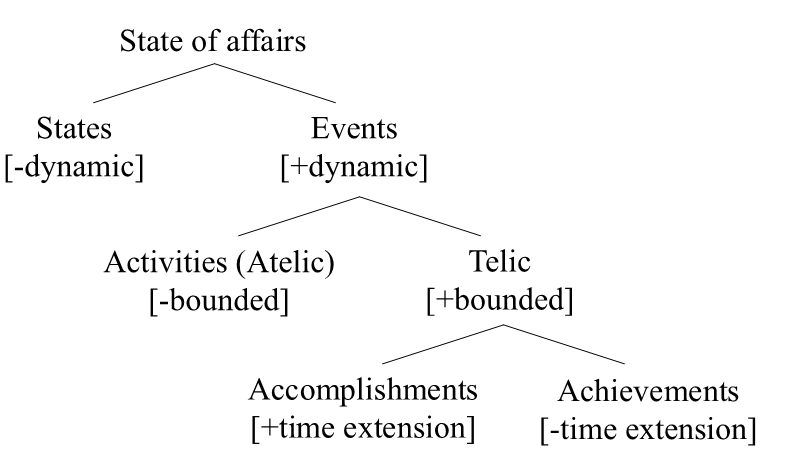
As this is not the place to discuss the pros and cons of the available feature systems, we simply summarize some of the conspicuous properties of the verb classes as distinguished in Vendler (1957) in Table (73); we refer the reader to Miller (1999) and Rosen (2003) for more discussion.
| state | activity | accomplishment | achievement | |
| dynamic | — | + | + | + |
| bounded/change-of-state | — | — | + | + |
| punctual | — | — | — | + |
| continuous tense | — | + | + | — |
This subsection discusses alternative approaches to Vendler’s classification that do not appeal primarily to the internal temporal organization of the events, but instead to specific properties of the participants in the event. An example of this was already discussed in Subsection I, where it was observed that the aspectual feature [±bounded] can easily be replaced by the feature [±change of state], which involves a property of one of the participants in the event. This shift in perspective may have been initiated (unintentionally) in Dowty (1979), in which it is suggested (consistent with the basic principle of generative semantics) that verbs can be semantically decomposed into a number of atomic semantic elements like do, become and cause, which combine with a stative n-place predicate πn in (74a) to form the more complex events in (74b-d). In fact, there are a number of more complex subclasses of these event types such as inchoative achievements such as ontbrandento ignite, which would be assigned the structure become [do (α1, [πn(α1, ..., αn)])].
| a. | State: πn(α1, ..., αn) |
| b. | Activity: do (α1, [πn(α1, ..., αn)]) |
| c. | Achievement: become [πn(α1, ..., αn)] |
| d. | Accomplishment: Φ cause (become [πn(α1, ..., αn)]) |
The status of the three semantic atoms is quite complex. The element do seems to function as a simple two-place predicate, taking an argument of the stative predicate πn as well as the stative predicate itself as arguments. The element become, on the other hand, functions as an operator, expressing that the truth value of the stative predicate πn(α1, ..., αn) changes from false to true. The element cause, finally, is a connective expressing that the event Φ is a causal factor for the event expressed by the formula following it (here: the achievement become [πn(α1, ..., αn)]): there is some event that causes some other event to come into existence.
The semantic structure attributed to accomplishments in (74d) correctly accounts for our intuition about example (75a) that the referent of the noun phrase de documententhe documents undergoes a change of state as a result of some unspecified action performed by the referent of the subject of the sentence, which can be further clarified by an instrumental met-PP such as met een papierversnipperaar: Jan destroyed the documents by putting them in a shredder. Note, however, that it is not immediately clear whether the inference that Jan is involved in some action is part of the verb’s meaning or the result of a conversational implicature in the sense of Grice (1975). The answer to this question may depend on whether an example such as (75b) also expresses that there is an event involving the referent of the noun phrase de orkaanthe hurricane that causes a change of state in the referent of the noun phrase de stadthe city.
| a. | Jan vernietigde | de documenten | (met een papierversnipperaar). | |
| Jan destroyed | the documents | with a paper.shredder |
| b. | De | orkaan | vernietigde | de stad | (*met veel wind). | |
| the | hurricane | destroyed | the city | with |
The fact that it is not possible to add an instrumental met-PP to example (75b) suggests that the causal relation is more direct in this case, and consequently that the inference we can draw from (75a) that it is some action of Jan that triggers the change of state is nothing more than a conversational implicature. Given this conclusion, it is tempting to simplify Dowty’s semantic structures in (74) by construing all semantic atoms (i.e. including become and cause) as n-place predicates, as in (76).
| a. | State: πn(α1, ..., αn) |
| b. | Activity: do (α1, [πn(α1, ..., αn)]) |
| c. | Achievement: become (β, [πn(α1, ..., αn)]), where β ∈ {α1, ..., αn} |
| d. | Accomplishment: cause (γ, (become (β, [πn(α1, ..., αn)]))), where β ∈ {α1, ..., αn} and γ ∉ { α1, ..., αn} |
The interpretations of states and activities remain the same, but those of achievements and accomplishments change: an achievement is now interpreted as a change of state such that β becomes an argument of πn, and an accomplishment is now interpreted as a change of state such that β becomes an argument of πn as a result of some external cause γ. In fact, this reinterpretation of Dowty’s system seems to come very close to proposals of the kind made in Van Voorst (1988) and Tenny (1994), according to which Vendler’s classes can be defined as in (77) by assuming that the nominal arguments in the clause can function as originator (typically the external argument) or delimiter (typically an internal argument of the verb) of the event; note that states do not fall into this classification, since they are characterized by the absence of an event structure; cf. also Levin & Rappaport Hovav (1995), Van Hout (1996), Van der Putten (1997), and many others for proposals along similar lines, and Levin & Rappaport Hovav (2005) for a review of research in this area.
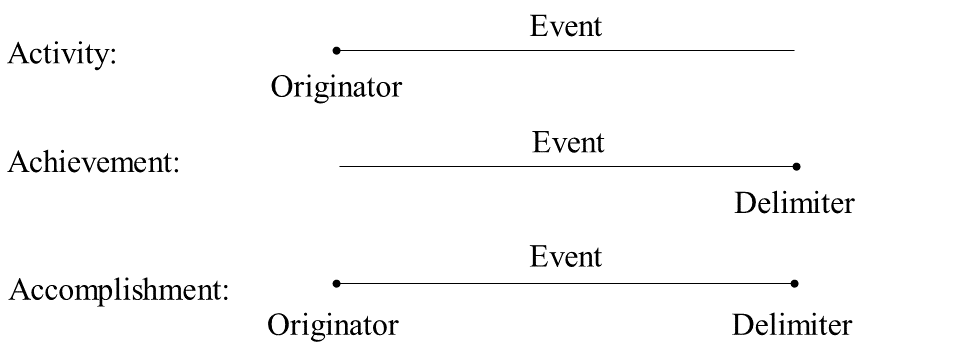
One advantage of using participant roles as the basis for the aspectual classification of events is that it immediately explains that the interpretations found for intransitive and transitive uses of verbs like schrijvento write and etento eat differ in the way they do: only the primed transitive examples have an internal argument that can act as a delimiter.
| a. | Jan schreef | twee uur lang/*binnen twee uur. | activity | |
| Jan wrote | for two hours/within two hours |
| a'. | Jan schreef | de brief | binnen twee uur/*twee uur lang. | accomplishment | |
| Jan wrote | the letter | within two hours/for two hours |
| b. | Jan at | vijf minuten lang/*binnen vijf minuten. | activity | |
| Jan ate | for five minutes/within five minutes |
| b'. | Jan at | zijn lunch | binnen vijf minuten/*vijf minuten lang. | accomplishment | |
| Jan ate | his lunch | within five minutes/for five minutes |
Moreover, this approach may provide a better understanding of the fact established earlier that properties of the nominal arguments of the verb can affect the aspectual interpretation by assuming additional conditions that the nominal arguments must fulfill in order to be able to function as delimiters. This is illustrated again by the examples in (79), repeated from (64), which show that verbs like schrijvento write and etento eat are interpreted as accomplishments only when the objects refer to specified quantities. This suggests that bare plurals and noun phrases headed by a mass noun cannot function as delimiters.
| a. | Jan schreef | gedurende/*binnen | twee jaar | boeken. | activity | |
| Jan wrote | during/within | two year | books |
| a'. | Jan schreef | binnen/*gedurende | twee jaar | drie boeken. | accomplishment | |
| Jan wrote | within/during | two year | three books |
| b. | Jan at | spaghetti. | activity | |
| Jan ate | spaghetti |
| b'. | Jan at | een bord spaghetti. | accomplishment | |
| Jan ate | a plate [of] spaghetti |
In fact, it also allows us to account for the fact illustrated in (65), repeated here as (80), that the subject can affect the aspectual interpretation of the sentence by imposing a similar restriction on the originator.
| a. | De bom | ontplofte | om drie uur/*de hele dag. | achievement | |
| the bomb | exploded | at three o’clock/the whole day |
| b. | De bommen | ontploften | om drie uur/de hele dag. | achievement or activity | |
| the bombs | exploded | at three o’clock/the whole day |
| c. | Er | ontploften | de hele dag/?om drie uur | bommen. | activity | |
| there | exploded | the whole day/at three o’clock | bombs | |||
| 'There were bombs exploding the whole day.' | ||||||
This is formalized in Verkuyl (1972/2005) in the hypothesis that the aspectual interpretation is compositional in the sense that it depends on both a feature of the verb and a feature of its nominal arguments (i.e. subject and object). According to Verkuyl, the relevant feature of the verb is [±dynamic], which distinguishes between states and events in the sense of Figure 3 above, and the relevant feature of the nominal arguments is [±sqa], which distinguishes between noun phrases that refer to a specified quantity or a non-specified quantity; once the subject or object is assigned the feature [-sqa], the event becomes unbounded.
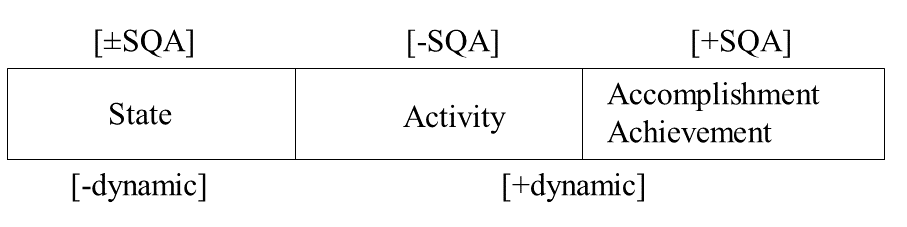
Another advantage of using participant roles as the basis of the aspectual event classification is that it makes it easy to explain why the so-called inchoative-causative alternation in (81) has the effect of turning an achievement into an accomplishment: the causative construction in (81b) has an additional external argument that can act as an originator.
| a. | Het raam | breekt. | achievement | |
| the window | breaks |
| b. | Jan breekt | het raam. | accomplishment | |
| Jan breaks | the window |
It also allows us to account for the earlier observation that the addition of complementives or verbal particles can affect the aspectual interpretation by assuming that these add a meaning aspect to the construction that enables the object to function as a delimiter. For example, Tenny (1994) claims that such elements add a terminus (i.e. a point of termination), as a result of which the object of an activity can become a delimiter; cf. the examples in (82).
| a. | Janoriginator | hielp | de dame. | activity | |
| Jan | helped | the lady |
| a'. | Janoriginator | hielp | de damedelimiter | uit de autoterminus. | accomplishment | |
| Jan | helped | the dame | out.of the car |
| b. | Janoriginator | duwde | de kar. | activity | |
| Jan | pushed | the cart |
| b'. | Janoriginator | duwde | de kardelimiter | wegterminus. | accomplishment | |
| Jan | pushed | the cart | away |
Something similar is shown in the slightly more complex cases in (66), repeated here as (83), where the addition of a complementive/verbal particle adds a terminus and thus turns an intransitive activity into an (unaccusative) achievement.
| a. | Jan wandelde | twee uur lang/*binnen twee uur. | activity | |
| Jan walked | two hours long/within two hours | |||
| 'Jan walked for two hours.' | ||||
| b. | Jan wandelde | binnen twee uur/*twee uur lang | naar huis. | achievement | |
| Jan walked | within two hours/two hours long | to home | |||
| 'Jan walked home within two hours.' | |||||
| b'. | Jan wandelde | in twee uur/*twee uur lang | terug. | achievement | |
| Jan walked | in two hours/two hours long | back | |||
| 'Jan walked back within two hours.' | |||||
Note that the (b)-examples are analyzed as accomplishments in Vendler’s approach because they are temporally bounded, but as achievements according to the classification in (77) because Jan does not function as an originator but as a delimiter. This shows that the redefinition of Vendler’s original categories in terms of participant roles is not entirely innocuous, but can lead to different dividing lines between event types.
The participant perspective on the aspectual classification of events discussed in Subsection II implies that temporal notions no longer enter this classification. Subsection A will argue that this is a desirable result: the feature [±time extension] applies to all event types and can thus be used to extend the classification. Subsection B will discuss the feature [±control]; we will argue that this feature also applies to all types of states of affairs and so can also be used to extend the classification.
Subsection II has shown that Vendler’s classification can also be expressed by appealing to the roles that nominal arguments play in the event and it considered a number of advantages of this shift in perspective. Another potential advantage is that activities, achievements and accomplishments no longer need to be defined in terms of the temporal feature [±time extension]. This allows us to solve the problem for Vendler’s original proposal that there is a class of achievements that have a temporal extension: verbs like afkoelento cool, smeltento melt, and zinkento sink are not momentaneous, but involve a gradual change of state; cf. Dowty (1979: §2.3.5). Moreover, we can now also define the class of so-called semelfactive verbs like kloppento knock, krabbento scratch and kuchento cough as instantaneous activities. Finally, we can also understand that accomplishments like een boek schrijvento write a book and een raam brekento break a window differ in their temporal extension. In short, the aspectual feature [±time extension] can be used to divide all three main event types into two subclasses.
| [-time extension] | [+time extension] | |
| activities | kloppen ‘to knock’ kuchen ‘to cough’ knipogen ‘to wink’ rukken ‘to jerk’ | dragen ‘to carry’ lachen ‘to laugh’ luisteren ‘to listen’ wachten (op) ‘to wait (for)’ |
| achievements | arriveren ‘to arrive’ herkennen ‘to recognize’ ontploffen ‘to explode’ overlijden ‘to die’ | afkoelen ‘to cool’ smelten ‘to melt’ verdorren ‘to wither’ zinken ‘to sink’ |
| accomplishments | doorslikken ‘to swallow’ omstoten ‘to knock over’ verraden ‘to betray’ wegslaan ‘to hit away’ | bouwen ‘to build’ opeten ‘to eat up’ oversteken ‘to cross’ verbergen ‘to hide’ |
Note that our discussion above abstracted from the fact that properties of the nominal arguments of the verb can affect the temporal interpretation: for example, crossing a square has a temporal extension, while crossing a line is instantaneous. The three classes of non-momentaneous verbs in Table (84) are easy to recognize, since they can always be the complement of the inchoative verb beginnento begin.
| a. | Jan begon | te lachen. | activity | |
| Jan started | to laugh |
| b. | Het ijs | begon | te smelten. | achievement | |
| the ice | started | to melt |
| c. | Jan begon | het huis | te bouwen. | accomplishment | |
| Jan started | the house | to build | |||
| 'Jan started to build the house.' | |||||
The momentaneous verbs, on the other hand, usually do not allow this, except when they can be repeated and thus receive an iterative reading when combined with a durative adverbial phrase; cf. the examples in (86).
| a. | Jan kuchte | drie keer. | |
| Jan coughed | three times |
| a'. | Jan kuchte | vijf minuten lang. | |
| Jan coughed | for five minutes |
| b. | Jan sloeg | de hond | drie keer. | |
| Jan hit | the dog | three times |
| b'. | Jan sloeg | de hond | vijf minuten lang. | |
| Jan hit | the dog | for five minutes |
Since momentaneous activities differ from momentaneous achievements and accomplishments in that they can typically be repeated, it is the former type, not the latter, that is typically used as the complement of beginnen.
| a. | Jan begon | te kuchen. | |
| Jan started | to cough |
| b. | * | Jan begon | aan | te komen. |
| Jan started | prt. | to arrive |
| c. | * | Jan begon | de lamp | om | te stoten. |
| Jan started | the lamp | prt. | to knock.over |
Another way to extend Vendler’s classification is to add Dik’s (1997) feature [±control]. This feature denotes a property of the subject of the clause and expresses whether the referent of the subject can initiate or terminate the event. The examples in (88) show that this feature can be superimposed on all four subclasses; the states of affairs in the primeless examples are all controlled, whereas those in the primed examples are not.
| a. | Jan gelooft | het. | |
| Jan believes | it |
| a'. | Jan weet het. | state | |
| Jan knows it |
| b. | Jan wandelt | in het park. | |
| Jan walks | in the park |
| b'. | Jan rilt | van de kou. | activity | |
| the shivers | from the cold |
| c. | Jan vertrok | op tijd. | |
| Jan left | on time |
| c'. | Jan overleed. | achievement | |
| Jan died |
| d. | Jan vernielde | de auto | |
| Jan vandalized | the car |
| d'. | Jan verzwikte | zijn enkel. | accomplishment | |
| Jan twisted | his ankle |
Dik provides a number of tests that can be used to determine whether the subject is able to control the event. The first involves the use of the imperative: while controlled events allow the imperative, non-controlled events do not. This is shown in (89).
| a. | Geloof | het | maar! | |
| believe | it | prt. |
| a'. | * | Weet het maar! | state |
| Jan knows it |
| b. | Wandel | in het park! | |
| Jan walks | in the park |
| b'. | * | Ril van de kou! | activity |
| Shiver from the cold |
| c. | Vertrek | op tijd! | |
| leave | in time |
| c'. | * | overlijd! | achievement |
| die |
| d. | Verniel de auto! | |
| vandalize the car |
| d'. | * | Verzwik je enkel! | accomplishment |
| twist you ankle |
This finding is interesting because Vendler (1957) and Dowty (1979) have claimed that states cannot occur in the imperative form in their prototypical use: an example such as Ken uw rechten!Know your rights! was explained by saying that this example did not involve an order/advice to know something, but to do something that would lead to the state of knowing something. Similarly, a command such as Zit!Sit! would be interpreted as an instruction to perform an activity that would lead to assuming the desired posture. However, if gelovento believe indeed denotes a state, this cannot be maintained. Other typical states that can occur in imperatives are copular constructions with zijnto be, provided that the predicative element is a stage-level predicate (i.e. denotes a transitory property); individual-level predicates, which denote more permanent properties, usually give infelicitous results in the imperative construction. The restrictions illustrated in (89) and (90) follow if the imperative is only possible with states of affairs that are [+control].
| a. | Wees | verstandig/geduldig! | stage-level predicate | |
| be | sensible/patient |
| b. | * | Wees | intelligent/klein! | individual-level predicate |
| be | intelligent/little |
Another context in which the difference between controlled and non-controlled events comes out clearly is in infinitival constructions such as (91), in which the implied subject PRO of the infinitival clause is interpreted as coreferential with the subject of the main verb belovento promise.
| a. | Jan belooft [PRO | het | te geloven/*weten]. | |
| Jan promises | it | to believe/know | ||
| 'Jan promises to believe it.' | ||||
| b. | Jan belooft [PRO | te wandelen in het park/*te rillen van de kou]. | |
| Jan promises | to walk in the park/to shiver from the cold | ||
| 'Jan promises to walk in the park.' | |||
| c. | Jan belooft [PRO | op tijd | te vertrekken/*te overlijden]. | |
| Jan promises | in time | to leave/to die | ||
| 'Jan promises to leave in time.' | ||||
| d. | Jan beloofde [PRO | de auto | te vernielen/*zijn enkel | te verzwikken]. | |
| Jan promised | the car | to vandalize/his ankle | to twist | ||
| 'Jan promised to vandalize the car.' | |||||
Note that this runs counter to earlier claims (e.g. Dowty 1979) that states cannot occur in this environment. The examples in (92) show that the difference between stage-level and individual-level predicates which we observed in the copular constructions in (90) is also relevant in this context.
| a. | Jan beloofde [PRO | verstandig/geduldig | te zijn]! | stage-level predicate | |
| Jan promised | sensible/patient/nice | to be |
| b. | * | Jan beloofde [PRO | intelligent/klein | te zijn]. | individual-level predicate |
| Jan promised | intelligent/little | to be |
Although some verbs require a [+control] or [-control] subject, other verbs may be more permissive in this respect; a verb such as rollento roll in (93), for example, is compatible with both a [+control] and a [-control] subject. That the referent of Jan in (93a) is a controller, but the referent of de steenthe stone in (93b) is not, is clear from the fact that the adverbial phrases opzettelijk/vrijwilligon purpose/voluntarily can only be used with the former. The examples also show that [+control] subjects are typically animate (with the possible exception of certain machines).
| a. | Jan rolde | opzettelijk/vrijwillig | van de heuvel. | |
| Jan rolled | on purpose/voluntarily | from the hill |
| b. | De steen | rolde | (*opzettelijk/*vrijwillig) | van de heuvel. | |
| the stone | rolled | on purpose/voluntarily | from the hill |
For completeness’ sake, note that controllability and volitionality are often seen as defining properties of the thematic role of agent; cf. Levin & Rappaport Hovav (2005: §2.3.1). The fact that the subjects of states and achievements are typically not agents, but can still have these properties if they are animate, casts serious doubt on such proposals.
The previous subsections reviewed a line of research concerned with verb/event classification that began with Vendler (1957); however, there are other classifications based on specific inherent conceptual properties of verbs. Verbs have been classified as verbs of putting, removing, sending and carrying, change of possession, concealment, creation and transformation, perception, social interaction, communication, sound and light emission, bodily functions, grooming and body care, and so on; cf. Levin (1993: Part II) for a long list of such classes. Although such lists are somewhat arbitrary, making such distinctions can be useful because these classes may have several defining semantic and syntactic properties. For example, Levin’s classification is based on the ways in which the participants involved in the state of affairs can be expressed syntactically in English. Although we will refer to at least some of these classes in our discussion of verb-frame alternation in Chapter 3, we do not think it would be very helpful or enlightening to list them here: we will simply introduce the relevant classes where appropriate, and refer the reader to Levin’s book for details.
