- Dutch
- Frisian
- Saterfrisian
- Afrikaans
-
- Syntax
- Preface and acknowledgements
- Verbs and Verb Phrases
- 1 Verbs: Characterization and classification
- 2 Projection of verb phrases I: Argument structure
- 3 Projection of verb phrases IIIa: Selected clauses/verb phrases (introduction)
- 1.0. Introduction
- 1.1. Main types of verb-frame alternation
- 1.2. Alternations involving the external argument
- 1.3. Alternations of noun phrases and PPs
- 1.4. Some apparent cases of verb-frame alternation
- 1.5. Bibliographical notes
- 4 Projection of verb phrases IIIa: Selected clauses/verb phrases (introduction)
- 4.0. Introduction
- 4.1. Semantic types of finite argument clauses
- 4.2. Finite and infinitival argument clauses
- 4.3. Control properties of verbs selecting an infinitival clause
- 4.4. Three main types of infinitival argument clauses
- 4.5. Non-main verbs
- 4.6. The distinction between main and non-main verbs
- 4.7. Bibliographical notes
- 5 Projection of verb phrases IIIb: Argument and complementive clauses
- 5.0. Introduction
- 5.1. Finite argument clauses
- 5.2. Infinitival argument clauses
- 5.3. Complementive clauses
- 5.4. Bibliographical notes
- 6 Projection of verb phrases IIIc: Complements of non-main verbs
- 7 Projection of verb phrases IIId: Verb clustering
- 8 Projection of verb phrases IV: Adverbial modification
- 9 Word order in the clause I: General introduction
- 10 Word order in the clause II: Position of the finite verb (verb-first/second)
- 11 Word order in the clause III:Clause-initial position (wh-movement)
- 11.0. Introduction
- 11.1. The formation of V1 and V2-clauses
- 11.2. Clause-initial position remains (phonetically) empty
- 11.3. Clause-initial position is filled
- 11.4. Bibliographical notes
- 12 Word order in the clause IV: Postverbal field (extraposition)
- 13 Word order in the clause V: Middle field (scrambling)
- Nouns and Noun Phrases
- 14 Characterization and classification
- 15 Projection of noun phrases I: Complementation
- 15.0. Introduction
- 15.1. General observations
- 15.2. Prepositional and nominal complements
- 15.3. Clausal complements
- 15.4. Bibliographical notes
- 16 Projection of noun phrases II: Modification
- 16.0. Introduction
- 16.1. Restrictive and non-restrictive modifiers
- 16.2. Premodification
- 16.3. Postmodification
- 16.3.1. Adpositional phrases
- 16.3.2. Relative clauses
- 16.3.3. Infinitival clauses
- 16.3.4. A special case: clauses referring to a proposition
- 16.3.5. Adjectival phrases
- 16.3.6. Adverbial postmodification
- 16.4. Bibliographical notes
- 17 Projection of noun phrases III: Binominal constructions
- 17.0. Introduction
- 17.1. Binominal constructions without a preposition
- 17.2. Binominal constructions with a preposition
- 17.3. Bibliographical notes
- 18 Determiners: Articles and pronouns
- 18.0. Introduction
- 18.1. Articles
- 18.2. Pronouns
- 18.3. Bibliographical notes
- 19 Numerals and quantifiers
- 19.0. Introduction
- 19.1. Numerals
- 19.2. Quantifiers
- 19.2.1. Introduction
- 19.2.2. Universal quantifiers: ieder/elk ‘every’ and alle ‘all’
- 19.2.3. Existential quantifiers: sommige ‘some’ and enkele ‘some’
- 19.2.4. Degree quantifiers: veel ‘many/much’ and weinig ‘few/little’
- 19.2.5. Modification of quantifiers
- 19.2.6. A note on the adverbial use of degree quantifiers
- 19.3. Quantitative er constructions
- 19.4. Partitive and pseudo-partitive constructions
- 19.5. Bibliographical notes
- 20 Predeterminers
- 20.0. Introduction
- 20.1. The universal quantifier al ‘all’ and its alternants
- 20.2. The predeterminer heel ‘all/whole’
- 20.3. A note on focus particles
- 20.4. Bibliographical notes
- 21 Syntactic uses of noun phrases
- 22 Referential dependencies (binding)
- Adjectives and Adjective Phrases
- 23 Characteristics and classification
- 24 Projection of adjective phrases I: Complementation
- 25 Projection of adjective phrases II: Modification
- 26 Projection of adjective phrases III: Comparison
- 27 Attributive use of the adjective phrase
- 28 Predicative use of the adjective phrase
- 29 The partitive genitive construction
- 30 Adverbial use of the adjective phrase
- 31 Participles and infinitives: their adjectival use
- Adpositions and adpositional phrases
- 32 Characteristics and classification
- 32.0. Introduction
- 32.1. Characterization of the category adposition
- 32.2. A syntactic classification of adpositional phrases
- 32.3. A semantic classification of adpositional phrases
- 32.4. Borderline cases
- 32.5. Bibliographical notes
- 33 Projection of adpositional phrases: Complementation
- 34 Projection of adpositional phrases: Modification
- 35 Syntactic uses of adpositional phrases
- 36 R-pronominalization and R-words
- 32 Characteristics and classification
- Coordination and Ellipsis
- Syntax
-
- General
-
- General
- Morphology
- Morphology
- 1 Word formation
- 1.1 Compounding
- 1.1.1 Compounds and their heads
- 1.1.2 Special types of compounds
- 1.1.2.1 Affixoids
- 1.1.2.2 Coordinative compounds
- 1.1.2.3 Synthetic compounds and complex pseudo-participles
- 1.1.2.4 Reduplicative compounds
- 1.1.2.5 Phrase-based compounds
- 1.1.2.6 Elative compounds
- 1.1.2.7 Exocentric compounds
- 1.1.2.8 Linking elements
- 1.1.2.9 Separable Complex Verbs and Particle Verbs
- 1.1.2.10 Noun Incorporation Verbs
- 1.1.2.11 Gapping
- 1.2 Derivation
- 1.3 Minor patterns of word formation
- 1.1 Compounding
- 2 Inflection
- 1 Word formation
- Morphology
- Syntax
- Adjectives and adjective phrases (APs)
- 0 Introduction to the AP
- 1 Characteristics and classification of APs
- 2 Complementation of APs
- 3 Modification and degree quantification of APs
- 4 Comparison by comparative, superlative and equative
- 5 Attribution of APs
- 6 Predication of APs
- 7 The partitive adjective construction
- 8 Adverbial use of APs
- 9 Participles and infinitives as APs
- Nouns and Noun Phrases (NPs)
- 0 Introduction to the NP
- 1 Characteristics and Classification of NPs
- 2 Complementation of NPs
- 3 Modification of NPs
- 3.1 Modification of NP by Determiners and APs
- 3.2 Modification of NP by PP
- 3.3 Modification of NP by adverbial clauses
- 3.4 Modification of NP by possessors
- 3.5 Modification of NP by relative clauses
- 3.6 Modification of NP in a cleft construction
- 3.7 Free relative clauses and selected interrogative clauses
- 4 Partitive noun constructions and constructions related to them
- 4.1 The referential partitive construction
- 4.2 The partitive construction of abstract quantity
- 4.3 The numerical partitive construction
- 4.4 The partitive interrogative construction
- 4.5 Adjectival, nominal and nominalised partitive quantifiers
- 4.6 Kind partitives
- 4.7 Partitive predication with a preposition
- 4.8 Bare nominal attribution
- 5 Articles and names
- 6 Pronouns
- 7 Quantifiers, determiners and predeterminers
- 8 Interrogative pronouns
- 9 R-pronouns and the indefinite expletive
- 10 Syntactic functions of Noun Phrases
- Adpositions and Adpositional Phrases (PPs)
- 0 Introduction to the PP
- 1 Characteristics and classification of PPs
- 2 Complementation of PPs
- 3 Modification of PPs
- 4 Bare (intransitive) adpositions
- 5 Predication of PPs
- 6 Form and distribution of adpositions with respect to staticity and construction type
- 7 Adpositional complements and adverbials
- Verbs and Verb Phrases (VPs)
- 0 Introduction to the VP in Saterland Frisian
- 1 Characteristics and classification of verbs
- 2 Unergative and unaccusative subjects and the auxiliary of the perfect
- 3 Evidentiality in relation to perception and epistemicity
- 4 Types of to-infinitival constituents
- 5 Predication
- 5.1 The auxiliary of being and its selection restrictions
- 5.2 The auxiliary of going and its selection restrictions
- 5.3 The auxiliary of continuation and its selection restrictions
- 5.4 The auxiliary of coming and its selection restrictions
- 5.5 Modal auxiliaries and their selection restrictions
- 5.6 Auxiliaries of body posture and aspect and their selection restrictions
- 5.7 Transitive verbs of predication
- 5.8 The auxiliary of doing used as a semantically empty finite auxiliary
- 5.9 Supplementive predication
- 6 The verbal paradigm, irregularity and suppletion
- 7 Verb Second and the word order in main and embedded clauses
- 8 Various aspects of clause structure
- Adjectives and adjective phrases (APs)
A locational adposition places the located object in space relative to the reference object. However, instead of placing the located object in a specific position, the adposition places it in an area. The PP achter de camerabehind the camera in (3a) denotes the entire gray area in Figure 1. This is clear from the fact that the located object need not occupy a specific point in space, as in (3a), but can also be more scattered, as in (3b); cf. Section 32.3.1.1, sub III, for a more detailed discussion.
| a. | De fotograaf | staat | achter de camera. | |
| the photographer | stands | behind the camera | ||
| 'The photographer stands behind the camera.' | ||||
| b. | De lampen | staan | achter de camera. | |
| the lamps | stand | behind the camera | ||
| 'The lights are behind the camera.' | ||||
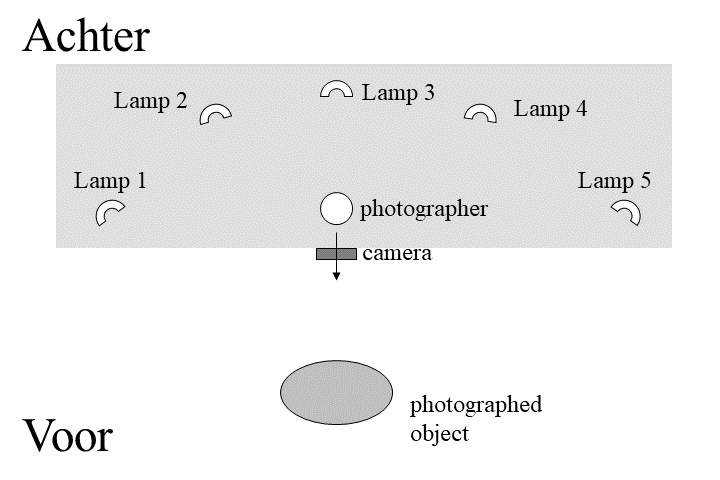
The area denoted by the adpositional phrase can be restricted by the use of modifiers. For example, the use of the modifier rechtstraight in (4a) restricts the area in such a way that only the noun phrases de fotograaf and lamp 3 can be substituted for “NP”. The use of the modifier vlakright in (4b) restricts the area so that, under the right pragmatic conditions, only the noun phrase de fotograaf can be substituted for “NP”.
| a. | NP staat | recht | achter de camera. | |
| NP stands | straight | behind the camera | ||
| 'NP is straight behind the camera.' | ||||
| b. | NP staat | vlak | achter de camera. | |
| NP stands | right | behind the camera | ||
| 'NP is right behind the camera.' | ||||
The difference between modifiers like rechtstraight and vlakright is that the former specifies the spatial relation between the located and the reference object with respect to the orientation, while the latter specifies the distance between the two. The fact that these two kinds of modifications are possible is not accidental; Section 32.3.1.1 suggested that locational PPs, instead of referring to an area, can be considered to denote sets of vectors that take the reference object as their starting point; this is shown in the more abstract representation of the situation in Figure 1 given in Figure 2, which is also taken from Section 32.3.1.1, sub III.
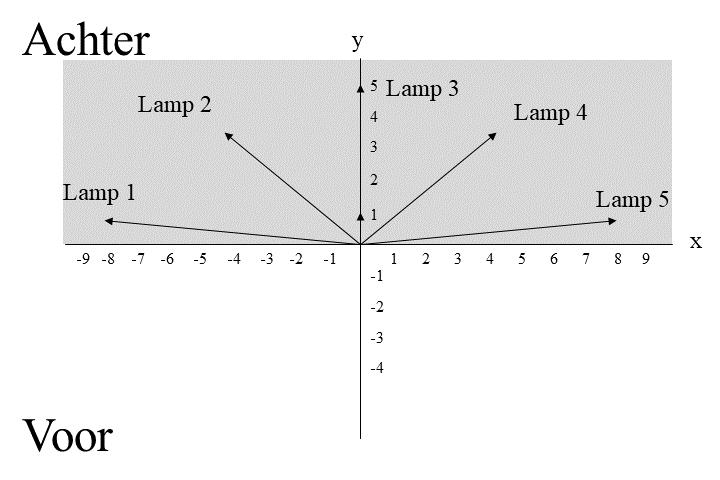
The PP achter de camera refers to the set of vectors V‹x,y› that originate in (0,0) (viz. the position of the camera) and have their endpoint somewhere in the gray area, i.e. for which y > 0. Modifiers are used to restrict this set. The modifiers of orientation select a subset based on the direction of the vectors: the modifier rechtstraight in (4a) selects the subset of vectors for which x = 0, while the modifier schuindiagonally would select the vectors for which x ≠ 0. The modifiers of distance select a subset based on the magnitude (length) of the vector: the modifier vlakright in (4b) restricts the set of vectors to those that are smaller than some contextually given magnitude m, while the modifier verfar restricts the set to those vectors that are longer than some contextually given magnitude m', where m < m'.
In the examples above, the reference object is represented as a point in space. The vector approach to prepositions becomes more complicated when the reference object is represented as a three-dimensional object. Consider the examples in (5).
| a. | Het kasteel | staat | twee/#vier | kilometer | buiten de stad. | |
| the castle | stands | two/four | kilometers | outside the city |
| b. | De lamp | hangt | recht/#schuin | boven de tafel. | |
| the lamp | hangs | straight/diagonally | above the table |
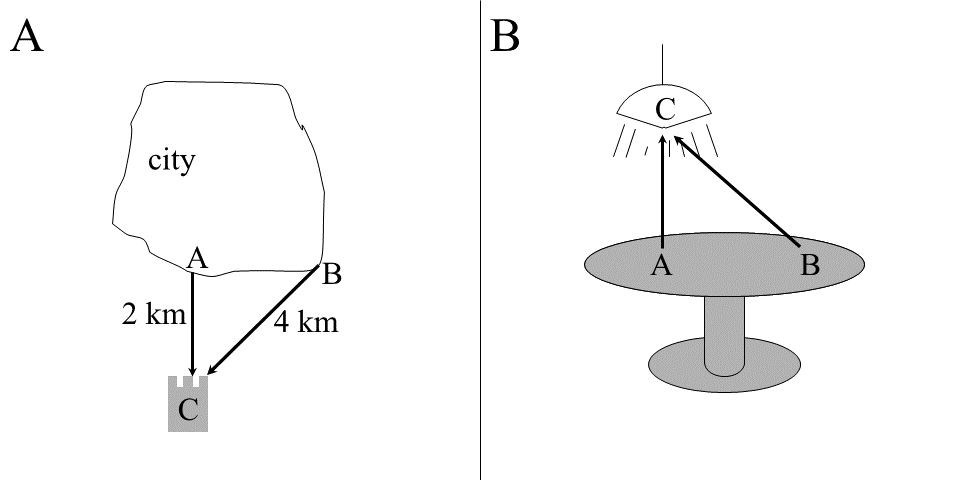
Example (5a) can refer to the situation in Figure 3A if the nominal modifier is twee kilometer but not if it is vier kilometer. Similarly, (5b) can refer to Figure 3B if the adjectival modifier is recht, but not if it is schuin. The contrasts found in (5) would of course be unexpected if the vectors  and
and  were both part of the vector set denoted by the adpositional phrases. This suggests that some minimality requirement is involved: only the shortest vectors going from the reference object to the located object are part of the set denoted by the adpositional phrase.
Note that the modifier recht in (5b) can also be used to express that the lamp hangs right over the center of the table. In this reading, the table may be mentally represented as a point in space, but we will not dwell on this issue.
Now that we have recapitulated the basic aspects of vector theory, we can discuss the modification of spatial adpositional phrases in more detail. Section 34.1.2 will show that vector theory provides us with a proper understanding of the modification possibilities: PPs headed by prepositions denoting sets of vectors can be modified for orientation and distance, which is clearly related to the fact that vectors have an orientation and a magnitude. Given the fact that the null vector lacks these properties (the magnitude of the null vector is zero, so the vector has no orientation either), it is to be expected that locational PPs denoting the null vector cannot be modified by orientation or distance modifiers. Section 34.1.3 will show that this prediction is indeed borne out, despite seeming counterexamples. Finally, Section 34.1.4 discusses the modification of directional adpositional phrases; in this case, the possibilities are limited to modifiers expressing the extent of the implied path actually traversed.
