- Dutch
- Frisian
- Saterfrisian
- Afrikaans
-
- Syntax
- Preface and acknowledgements
- Verbs and Verb Phrases
- 1 Verbs: Characterization and classification
- 2 Projection of verb phrases I: Argument structure
- 3 Projection of verb phrases IIIa: Selected clauses/verb phrases (introduction)
- 1.0. Introduction
- 1.1. Main types of verb-frame alternation
- 1.2. Alternations involving the external argument
- 1.3. Alternations of noun phrases and PPs
- 1.4. Some apparent cases of verb-frame alternation
- 1.5. Bibliographical notes
- 4 Projection of verb phrases IIIa: Selected clauses/verb phrases (introduction)
- 4.0. Introduction
- 4.1. Semantic types of finite argument clauses
- 4.2. Finite and infinitival argument clauses
- 4.3. Control properties of verbs selecting an infinitival clause
- 4.4. Three main types of infinitival argument clauses
- 4.5. Non-main verbs
- 4.6. The distinction between main and non-main verbs
- 4.7. Bibliographical notes
- 5 Projection of verb phrases IIIb: Argument and complementive clauses
- 5.0. Introduction
- 5.1. Finite argument clauses
- 5.2. Infinitival argument clauses
- 5.3. Complementive clauses
- 5.4. Bibliographical notes
- 6 Projection of verb phrases IIIc: Complements of non-main verbs
- 7 Projection of verb phrases IIId: Verb clustering
- 8 Projection of verb phrases IV: Adverbial modification
- 9 Word order in the clause I: General introduction
- 10 Word order in the clause II: Position of the finite verb (verb-first/second)
- 11 Word order in the clause III:Clause-initial position (wh-movement)
- 11.0. Introduction
- 11.1. The formation of V1 and V2-clauses
- 11.2. Clause-initial position remains (phonetically) empty
- 11.3. Clause-initial position is filled
- 11.4. Bibliographical notes
- 12 Word order in the clause IV: Postverbal field (extraposition)
- 13 Word order in the clause V: Middle field (scrambling)
- Nouns and Noun Phrases
- 14 Characterization and classification
- 15 Projection of noun phrases I: Complementation
- 15.0. Introduction
- 15.1. General observations
- 15.2. Prepositional and nominal complements
- 15.3. Clausal complements
- 15.4. Bibliographical notes
- 16 Projection of noun phrases II: Modification
- 16.0. Introduction
- 16.1. Restrictive and non-restrictive modifiers
- 16.2. Premodification
- 16.3. Postmodification
- 16.3.1. Adpositional phrases
- 16.3.2. Relative clauses
- 16.3.3. Infinitival clauses
- 16.3.4. A special case: clauses referring to a proposition
- 16.3.5. Adjectival phrases
- 16.3.6. Adverbial postmodification
- 16.4. Bibliographical notes
- 17 Projection of noun phrases III: Binominal constructions
- 17.0. Introduction
- 17.1. Binominal constructions without a preposition
- 17.2. Binominal constructions with a preposition
- 17.3. Bibliographical notes
- 18 Determiners: Articles and pronouns
- 18.0. Introduction
- 18.1. Articles
- 18.2. Pronouns
- 18.3. Bibliographical notes
- 19 Numerals and quantifiers
- 19.0. Introduction
- 19.1. Numerals
- 19.2. Quantifiers
- 19.2.1. Introduction
- 19.2.2. Universal quantifiers: ieder/elk ‘every’ and alle ‘all’
- 19.2.3. Existential quantifiers: sommige ‘some’ and enkele ‘some’
- 19.2.4. Degree quantifiers: veel ‘many/much’ and weinig ‘few/little’
- 19.2.5. Modification of quantifiers
- 19.2.6. A note on the adverbial use of degree quantifiers
- 19.3. Quantitative er constructions
- 19.4. Partitive and pseudo-partitive constructions
- 19.5. Bibliographical notes
- 20 Predeterminers
- 20.0. Introduction
- 20.1. The universal quantifier al ‘all’ and its alternants
- 20.2. The predeterminer heel ‘all/whole’
- 20.3. A note on focus particles
- 20.4. Bibliographical notes
- 21 Syntactic uses of noun phrases
- 22 Referential dependencies (binding)
- Adjectives and Adjective Phrases
- 23 Characteristics and classification
- 24 Projection of adjective phrases I: Complementation
- 25 Projection of adjective phrases II: Modification
- 26 Projection of adjective phrases III: Comparison
- 27 Attributive use of the adjective phrase
- 28 Predicative use of the adjective phrase
- 29 The partitive genitive construction
- 30 Adverbial use of the adjective phrase
- 31 Participles and infinitives: their adjectival use
- Adpositions and adpositional phrases
- 32 Characteristics and classification
- 32.0. Introduction
- 32.1. Characterization of the category adposition
- 32.2. A syntactic classification of adpositional phrases
- 32.3. A semantic classification of adpositional phrases
- 32.4. Borderline cases
- 32.5. Bibliographical notes
- 33 Projection of adpositional phrases: Complementation
- 34 Projection of adpositional phrases: Modification
- 35 Syntactic uses of adpositional phrases
- 36 R-pronominalization and R-words
- 32 Characteristics and classification
- Coordination and Ellipsis
- Syntax
-
- General
-
- General
- Morphology
- Morphology
- 1 Word formation
- 1.1 Compounding
- 1.1.1 Compounds and their heads
- 1.1.2 Special types of compounds
- 1.1.2.1 Affixoids
- 1.1.2.2 Coordinative compounds
- 1.1.2.3 Synthetic compounds and complex pseudo-participles
- 1.1.2.4 Reduplicative compounds
- 1.1.2.5 Phrase-based compounds
- 1.1.2.6 Elative compounds
- 1.1.2.7 Exocentric compounds
- 1.1.2.8 Linking elements
- 1.1.2.9 Separable Complex Verbs and Particle Verbs
- 1.1.2.10 Noun Incorporation Verbs
- 1.1.2.11 Gapping
- 1.2 Derivation
- 1.3 Minor patterns of word formation
- 1.1 Compounding
- 2 Inflection
- 1 Word formation
- Morphology
- Syntax
- Adjectives and adjective phrases (APs)
- 0 Introduction to the AP
- 1 Characteristics and classification of APs
- 2 Complementation of APs
- 3 Modification and degree quantification of APs
- 4 Comparison by comparative, superlative and equative
- 5 Attribution of APs
- 6 Predication of APs
- 7 The partitive adjective construction
- 8 Adverbial use of APs
- 9 Participles and infinitives as APs
- Nouns and Noun Phrases (NPs)
- 0 Introduction to the NP
- 1 Characteristics and Classification of NPs
- 2 Complementation of NPs
- 3 Modification of NPs
- 3.1 Modification of NP by Determiners and APs
- 3.2 Modification of NP by PP
- 3.3 Modification of NP by adverbial clauses
- 3.4 Modification of NP by possessors
- 3.5 Modification of NP by relative clauses
- 3.6 Modification of NP in a cleft construction
- 3.7 Free relative clauses and selected interrogative clauses
- 4 Partitive noun constructions and constructions related to them
- 4.1 The referential partitive construction
- 4.2 The partitive construction of abstract quantity
- 4.3 The numerical partitive construction
- 4.4 The partitive interrogative construction
- 4.5 Adjectival, nominal and nominalised partitive quantifiers
- 4.6 Kind partitives
- 4.7 Partitive predication with a preposition
- 4.8 Bare nominal attribution
- 5 Articles and names
- 6 Pronouns
- 7 Quantifiers, determiners and predeterminers
- 8 Interrogative pronouns
- 9 R-pronouns and the indefinite expletive
- 10 Syntactic functions of Noun Phrases
- Adpositions and Adpositional Phrases (PPs)
- 0 Introduction to the PP
- 1 Characteristics and classification of PPs
- 2 Complementation of PPs
- 3 Modification of PPs
- 4 Bare (intransitive) adpositions
- 5 Predication of PPs
- 6 Form and distribution of adpositions with respect to staticity and construction type
- 7 Adpositional complements and adverbials
- Verbs and Verb Phrases (VPs)
- 0 Introduction to the VP in Saterland Frisian
- 1 Characteristics and classification of verbs
- 2 Unergative and unaccusative subjects and the auxiliary of the perfect
- 3 Evidentiality in relation to perception and epistemicity
- 4 Types of to-infinitival constituents
- 5 Predication
- 5.1 The auxiliary of being and its selection restrictions
- 5.2 The auxiliary of going and its selection restrictions
- 5.3 The auxiliary of continuation and its selection restrictions
- 5.4 The auxiliary of coming and its selection restrictions
- 5.5 Modal auxiliaries and their selection restrictions
- 5.6 Auxiliaries of body posture and aspect and their selection restrictions
- 5.7 Transitive verbs of predication
- 5.8 The auxiliary of doing used as a semantically empty finite auxiliary
- 5.9 Supplementive predication
- 6 The verbal paradigm, irregularity and suppletion
- 7 Verb Second and the word order in main and embedded clauses
- 8 Various aspects of clause structure
- Adjectives and adjective phrases (APs)
This section discusses the binary tense system originally proposed in Te Winkel (1866) and briefly outlined above, in which three binary oppositions are central: present versus past, imperfect versus perfect, and non-future versus future. Te Winkel was not so much concerned with the properties ascribed to time in physics and philosophy, which have strongly influenced the today’s dominant view on the tense system based on Reichenbach’s (1947) seminal work, which centers on two ternary oppositions: (i) past-present-future and (ii) anterior-simultaneous-posterior. Instead, Te Winkel had a (surprisingly modern) mentalist view of the study of language, and was primarily interested in the properties of time as encoded in the tense systems found in natural language. Verkuyl (2008: §1) compared the two systems and argued that Te Winkel’s system is more successful in describing the universal properties of tense than the Reichenbachian systems, for reasons that will be reviewed in Subsection II, after discussing the details of Te Winkel/Verkuyl’s binary approach in Subsection I.
- I. Binary tense theory: time from a linguistic perspective
- II. A comparison with Reichenbach’s approach
- III. Conclusion
Verkuyl (2008) refers to Te Winkel’s (1866) proposal as the binary tense system, since the crucial distinctions proposed by Te Winkel can be expressed by the three binary features in (260).
| a. | [±past]: present versus past |
| b. | [±posterior]: future versus non-future |
| c. | [±perfect]: imperfect versus perfect |
The binary features in (260) define eight different tenses, which are illustrated in Table 9 by examples in the first-person singular form.
| present | past | ||
| synchronous | imperfect | simple present Ik wandel. I walk | simple past Ik wandelde. I walked |
| perfect | present perfect Ik heb gewandeld. I have walked | past perfect Ik had gewandeld. I had walked | |
| posterior | imperfect | future Ik zal wandelen. I will walk | future in the past Ik zou wandelen. I would walk |
| perfect | future perfect Ik zal hebben gewandeld. I will have walked | future perfect in the past Ik zou hebben gewandeld. I would have walked | |
The features in (260) need some further clarification, which will be given in the following subsections. For the sake of clarity, we will focus on the temporal interpretations cross-linguistically assigned to the tenses in Table 9, thereby postponing the discussion of the more special temporal and non-temporal aspects of their interpretation in Dutch to Sections 1.5.2 and 1.5.4, respectively.
Binary tense theory differs crucially from the Reichenbachian approaches in that it does not identify the notion of present with the notion of speech time. Keeping the notions of speech time and present strictly separate will turn out to have important advantages. For example, it allows us to treat the present as part of an evolving discourse: a shift in speech time does not necessarily lead to a shift of the present, because in the binary system the present tense can be seen as referring to a larger temporal domain i that includes n, not to the speech time n itself. The crucial assumption that distinguishes binary tense theory from other approaches is that the use of the present tense signals that the speaker is speaking about eventualities as occurring in his or her present, even though these eventualities need not occur at speech time itself. This is clear from the fact that a speaker might utter a present-tense example such as (261a) on Tuesday to express that he is devoting the whole week (i.e. the time interval from Monday to Sunday) to writing the section on the tense system mentioned in (261a). It is also evident from the fact that this example can be followed in discourse by the utterances in (261b-d), which subdivide the present-tense interval evoked by the adverbial phrase deze weekthis week in (261a) into smaller subparts. We conclude from this that the present is not to be equated with the simple present, but also includes the present perfect, the future and the future perfect; cf. Table 9.
| a. | Ik | werk | deze week | aan de paragraaf | over het tempussysteem. | |
| I | work | this week | on the section | about the tense system | ||
| 'This week, I am working on the section on the tense system.' | ||||||
| b. | Gisteren | heb | ik | de algemene opbouw | vastgesteld. | present perfect | |
| yesterday | have | I | the overall organization | prt.-determined | |||
| 'Yesterday, I determined the overall organization.' | |||||||
| c. | Vandaag | schrijf | ik | de inleiding. | simple present | |
| today | write | I | the introduction | |||
| 'Today, I am writing the introduction.' | ||||||
| d. | Daarna | zal | ik | de acht temporele vormen | beschrijven. | future | |
| after.that | will | I | the eight tense forms | describe | |||
| 'After that, I will describe the eight tense forms.' | |||||||
| e. | Ik | zal | het | zaterdag | wel | voltooid | hebben. | future perfect | |
| I | will | it | Saturday | prt. | completed | have | |||
| 'I probably will have finished it on Saturday.' | |||||||||
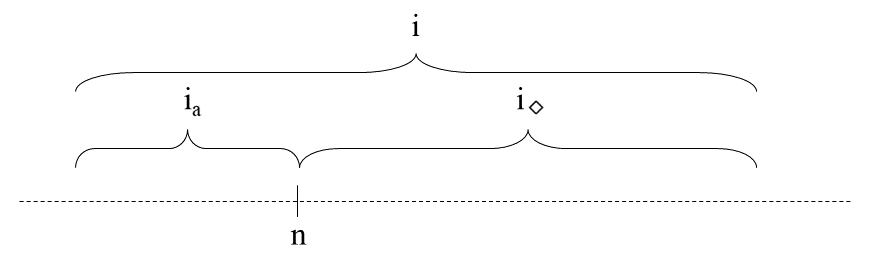
The sequence of utterances in (261) thus shows that what counts as the present for the speaker/hearer is a temporal domain that consists of several subdomains, each of which is denoted by a temporal adverbial phrase that locates the four eventualities expressed in (261b-e) more precisely within the interval denoted by deze weekthis week in (261a). Following Verkuyl (2008), we show the global structure of a present domain in Figure 5: the dotted line represents the time line, n stands for speech time, and i for the time interval that is construed as the present for the speaker/hearer. The role of the rightward shifting speech time n is to divide the present-tense interval i into an actualized part ia (the present preceding n) and a non-actualized part i◊ (the present following n).
It is important to realize that the present-tense interval i is contextually determined. In the discourse chunk in (261), it may seem as if the present i is defined by the adverbial phrase deze weekthis week, but (262) shows that the present-tense interval can easily be stretched by embedding (261a) in a larger story in the present tense.
| We werken | nu | al | jaren | aan een grammatica van het Nederlands. | De eerste delen | zijn | al | afgerond | en | we | beginnen | nu | aan het deel over het werkwoord. | Deze week | werk | ik | aan de paragraaf | over | het temporele systeem. | |||||||||||||||||
| we work | now | already | for.years | on a grammar of the Dutch | the first parts | are | already | prt.-finished | and | we | start | now | with the part on the verb | this week | work | I | on the section | about | the temporal system | continue as in (261b-d) | ||||||||||||||||
| 'We have been working for years on a grammar of the Dutch language. The first volumes are already finished and we are now starting the part on verbs. This week I am working on the section on the tense system. [....]' | ||||||||||||||||||||||||||||||||||||
In fact, example (263) shows that we can extend the present-tense interval i indefinitely, since this sentence involves an eternal, perhaps everlasting, present.
| Sinds de oerknal | breidt | het heelal | zich | in alle richtingen | uit | en | waarschijnlijk | zal | dat | voortduren | tot het einde der tijden. | |||||||
| since the Big Bang | expands | the universe | refl | in all directions | prt. | and | probably | will | that | continue | until the end thegen times | |||||||
| 'Since the Big Bang, the universe has been expanding in all directions and will probably continue to do so until the end of time.' | ||||||||||||||||||
Ultimately, it is the shared extra-linguistic knowledge of the speaker and hearer that determines what counts as the present-tense interval and, consequently, which eventualities can be discussed using present-tense forms. This has already been pointed out in Janssen (1983) by examples such as (264); the extent of the presumed present-tense interval is determined (i) by the difference between the lifespan of planets and human individuals, and (ii) by the fact that “being a stutterer” and “being ill” are normally understood as individual-level and stage-level predicates, respectively.
| a. | De aarde is rond. | |
| the earth is round |
| b. | Jan is een stotteraar. | |
| Jan is a stutterer |
| c. | Jan is ziek. | |
| Jan is ill |
Following Verkuyl (2008), we can define Te Winkel’s binary oppositions by means of the indices i and n introduced earlier, and the indices j and k, which pertain to the temporal location of the eventuality (state of affairs) denoted by the main verb or, rather, the lexical projection of this verb. We have already mentioned that the defining property of the present domain is that it includes speech time n, which is expressed in (265a) by the connector “○”. Verkuyl assumes that the present differs from the past in that the past-tense interval i precedes speech time n, as indicated in (265b); however, we will see in Subsection C that there are reasons not to adopt this assumption.
| a. | Present: i ○ n | i includes speech time n |
| b. | Past: i < n | i precedes speech time n |
The index j is taken as the temporal domain in which the eventuality k is located. In other words, each eventuality k has not only its running time, but also its own present j, which may vary depending on the way we talk about it. This can be seen in the examples in (261), where the location of the present j of k is indicated by adverbial phrases; in (261d), for example, the adverbial phrase daarna restricts j to the time interval following Tuesday, and the semantic representation of (261d) is therefore as schematically shown in Figure 6, where the line below k indicates the actual running time of the eventuality.
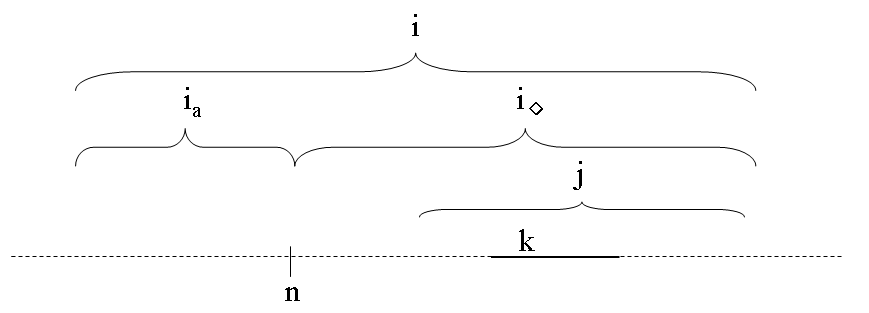
It is important to note that the use of the present-tense form in (261d) reduces the notion of future to the relation of posteriority within present-tense interval i in Figure 6. The difference between non-future and future is that in the former case the present j of eventuality k can synchronize with any subpart of i, while in the latter case it cannot synchronize with any subpart of the actualized part of the present; it must be located in the non-actualized part i◊ of what counts as the present for the speaker/hearer. This is expressed in (266) by the use of the connectors ≈ and <.
| a. | Non-future: i ≈ j | i and j synchronize |
| b. | Future: ia < j | ia precedes j |
The difference between the imperfect and the perfect tense concerns the relation between the eventuality k and its present j; in the latter case k is presented as completed (i.e. bounded to its right) within j, whereas in the former case it is left indeterminate whether or not k is completed within j. This is expressed in (267) by the connectors ≼ and ≺.
| a. | imperfect: k ≼ j | k need not be completed within j |
| b. | Perfect: k ≺ j | k is completed within j |
The following subsections will show that the four present tenses in Table 9 in the introduction to this subsection differ with respect to (i) the location of eventuality k, denoted by the lexical projection of the main verb, within present-tense interval i, and (ii) whether eventuality k is presented as completed within its own present j or not. Recall that we will focus on the temporal interpretations assigned cross-linguistically to the tenses in Table 9; the discussion of the more special temporal and the non-temporal aspects of the interpretations in Dutch will be discussed in Section 1.5.4.
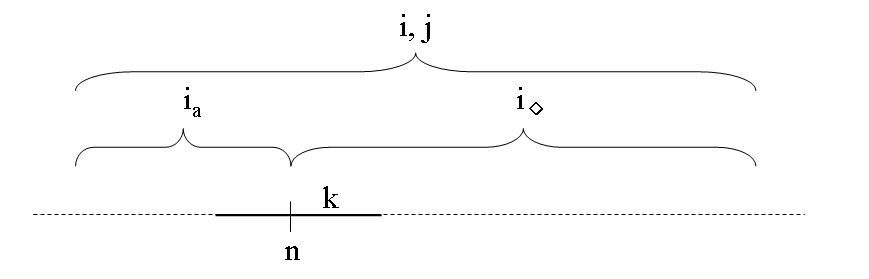
The simple present expresses that eventuality k takes place during present-tense interval i. This can be represented as in Figure 7, where index j is taken by default to be synchronous to the present i of the speaker/hearer (j = i). The solid part of the line below k indicates that the preferred reading of an example such as Ik wandelI am walking is that eventuality k overlaps with speech time n.
In many languages, including Dutch, the implication that k is true at speech time n can easily be canceled by e.g. adverbial modification: the simple present example (268) with the adverbial phrase morgentomorrow can be used to refer to a future eventuality k.
| Ik | wandel | morgen. | ||
| I | walk | tomorrow | ||
| 'I will walk tomorrow.' | ||||
Of course, this is to be expected from the definition of the present in (265a), which states that the present-tense interval i must include speech time n, but does not impose any restrictions on j or k. Although we will return to this issue briefly in Subsection 5, we will defer a more thorough discussion of it to Section 1.5.4, where we will show that this use of the simple present is a characteristic property of languages that do not express the future within the verbal tense system, but by other means, such as adverbials.
The default reading of the present perfect is that eventuality k takes place before speech time n, i.e. eventuality k is located in the actualized part of the present-tense interval ia (j = ia). In addition, the present perfect presents eventuality k as a discrete, bounded unit that is completed within time interval j and therefore cannot be continued after n; this is represented in Figure 8 by the short vertical line after the solid line below k.

The acceptability of a present-perfect construction such as Ik heb gisteren gewandeldI walked yesterday can now be fully understood: (i) the present-tense form hebhave of the auxiliary indicates that we are dealing with a present-tense interval i, i.e. a time interval including speech time n; (ii) the fact that the definition of the present in (265a) and the definition of the perfect in (267b) do not impose any restriction on the location of j with respect to n means that j can precede, follow or overlap with n; (iii) since j can precede n, the adverb gisterenyesterday is eligible as a modifier of j; (iv) the use of gisteren thus implies that eventually k is located in ia, the actualized part of present-tense interval i.
In many languages, including Dutch, the default interpretation that k takes place before speech time n can easily be canceled by e.g. adverbial modification: the present perfect example (269) with the adverb morgentomorrow can be used to refer to some future eventuality k. Again, this is to be expected, since neither the definition of present in (265a) nor the definition of perfect in (267b) imposes any restriction on the location of the present j of eventuality k with respect to n; Section 1.5.4 will return to this issue.
| Ik | heb | je paper | morgen | zeker | gelezen. | ||
| I | have | your paper | tomorrow | certainly | read | ||
| 'I will certainly have read your paper by tomorrow.' | |||||||
There is considerable debate in the literature as to whether perfect-tense constructions should be considered temporal or aspectual in nature. The position taken by individual linguists often depends on the specific tense and aspect theories they endorse. Since the characterization of the perfect tense in binary (and Reichenbachian) tense theory does not appeal to the internal temporal structure of the event, this allows us to adopt a non-aspectual view of the perfect tense. The non-aspectual view may also be supported by the fact that the use of the perfect tense does not affect the way in which the internal structuring of eventuality k is presented; rather, it is the interaction of the perfect tense and the Aktionsart (inner aspect) that should be held responsible; cf. Section 1.2.3 for a discussion of the different kinds of Aktionsart. This will become clear when we consider the contrast between the atelic (states and activities) and telic (accomplishments and achievements) eventualities in (270).
| a. | Jan heeft | zijn hele leven | van Marie | gehouden. | state | |
| Jan has | always | of Marie | loved | |||
| 'Jan has loved Marie always.' | ||||||
| b. | Jan heeft | vanmorgen | aan zijn dissertatie | gewerkt. | activity | |
| Jan has | this.morning | on his dissertation | worked | |||
| 'Jan has worked on his PhD thesis all morning.' | ||||||
| c. | Jan is | vanmorgen | uit Amsterdam | vertrokken. | achievement | |
| Jan is | this.morning | from Amsterdam | left | |||
| 'Jan left Amsterdam this morning.' | ||||||
| d. | Jan heeft | de brief | vanmorgen | geschreven. | accomplishment | |
| Jan has | the letter | this.morning | written | |||
| 'Jan wrote the letter this morning.' | ||||||
All examples in (270) present the eventualities as autonomous units which (in the default reading) are completed at or before speech time n. This does not imply, however, that the eventualities cannot be continued or resumed after n. In fact, this is quite natural in the case of atelic verbs: an example such as (270a) does not imply that Jan will not love Marie after speech time n, as is clear from the fact that it can easily be followed by ... en hij zal dat wel altijd blijven doenand he will probably continue to do so forever. Similarly, example (270b) does not imply that Jan will not continue to work on his thesis after speech time n, as is clear from the fact that (270b) can easily be followed by ... en hij zal daar vanmiddag mee doorgaan... and he will continue to do so in the afternoon. The telic events in (270c&d), on the other hand, do imply that the events have reached their implied endpoint and therefore cannot be continued after speech time n. The examples in (270) thus show that the internal temporal structure of the eventualities is not affected by the perfect tense, but is determined by the Aktionsart of the verbs/verbal projections in question. From this we conclude that the perfect is not aspectual in nature, but part of the tense system; cf. Verkuyl (2008:20-27) for a more detailed discussion.
The future expresses that eventuality k takes place after speech time n, i.e. eventuality k is located in the non-actualized part of the present-tense interval (j = i◊).
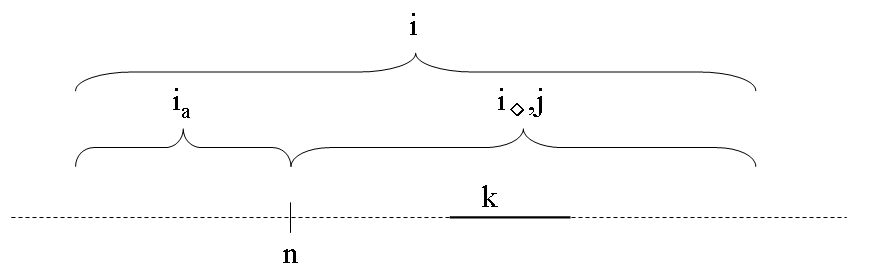
The implication of Figure 9 is that eventuality k cannot occur during ia, but example (271) shows that this implication can be easily canceled in languages like Dutch: the second sentence explicitly leaves open the possibility that Jan has already read the paper at speech time n. This will be one of the main reasons for denying that zullenwill functions as a future auxiliary in Dutch. We will return to this in Sections 1.5.2 and 1.5.4.
| Jan zal | je paper | lezen. | Misschien | heeft | hij | het | al | gedaan. | ||
| Jan will | your paper | read | maybe | has | he | it | already | done | ||
| 'Jan will read your paper. Maybe he has already done it.' | ||||||||||
The interpretation of the future perfect is similar to that of the future, but differs in two ways: (i) it is not necessary that the eventuality k has started after n, and (ii) it is implied that the state of affairs is completed before the time span i◊ has come to an end.
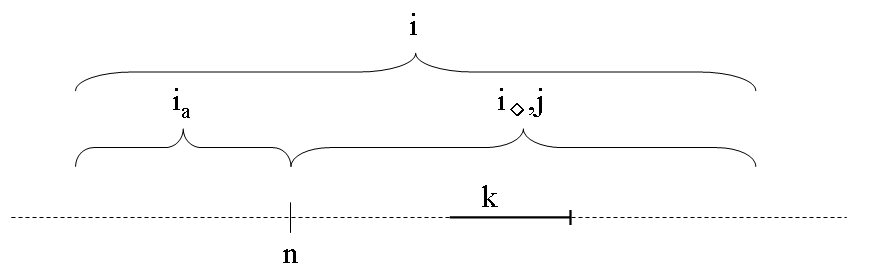
The implication of Figure 10 is again that eventuality k cannot take place/be completed during ia, but example (272) shows that this implication can be easily canceled in languages like Dutch by e.g. adverbial modification. We will leave this non-future reading aside for the moment, but return to it in Sections 1.5.2 and 1.5.4.
| Jan zal | je paper | ondertussen | waarschijnlijk | wel | gelezen | hebben. | ||
| Jan will | your paper | by.now | probably | prt | read | have | ||
| 'Jan will probably have read your paper by now.' | ||||||||
The main difference between the future and the future perfect is that the former focuses on the progress of the eventuality (without considering its completion), whereas the latter focuses on the completion of the eventuality k in j. This difference is often subtle in the case of states and activities but transparent in the case of telic events. Whereas the future tense in example (273a) expresses that the melting process will start/take place after speech time n, the future perfect in (273b) simply expresses that the completion of the melting process will take place in some j located in i◊; the future perfect leaves entirely open whether the melting process started before, after, or at n.
| a. | Het ijs | zal | vanavond | smelten. | |
| the ice | will | tonight | melt | ||
| 'The ice will melt tonight.' | |||||
| b. | Het ijs | zal | vanavond | gesmolten | zijn. | |
| the ice | will | tonight | melted | be | ||
| 'The ice will have melted tonight.' | ||||||
In (274), similar examples are given with the accomplishment die brief schrijven: (274a) places the entire eventuality after the time n, while (274b) makes no claim about the starting point of the eventuality, but simply expresses that the eventuality will be completed after n (but within i◊).
| a. | Jan zal | vanavond | die brief | schrijven. | |
| Jan will | tonight | that letter | write | ||
| 'Jan will write that letter tonight.' | |||||
| b. | Jan zal | vanavond | die brief | geschreven | hebben. | |
| Jan will | tonight | that letter | written | have | ||
| 'Jan will have written that letter by tonight.' | ||||||
For the moment, we will ignore the difference between future and future perfect with respect to the starting point of the state of affairs, but we will return to it in Section 1.5.2, where we will question the claim that zullen is a future auxiliary.
In the tense representations given in the previous subsections, we have distinguished between (i) the present i of the speaker/hearer and (ii) the present j of eventuality k. Although the latter is always included in the former, it is easy to show that the distinction must be made. This may not be so clear in examples such as (275a), where j seems to synchronize with the entire present-tense interval i of the speaker/hearer. However, adverbial phrases of time can cause j to synchronize with a subpart of i: the adverb vandaagtoday in (275b) refers to a subpart of i including n, while morgentomorrow in (275c) refers to a subpart of i located in i◊.
| a. | We | zijn | thuis. | |
| we | are | at.home | ||
| 'We are at home.' | ||||
| b. | We | zijn | vandaag | thuis. | |
| we | are | today | at.home |
| c. | We | zijn | morgen | thuis. | |
| we | are | tomorrow | at.home |
That it is the present j of k and not the present-tense interval i that is affected by adverbial modification is also clear from the fact that it is possible to have conjoined present-tense examples such as (276) in which the two adverbial phrases refer to distinct subdomains within i.
| We | zijn | vandaag | thuis | en morgen | in Utrecht. | ||
| we | are | today | at.home | and tomorrow | in Utrecht |
Furthermore, entailments are computed on the basis of j and not on the basis of the present-tense interval i. Example (275b), in which j synchronizes with a subpart of i that includes n, says nothing about the speaker’s whereabouts yesterday or tomorrow, even if these time intervals are construed as part of present-tense interval i. The fact that entailments are computed on the basis of j and not i is even clearer in example (275c), in which j synchronizes with (a subpart of) i◊; this example says nothing about the speaker’s whereabouts at speech time n, clearly showing that the state of affairs need not hold for the entire present-tense interval i. It is only in cases such as (275a), without a temporal modifier, that we (by default) conclude that the state of affairs holds for the entire present-tense interval i.
The examples in (277) show that the past tense is like the present tense in that it involves a larger time interval that can be divided into smaller subdomains. A speaker may use a past-tense sentence such as (277a) to report on Els’ activities during the past-tense interval evoked by the adverbial phrase vorige weeklast week. This utterance can be followed in discourse by the utterances in (277b-d), which subdivide this past-tense interval into smaller subparts in a way that is completely parallel to the way in which the present-tense examples in (261b-d) subdivide the present-tense interval evoked by the adverbial phrase deze weekthis week in (261a). The examples in (277) show that the past cannot be equated with the simple past, since it includes three other past tenses, namely the past perfect, the future in the past and the future perfect in the past; cf. Table 9.
| a. | Els werkte | vorige week | aan de paragraaf | over het temporele systeem. | |
| Els worked | last week | on the section | about the tense system | ||
| 'Last week, Els was working on the section on the tense system.' | |||||
| b. | Op maandag | had | ze | de algemene opbouw | vastgesteld. | past perfect | |
| on Monday | had | she | the overall organization | prt.-determined | |||
| 'On Monday, she had determined the overall organization.' | |||||||
| c. | Op dinsdag | schreef | ze | de inleiding. | simple past | |
| on Tuesday | wrote | she | the introduction | |||
| 'On Tuesday, she wrote the introduction.' | ||||||
| d. | Daarna | zou | ze | de acht tijdsvormen | beschrijven. | future in past | |
| after.that | would | she | the eight tense.forms | describe | |||
| 'After that, she would (i.e. was going to) describe the eight tense forms.' | |||||||
| e. | Ze | zou | het | zaterdag | wel | voltooid | hebben. | future perfect in past | |
| she | would | it | Saturday | prt | completed | have | |||
| 'She would (i.e. expected to) have finished it on Saturday.' | |||||||||
The striking parallelism between the four present-tense forms and the four past-tense forms makes it possible to assume that the mental representations of the past tenses are similar to those of the present tenses, except for n. To account for this parallelism between the four present tenses and the four past tenses, we will assume that the past tenses are defined with the help of a virtual “speech-time-in-the past”, which we will call n'. To make this more concrete, suppose that the speaker of the discourse chunk in (277) is talking about a conversation he had with Els. We can then identify n' with the moment when the conversation took place; the speaker repeats the information provided by Els from the perspective of that specific moment. This would then lead to the representation in Figure 11, where the dotted line represents the time line, the index i stands for the time interval that is construed as the past (i.e. the then-present) for the speaker/hearer, ia for the actualized part of the past at n', and i◊ for the non-actualized part of the past at n'.
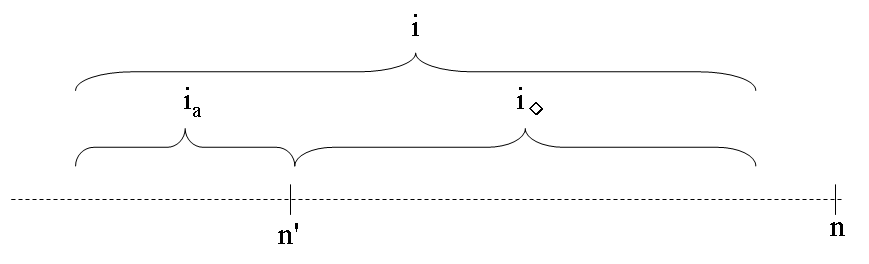
In what follows, we will show that the four past tenses in Table 9 differ in the way they locate the eventuality k in past-tense interval i. Before doing so, we will point out that the present proposal differs in one crucial respect from the proposal in Verkuyl (2008). In Figure 11, we have placed speech time n external to i, and Verkuyl indeed claims that this is a defining property of the past-tense interval i, as is clear from his definition of present and past tense given in Subsection A, repeated here as (278).
| a. | Present: i ○ n | i includes speech time n |
| b. | Past: i < n | i precedes speech time n |
The idea that the past-tense interval must precede speech time n does not seem to follow from anything in the system. Like in the case of the present-tense interval, there is no a priori reason to reject the idea that the past-tense interval can be extended indefinitely; this implies that it can include speech time n. The subsections below will provide empirical evidence that the inclusion of n is possible; for example, the future-in-the-past and future-perfect readings in the past-tense examples in (279) show that eventuality k can easily be placed after speech time n.
| a. | Marie zou | morgen | vertrekken. | future in the past | |
| Marie would | tomorrow | leave | |||
| 'Marie would leave tomorrow.' | |||||
| b. | Marie zou | oma | morgen | bezocht | hebben. | future perfect | |
| Marie would | grandma | tomorrow | visited | have | |||
| 'Marie would have visited Grandma tomorrow.' | |||||||
To formally account for the acceptability of examples such as (279), Broekhuis & Verkuyl (2014) adapted definition (278b) as in (280b). Note that the examples in (279) also have a modal component; we ignore this here, but return to it in Section 1.5.2.
| a. | Present: i ○ n | i includes speech time n |
| b. | Past: i ○ n' | i includes virtual speech-time-in-the-past n' |
The definitions in (280) leave the core of the binary tense system untouched, since they maintain the asymmetry between the present and the past but now on the basis of an opposition between the now-present (characterized by the inclusion of n) and the then-present (characterized by the inclusion of n'). The now-present could be seen as the time interval that is immediately accessible and directly relevant to the speaker/hearer-in-the-present, whereas the then-present should rather be seen as the time interval accessible and relevant to some speaker/hearer-in-the-past; cf. Janssen (1983:324ff) and Boogaart & Janssen (2007) for an overview of a number of descriptions in cognitive terms of the distinction between past and present that may prove useful for sharpening the characterization of the now-present and the then-present given here. The definition of past in (280b) is also preferable to the one in (278b) for theoretical reasons: first and most importantly, it formally accounts for the parallel architecture of the present and the past, and second, it solves the problem that n' did not play an explicit role in the definition of the three binary oppositions given in Subsection A and was therefore left undefined.
The following subsections will show that the four past tenses in Table 9 in the introduction to this subsection differ with respect to (i) the position of eventuality k, denoted by the lexical projection of the main verb, within the past-tense interval i, and (ii) whether or not it is presented as completed within its own past-tense interval j. Again, we focus on the temporal interpretations assigned cross-linguistically to the tenses in Table 9, postponing the discussion of the more special temporal and non-temporal aspects of their interpretations in Dutch to Section 1.5.4.
The simple past expresses that eventuality k occurs during past-tense interval i. This can be expressed as in Figure 12, in which the solid line below k refers to the time interval during which the eventuality occurs. The solid line below k indicates that the default reading of an example such as Ik wandeldeI was walking is that eventuality k takes place at n'.
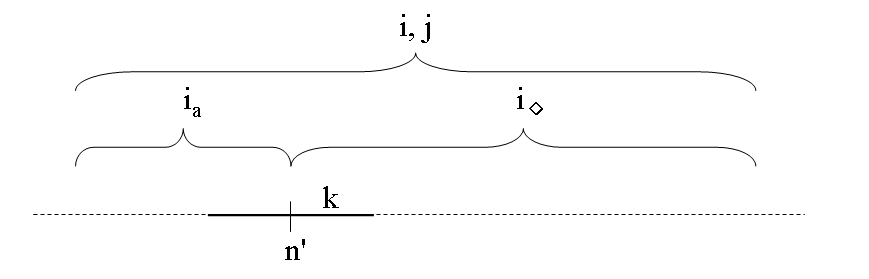
By stating that j = i, Figure 12 also expresses that the simple past has no implications for the time before or after the relevant past-tense interval i: the eventuality k may or may not hold before/after i. Consequently, an example such as (281) says nothing about the speaker’s feelings before yesterday, or today and later. This implies that the simple past cannot shed any light on the question as to whether speech time n can be included in the past-tense interval i.
| Ik | was | gisteren | erg gelukkig. | ||
| I | was | yesterday | very happy | ||
| 'I was very happy yesterday.' | |||||
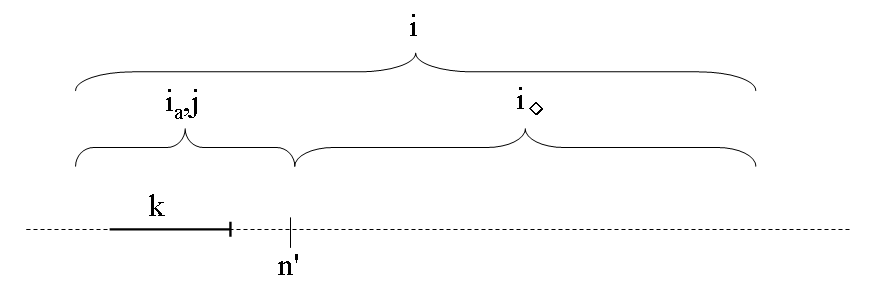
The default reading of the past perfect is that eventuality k takes place before n', i.e. k is located in the actualized past-tense interval ia (j = ia). In addition, the past perfect presents the eventuality as a discrete, bounded unit that is completed within the present j of k, i.e. that cannot be continued after n'; this is again represented by the short vertical line after the solid line below k. Since k precedes n' and n' precedes n, k also precedes n, which implies that examples of this type cannot shed any light on whether speech time n can be included in the past-tense interval i.
The future in the past expresses that the eventuality k takes place after n', i.e. k is located in the non-actualized part of the past-tense interval (j = i◊).
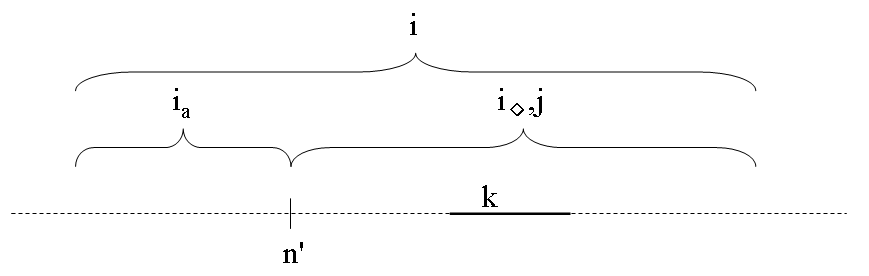
The future in the past examples in (282b&c) show that speech time n can be included in the past-tense interval. We have already seen above that this refutes the definition of past in (278b) and supports the revised definition in (280b).
| a. | Els zou | gisteren | wandelen. | |
| Els would | yesterday | walk |
| b. | Els zou | vandaag | wandelen. | |
| Els would | today | walk |
| c. | Els zou | morgen | wandelen. | |
| Els would | tomorrow | walk |
The interpretation of the future perfect in the past is similar to that of the future in the past, but requires the state of affairs to be completed within time span i◊.

The difference between the future in the past and the future perfect in the past is parallel to the difference between the future and the future perfect discussed in Subsection A: in future in the past examples such as (283a) the focus is on the progress of the eventuality, which in its entirety is placed after n', whereas in future perfect in the past examples such as (283b) the focus is on the completion of the eventuality and no particular claim is made about the starting point of the event.
| a. | Het ijs | zou | gisteren | smelten. | |
| the ice | would | yesterday | melt | ||
| 'The ice would melt yesterday.' | |||||
| b. | Het ijs | zou | gisteren | gesmolten | zijn. | |
| the ice | will | yesterday | melted | be | ||
| 'The ice would have melted yesterday.' | ||||||
Similar examples with the achievement die brief schrijven are given in (284): the future in the past in (284a) locates the entire eventuality after n', whereas the future perfect in the past in (284b) does not seem to make any claim about the starting point of the eventuality, but simply expresses that the eventuality will be completed after n' (but within i◊).
| a. | Jan zou | gisteren | die brief | schrijven. | |
| Jan would | yesterday | that letter | write | ||
| 'Jan would write that letter yesterday.' | |||||
| b. | Jan zou | gisteren | die brief | geschreven | hebben. | |
| Jan would | yesterday | that letter | written | have | ||
| 'Jan would have written that letter yesterday.' | ||||||
The examples in (285) with the adverbial phrase morgentomorrow show that the future perfect in the past provides evidence for the claim that speech time n can be included in the past-tense interval. We have already seen that this refutes the definition of the past tense in (278b) and supports the revised definition in (280b).
| a. | Het ijs | zou | morgen | gesmolten | zijn. | |
| the ice | will | tomorrow | melted | be | ||
| 'The ice would have melted tomorrow.' | ||||||
| b. | Jan zou | morgen | die brief | geschreven | hebben. | |
| Jan would | tomorrow | that letter | written | have | ||
| 'Jan would have written that letter tomorrow.' | ||||||
So far, we have discussed the three binary features in (286) that are assumed within Te Winkel/Verkuyl’s binary tense theory: these features define the four present and four past tenses exemplified shown in Table 9.
| a. | [±past]: present versus past |
| b. | [±posterior]: future versus non-future |
| c. | [±perfect]: imperfect versus perfect |
Subsections A and C discussed the default interpretations assigned to these present and past tenses in Verkuyl (2008). We also discussed Verkuyl’s formalizations of the features in (286) and saw that there was reason to adjust the definition of [+past] slightly. This resulted in the set of definitions in (287).
| a. | Present: i ○ n | i includes speech time n |
| a'. | Past: i ○ n' | i includes virtual speech-time-in-the-past n' |
| b. | Non-future: i ≈ j | i and j synchronize |
| b'. | Future: ia < j | ia precedes j |
| c. | Imperfect: k ≼ j | k need not be completed within j |
| c'. | Perfect: k ≺ j | k is completed within j |
An important result of the previous subsections is that, in principle, both the present-tense interval and the past-tense interval can be infinitely large, with the result that the past-tense interval can include speech time n. This implies that the present and the past do not refer to mutually exclusive temporal domains, and consequently that it should be possible to discuss eventualities simultaneously as part of the past-tense domain and as part of the present-tense domain. This subsection will provide evidence for this position and argue that the choice between the two options is a matter of perspective, i.e. whether the eventuality is viewed from the perspective of speech time n or from the perspective of the virtual speech time in the past n'.
The use of adverbial phrases of time in sentences with a past tense can introduce a so-called supratemporal ambiguity; cf. Verkuyl (2008:118-123). This ambiguity is especially visible when the adverbial phrase occupies the sentence-initial position, as in (288).
| a. | Om vijf uur | ging | Marie weg. | |
| at 5 oʼclock | went | Marie away | ||
| 'Marie would leave at 5 oʼclock.' | ||||
| b. | Een uur geleden | had Marie nog | zwart haar. | |
| an hour ago | had Marie still | black hair | ||
| 'An hour ago Marie still had black hair.' | ||||
The two sentences in (288) have a regular “real event” interpretation in the sense that the sentence is about Marie’s departure or about Marie having black hair at the time indicated by the adverbial phrase; in such cases the adverbial phrase functions as a regular temporal modifier of the time interval j that includes eventuality k. However, there is also a supratemporal interpretation in which the eventuality itself plays no particular role apart from being the topic of discussion. In this interpretation, the speaker of (288a) expresses that his latest information about Marie’s departure goes back to five o’clock: “according to my information at five o’clock, the situation was such that Marie would be leaving”. Similarly, (288b) can be interpreted as a correction of an error signaled by the speaker, e.g. in a manuscript; “An hour ago I read that Marie has black hair (but now it is mentioned that Jan likes her auburn hair)”.
Past-tense clauses are compatible with future eventualities on a supratemporal reading. Consider a situation in which the speaker is discussing Els’ plans for some time interval after speech time n. He can then compare the information available at two different moments: sentence (289a), for example, compares the information the speaker had yesterday with the information he has just received. The first conjunct of (289a) also illustrates that past-tense clauses with a supratemporal reading are compatible with locating the eventuality k after speech time, as the speaker’s talk is located in the speaker’s future. Example (289b) shows that it is even possible to make the future location of k explicit by using a second adverbial phrase such as morgentomorrow, especially if the particle nog is added right after gisterenyesterday; cf. Boogaart & Janssen (2007) for similar cases.
| a. | Gisteren | zou | Els mijn lezing | bijwonen, | maar | nu | gaat ze op vakantie. | |
| yesterday | would | Els my talk | attend | but | now | goes she on vacation | ||
| 'As of yesterday, the plan was that Els would attend my lecture, but now I have information that she will be going on vacation.' | ||||||||
| b. | Gisteren | (nog) | zou | Els morgen | mijn lezing | bijwonen, | maar | nu | gaat | ze | op vakantie. | ||||||
| yesterday | prt | would | Els tomorrow | my lecture | attend | but | now | goes | she | on vacation | |||||||
| 'Just yesterday, Els was supposed to attend my talk tomorrow, but now I have been told that she is going on vacation.' | |||||||||||||||||
The fact that the past tense in the first conjunct of the examples in (289) is compatible with locating the eventuality after speech time n, and that the adverbs gisterenyesterday and morgentomorrow can be used in a single clause is exceptional. That this is possible, however, is not surprising when we realize that speech time n can be included in the past-tense interval. As shown in Figure 16 for example (289b), the first conjuncts in sentences such as (289) give rise to completely coherent interpretations. The notation used aims at expressing that the adverbial phrase gisteren is a supratemporal modifier denoting a time interval including the virtual speech-time-in-the past n', whereas the adverbial phrase morgentomorrow functions as a regular temporal modifier of j.
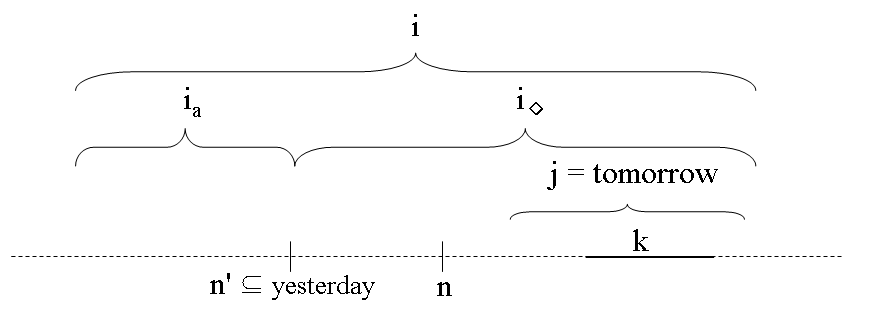
The claim that speech time n can be included in the past-tense interval also has important consequences for the description of the so-called sequence of tense phenomenon, i.e. the fact that the tense of a dependent clause can be adapted to coincide with the past tense of the matrix clause. Sequence of tense is illustrated in (290): example (290a) is unacceptable if we interpret the adverb morgentomorrow as a temporal modifier of the eventuality k, while example (290b) is perfectly acceptable in that case.
| a. | $ | Jan vertrok | morgen. |
| Jan left | tomorrow | ||
| 'Jan was leaving tomorrow.' | |||
| b. | Els zei | [dat | Jan morgen | vertrok]. | |
| Els said | that | Jan tomorrow | left | ||
| 'Els said that Jan was leaving tomorrow.' | |||||
The unacceptability of (290a) is usually taken to represent the normal case: past tense is incompatible with adverbial phrases such as morgen that locate the eventuality after speech time n, and therefore (290a) cannot be interpreted as a modifier of the then-present j of the eventuality k; on this view, the sequence-of-tense example in (290b) is unexpected and must therefore be regarded as a special case. If, on the other hand, we assume that speech time n can be included in the past-tense interval, the acceptability of (290b) is expected; the eventualities in the main clause and the embedded clause are both seen as belonging to past-tense interval i, which happens to include speech time n. The real problem on this view is the unacceptability of example (290a), since the system predicts that this example is also possible in the intended reading.
The claim that the past-tense interval can include speech time n can also explain the contrast between the two examples in (291). In (291a) the eventualities expressed by the embedded and the main clause are both considered to be part of the past-tense interval, and as a result we cannot determine from this example whether the speaker believes that Els is (still) pregnant at speech time n; this may or may not be the case. In (291b), on the other hand, the eventuality of Els being pregnant is presented as part of the present-tense domain, and the speaker therefore implies that Els is still expecting at speech time n; cf. Hornstein (1990: §4.1) for similar intuitions.
| a. | Jan zei | [dat | Els zwanger | was]. | |
| Jan said | that | Els pregnant | was | ||
| 'Jan said that Els was pregnant.' | |||||
| b. | Jan | zei | [dat | Els zwanger | is]. | |
| Jan | said | that | Els pregnant | is | ||
| 'Jan said that Els is pregnant.' | ||||||
This contrast in interpretation can be seen in the examples in (292). Since sequence-of-tense constructions do not imply that the eventuality expressed by the embedded clause still exists at speech time n, the continuation in (292a) is perfectly natural; it is suggested that Els has given birth and hence is now a mother. In (292b), on the other hand, the continuation leads to a semantic anomaly because the use of the present tense in the embedded clause indicates that the speaker believes that Els is still pregnant.
| a. | Jan zei | [dat | Els zwanger | was]; | ze | zal | ondertussen | wel | moeder | zijn. | |
| Jan said | that | Els pregnant | was | she | will | by.now | prt | mother | be | ||
| 'Jan said that Els was pregnant; she will probably be a mother by now.' | |||||||||||
| b. | $ | Jan | zei | [dat | Els zwanger | is]; | ze | zal | ondertussen | wel | moeder | zijn. |
| Jan | said | that | Els pregnant | is | she | will | by.now | prt | mother | be | ||
| 'Jan said that Els is pregnant; she will probably be a mother by now.' | ||||||||||||
A similar account can be given for the observation in Kiparsky & Kiparsky (1970:162-3), illustrated in (293), that for some speakers factive and non-factive constructions differ in that the former usually display optional sequence of tense, whereas the latter tend to have obligatory sequence of tense. Again, the reason for this is that the use of present tense suggests that the speaker believes that the eventuality expressed by the embedded clause holds at speech time n. We used a percentage sign in (293b) to indicate that some speakers seem to accept the use of present tense in non-factive constructions like this.
| a. | De oude Grieken | wisten | al | [dat | de wereld | rond | was/is]. | |
| the old Greeks | knew | already | that | the world | round | was/is | ||
| 'The old Greeks knew already that the world is round.' | ||||||||
| b. | De kerk | beweerde | lang | [dat | de wereld | plat | was/%is]. | |
| the church | claimed | long | that | the world | flat | was/is | ||
| 'The church claimed for a long time that the world was flat.' | ||||||||
The discussion in the previous subsection has shown that the claim that the past-tense interval can include speech time n correctly predicts that sequence of tense is not required, and may even be impossible, if the right conditions are met. As we noted earlier in our discussion of (290), this in a sense reverses the traditional problem; it is not the sequence-of-tense example in (290b) that poses a problem, but the fact that the past tense in simple clauses such as (290a) blocks the use of adverbial phrases such as morgentomorrow that locate the eventuality after speech time n.
Note, however, that under certain conditions the past tense can actually be combined with adverbs such as morgen. This is the case, for instance, in the question in (294b) provided by Angeliek van Hout (p.c.). The two examples in (294) differ in their point of perspective: (294a) expresses that the speaker assumes, on the basis of his knowledge at speech time n, that the addressee will come tomorrow, whereas (294b) expresses that the speaker assumes this on the basis of his knowledge at virtual speech-time-in-the-past n'. Some speakers report that (294b) feels a bit more polite than (294a), which may be related to this difference in perspective; by using (294b) the speaker explicitly leaves open the possibility that his information is outdated and consequently that the conclusion he draws from it may be wrong, i.e. the question can be seen as a request for reaffirmation; cf. also Haans & De Hoop (2023), which comes to a similar conclusion (formulated in Reichenbachian terms).
| a. | Je | komt | morgen | toch? | |
| you | come | tomorrow | prt | ||
| 'You have the intention to come tomorrow, donʼt you?' | |||||
| b. | Je | kwam | morgen | toch? | |
| you | came | tomorrow | prt | ||
| 'You had the intention to come tomorrow, didnʼt you?' | |||||
Past tenses can also be combined with the adverb morgen in questions such as (295b). Again, the difference is one of perspective. In question (295a) the speaker is simply asking for some information available at n; he expects that there will be a visitor tomorrow and he wants to know who this visitor is. Example (295b) is used when the speaker is aware of the fact that he had information about the identity of the visitor at some virtual speech-time-in-the-past n', but is not entirely sure of the accuracy of his recollection (which is typically signaled by the string ook al weer).
| a. | Wie komt er morgen? | |
| who comes there tomorrow | ||
| 'Who is coming tomorrow?' |
| b. | Wie | kwam | morgen | ook al weer? | |
| who | came | tomorrow | ook al weer | ||
| 'Please, tell me again who will come tomorrow?' | |||||
Another example, taken from Boogaart & Janssen (2007:809), is given in (296). Example (296a) simply states the speaker’s intention to leave tomorrow, whereas example (296b) leaves open the possibility that there are reasons, not known at some virtual speech-time-in-the-past n', that may prevent the speaker’s intention to leave from being realized.
| a. | Ik vertrek | morgen. | |
| I leave | tomorrow | ||
| 'I will leave tomorrow.' | |||
| b. | Ik | vertrok | graag | morgen. | |
| I | left | gladly | tomorrow | ||
| 'I would have liked to leave tomorrow.' | |||||
A final example that seems closely related to the one in (296b), also taken in slightly adapted form from Boogaart & Janssen, is given in (297b). Examples like this can be used as objections to a command or request by showing that it is inconsistent with some previous commitment or plan.
| a. | Je | moet | morgen | thuis | blijven. | |
| you | must | tomorrow | at.home | stay | ||
| 'You have to stay at home tomorrow.' | ||||||
| b. | Maar | ik | vertrok | morgen | naar Budapest! | |
| but | I | left | tomorrow | to Budapest | ||
| 'But I was supposed to leave for Budapest tomorrow.' | ||||||
The examples in (294) to (297) show that there is no inherent prohibition on combining past tenses with adverbs such as morgentomorrow; they show that there is no need to build such a prohibition into tense theory. Of course, this still leaves the unacceptability of simple declarative clauses such as Jan kwam morgenJan came tomorrow, but Section 1.5.4 will solve this problem by arguing that this example is excluded not because it is semantically incoherent, but for pragmatic reasons: Grice’s maxim of quantity prefers the use of the simple present/future in cases like this.
The previous subsection has shown that it is possible to combine past tenses with adverbs referring to time intervals following speech time n. Similarly, it seems possible to combine present tenses with adverbs such as gisterenyesterday referring to time intervals preceding speech time n. Subsection A 2 has already discussed this for present-perfect constructions such as (298), and has shown that it is fully allowed by our definitions in (287); since neither the definition of present in (287a) nor the definition of perfect in (287c) imposes any restriction on the location of j (or k) with respect to n, the adverbial gisterenyesterday can be analyzed as an identifier of j on the assumption that the time interval referred to by gisteren is part of a larger present-tense interval i that includes speech time n.
| a. | Ik | heb | gisteren | gewandeld. | |
| I | have | yesterday | walked | ||
| 'I walked yesterday.' | |||||
For the same reason, we would expect it to be possible to combine adverbs such as gisteren with the simple present: the definition of present in (287a) imposes no restriction on the location of j (or k) with respect to n. This means that we expect examples such as (299c) to be possible alongside (299a&b). Although the examples in (299a&b) are certainly more common, examples such as (299c) occur regularly in speech and can be easily found on the internet.
| a. | Ik | las | gisteren/daarnet | in de krant | dat ... | |
| I | readpast | yesterday/just.now | in the newspaper | that | ||
| 'Yesterday/A moment ago, I read in the newspaper that ...' | ||||||
| b. | Ik | heb | gisteren/daarnet | in de krant | gelezen | dat ... | |
| I | have | yesterday/just.now | in the newspaper | readpart | that | ||
| 'Yesterday/A moment ago, I read in the newspaper that ...' | |||||||
| c. | Ik | lees | gisteren/daarnet | in de krant | dat ... | |
| I | readpresent | yesterday/just.now | in the newspaper | that | ||
| 'Yesterday/A moment ago, I was reading in the newspaper that ...' | ||||||
The acceptability of examples such as (299c) is not surprising, and so needs no special explanation. The only thing we need to consider is why the frequency of such examples is relatively low: one reason that might come to mind is simply that examples of this kind are blocked by the perfect-tense example in (299b), because the latter is more precise in that it presents the eventuality as completed.
Present-tense examples such as (299c) are particularly common in narrative contexts as an alternative to the simple past, which is why this use of the simple present is often referred to as the historical present. The historical present is often said to result in a more vivid narrative style (Haeseryn et al. 1997:120), which is easily understood from the perspective of binary tense theory. First, it should be noted that the simple past is usually preferred to the present perfect in narrative contexts because it presents the story not as a series of completed eventualities but as a series of ongoing events. However, because the simple past presents the story from the perspective of a virtual speech-time-in-the-past, it maintains a certain distance between the events being discussed and the listener/reader. The vividness of the historical present results from the fact that the simple present removes this distance by presenting the story as part of the actual present-tense interval of the listener/reader.
The historical present has become an often-used convention in the narration of historical events, even if the events are more likely to be construed as part of a past-tense interval; cf. (300). Again, the purpose of using the historical present is to bridge the gap between the reader and the narrated events by presenting them as part of the reader’s present-tense interval.
| a. | In 1957 verscheen | Syntactic structures, | dat Chomsky beroemd zou maken. | |
| in 1957 appeared | Syntactic structures | that Chomsky famous would make | ||
| 'In 1957, Syntactic Structures appeared, which would make Chomsky famous.' | ||||
| b. | In 1957 | verschijnt | Syntactic structures, | dat | Chomsky beroemd | zal maken. | |
| in 1957 | appears | Syntactic structures | that | Chomsky famous | will make | ||
| 'In 1957, Syntactic Structures appears, which will make Chomsky famous.' | |||||||
This use of the historical present is therefore not very special from a grammatical point of view, since it only involves the pretence that n' = n, and we will therefore not elaborate on this use. The conclusion that we can draw from the above discussion is that the stylistic effect of the so-called historical present confirms our main claim that the choice between past and present tense is a matter of perspective.
This subsection concludes our discussion of the choice between present and past by showing that tense not only determines the perspective on the eventuality expressed by the lexical projection of the main verb, but also affects the interpretation of so-called non-rigid designators such as de minister-presidentthe Prime Minister; cf. Cremers (1980) and Janssen (1983). Non-rigid designators are noun phrases that do not have a fixed referent, but have referents that change over time: whereas the noun phrase de minister-president refers to Jan Peter Balkenende in the period July 2002–February 2010, it refers to Mark Rutte in the period October 2010–July 2024.
That the choice of tense can affect the interpretation of the noun phrase can be illustrated by the examples in (301). The interpretation of the present-tense example in (301a) depends on the actual speech time n; if uttered in 2008, it is an assertion about the then Prime Minister Balkenende, but if uttered in 2022, it is a declaration about Prime Minister Rutte. Similarly, the interpretation of the past-tense example in (301b) depends on the location of the virtual speech-time-in-the past n': in a discussion about the period 2002 to 2010 it will be interpreted as a declaration about Balkenende, but in a discussion about the period 2010 to 2024 it will be interpreted as a declaration about Rutte. Crucially, example (301b) need not be interpreted as an assertion about the person performing the function of Prime Minister at speech time n.
| a. | De minister-president | is een bekwaam bestuurder. | |
| the prime.minister | is a skilled governor |
| b. | De minister-president | was een bekwaam bestuurder. | |
| the prime.minister | was a skilled governor |
The examples in (301) show that present/past tense fixes the reference of non-rigid designators; we choose their reference at n/n'. Now consider the examples in (302), in which the index now on the noun phrase is used to indicate that the intended referent is the one who performs the function of Prime Minister at speech time n. The number sign indicates that example (302a) is not very felicitous if one wants to express that the current Prime Minister attended high school when he was young. This follows directly from the claim that the reference of non-rigid designators is determined by tense; the past tense indicates that the description de minister-president can only refer to the person who performs the function of Prime Minister at virtual speech-time-in-the-past n'. Example (302b), on the other hand, can felicitously express the intended meaning, since it simply presents the Prime Minister’s school days as part of the present-tense interval: the person referred to by the description de minister-president at speech time n is said to have attended high school during the actualized part of the present-tense interval.
| a. | # | De minister-president | zat | op het gymnasium. |
| the prime.ministernow | sat | on the high.school | ||
| 'The Prime Minister attended high school.' | ||||
| b. | De minister-president | heeft | op het gymnasium | gezeten. | |
| the prime.ministernow | has | on the high.school | sat | ||
| 'The Prime Minister has attended high school.' | |||||
Note that we are not claiming that it is impossible to interpret a non-rigid designator from the perspective of speech time n in past tense sentences, but this is only possible if the description happens to refer to the same person at n and n'. This is illustrated by the fact that the two examples in (303) are both perfectly acceptable.
| a. | De minister-president | was | enkele dagen | in Brussel. | |
| the prime.ministernow | was | some days | in Brussels | ||
| 'The Prime Minister was in Brussels for a couple of days.' | |||||
| b. | De minister-president | is enkele dagen | in Brussel | geweest. | |
| the prime.ministernow | is some days | in Brussels | been | ||
| 'The Prime Minister has been in Brussels for a couple of days.' | |||||
The discussion above has shown that present/past tense not only determines the perspective from which the eventuality as a whole is viewed, but also affects the interpretation of noun phrases that function as non-rigid designators. Before concluding this subsection, we should mention that Cremers (1980:44) has claimed that the judgments on the above examples hold only when a non-rigid designator is used descriptively, because in certain contexts such noun phrases can also be used as proper names. For instance, an example such as (304b) can easily be used in a historical narrative to refer to Queen Beatrix, even if the story is told or written during the reign of King Willem-Alexander.
| a. | De koningin | was zich | voortdurend | bewust | van ... | |
| the queenpast | was refl | continuously | aware | of | ||
| 'The Queen was continuously aware of ....' | ||||||
| b. | De koningin | is zich | voortdurend | bewust | van ... | |
| the queenpast | is refl | continuously | aware | of | ||
| 'The Queen is constantly aware of ...' | ||||||
Since the previous subsection already mentioned that historical narratives often use the historical present, an alternative account for the interpretation in (304b) might be that this use of the present affects the interpretation of non-rigid designators; pretending that n' = n simply does not block the possibility of interpreting the non-rigid designator with respect to n'. We leave this issue to future research.
The previous subsections have shown that in Te Winkel/Verkuyl’s binary tense system the present and past tenses are structured in a completely parallel way. The present subtenses are located in a present-tense interval including speech time n, whereas the past subtenses are located in a past-tense interval including a contextually determined virtual speech-time-in-the-past n'. The subtenses locate the eventuality with respect to n/n'.
Subsection I has outlined Te Winkel/Verkuyl’s binary tense system based on three binary oppositions: present versus past, imperfect versus perfect, and non-future versus future. This subsection briefly discusses why we do not follow (the more recent versions) of Reichenbach’s (1947) approach to tense; cf. e.g. Comrie (1985), Hornstein (1990), and Verkuyl (2008/2022) for detailed discussions of such approaches. Reichenbach’s proposal is based on the two ternary oppositions in (305): S stands for speech time, i.e. the time at which the sentence is uttered; R stands for the so-called reference point, the function of which will be clarified in a moment; E stands for event time, i.e. the time at which the eventuality denoted by the lexical projection of the main verb is located. The comma and the dash “—” express a relation of simultaneity and a relation of precedence, respectively: (S,R) thus states that the speech time and the reference point share the same point on the time line, and (S—R) that the speech time precedes the reference point.
| a. | present (S,R), past (R—S), and future (S—R) |
| b. | simultaneous (R,E), anterior (E—R), and posterior (R—E) |
The crucial component of Reichenbach’s theory is the reference point R, without which it would be impossible to define tenses like the past perfect, the future in the past or the future perfect. The oppositions in (305) define nine different tenses, as shown in Figure 17. Reichenbach’s proposal is relatively successful in its descriptive adequacy, which can be seen from the fact, discussed in Subsection I, that 7 out of the 9 predicted tenses are actually found in Dutch.
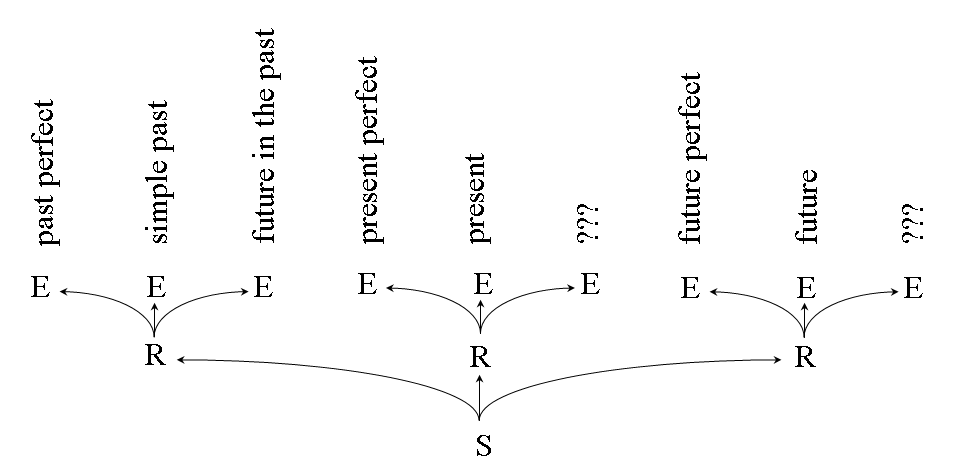
However, there are some serious problems. The best-known problem is that Reichenbach’s proposal is not able to account for the future perfect in the past: Ik zou hebben gewandeldI would have walked. The reason is quite simple: Figure 17 shows that the perfect involves the anterior relation E—R, whereas the future in the past involves the posterior relation R—E, and combining the two would therefore lead to the contradiction that E must both precede and follow R. There are proposals that resolve this contradiction by introducing a second reference point R' (as in Prior 1967, Comrie 1985, Vikner 1985, Haeseryn et al. 1997:116), but this of course goes against the spirit of the original proposal that the tense system can be described by postulating no more than three temporal points S, R, and E, based on the two ternary oppositions in (305).
Another possible problem with Reichenbach’s proposal is that there are in fact two different notions of the future, viz. future (S—R) and posteriority (R—E), and it remains to be seen whether there are systematic semantic differences between the two notions. It is important to note that it is impossible to eliminate one of these relations in favor of the other, since this would result in too few future tenses; if we abandon the relation S—R, as in the left part of Figure 18, we will no longer be able to derive the future perfect, since this would exclude the last triplet in Figure 17; if we abandon the relation R—E, as in the right part of Figure 18, we will no longer be able to account for the future in the past, since this would exclude the third option in each triplet. Figure 18 shows that both adjustments lead to a system with only six tenses, which is two tenses too few.
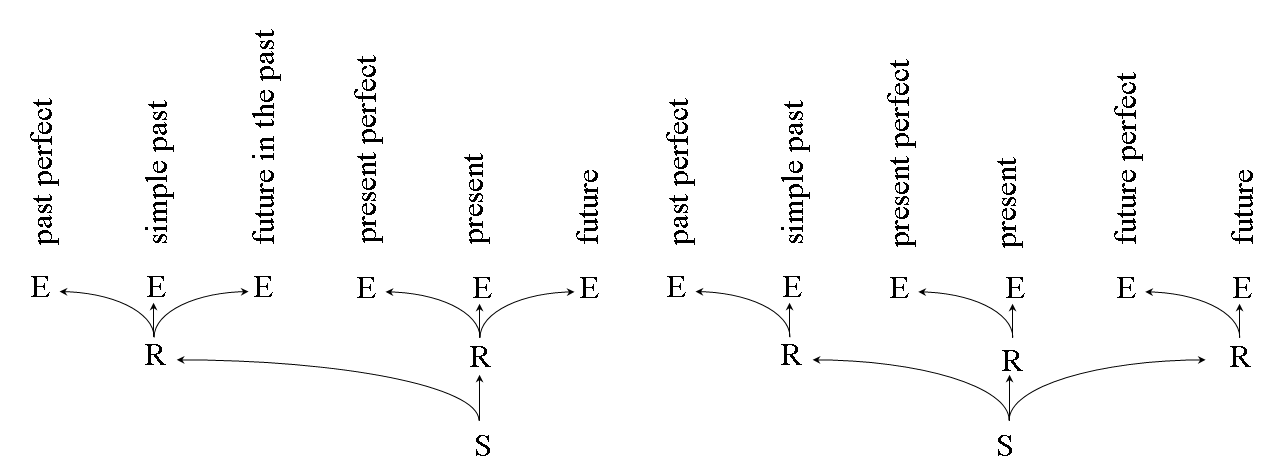
A third problem is that, at least in Dutch, the nine tenses defined in the Reichenbachian system cannot be derived compositionally. In the binary system, the three oppositions in (260) are nicely matched by specific morphological or lexical units: [±past] can be expressed in Dutch by the tense marking of the finite verb, [±perfect] by the auxiliary or past participle, and [±posterior] by the future auxiliary zullen (if this is indeed the correct analysis for Dutch). This does not seem to hold for the ternary oppositions in (305) postulated in the Reichenbachian approach; although there are designated morphological/syntactic means for expressing present/past (R,S and R—S), future (R—S) and perfect (E—R), it remains to be seen whether similar means can be identified for the simultaneity relation (R,E) and the posteriority relation (R—E). This becomes particularly clear for the posteriority relation if we place the nine tenses defined in Figure 17 in the matrix in Table 10 and try to match them with the tense forms actually found in Dutch. The problem is that the matrix seems to define two (posteriority) tenses too many; it remains to be established whether these tenses can actually be found in the languages of the world. The tense form that comes closest to the two gaps in Figure 17 is the one with the present-tense form of zullenwill, which shows that zal lopenwill walk should be considered three-way ambiguous in Reichenbach’s system, as indicated by the three cells within the bold lines in Table 10, which is taken in a slightly adapted form from Verkuyl (2008).
| past (R—S) | present (S,R) | future (S—R) | |
| anterior (E—R) | past perfect had gelopen ‘had walked’ | present perfect heeft gelopen ‘has walked’ | future perfect zal hebben gelopen ‘will have walked’ |
| simultaneous (R,E) | simple past liep ‘walked’ | simple present loopt ‘walks’ | future zal lopen ‘will walk’ |
| posterior (R—E) | future in past zou lopen ‘would walk’ | ??? zal lopen ‘will walk’ | ??? zal lopen ‘will walk’ |
Table 10 also shows that Reichenbach’s approach leads to the conclusion that the verb zullenwill expresses not only future (S—R) but also posteriority (R—E); cf. also Janssen (1983). This in turn predicts that the S—R—E relation should be expressed by two occurrences of zullen. The fact that *zal zullen wandelen (lit. will will walk) is excluded in Dutch thus supports the idea that the posteriority (R—E) relation is not part of the tense system.
The discussion above has shown that there are a number of serious empirical problems with Reichenbach’s tense system, all of which are related to the postulated posteriority (R—E) relation: (i) posteriority is incompatible with anteriority, and as a result the future perfect in the past cannot be derived; (ii) it is not clear how posteriority and future differ semantically; (iii) posteriority defines a number of future tenses the existence of which remains to be established. Since it seems impossible to solve these problems in a non-ad hoc way by replacing the posteriority relation by some other relation, we conclude that the binary tense system as described in Subsection I is superior to Reichenbach’s proposal. For a more detailed critical discussion of Reichenbach’s tense system on the basis of Dutch, we refer to Janssen (1983) and Verkuyl (2008/2022).
This section has discussed the tense system proposed in Te Winkel (1866), which distinguishes eight different tenses on the basis of the three binary oppositions in (306). We have argued that this system is superior to the Reichenbachian approach to the tense system.
| a. | [±past]: present versus past |
| b. | [±posterior]: future versus non-future |
| c. | [±perfect]: imperfect versus perfect |
Verkuyl (2008) referred to Te Winkel’s system as the binary tense system and claimed that this system is universally (i.e. in all languages) used for the cognitive representation of tense. This claim is not meant to imply that all oppositions are morphologically or syntactically encoded in the verbal systems of all languages; some languages may have a poor tense system in the sense that they lack the morphological or syntactic means to express one or more of the three oppositions in (306) in the verbal system and must therefore resort to other means like adverbial phrases, aspectual markers, or even pragmatic information to make the desired distinctions; cf. Verkuyl (2008: §6) for some examples.
Although we have illustrated the properties of the binary tense system with Dutch examples, this does not imply that Dutch really expresses all three oppositions in its verbal system (although Verkuyl 2008 assumes this to be the case without providing sufficient arguments). Section 1.5.2 will show that there are reasons to reject the generally accepted claim that the opposition [±posterior] in the Dutch verbal system is not overtly expressed by zullenwill: whatever the meaning of this verb may be, it is non-temporal in nature. Section 1.5.3 considers some issues related to the internal temporal organization of events (i.e. aspect) expressed by clauses. Section 1.5.4 will then continue with a more complete discussion of the Dutch verbal tense system.
