- Dutch
- Frisian
- Saterfrisian
- Afrikaans
-
- Syntax
- Preface and acknowledgements
- Verbs and Verb Phrases
- 1 Verbs: Characterization and classification
- 2 Projection of verb phrases I: Argument structure
- 3 Projection of verb phrases IIIa: Selected clauses/verb phrases (introduction)
- 1.0. Introduction
- 1.1. Main types of verb-frame alternation
- 1.2. Alternations involving the external argument
- 1.3. Alternations of noun phrases and PPs
- 1.4. Some apparent cases of verb-frame alternation
- 1.5. Bibliographical notes
- 4 Projection of verb phrases IIIa: Selected clauses/verb phrases (introduction)
- 4.0. Introduction
- 4.1. Semantic types of finite argument clauses
- 4.2. Finite and infinitival argument clauses
- 4.3. Control properties of verbs selecting an infinitival clause
- 4.4. Three main types of infinitival argument clauses
- 4.5. Non-main verbs
- 4.6. The distinction between main and non-main verbs
- 4.7. Bibliographical notes
- 5 Projection of verb phrases IIIb: Argument and complementive clauses
- 5.0. Introduction
- 5.1. Finite argument clauses
- 5.2. Infinitival argument clauses
- 5.3. Complementive clauses
- 5.4. Bibliographical notes
- 6 Projection of verb phrases IIIc: Complements of non-main verbs
- 7 Projection of verb phrases IIId: Verb clustering
- 8 Projection of verb phrases IV: Adverbial modification
- 9 Word order in the clause I: General introduction
- 10 Word order in the clause II: Position of the finite verb (verb-first/second)
- 11 Word order in the clause III:Clause-initial position (wh-movement)
- 11.0. Introduction
- 11.1. The formation of V1 and V2-clauses
- 11.2. Clause-initial position remains (phonetically) empty
- 11.3. Clause-initial position is filled
- 11.4. Bibliographical notes
- 12 Word order in the clause IV: Postverbal field (extraposition)
- 13 Word order in the clause V: Middle field (scrambling)
- Nouns and Noun Phrases
- 14 Characterization and classification
- 15 Projection of noun phrases I: Complementation
- 15.0. Introduction
- 15.1. General observations
- 15.2. Prepositional and nominal complements
- 15.3. Clausal complements
- 15.4. Bibliographical notes
- 16 Projection of noun phrases II: Modification
- 16.0. Introduction
- 16.1. Restrictive and non-restrictive modifiers
- 16.2. Premodification
- 16.3. Postmodification
- 16.3.1. Adpositional phrases
- 16.3.2. Relative clauses
- 16.3.3. Infinitival clauses
- 16.3.4. A special case: clauses referring to a proposition
- 16.3.5. Adjectival phrases
- 16.3.6. Adverbial postmodification
- 16.4. Bibliographical notes
- 17 Projection of noun phrases III: Binominal constructions
- 17.0. Introduction
- 17.1. Binominal constructions without a preposition
- 17.2. Binominal constructions with a preposition
- 17.3. Bibliographical notes
- 18 Determiners: Articles and pronouns
- 18.0. Introduction
- 18.1. Articles
- 18.2. Pronouns
- 18.3. Bibliographical notes
- 19 Numerals and quantifiers
- 19.0. Introduction
- 19.1. Numerals
- 19.2. Quantifiers
- 19.2.1. Introduction
- 19.2.2. Universal quantifiers: ieder/elk ‘every’ and alle ‘all’
- 19.2.3. Existential quantifiers: sommige ‘some’ and enkele ‘some’
- 19.2.4. Degree quantifiers: veel ‘many/much’ and weinig ‘few/little’
- 19.2.5. Modification of quantifiers
- 19.2.6. A note on the adverbial use of degree quantifiers
- 19.3. Quantitative er constructions
- 19.4. Partitive and pseudo-partitive constructions
- 19.5. Bibliographical notes
- 20 Predeterminers
- 20.0. Introduction
- 20.1. The universal quantifier al ‘all’ and its alternants
- 20.2. The predeterminer heel ‘all/whole’
- 20.3. A note on focus particles
- 20.4. Bibliographical notes
- 21 Syntactic uses of noun phrases
- 22 Referential dependencies (binding)
- Adjectives and Adjective Phrases
- 23 Characteristics and classification
- 24 Projection of adjective phrases I: Complementation
- 25 Projection of adjective phrases II: Modification
- 26 Projection of adjective phrases III: Comparison
- 27 Attributive use of the adjective phrase
- 28 Predicative use of the adjective phrase
- 29 The partitive genitive construction
- 30 Adverbial use of the adjective phrase
- 31 Participles and infinitives: their adjectival use
- Adpositions and adpositional phrases
- 32 Characteristics and classification
- 32.0. Introduction
- 32.1. Characterization of the category adposition
- 32.2. A syntactic classification of adpositional phrases
- 32.3. A semantic classification of adpositional phrases
- 32.4. Borderline cases
- 32.5. Bibliographical notes
- 33 Projection of adpositional phrases: Complementation
- 34 Projection of adpositional phrases: Modification
- 35 Syntactic uses of adpositional phrases
- 36 R-pronominalization and R-words
- 32 Characteristics and classification
- Coordination and Ellipsis
- Syntax
-
- General
-
- General
- Morphology
- Morphology
- 1 Word formation
- 1.1 Compounding
- 1.1.1 Compounds and their heads
- 1.1.2 Special types of compounds
- 1.1.2.1 Affixoids
- 1.1.2.2 Coordinative compounds
- 1.1.2.3 Synthetic compounds and complex pseudo-participles
- 1.1.2.4 Reduplicative compounds
- 1.1.2.5 Phrase-based compounds
- 1.1.2.6 Elative compounds
- 1.1.2.7 Exocentric compounds
- 1.1.2.8 Linking elements
- 1.1.2.9 Separable Complex Verbs and Particle Verbs
- 1.1.2.10 Noun Incorporation Verbs
- 1.1.2.11 Gapping
- 1.2 Derivation
- 1.3 Minor patterns of word formation
- 1.1 Compounding
- 2 Inflection
- 1 Word formation
- Morphology
- Syntax
- Adjectives and adjective phrases (APs)
- 0 Introduction to the AP
- 1 Characteristics and classification of APs
- 2 Complementation of APs
- 3 Modification and degree quantification of APs
- 4 Comparison by comparative, superlative and equative
- 5 Attribution of APs
- 6 Predication of APs
- 7 The partitive adjective construction
- 8 Adverbial use of APs
- 9 Participles and infinitives as APs
- Nouns and Noun Phrases (NPs)
- 0 Introduction to the NP
- 1 Characteristics and Classification of NPs
- 2 Complementation of NPs
- 3 Modification of NPs
- 3.1 Modification of NP by Determiners and APs
- 3.2 Modification of NP by PP
- 3.3 Modification of NP by adverbial clauses
- 3.4 Modification of NP by possessors
- 3.5 Modification of NP by relative clauses
- 3.6 Modification of NP in a cleft construction
- 3.7 Free relative clauses and selected interrogative clauses
- 4 Partitive noun constructions and constructions related to them
- 4.1 The referential partitive construction
- 4.2 The partitive construction of abstract quantity
- 4.3 The numerical partitive construction
- 4.4 The partitive interrogative construction
- 4.5 Adjectival, nominal and nominalised partitive quantifiers
- 4.6 Kind partitives
- 4.7 Partitive predication with a preposition
- 4.8 Bare nominal attribution
- 5 Articles and names
- 6 Pronouns
- 7 Quantifiers, determiners and predeterminers
- 8 Interrogative pronouns
- 9 R-pronouns and the indefinite expletive
- 10 Syntactic functions of Noun Phrases
- Adpositions and Adpositional Phrases (PPs)
- 0 Introduction to the PP
- 1 Characteristics and classification of PPs
- 2 Complementation of PPs
- 3 Modification of PPs
- 4 Bare (intransitive) adpositions
- 5 Predication of PPs
- 6 Form and distribution of adpositions with respect to staticity and construction type
- 7 Adpositional complements and adverbials
- Verbs and Verb Phrases (VPs)
- 0 Introduction to the VP in Saterland Frisian
- 1 Characteristics and classification of verbs
- 2 Unergative and unaccusative subjects and the auxiliary of the perfect
- 3 Evidentiality in relation to perception and epistemicity
- 4 Types of to-infinitival constituents
- 5 Predication
- 5.1 The auxiliary of being and its selection restrictions
- 5.2 The auxiliary of going and its selection restrictions
- 5.3 The auxiliary of continuation and its selection restrictions
- 5.4 The auxiliary of coming and its selection restrictions
- 5.5 Modal auxiliaries and their selection restrictions
- 5.6 Auxiliaries of body posture and aspect and their selection restrictions
- 5.7 Transitive verbs of predication
- 5.8 The auxiliary of doing used as a semantically empty finite auxiliary
- 5.9 Supplementive predication
- 6 The verbal paradigm, irregularity and suppletion
- 7 Verb Second and the word order in main and embedded clauses
- 8 Various aspects of clause structure
- Adjectives and adjective phrases (APs)
This section discusses topicalization, the phenomenon that in main clauses virtually any clausal constituent (and sometimes parts of them) can precede the finite verb in second position. Subsection I begins by showing that, as in question formation, the moved constituent can have a wide range of syntactic functions and can be of any category. Subsection II compares topicalization with question formation (as well as relativization) in order to motivate the claim that it is derived by wh-movement; we will see that, apart from the fact that topicalization is a root phenomenon, there are indeed compelling reasons to assume that wh-movement is involved in the derivation. Subsection III reiterates some arguments from Section 9.3 for rejecting the traditional view that subject-initial sentences are necessarily derived by topicalization; excluding such sentences from the set of topicalization constructions leads to the conclusion that topicalization constructions have two characteristic properties: they exhibit subject-verb inversion and have a non-neutral reading. Subsection IV explores the latter issue and will show that topicalized phrases often play a special role in discourse; they express a contrastive focus, act as a topic, or perform a special function in the organization of the discourse. Given this, we might expect, at least for contrastively focused phrases and topics, that wh-movement can pied-pipe a larger phrase when syntactic constraints prohibit extraction, and Subsection V shows that this expectation is indeed borne out. Subsection VI continues with a discussion of topicalization of clauses and smaller verbal projections: such cases are special because wh-movement of such constituents is not possible in the case of question formation and relativization. Subsection VII concludes with a comparison of topicalization in Dutch and English, and will show that there are a number of striking differences, raising the question of whether the two should be considered phenomena of the same kind.
- I. Syntactic function and categorial status of the topicalized element
- II. Topicalization is a subcase of wh-movement
- III. Subject-initial clauses versus topicalization constructions
- IV. Information structure: focus and topic
- V. Pied piping and stranding
- VI. Topicalization of verbal projections
- VII. Some final remarks on English and Dutch topicalization
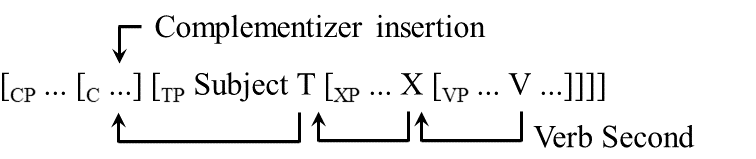
The traditional generative analysis holds that main clauses are derived by placing the finite verb in the second position of the clauses, the so-called C-position in (316), followed by topicalization of some constituent into the so-called clause-initial position, the specifier of CP; cf. Section 11.1 for details.
 |
There seem to be virtually no restrictions on the syntactic function or categorial status of the topicalized element. The examples in (317) begin by showing show this for nominal arguments: subjects, direct and indirect objects are all possible in main-clause initial position.
| a. | Marie/Ze | heeft | haar broer/hem | die baan | aangeboden. | subject | |
| Marie/she | has | her brother/him | that job | prt.-offered | |||
| 'Marie/She has offered her brother/him that job.' | |||||||
| b. | Die baan | heeft | ze | haar broer/hem | aangeboden. | direct object | |
| that job | has | she | her brother/him | prt.-offered | |||
| 'That job, she has offered [to] her brother/him.' | |||||||
| c. | Haar broer/Hem | heeft | ze | die baan | aangeboden. | indirect object | |
| her brother/him | has | she | that job | prt.-offered | |||
| 'Her brother/Him, she has offered that job.' | |||||||
However, there are two important differences between subject-initial sentences and sentences with an object in the first position. First, topicalized objects can be considered semantically marked in that they function as discourse topics or contrastive foci, or have some other special function in the organization of the discourse, whereas this is not necessarily the case for clause-initial subjects. Second, topicalized objects are often characterized by a special intonation pattern: the objects in (317b&c), but not the clause-initial subjects in (317a), must be accented, as indicated by the fact that the latter, but not the former, can be a reduced pronoun. This suggests that subject-initial sentences may also be syntactically different from constructions with topicalized objects; we will return to this issue in Subsection III.
Next, the examples in (318) show that it is also possible to topicalize prepositional objects: (318a) illustrates this for a prepositional indirect object and (318b) for the prepositional object of kijken (naar)to look (at).
| a. | Aan haar broer/Hem | heeft | ze | die baan | aangeboden. | indirect object | |
| to her brother/him | has | she | that job | prt.-offered | |||
| 'Her brother/him, she has offered that job to.' | |||||||
| b. | Naar dat huis | staat | Jan al | een uur te kijken. | prepositional object | |
| at that house | stands | Jan already | an hour to look | |||
| 'That house, Jan has been staring at for an hour.' | ||||||
Complementives can also be topicalized: we illustrate this in (319) with three examples involving complementives of a different categorial status; they show that noun phrases, APs, and PPs can all be topicalized.
| a. | Een liefhebber van Jazz | ben | ik | niet | echt. | nominal | |
| a devotee of jazz | am | I | not | really | |||
| 'A devotee of jazz, I am not really.' | |||||||
| b. | Aardig | is de nieuwe directeur | beslist. | adjectival | |
| nice | is the new director | definitely | |||
| 'Nice, the new director definitely is.' | |||||
| c. | In de la | heb | ik | de schaar | gelegd. | adpositional | |
| in the drawer | have | I | the scissors | put | |||
| 'In the drawer, I have put the scissors.' | |||||||
Adjuncts can also be topicalized. Example (320a) shows this for supplementives and examples (320b&c) for adverbial phrases. Note that we have not marked the adverbial phrases for accent; assigning accent is possible, but does not seem necessary; cf. Subsection IV for further discussion.
| a. | Kwaad | liep | hij | weg. | supplementive | |
| angry | walked | he | away | |||
| 'Angry, he walked away.' | ||||||
| b. | Op zolder | slapen | de kinderen. | place adverbial | |
| on attic | sleep | the children | |||
| 'In the attic, the children sleep/are sleeping.' | |||||
| c. | Na de vergadering | vertrekken | we. | time adverbial | |
| after the meeting | leave | we | |||
| 'After the meeting, we will leave.' | |||||
The discussion above has shown that topicalization is similar to wh-question formation in that constituents with different syntactic functions (argument, complementive and adjunct) and of various different forms (noun phrase, AP, and PP) can be moved into main-clause initial position. Topicalization differs from wh-movement, however, in that it also allows preposing of clauses, as shown in (321) for a finite clause; cf. also Subsection VI below. Accents can be placed at different positions within the preposed clause.
| a. | Ik | verwacht | niet | [dat | hij | dat boek | wil | hebben]. | |
| I | expect | not | that | he | that book | wants | have | ||
| 'I do not expect that he wants to have that book.' | |||||||||
| b. | [Dat hij dat boek wil hebben] verwacht ik niet. |
The examples in (322) show that it is also possible to topicalize the verbal complement of perfect and passive auxiliaries, a phenomenon known as VP-topicalization. The (a)-examples show that topicalization of the participle is possible both with and without the direct object; accent is usually assigned to the object when it is pied-piped by VP-topicalization. The (b)-examples show that subjects are usually not affected. VP-topicalization is discussed further in Subsection VI.
| a. | Ze | hebben | mijn huis | nog | niet | geschilderd. | perfect | |
| they | have | my house | yet | not | painted | |||
| 'They have not painted my house yet.' | ||||||||
| a'. | [<Mijn huis> geschilderd] hebben ze <mijn huis> nog niet. |
| b. | Mijn huis | wordt | volgend jaar | geschilderd. | passive | |
| my house | be | next year | painted | |||
| 'My house will be painted next year.' | ||||||
| b'. | Geschilderd wordt mijn huis volgend jaar. |
Topicalization involves the movement of a constituent into the initial position of the main clause. It is similar to the formation of wh-questions in that the movement targets the position immediately preceding the finite verb; this is again illustrated in the (b)-examples in (323). This observation is not trivial, since it does not hold for a language such as English; cf. Subsection VII.
| a. | Jan | heeft | gisteren | dat boek | gelezen. | |
| Jan | has | yesterday | that book | read | ||
| 'Jan read that book yesterday.' | ||||||
| b. | Welk boeki | heeft | Jan gisteren ti | gelezen? | wh-question | |
| which book | has | Jan yesterday | read | |||
| 'Which book did Jan read yesterday?' | ||||||
| b'. | Dat boeki | heeft | Jan gisteren ti | gelezen. | topicalization | |
| that book | has | Jan yesterday | read | |||
| 'That book, Jan read yesterday.' | ||||||
The (b)-examples in (324) show that topicalization differs from question formation (and relativization) in that it is a root phenomenon. It cannot occur in embedded clauses.
| a. | Marie zei | [dat | Jan | dat boek | gelezen | heeft]. | |
| Marie said | that | Jan | that book | read | has | ||
| 'Marie said that Jan has read that book.' | |||||||
| b. | Marie vroeg | [welk boeki | Jan ti | gelezen | heeft]. | wh-question | |
| Marie asked | which book | Jan | read | has | |||
| 'Marie asked which book Jan has read.' | |||||||
| b'. | * | Marie zei | [dat boeki | Jan ti | gelezen | heeft]. | topicalization |
| Marie said | that book | Jan | read | has |
There is no way to improve embedded topicalization in example (324b'). For instance, the examples in (325) show that Dutch does not have the possibility found in German to have topicalization in embedded clauses with verb-second, because embedded verb-second is categorically forbidden in Dutch; cf. Haider (1985/2010) and Barbiers (2008: §1.3.1.8) for a discussion of embedded verb-second in German and a number of non-standard varieties of Dutch, respectively; the German example in (325a) is taken from Müller (1998:42) in a slightly adapted form.
| a. | Marie | sagte | [dieses Buchi | habeconjunctive | sie ti | bereits | gelesen]. | German | |
| Marie | said | this book | has | she | already | read | |||
| 'Marie said that this book, she had already read.' | |||||||||
| b. | * | Marie | zei | [dit boeki | had | ze ti | al | gelezen]. | Dutch |
| Marie | said | this book | had | she | already | read |
The (b)-examples in (326) show that embedded topicalization is also impossible with a phonetically expressed complementizer, in contrast to English examples such as (326a); cf. Chomsky (1977), Baltin (1982), and Lasnik & Saito (1992). Since there is no a priori reason to think that Dutch topicalization targets a different position than English topicalization, we have added (326b') to show that the result is also unacceptable when the complementizer precedes the topicalized phrase.
| a. | Marie thinks [that this booki you should read ti ]. | English |
| b. | * | Marie denkt | [dit boeki | dat | je | zou ti | moeten | lezen]. | Dutch |
| Marie thinks | this book | that | you | would | must | read |
| b'. | * | Marie denkt | [dat | dit boeki | je ti | zou | moeten | lezen]. | Dutch |
| Marie thinks | that | this book | you | would | must | read |
Examples (327a&b) show that topicalization is like question formation in that it allows long wh-movement when a bridge verb such as denkento think is present. Note, however, that long topicalization is like relativization in that it is possible with a wider range of verbs than question formation; cf. Schippers (2012:105). For example, the factive verb wetento know allows long topicalization (and long relativization), but not long wh-movement. The question mark between brackets is used to indicate that some speakers prefer the resumptive prolepsis construction in (327c) to the long topicalization construction in (327b).
| a. | Welk boeki | denk/*weet | je | [dat | Jan ti | gekocht | heeft]? | wh-question | |
| which book | think/know | you | that | Jan | bought | has | |||
| 'Which book do you think that Jan has bought?' | |||||||||
| b. | (?) | Dit boeki | denk/weet | ik | [dat | Jan ti | gekocht | heeft]. | topicalization |
| this book | think/know | I | that | Jan | bought | has | |||
| 'This book I think/know that Jan has bought.' | |||||||||
| c. | Van dit boeki | denk/weet | ik | [dat | Jan heti | gekocht | heeft]. | prolepsis | |
| of this book | think/know | I | that | Jan it | bought | has | |||
| 'As for this book, I think/know that Jan has bought it.' | |||||||||
That topicalization involves wh-movement is also suggested by the fact that it is like question formation and relativization in that it is island-sensitive. We illustrate this in (328b) with an embedded polar question. We have also added (328b') to show that the intended meaning can be expressed by a resumptive prolepsis construction.
| a. | Ik | vraag | me | af | [of | Jan dat boek | gekocht | heeft]? | |
| I | wonder | refl | prt. | if | Jan that book | bought | has | ||
| 'I wonder whether Jan has bought that book.' | |||||||||
| b. | * | Dat boeki | vraag | ik | me | af | [of | Jan ti | gekocht | heeft]? |
| that book | wonder | I | refl | prt. | if | Jan | bought | has |
| b'. | Van dat boeki | vraag | ik | me | af | [of | Jan heti | gekocht | heeft]? | |
| of that book | wonder | I | refl | prt. | if | Jan it | bought | has | ||
| 'As for this book, I am wondering whether Jan has bought it.' | ||||||||||
Example (329b) illustrates the island sensitivity of topicalization by means of an adjunct island. In this case, the resumptive prolepsis construction is not available as an alternative because the verb huilento cry does not license a resumptive van-PP.
| a. | Jan huilt | [omdat | Marie dat boek | gestolen | heeft]. | |
| Jan cries | because | Marie that book | stolen | has | ||
| 'Jan is crying because Marie has stolen that book.' | ||||||
| b. | * | Dat boeki | huilt Jan [omdat | Marie ti | gestolen | heeft]. |
| that book | cries Jan because | Marie | stolen | has |
This subsection has shown that topicalization has several features in common with wh-movement: it targets the clause-initial position, it can be extracted from clauses selected by bridge verbs, and it is island-sensitive. What sets it apart from wh-movement and relativization is that it is a root phenomenon; it cannot target the initial position of embedded clauses. We refer to Hoekstra & Zwart (1994), Sturm (1996) and Zwart & Hoekstra (1997) for a discussion of whether this shows that topicalization targets a different position than wh-movement, as the cartographic approach initiated in Rizzi (1997) would claim.
The standard view in generative grammar is that topicalization is responsible for verb-second in declarative main clauses in Dutch. The verb is first moved into the C-position immediately preceding the canonical subject position, after which the specifier position of CP is filled by some topicalized phrase. This implies that subject-initial main clauses such as (330a) can only be derived by topicalization, as in (330b).
| a. | Mijn zuster/Zij/Ze | heeft | dit boek | gelezen. | subject | |
| my sister/she/she | has | this book | read | |||
| 'My sister/she has read this book.' | ||||||
| b. |  |
If the derivation in (330) is correct, we would expect the placement of subjects to be subject to similar restrictions as in other cases of topicalization, as in (331). However, we have seen in Subsection I that subjects differ crucially from objects in that they do not need to be accented. The effect is even more striking with weak (phonetically reduced) pronouns; while (330a) shows that the weak subject pronoun zeshe is perfectly acceptable in main-clause initial position, weak object pronouns such as ʼrher in (331a&b) are not, because they cannot be accented; cf. Bouma (2008:34) for further discussion. Adverbial PPs with a weak pronominal complement can be topicalized, but only if the preposition can be accented; cf. Salverda (2000).
| a. | Mijn zuster/Haar/*ʼr | heb | ik | nog niet | gezien. | direct object | |
| my sister/her/her | have | I | yet not | seen | |||
| 'My sister/her I have not seen yet.' | |||||||
| b. | Op mijn zuster/haar/*ʼr | wil ik niet wachten. | PP-complement | |
| for my sister/her/her | want I not wait | |||
| 'My sister/Her I do not want to wait for.' | ||||
| c. | Naast ʼr | zat | een aardige heer. | adverbial PP | |
| next.to her | sat | a kind gentleman | |||
| 'Next to her sat a kind gentleman.' | |||||
A similar contrast is found with the weak R-word er: the examples in (332) show that the expletive er, which is normally assumed to occupy the regular subject position, can easily occur in main-clause initial position, whereas this is excluded for er functioning as locative proform or the pronominal part of a PP; topicalization is only possible with strong R-words like daarthere and hierhere; cf. Bouma (2008:29-30). Note that we have ignored here that things are somewhat complicated by the fact that (sentence-initial) er can sometimes have more than one syntactic function; we refer the reader to Section P36.5.3 for discussion and examples.
| a. | Er | spelen | veel kinderen | op straat. | expletive er | |
| there | play | many children | on street | |||
| 'There are many children playing in the street.' | ||||||
| b. | Daar/*Er | spelen | de kinderen | graag. | locative er | |
| there/there | play | the children | gladly | |||
| 'The children like to play there.' | ||||||
| c. | Daari/*Eri | wacht | ik | niet [ ti | op]. | pronominal part of PP | |
| there/there | wait | I | not | for | |||
| 'I will not wait for that.' | |||||||
That this contrast should have an impact on our syntactic analysis is clear from the fact, illustrated in (333), that subject pronouns exhibit a behavior similar to that of object pronouns when extracted from an embedded clause: while noun phrases such as mijn zustermy sister and strong (phonetically non-reduced) subject pronouns such as zij give a reasonably acceptable result, this kind of long wh-movement is excluded when the subject pronoun is weak.
| a. | (?) | Mijn zusteri/Ziji | zei | Jan | [dat ti | dit boek | gelezen | had]. |
| my sister/she | said | Jan | comp | this book | read | had | ||
| 'My sister/she, Jan said had read the book.' | ||||||||
| b. | * | Zei | zei | Jan [dat ti | dit boek | gelezen | had]. |
| she | said | Jan comp | this book | read | had |
Section 9.3 concluded from this that regular subject-initial constructions do not involve topicalization, but are derived by simply placing the subject in the regular subject position, the specifier of the T(ense) head. This led to the derivations of subject-initial clauses and topicalization constructions in (334); cf. Travis (1984) and Zwart (1992/1997). Note that these analyses suggest that subject-verb inversion is a defining feature of topicalization constructions; cf. Salverda (1982/2000).
| a. | Subject-initial sentences (revised version): |
 |
| b. | Topicalization constructions: |
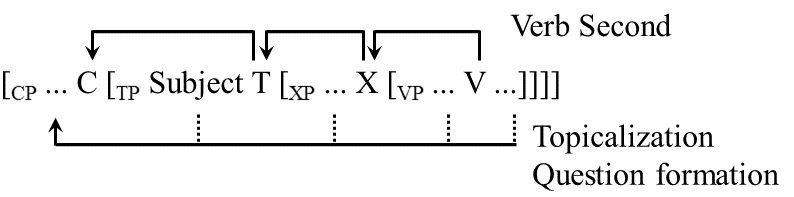 |
Note that we are not claiming here that subjects cannot be topicalized, but only that they are not topicalized when they occur in a neutrally pronounced sentence. Examples like (335a) with a contrastive accent on the subject may well involve topicalization. That they indeed do is strongly suggested by expletive constructions like (335b); since it is usually assumed that the expletive erthere occupies the regular subject position, the subject niemand can only occur in sentence-initial position as a result of topicalization. Note that we have added the locational adverbial phrase op de vergadering to example (335b) in order to block a locative interpretation of erthere and to ensure that er indeed functions as an expletive.
| a. | Mijn zuster | heeft | dit boek | gelezen. | |
| my sister | has | this book | read | ||
| 'My sister/she has read this book.' | |||||
| b. | Niemand | was er | op de vergadering. | |
| nobody | was there | at the meeting | ||
| 'Nobody was there at the meeting.' | ||||
The analyses suggested in (334) are interesting in view of the fact that subject-initial clauses are the most neutral form of an utterance from a semantic point of view: while topicalized phrases are special in that they play a specific role in structuring the discourse, sentence-initial subjects are often neutral in this respect. The representations in (334) thus allow us to formally express this by postulating that topicalization is like question formation and relativization in that it is semantically motivated; cf. Dik (1978: §8.3.3), Haegeman (1995), Rizzi (1997), and many others. This will be the main topic of Subsection IV.
The information structure of a clause is closely related to its intonation pattern. Utterances like the (b)-examples in (336) can only present new information, e.g. if they are used as an answer to the question in (336a). If so, the main accent (indicated by small caps) is at the end of the clause, usually on the constituent preceding the clause-final verbs. We will call utterances with this intonation pattern neutral clauses. Note that for the sake of simplicity we will only discuss main clauses.
| a. | Wat | is er | gebeurd? | |
| what | is there | happened | ||
| 'What has happened?' | ||||
| b. | Jan heeft | Marie | een brief | gestuurd. | |
| Jan has | Marie | a letter | sent | ||
| 'Jan has sent Marie a letter.' | |||||
| b'. | Jan heeft | een brief | naar Marie | gestuurd. | |
| Jan has | a letter | to Marie | sent | ||
| 'Jan has sent a letter to Marie.' | |||||
The examples in (337) show that the intonation pattern of utterances can be affected by changing the information structure of the clause. The primed examples contain both presupposed and new information when used as answers to the questions in the primeless examples, and the main accent must be located in the new information of the clause (i.e. the new-information focus). In the cases at hand, this results in the placement of the main accent in a more leftward position; cf. Section 13.1, sub III, for more information on the placement of the main accent in clauses.
| a. | Wie heeft | Jan | een brief | gestuurd? | question | |
| who has | Jan | a letter | sent | |||
| 'Who has Jan sent a letter?' | ||||||
| a'. | Hij heeft | Marie | een brief | gestuurd. | answer | |
| Jan has | Marie | a letter | sent | |||
| 'He has sent Marie a letter.' | ||||||
| b. | Wat | heeft | Jan | naar Marie | gestuurd? | question | |
| what | has | Jan | to Marie | sent | |||
| 'What has Jan sent to Marie?' | |||||||
| b'. | Hij heeft | een brief | naar Marie | gestuurd. | answer | |
| Jan has | a letter | to Marie | sent | |||
| 'Jan has sent a letter to Marie.' | ||||||
The following subsections will show that topicalization can also affect the intonation pattern of utterances; we will see that the way in which the intonation pattern is affected depends on the effect of topicalization on the information structure of the clause. There are also a number of cases in which topicalization does not seem to have such a large effect on the intonation of the clause; we will discuss some of the prototypical cases. Before we begin, we should note that the literature shows a great deal of variation when it comes to information-structural notions like focus and topic; cf. Erteschik-Shir (2007) for a comprehensive review. We aim to stay close to the use of these notions in É. Kiss’ (2002: §1-6) description of the Hungarian clause, where these notions play a prominent role.
The new-information focus can be placed in the sentence-initial position as a result of topicalization. Thus, in addition to the responses in the primed examples in (337), we also find utterances like (338a&b). The parentheses indicate that the presuppositional part of such responses is usually omitted; cf. Section 5.1.5.
| a. | Marie | (heeft | hij | een brief | gestuurd). | answer to (337a) | |
| Marie | has | he | a letter | sent | |||
| 'Marie, he has sent a letter.' | |||||||
| b. | Een brief | (heeft | hij | naar Marie | gestuurd). | answer to (337b) | |
| a letter | has | he | to Marie | sent | |||
| 'A letter, he has sent to Marie.' | |||||||
Jansen (1981: §4.2.1) claims that focus topicalization of the type in (338) is not very common (in non-interrogative contexts), which raises the question of whether we are simply dealing with new-information focus or whether utterances such as (338) have some additional property. We tend to think that the accents in these topicalization constructions are stronger than those in the primed examples in (337), which may suggest that topicalization constructions express contrastive or restrictive focus in the sense that the proposition holds for the focused phrases to the exclusion of any other referent; cf. Section 13.3.2 for further discussion. This would be consistent with the fact that utterance (338a) expresses that in the relevant domain of discourse only Marie was sent a book by Jan: if it turns out that Jan also sent a letter to Peter and that the speaker of (338a) was aware of this, he could be accused of not being fully informative by withholding information. The same would apply to utterance (338b) if it turns out that Jan also sent cocaine to Marie.
That we are dealing with restrictive focus is also supported by the fact that it is often impossible to topicalize non-specific indefinite noun phrases, since these are typically used to introduce new information, but cannot easily be used in a contrastive or restrictive way. For instance, example (339a') shows that topicalization of the existential pronoun iemand leads to a highly marked result, and (339b') shows that topicalization of an indefinite noun phrase such as een pianist is limited to cases in which the speaker contradicts a certain presupposition on the part of the addressee: it could then be used as a correction to the question Hoe was je ontmoeting met die cellist gisteren?How was your meeting with that cellist yesterday? before answering the how-part of the question.
| a. | Ik | heb | gisteren | iemand | ontmoet. | |
| I | have | yesterday | someone | met | ||
| 'I met someone yesterday.' | ||||||
| a'. | ?? | Iemand heb ik gisteren ontmoet. |
| b. | Ik | heb | gisteren | een pianist | ontmoet. | |
| I | have | yesterday | a pianist | met | ||
| 'I met a pianist yesterday.' | ||||||
| b'. | # | Een pianist heb ik gisteren ontmoet. |
The negative pronoun niemandnobody, on the other hand, can be topicalized in constructions such as (340a) when the speaker wants to express that he expected to meet at least one person from the given domain of discourse in Amsterdam. Similarly, example (340b) expresses that the speaker did not expect to be able to meet all persons from the given domain of discourse in Amsterdam.
| a. | Niemand | heb | ik | in Amsterdam gezien | (zelfs | Jan | niet). | |
| nobody | have | I | in Amsterdam seen | even | Jan | not | ||
| 'Nobody, I have seen in Amsterdam (not even Jan).' | ||||||||
| b. | Iedereen | heb | ik | in Amsterdam | kunnen | ontmoeten | (zelfs | marie). | |
| everybody | have | I | in Amsterdam | can | meet | even | Marie | ||
| 'Everyone, I have been able to meet in Amsterdam (even Marie).' | |||||||||
Another indication that we are not dealing with a mere new-information focus is that the topicalized phrase can be preceded by an (emphatic) focus particle like zelfseven, alleensolely, slechts/maaronly: cf. Barbiers (1995a: §3).
| a. | Zelfs Marie | heeft | hij | een brief | gestuurd. | |
| even Marie | has | he | a letter | sent | ||
| 'He has even sent Marie a letter.' | ||||||
| b. | Alleen Marie | heeft | hij | een brief | gestuurd. | |
| only Marie | has | he | a letter | sent | ||
| 'Only Marie he has sent a letter.' | ||||||
| c. | Slechts twee studenten | haalden | het examen. | |
| only two students | passed | the exam | ||
| 'Only two students passed the exam.' | ||||
In the absence of more detailed information on the question of whether topicalized focus phrases indeed necessarily express more than just new information, we leave the issue for future research.
The sentence-initial position is typically occupied by an aboutness topic, a phrase referring to an entity about which the sentence as a whole provides more information. Although the three examples in (342) express the same propositions, they provide additional information about completely different topics: in (342a) the topic is the subject Jan, in (342b) the topic is the direct object de briefthe letter, and in (342c) the topic is the noun phrase Marie embedded in the complementive naar-PP. Note that the comments in (342) typically contain new information and thus also contain sentence accent (which is again placed on the constituent preceding the clause-final verbs when the whole comment consists of new information).
| a. | [topic | Jan] [comment | heeft | de brief | naar Marie | gestuurd].’ | |
| [topic | Jan | has | the letter | to Marie | sent | ||
| 'Jan has sent the letter to Marie.' | |||||||
| b. | [topic | De brief] [comment | heeft | Jan naar Marie | gestuurd]. | |
| [topic | the letter | has | Jan to Marie | sent | ||
| 'The letter, Jan has sent to Marie.' | ||||||
| c. | [topic | Naar Marie] [comment | heeft Jan de brief gestuurd]. | |
| [topic | to Marie | has Jan the letter sent | ||
| 'To Marie, Jan has sent the letter.' | ||||
The new information in (342) is provided by an argument, but the examples in (343) show that it can also be an adverbial element that can be used contrastively, such as the negative adverb niet, which can be contrasted with the affirmative marker wel, or adverbs such as morgentomorrow, which can be contrasted with adverbs like vandaagtoday or nunow. For further examples, see Salverda (2000:100-1).
| a. | Peter | heb | ik | nog niet | gezien. | |
| Peter | have | I | not yet | seen | ||
| 'Peter, I have not seen yet.' | ||||||
| b. | Het boek | moet | je | morgen | maar | lezen. | |
| the book | must | you | tomorrow | prt | read | ||
| 'The book, you should read tomorrow.' | |||||||
The aboutness topic is always part of the discourse domain, which means that it must satisfy certain criteria: (i) it must be referential, in that it refers to an entity or set of entities, and (ii) it must be specific, in that the entity or set of entities must be identifiable in the discourse domain. This implies that the aboutness topic is prototypically a proper noun, a referential personal pronoun, a definite noun phrase, a specific indefinite noun phrase, or a PP containing such a noun phrase; cf. É. Kiss (2002: §2).
Contrastive topics differ from aboutness topics in that they need not be referential or specific; the examples in (344) show that they can be non-individual-denoting elements like bare plurals, indefinite noun phrases, adverbial phrases and verbal particles; examples like (344a&b) are of course also possible with definite noun phrases (de zwaan/zwanenthe swan/swans), but this is not illustrated here. Contrastive topics are accented and followed by a brief fall in intonation on the following comment, resulting in a typical “hat” contour marked by the symbols “/” and “\”. Contrastive topic constructions convey that there is an alternative topic for which an alternative comment is valid (É. Kiss 2002: §2.7); we have made this explicit in the examples in (344) by adding the part in brackets.
| a. | [topic | /Zwanen] [comment | \heb | ik | niet | gezien] | (maar | ganzen | wel). | |
| [topic | swans | have | I | not | seen | but | geese | aff | ||
| 'I have not seen swans, but I did see geese.' | ||||||||||
| b. | [topic | /Een zwaan] [comment | \heb | ik | niet | gezien] | (maar | wel | een gans). | |
| [topic | a swan | have | I | not | seen | but | aff | a goose | ||
| 'I have not seen a swan, but I did see a goose.' | ||||||||||
| c. | [topic | /Omhoog] [comment | \ga ik | met de lift] | (maar | omlaag | via de trap). | |
| [topic | up | go I | by the elevator | but | down | via the stairs | ||
| 'Up I will use the elevator, but down I will take the stairs.' | ||||||||
| d. | [topic | /Tegen] [comment | \stemden | de socialisten] | (voor | de liberalen). | |
| [topic | against | voted | the socialists | for | the liberals | ||
| 'The conservatives voted against (the bill), the liberals for.' | |||||||
The intonation pattern found in utterances such as (344) is also possible with topicalized individual-denoting elements, like the topics in (342); applying the “hat” contour to these examples leads to contrastive readings similar to those in (344). Note that Subsection F will return to examples with a particle verb, such as (344d); for a more detailed discussion of contrastive topics, see Section 13.3.2, sub II.
The distal demonstrative pronouns diethat and datthat are very common in sentence-initial position. These pronouns are used to refer to a referent in the immediately preceding context, as in example (345). We have added indices to indicate the intended interpretation of the pronoun. Topicalized demonstratives differ from the topicalized phrases discussed so far in that they need not have a contrastive accent; cf. Salverda (1982/2000) and Bouma (2008:45).
| a. | Heb | je | Jani | gezien? | Nee, | diei | is | ziek. | |
| have | you | Jan | seen | no | dem | is | ill | ||
| 'Did you see Jan? No, he is ill.' | |||||||||
The demonstrative can be accented, in which case it receives a contrastive/restrictive focus interpretation. If it remains unstressed, it typically indicates a topic shift, i.e. a change in the aboutness topic. In this respect, distal demonstratives differ crucially from referential personal pronouns like hijhe or zijshe, which typically refer to active topics. This is illustrated in the examples in (346); that the distal demonstrative brings about a topic shift is clear from the fact that it cannot refer to the subject (the default topic) of the preceding sentence; referential pronouns are not subject to this restriction. We will not digress on topic shift here, but refer the reader to Section N18.2.3.2, sub II, for a more detailed discussion.
| a. | [Jani | ontmoette | Elsj ] | en | [hiji/*diei | vertelde | haarj | dat ... ] | |
| Jan | met | Els | and | he/dem | told | her | that |
| b. | [Jani | ontmoette | Elsj ] | en | [zej/diej | vertelde | hemi | dat ... ] | |
| Jan | met | Els | and | she/ dem | told | him | that |
Note also that distal demonstrative proforms like diethat and datthat in main-clause initial position are often omitted in speech; cf. Section 11.2.2 for a discussion.
The previous subsection has shown that unstressed demonstratives can be used to indicate a topic shift and are therefore quite important for a smooth continuation of the discourse. Other topicalized elements with a similar function are connectives like daarom/dustherefore and desondanksnevertheless in (347), which are neither topical nor focal in nature, but are used to indicate the relationship between two successive sentences; cf. Salverda (1982).
| a. | [Marie is ziek] | en | [daarom | kan | ik | niet | komen]. | |
| Marie is ill | and | therefore | can | I | not | come | ||
| 'Marie is ill and therefore I cannot come.' | ||||||||
| b. | [Marie is ziek] | maar | [desondanks | zal | ik | komen]. | |
| Marie is ill | but | nevertheless | will | I | come | ||
| 'Marie is ill, but I will come nevertheless.' | |||||||
This subsection discusses examples such as (344d) in Subsection C, repeated in (348), in more detail. Such examples refute the persistent claim that verbal particles cannot be topicalized (Zwart 2011:72). This is possible, however, provided that they stand in opposition to another verbal particle and thus allow a contrastive interpretation; cf. Hoeksema (1991a) and Haeseryn et al. (1997:1290ff.).
| Tegen | stemden | de socialisten | (voor | de liberalen). | ||
| against | voted | the socialists | for | the liberals | ||
| 'The conservatives voted against (the bill), the liberals for.' | ||||||
It has also been argued that topicalization of verbal particles is possible with particle verbs that are semantically transparent in the sense that the particle has a distinct meaning contribution of its own; this is shown by the acceptability contrast between the examples with the verb over hebben in (349), adapted from Haeseryn et al. (1997), The acceptability contrast is confirmed by the sentence judgment task reported by Foolen & Schoenmakers (2022).
| a. | * | Over | heeft | hij | nooit | iets | voor een ander. | idiomatic |
| over | has | he | never | anything | for one other | |||
| 'He wouldn't do anything for someone else.' | ||||||||
| b. | Over | hebben we nog vijf schroeven en zes spijkers. | transparent | |
| over | have we still five screws and six nails | |||
| 'We have five screws and six nails left over.' | ||||
The acceptability contrast indicates that the status of the particle in the two constructions may be quite different; while we are clearly dealing with a partially lexicalized P+V collocation in (349a), the intransitive adposition in (349b) seems to express a meaning of its own, which we also find in copular constructions such as Deze spijkers and schroeven zijn overThese screws and nails are left over. For this reason, however, it seems reasonable to consider over hebben in (349b) not as a particle verb, but as a verb taking a regular intransitive PP used as a complementive; since complementives can be contrastively focused, we correctly predict that they can occur in clause-initial position; cf. Section P35.2.1 and also Foolen & Schoenmakers (2022: §4.1).
Haeseryn et al. (1997:1290) also notes that there is a tendency for the (presumed) particle verb to stay together . Consider the examples in (350) and (351); the numbers between brackets indicate the relative rating of the four construction types in the results of Foolen & Schoenmakers’ (2022) sentence judgment task, where 1 is the highest rating and 4 is the lowest; the diacritics preceding the examples are intended to reflect the judgments found in the existing linguistic literature on comparable cases.
| a. | Zijn klasgenoten | hebben | hem | jarenlang | toegetakeld. | 1 | |
| his classmates | have | him | for.years | prt.-beat | |||
| 'His classmates beat him up for years.' | |||||||
| b. | Toegetakeld hebben zijn klasgenoten hem jarenlang. | 2 |
| c. | * | Toe hebben zijn klasgenoten hem jarenlang getakeld. | 4 |
| d. | *? | Toe | takelden | zijn klasgenoten | hem | jarenlang. | 3 |
| prt. | beat | his classmates | him | for.years |
| a. | Ze | hebben | hun schoenen | echt | net | aan | gedaan. | 1 | |
| they | had | their shoes | really | just | on | put | |||
| 'They really just put their shoes on.' | |||||||||
| b. | Aangedaan hebben ze hun schoenen echt net. | 3 |
| c. | Aan hebben ze hun schoenen echt net gedaan. | 4 |
| d. | Aan | deden | ze | hun schoenen | echt | net. | 2 | |
| on | did | they | their shoes | really | not |
The ordening or the ratings in (350) and (351) is based on the plot in Figure 1, taken from the article; the difference in the order of the ratings is not discussed in the article. The (a)-examples are just the reference sentences in their unmarked order, so we will focus on the ratings of the remaining examples derived by topicalization.
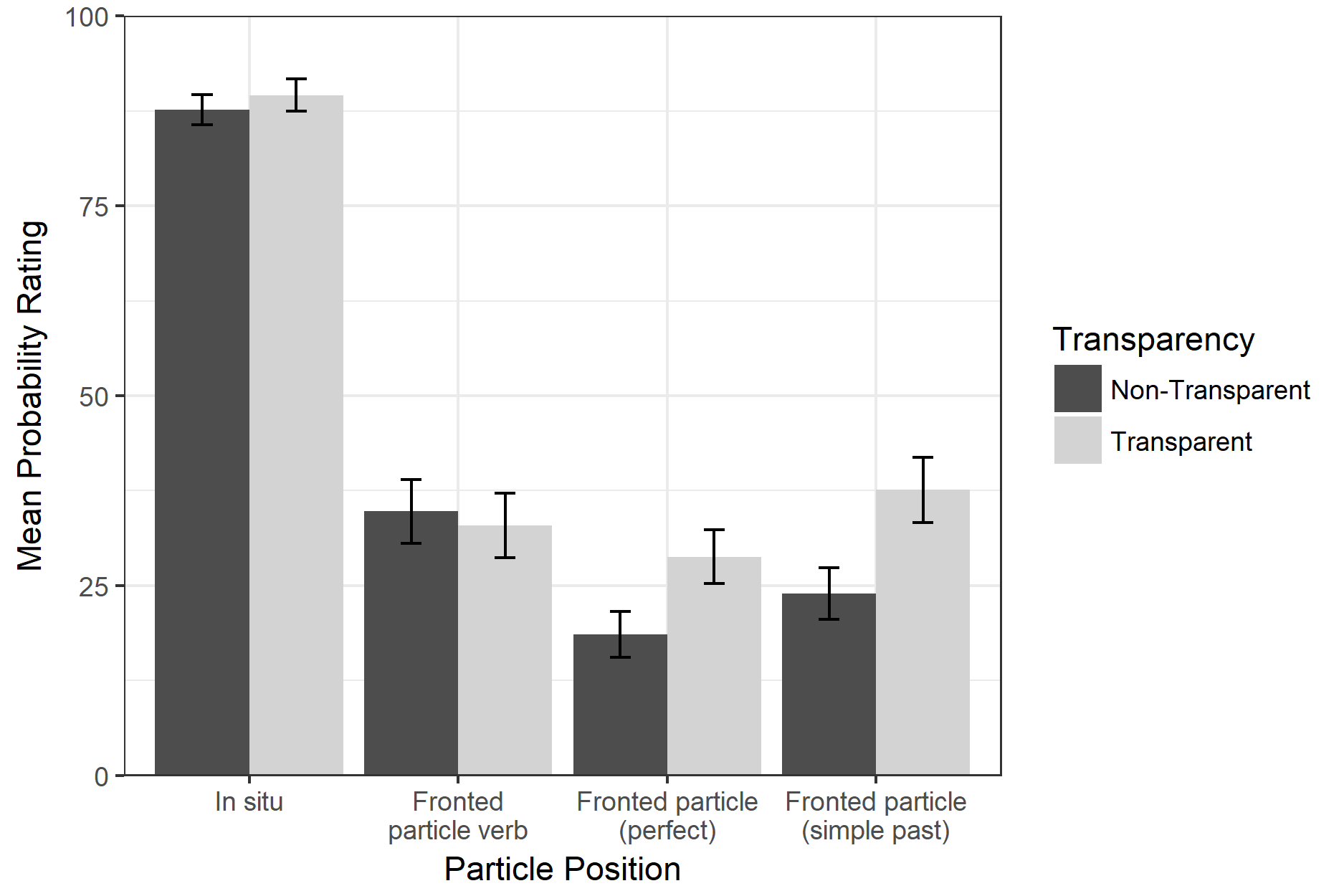
What we are particularly interested in is the status of particle fronting in the two sets: in the non-transparent cases, particle fronting receives a significantly lower rating than fronting of the particle verb as a whole; in the transparent cases, on the other hand, particle fronting receives a more or less similar rating as fronting of the particle verb as a whole. This is consistent with earlier claims in the linguistic literature that particle fronting is much more difficult in the case of non-transparant particle verbs than in the case of transparent ones.
Foolen & Schoenmakers (2022:§4.1) appeals to an economy consideration to account for the relatively low rating of splitting the particle verbs in the (c)-examples: because particle verbs are lexical items/semantic units, separating them syntactically by topicalization and then relinking them semantically induces additional processing cost. This proposal may be fit for the cases in (350), in which toetakelen is indeed a lexicalized form, but less so for cases such as (351), which we argued involve compositional combinations of a verb and a complementive PP. That processing costs are not involved in the latter cases seems to be supported by the fact that the study explicitly mentions that “the interaction effect within the contrast between the two conditions that started with a particle (present perfect vs. simple past) was not significant” (p.381-2; italics are ours). Since the rating of non-transparent cases with a fronted particle verb, such as (351b), lies between the two cases with particle fronting in (351c-d), we can conclude that the relative ratings of the topicalization examples in these examples are entirely irrelevant: it seems sufficient to say that, again in accordance with the earlier literature, the set in (350) shows a clear difference in acceptability between the (b) and (c/d)-examples, while the set in (351) does not. The remainder of this subsection will outline how this difference can be explained semantico-syntactically, starting with the cases in (350).
Suppose that the participle getakeld and the particle toe form a verbal projection, which we will conveniently call VP for our present purpose; for simplicity, we will ignore a number of complications related to the direct object, which has evacuated this VP by scrambling. If so, then example (350a) looks like (352a). The perfect-tense example (350b) can be analyzed as a case of so-called VP-topicalization, which will be discussed in Subsection VIC below: the VP is placed in main-clause initial position (and triggers subject-verb inversion), which leads to the simplified structure in (352b), in which the trace t indicates the original position of the moved VP. Example (350c), on the other hand, cannot be derived by VP-topicalization given that the participle remains in clause-final position; we must be dealing with topicalization of the verbal particle, i.e. the particle toe is extracted from the VP and placed in clause-initial position, as in (352c). The simple-past example (350d) cannot be derived by VP-topicalization either, since the finite verb in (350d) is extracted from the VP in order to be placed in the second position of the clause, and it is generally assumed that VP-topicalization requires the verbal head to be VP-internal: so again it is the particle that is topicalized, as in (352d). This means that the degraded status of the examples in (350c&d) can be attributed to a single fact, viz. that verbal particles cannot be topicalized due to their lack of semantic content.
| a. | Zijn klasgenoten | hebben | hem | jarenlang [VP | toegetakeld]. | |
| his classmates | have | him | for.years | prt.-beat |
| b. | [VP Toegetakeld]i hebben zijn klasgenoten hem jarenlang ti. |
| c. | * | Toei hebben zijn klasgenoten hem jarenlang [VP ti toegetakeld]. |
| d. | *? | Toei takeldeni zijn klasgenoten hem jarenlang [VP tj ti ]. |
The derivation of the examples in (351) goes along the same line, but the result is different in that the structures in (353c&d) are perfectly acceptable in the right context; cf. Foolen & Schoenmakers (2022:§4.4) for a relevant discussion. This can be attributed to the fact that fronting of complementive PPs is expected, given that they do have sufficient semantic content.
| a. | Ze | hebben | hun schoenen | echt [VP | aan | gedaan]. | |
| they | had | their shoes | really | on | put |
| b. | [VP Aangedaan]i hebben ze hun schoenen echt net tVP. |
| c. | Aani hebben ze hun schoenen | echt net [VP ti | gedaan]. |
| d. | Aanj dedeni ze hun schoenen echt net [VP tj ti ]. |
The cases of topicalization discussed in the previous subsections are all functionally motivated by information-structural considerations or considerations related to the organization of discourse. However, there are many cases in which it is not so clear what the functional motivation of topicalization would be. Consider the examples in (354): it has been claimed that the locational PP in (354a) must be interpreted contrastively and thus be accented, whereas the locational PP in (354b) can be interpreted neutrally and thus pronounced without any phonetic emphasis.
| a. | In Utrecht | heeft | Marie haar broer | bezocht. | |
| in Utrecht | has | Marie her brother | visited | ||
| 'In Utrecht Marie has visited het brother.' | |||||
| b. | In Utrecht | is Els erg populair. | |
| in Utrecht | is Els very popular | ||
| 'In Utrecht, Els is still very popular.' | |||
This contrast between the two examples has been related to the semantic contribution of the PPs. The PP in (354a) is event-related in the sense that it is part of what is asserted: Marie has met Jan & this eventuality took place in Utrecht. This reading has the property that the omission of the locational PP is possible without affecting the truth value of the assertion. The PP in (354b), on the other hand, is not event-related, but serves to restrict the speaker’s claim; this reading has the property that the omission of the locational PP can affect the truth value of the assertion: from the fact that Els is popular in Utrecht we cannot infer that she is popular in general. The contrast between the two examples in (355) shows that the difference between the two readings is related to a difference in the location of the PP in the middle field of the clause: while the PP can easily precede the subject in (355b), this leads to a marked result in (355a) (although the latter example improves when the subject is given a contrastive accent). For a more detailed discussion, see Maienborn (2001){Maienborn, 2001 #1411>.
| a. | dat | <??in Utrecht> | Marie <in Utrecht> | haar broer | bezocht | heeft. | |
| that | in Utrecht | Marie | her brother | visited | has | ||
| 'that Marie has visited her brother in Utrecht.' | |||||||
| b. | dat | <in Utrecht> | Els <in Utrecht> | erg populair | is. | |
| that | in Utrecht | Els | very popular | is | ||
| 'that in Utrecht Els is still very popular.' | ||||||
There is a wide range of (especially) adverbial phrases that are not directly event-related and can occur in main-clause initial positions with no or little emphasis; cf. Kooij (1978), Salverda (1982/2000) and Florijn (1992). These include at least certain restrictive temporal, modal and speaker-related adverbials. href='S'>href='peaker-'>href='oriented'>
| a. | In de middeleeuwen | waren | heksen | heel gewoon. | restrictive temporal | |
| in the middle ages | were | witches | very common | |||
| 'In the Middle Ages, witches were very common.' | ||||||
| b. | Misschien | komt | Peter straks | nog. | modal | |
| maybe | comes | Peter later | prt | |||
| 'Maybe Peter will come later.' | ||||||
| c. | Helaas | kan | Peter niet | komen. | speaker-related | |
| unfortunately | can | Peter not | come | |||
| 'Unfortunately, Peter cannot come.' | ||||||
Examples of the type in (354b) and (356) are sometimes explained by the introduction of special mechanisms. For instance, Odijk (1995: §2.1) suggests that adverbials like misschienmaybe and helaasunfortunately can be base-generated in main-clause initial position. Alternatively, in a discussion of similar German examples, Frey (2006) claims that all elements that can (optionally) precede the subject can be moved into main-clause initial position simply to satisfy the verb-second requirement; the topicalization of such elements is for purely formal reasons and thus predicted to have no effect on the information structure of the clause. Frey claims that this is confirmed by the fact that dative objects in passive and dyadic unaccusative (nom-dat) constructions can be topicalized without any particular effect; the topicalized dative phrases in the primed examples in (357) should be able to receive a neutral interpretation in terms of information structure and should not require any special phonetic prominence.
| a. | dat | Peter/hem/ʼm | gisteren | een gratis maaltijd | werd | aangeboden. | |
| that | Peter/him/m | yesterday | a free meal | was | prt-offered | ||
| 'that a free meal was offered to Peter/him yesterday.' | |||||||
| a'. | Peter/Hem/*ʼm | werd | gisteren | een gratis maaltijd | aangeboden. | |
| Peter/him/him | was | yesterday | a free meal | prt.-offered | ||
| 'A free meal was offered to Peter/him yesterday.' | ||||||
| b. | dat | Peter/hem/ʼm | die voorstelling | goed | bevallen | is. | |
| that | Peter/him/him | that show | well | pleased | is | ||
| 'that that show has pleased Peter/him a lot.' | |||||||
| b'. | Peter/Hem/*ʼm | is die voorstelling | goed | bevallen. | |
| Peter/him/him | is that show | well | pleased | ||
| 'That show has pleased Peter/him a lot.' | |||||
However, even though it seems to be the case that the topicalized dative objects do not need any special emphasis, the primed examples still show that they differ from sentence-initial subjects in that they are not able to take the form of the weak pronoun ʼmhim (cf. also Bouma 2008:26); this may be incompatible with Frey’s claim. Since the judgments about the contrast between the two examples in (354) are subtle anyway, we must leave it to future research to investigate further whether formal movement in Frey’s sense (i.e. movement solely for the sake of satisfying the verb-second requirement) really exists; it might be interesting, for example, to see whether Frey’s claim that the supposed cases of formal movement do not involve any form of prosodic prominence can be confirmed by a thorough phonetic investigation.
Subsection IV has shown that topicalization is often semantically motivated. If we restrict ourselves to those forms of topicalization that are related to information-structure, we can say that topicalization can be used to create a focus-background, a topic-comment, or a topic-focus structure. As in the case of wh-questions, we would expect that it would be sufficient to topicalize the focus/topic element, and this raises the question as to whether topicalization can trigger pied piping. It seems that we must answer this question in the affirmative. Consider the question-answer pair in (358). We have seen that questions such as (358a) involve pied piping: while the movement of the interrogative pronoun wienswhose would in principle suffice to form the desired operator-variable chain, syntactic restrictions force the movement of the complete noun phrase wiens boekwhose book. Since the focus in the answer in (358b) corresponds to the wh-pronoun wiens, we can conclude that the topicalization of a focus can trigger pied piping.
| a. | [Wiens boek]i | heb | je ti | gekocht? | |
| whose book | have | you | bought | ||
| 'Whose book have you bought?' | |||||
| b. | [Jans boek]i | heb | ik ti | gekocht | |
| Jan’s book | have | I | bought | ||
| 'Janʼs book, I have bought.' | |||||
The same can be illustrated for the question-answer pair in (359): while wh-movement of the nominal complement of the preposition op would in principle be sufficient to create the desired operator-variable chain in (359a), the restrictions on preposition stranding in Dutch force the movement of the whole PP op wiefor who. Since the new-information focus in (359b) corresponds to the wh-phrase wie, this example again shows that topicalization of a focused phrase can trigger pied piping.
| a. | [Op wie]i | wacht | je ti? | |
| for who | wait | you | ||
| 'Who are you waiting for?' | ||||
| b. | [Op Jan]i | wacht | ik ti. | |
| for Jan | wait | I | ||
| 'Jan, I am waiting for.' | ||||
That pied piping depends on independent syntactic constraints can be seen again by considering the question-answer pair in (360); the question in (360a) shows that stranding of prepositions is possible if the complement is an R-word such as waar. The fact that the focused constituent de postthe post must pied-pipe the preposition op shows that pied piping cannot be semantically motivated.
| a. | Waari | wacht | je [ti op]? | |
| where | wait | you | ||
| 'What are you waiting for?' | ||||
| b. | [Op de post]i | wacht | ik ti. | |
| for the post | wait | I | ||
| 'The mail, I am waiting for.' | ||||
The examples in (361) illustrate that topicalization of contrastively accented phrases can also trigger pied piping.
| a. | [[Jans boek]i | zal | ik ti | kopen] | (maar | Els’ boek | niet). | |
| Jan’s book | will | I | buy | but | Elsʼ book | not | ||
| 'Janʼs book I will buy, but not Elsʼ.' | ||||||||
| b. | [[Op Jan]i | zal | ik ti | wachten] | (maar | op Els niet). | |
| for Jan | will | I | wait | but | for Els not | ||
| 'Jan I will wait for, but I will not wait for Els.' | |||||||
| c. | Mijn moeder is 115 jaar, | maar | [zo oudi | [word | ik | echt | niet ti]]. | |
| my mother is 115 year | but | that old | become | I | really | not | ||
| 'My mother is 115 years old, but that old I really won't become.' | ||||||||
Although it is known that stranding and pied piping are relevant concepts in the domain of topicalization (Van Riemsdijk 1978), the literature tends to focus on wh-movement and relativization because these allow us to investigate these phenomena without having to appeal to discourse; to our knowledge there is no detailed investigation of pied piping in the context of topicalization that takes into account information-structural considerations. We are inclined to think that there are not many differences with question formation and relativization, but this would be confirmed by a more careful investigation than we can conduct here.
Topicalization differs from question formation and relativization in that it allows wh-movement of certain types of clauses and smaller verbal projections. This difference is due to the fact, illustrated in (362b&c), that question formation and relativization usually affect some pronoun or other proform, while topicalization also affects full focus/topic phrases (including clauses), as in (362d).
| a. | Het | hindert | Marie | [dat | jij | Peter niet gelooft]. | declarative | |
| it | annoys | Marie | that | you | Peter not believe | |||
| 'It annoys Marie that you do not believe Peter.' | ||||||||
| b. | Wat | hindert | Marie ti? | Dat | jij | Peter niet gelooft. | question formation | |
| what | annoys | Marie | that | you | Peter not believe | |||
| 'What annoys Marie? That you do not believe Peter.' | ||||||||
| c. | [Wat | Marie hindert ti] | is | dat jij | Peter niet gelooft. | relativization | |
| what | Marie annoys | is | that you | Peter not believe | |||
| 'The remark that bothers me is that you do not believe Peter.' | |||||||
| d. | [Focus/Topic | Dat | hij | Peter | niet | gelooft] | hindert | me ti. | topicalization | |
| [Focus/Topic | that | he | Peter | not | believes | annoys | me | |||
| 'That you do not believe Peter annoys Mary.' | ||||||||||
This means that in the case of question formation and relativization the only way to get a clause into sentence-initial position would be by pied piping, but this is generally forbidden: wh-movement of a (part of a) clausal constituent is not able to pied-pipe a clause. This is illustrated for question formation in the (b)-examples of (363): the only possibility is wh-extraction from (i.e. stranding of) the complement clause.
| a. | Marie denkt | [dat | Jan het boek | zal | kopen]. | declarative | |
| Marie thinks | that | Jan the book | will | buy | |||
| 'Marie thinks that Jan will buy the book.' | |||||||
| b. | Wati | denkt | Marie [t'i | dat | Jan ti | zal | kopen]? | wh-extraction/stranding | |
| what | thinks | Marie | that | Jan | will | buy | |||
| 'What does Marie think that Jan will buy?' | |||||||||
| b'. | * | [<Wat> | dat | Jan <wat> | zal | kopen] | denkt Marie? | pied piping |
| what | that | Jan | will | buy | thinks Marie |
If wh-extraction/stranding is excluded for some reason, pied piping is still impossible; this means that there is no grammatical output. This is illustrated in the (b)-examples in (364) for a wh-phrase embedded in an adverbial clause; cf. Section 11.3.1.3 for a discussion of the various islands for movement.
| a. | Marie lachte | [nadat | Jan het boek | gekocht | had]. | declarative | |
| Marie laughed | after | Jan the book | bought | had | |||
| 'Marie laughed after Jan had bought the book.' | |||||||
| b. | * | Wat lachte | Marie | [nadat | Jan ti | gekocht | had]? | wh-extraction/stranding |
| what laughed | Marie | after | Jan | bought | had |
| b'. | * | [Nadat | Jan wat | gekocht | had]i | lachte | Marie ti ? | pied piping |
| after | Jan what | bought | had | laughed | Marie |
This shows that wh-movement of clauses is a distinctive property of topicalization. However, it has been claimed that constructions with a topicalized verbal projection (and argument clauses in particular) should be analyzed as left-dislocation constructions with an elided (phonetically empty) resumptive pronoun; cf. Koster (1978b) for an early and Odijk (1998) and a more recent discussion of this issue. This subsection will therefore also consider whether the topicalization constructions discussed here have a corresponding left-dislocation construction, in order to see whether such an analysis can be maintained. Subsection A begins with a discussion of the topicalization of (finite and infinitival) argument clauses, which is followed in Subsection B by a discussion of the topicalization of adverbial clauses. Subsection C deals with VP-topicalization, i.e. the topicalization of verbal complements of non-main verbs. Subsection D summarizes some of the main findings and draws some general conclusions.
Chapter 5 has shown that there are different syntactic types of argument clauses. The main division is between finite and non-finite clauses, and the latter can be further subdivided into om + te-infinitival, te-infinitival, and bare infinitival clauses. We will discuss these (sub)types in the following subsections.
The singly-primed examples in (365) show that finite subject and direct object clauses can easily be topicalized, and the doubly-primed examples show that such clauses can also occur in left-dislocated position, i.e. be followed by the resumptive pronoun datthat in sentence-initial position. These examples thus seem to be consistent with the hypothesis that topicalization constructions are left-dislocation constructions with a phonetically empty resumptive element. An additional argument for this hypothesis is that the anticipatory pronoun hetit in the primeless examples cannot be used in the singly-primed topicalization constructions. This would follow immediately if these constructions did indeed contain a phonetically empty resumptive subject/object pronoun: the anticipatory pronoun het could then simply not appear for the same reason that it cannot appear in the doubly-primed examples, i.e. it cannot be assigned an independent syntactic function.
| a. | Het | hindert | Marie/haar | [dat | hij | Peter | niet | gelooft]. | subject | |
| it | annoys | Marie/her | that | he | Peter | not | believes | |||
| 'It annoys Marie/her me that he does not believe Peter.' | ||||||||||
| a'. | [Dat | hij | Peter | niet | gelooft] hindert (*het) Marie/haar. |
| a''. | [Dat | hij | Peter | niet | gelooft], dat hindert Marie/haar me. |
| b. | Hij | betwistte | (het) | [dat hij te laat was]. | direct object | |
| he | disputed | it | that he too late was | |||
| 'He disputed (it) that he was late.' | ||||||
| b'. | [Dat hij te laat was] betwistte hij (*het). |
| b''. | [Dat hij te laat was], dat betwistte hij. |
The situation is different for verbs that select a prepositional object. Even verbs that do not require the presence of an anticipatory pronominal PP do not allow the clause to be topicalized. Left dislocation, on the other hand, is perfectly acceptable.
| a. | Jan twijfelde | (erover) | [of | hij | het boek zou | kopen]. | PP-complement | |
| Jan doubted | about.it | if | he | the book would | buy | |||
| 'Jan doubted (about it) whether he would buy the book.' | ||||||||
| b. | * | [Of hij het boek zou kopen] twijfelde Jan (erover). |
| c. | [Of hij het boek zou kopen], daar twijfelde Jan over. |
Example (367) shows that omitting the pronominal part of the discontinuous PP daar ... over in example (366b) also leads to an unacceptable result for most speakers; the percentage sign is used to indicate that some speakers seem to accept it marginally.
| % | [Of | hij | het boek | zou | kopen] | twijfelde | Jan | over. | |
| whether | he | the book | would | buy | doubted | Jan | about |
The impossibility of omitting daar contradicts the hypothesis that the above topicalization constructions are left-dislocation constructions with an elided (phonetically empty) resumptive element. This hypothesis can only be maintained if we introduce additional mechanisms to regulate the deletion of resumptive pronouns.
Topicalization of finite argument clauses seems to be quite unrestricted. An exceptional case, taken from Odijk (1998), is given in (368). Odijk’s judgment on (368b) is correct, but it should be noted that example (368a) is an innovation in the language, as is clear from the fact that this use is not included in the Van Dale dictionary (14th edition). Furthermore, many of our informants answer in the affirmative when asked whether (368a) should be considered an abbreviation of the more regular expression Jan belde om te zeggen dat hij ziek was; cf. also the translation of (368a) taken from Odijk’s article. Our tentative conclusion is that topicalization of finite argument clauses is always possible.
| a. | Hij | belde | [dat | hij | ziek | was]. | |
| he | called | that | he | ill | was | ||
| 'He called to say that he was ill.' | |||||||
| b. | * | [Dat hij ziek was] belde hij. |
It is less clear to what extent om + te and te-infinitival clauses can be preposed. Koster (1987:129) claims that this is “often difficult” for te-infinitivals and assigns them an asterisk. Zwart (1993:263) presents a case of topicalization of a te-infinitive as perfectly acceptable, while Odijk (1995:12) claims that such cases “are always somewhat marginal”; in later work, Zwart (2011:112) assigns two question marks to both topicalized om + te and te-infinitivals. This means that we can safely conclude that topicalization of om + te and te-infinitivals always leads to a marked result. However, it also seems that topicalization of om + te-infinitivals leads to a significantly worse result than topicalization of te-infinitivals; this is expressed by the different diacritics on the two singly-primed examples in (369). The left-dislocation constructions in the doubly-primed examples seem to be acceptable (although speakers again seem to vary somewhat in their judgments). Of course, the contrast between the singly-primed and doubly-primed examples is unexpected on the hypothesis that topicalization constructions are left-dislocation constructions with an elided (phonetically empty) resumptive pronoun.
| a. | Jani weigert | [(om) PROi | weg | te gaan]. | om + te-infinitival | |
| Jan refuses | comp | away | to go | |||
| 'Jan refuses to leave.' | ||||||
| a'. | *? | [(om) PROi weg te gaan] weigert Jani. |
| a''. | [(om) PROi weg te gaan], dat weigert Jani. |
| b. | Jani probeert | al | tijden [PROi | de auto | te repareren]. | te-infinitival | |
| Jan tries | already | ages | the car | to repair | |||
| 'Jan has been trying for ages to repair the car.' | |||||||
| b'. | ? | [PROi de auto te repareren] probeert Jani al tijden. |
| b''. | [PROi de auto te repareren], dat probeert Jani al tijden. |
The examples in (369) are direct object clauses. In (370) we give similar examples with a verb that selects a prepositional object.
| a. | Jani klaagde | (erover) [PROi | niet | te kunnen | komen]. | |
| Jan complained | about.it | not | to be.able | come | ||
| 'Jan complained about not being able to come.' | ||||||
| b. | * | [PROi | niet | te kunnen | komen] klaagde Jani (erover). |
| c. | [PROi | niet | te kunnen | komen] daar klaagde Jani over. |
Example (371) further shows that the omission of the pronominal part of the discontinuous PP daar ... over in the left-dislocation construction (370b) leads to a degraded result for most speakers. Again, this contradicts the hypothesis that the above topicalization constructions are left-dislocation constructions with an elided resumptive element.
| % | [Niet | te kunnen | komen] | klaagde | Jan over. | |
| not | to be.able | come | complained | Jan about |
The above discussion is typical for opaque and semi-transparent infinitival clauses that can occur in extraposed position; cf. Section 5.2.2.3. There are a number of additional, complicating issues for transparent te-infinitivals, i.e. infinitivals that exhibit verb clustering and the infinitivus-pro-participio (IPP) effect. However, since topicalization of te-infinitivals usually leads to a marked result, and since we can discuss the same issues with perfectly acceptable cases with bare infinitival clauses, we will address these issues in the next subsection.
At first glance, topicalization of bare infinitival clauses seems to be easily possible, but a closer look soon reveals that there are at least two complicating issues. The first problem has to do with the fact that bare infinitival clauses are usually split as a result of verb clustering. This phenomenon is illustrated in (372a) for the bare infinitival complement of the modal main verb willento want; the verb oplossento solve and its object die problementhose problems are typically separated by the modal verb. If we now look at the corresponding topicalization in the (b)-examples, it is surprising that clause splitting is optional (although we should note that dat hij graag die problemen oplossen wil is possible as a marked order). The (c)-examples are added to show that both topicalization constructions have a left-dislocation counterpart, as predicted by the hypothesis that the topicalization constructions are left-dislocation constructions with an elided (phonetically empty) resumptive pronoun.
| a. | dat | hij | <die problemen> | graag | wil <*die problemen> | oplossen. | |
| that | he | those problems | gladly | wants | prt.-solve | ||
| 'that he dearly to solve those problems.' | |||||||
| b. | Die problemen oplossen wil hij graag. | topicalization |
| b'. | Oplossen wil hij die problemen graag. |
| c. | Die problemen oplossen, dat wil hij graag. | left dislocation |
| c'. | Oplossen, dat wil hij die problemen graag. |
A second problem is related to the infinitivus-pro-participio effect. Example (373a) first shows that in perfect-tense constructions the matrix verb appears not as a past participle but as an infinitive. The singly-primed examples in (373) show that this IPP-effect disappears in the topicalization constructions, regardless of whether the infinitival clause is split or not. The primed examples show the same for the corresponding left-dislocation constructions.
| a. | Hij | had | die problemen | graag | willen/*gewild | oplossen. | IPP | |
| he | had | those problems | gladly | want/wanted | prt.-solve | |||
| 'He had wanted to solve those problems very much.' | ||||||||
| b. | Die problemen oplossen had hij graag gewild/*willen. | no IPP |
| b'. | Die problemen oplossen, dat had hij graag gewild/*willen. |
| c. | Oplossen had hij die problemen graag gewild/*willen. | no IPP |
| c'. | Oplossen, dat had hij die problemen graag gewild/*willen. |
The set of data in (372) and (373) thus shows that the core properties of constructions with transparent infinitives (clause splitting and IPP) disappear when the infinitival clause is topicalized. Although this has been known for a long time, there is still no theoretical account of it that meets with general acceptance. This may have to do with the current state of theories of these two phenomena. First, there are many competing theories of verb clustering that are more or less successful in describing the core data (cf. Section 7.5), but they are often quite different in nature and therefore require quite different approaches to the (b) and (c)-examples in (372). Second, there are only a few theories for the IPP-effect, and most of them are highly controversial, so the best we can conclude from the data in (373) is that the IPP-effect only occurs when the embedded main verb is physically located in the verb cluster, which is supported by examples such as (374), which show that the IPP-effect must be preserved when the entire (non-finite part of the) verb cluster is topicalized.
| Willen/*Gewild | oplossen | had | hij | die problemen | graag. | ||
| want/wanted | prt.-solve | had | he | those problems | gladly | ||
| 'He had dearly wanted to solve those problems very much.' | |||||||
We will return to the problem of clause splitting, illustrated in examples (372b&c), in Subsection C on VP-topicalization, but must leave the other issues to future research.
We conclude with an issue concerning topicalization of bare infinitival argument clauses in accusativus-cum-infinitivo constructions such as (375a), where we have again italicized the full complement clause. Example (375b'') shows that it is impossible to topicalize the full bare infinitival clause: the subject die man must remain in the middle field of the matrix clause. The remaining two (b)-examples show that the direct object de boeken can be part of the topicalized phrase, but does not have to be. Note that we have added the negative adverb nietnot to these examples, because these topicalization constructions are only natural if the middle field contains some material besides the subject of the matrix verb.
| a. | dat | hij | die man | de boeken | niet | zag | stelen. | |
| that | he | that man | the books | not | saw | steal | ||
| 'that he did not see the man steal the books.' | ||||||||
| b. | Stelen zag hij die man de boeken niet. |
| b'. | De boeken stelen zag hij die man niet. |
| b''. | * | Die man de boeken stelen zag hij niet. |
One way of explaining the contrast between (375b') and (375b'') might be to appeal to the fact that while the object of the infinitival clause can be assigned accusative case by the infinitival verb stelento steal, the subject of the infinitival clause must be assigned accusative case by the matrix verb ziento see, as is clear from the fact that it can be replaced by the object pronoun hemhim; cf. Section 5.2.3.3. It may be that topicalization, as in (375b''), makes the latter form of case assignment impossible; cf. Lasnik’s (1999) discussion of “raising to object” in English for a line of thought that may indeed have this effect. A possible (but not insurmountable) problem for this proposal is that it is sometimes claimed that the subject can be part of the topicalized clause when it is indefinite, as in (376b''); cf. Odijk (1998:204).
| a. | dat | hij | iemand | de boeken | zag | stelen. | |
| that | he | someone | the books | saw | steal | ||
| 'that he saw someone steal the books.' | |||||||
| b. | Stelen zag hij iemand de boeken. |
| b'. | De boeken stelen zag hij iemand. |
| b''. | % | Iemand de boeken stelen zag hij niet. |
We have again added the negative adverb nietnot to example (376b'') to make it more natural, but even so many speakers find such examples highly questionable, which is why we have assigned a percentage sign to it.
From a syntactic point of view, topicalization of adverbial clauses seems to be quite unrestricted; we illustrate this in (377) for finite adverbial clauses of various kinds.
| a. | Voordat | ik | vertrek, | bezoek | ik | mijn moeder. | temporal | |
| before | I | leave | visit | I | my mother | |||
| 'Before I leave, I will visit my mother.' | ||||||||
| b. | Omdat/Doordat | Jan ziek | is, | gaat | het feest | niet | door. | reason/cause | |
| because/because | Jan ill | is | continue | the party | not | prt. | |||
| 'Because Jan is ill, the party is canceled.' | |||||||||
| c. | Als | je | op deze knop | drukt, | gaat | de computer | aan. | conditional | |
| if | you | on this button | press | goes | the computer | on | |||
| 'If one presses this button, the computer boots up.' | |||||||||
| d. | Ondanks | dat | hij | ziek | was, | was hij aanwezig. | concessive | |
| despite | that | he | ill | was | was he present | |||
| 'Despite his illness, he was present.' | ||||||||
This does not mean that anything goes. For instance, topicalization of an adverbial result clause such as (378a') is decidedly odd. We have marked this example with a dollar sign to indicate that its markedness may be non-syntactic in nature, and simply reflects the general tendency to present eventualities in the order of their actual occurrence: cf. Jan stond op en kleedde zich aanJan got up and dressed versus $Jan kleedde zich aan en stond op. Example (378b') presents another marginal case of topicalization that may be explained in a similar way.
| a. | Jan ging | naar buiten | zodat | hij | meer licht | had. | result | |
| Jan went | to outside | so.that | he | more light | had | |||
| 'Jan went outside so that he would have more light.' | ||||||||
| a'. | $ | Zodat hij meer licht had, ging hij naar buiten. |
| b. | Je | mag | komen, | mits | je | je | gedraagt. | conditional | |
| you | may | come | provided | you | refl | behave | |||
| 'You may come provided that you behave.' | |||||||||
| b'. | $ | Mits je je gedraagt, mag je komen. |
The examples in (379) show that infinitival adverbial clauses are like finite ones in that they are usually easily topicalized. Note in passing that goals differ from results in that they can be topicalized; this may have to do with the fact that a goal comes into existence before the action that aims at realizing it.
| a. | Alvorens | te vertrekken, | bezoek | ik | mijn moeder. | temporal | |
| before | to leave | visit | I | my mother | |||
| 'Before leaving, I will visit my mother.' | |||||||
| b. | Om | meer licht | te krijgen, | ging Jan naar buiten. | goal | |
| comp | more light | to get | went Jan to outside | |||
| 'In order to get more light, Jan went outside.' | ||||||
Finally, note that it is generally not easy to left-dislocate adverbial clauses, as illustrated in (380a) for the temporal adverbial clause in (377a). Conditional clauses are a notable exception; this is shown in (380b) for the conditional clause in (377c).
| a. | * | Voordat | ik | vertrek, | dan | bezoek | ik | mijn moeder. | temporal |
| before | I | leave | then | visit | I | my mother | |||
| 'Before I leave, I will visit my mother.' | |||||||||
| b. | Als | je | op deze knop drukt, | dan | gaat | de computer | aan. | conditional | |
| if | one | on this button presses | then | goes | the computer | on | |||
| 'When you press this button, the computer boots up.' | |||||||||
The unacceptability of examples such as (380a) suggests that the hypothesis formulated for argument clauses, that topicalization constructions are left-dislocation constructions with a deleted (phonetically empty) resumptive pronoun, cannot be extended to adverbial clauses.
The previous subsections have shown that (finite and infinitival) clauses acting as clausal constituents can normally be topicalized. This subsection will show that the same is true for verbal complements of non-main verbs. We will discuss the three cases in (381) with non-main verbs that take a complement headed by a past/passive participle, a te-infinitive, and a bare infinitive. Since these cases all have an accent on the topicalized phrase and all receive a contrastive interpretation, we can safely assume that we are dealing with focus constructions.
| a. | Hij | heeft | nooit | geschaakt. | past/passive participle | |
| he | has | never | played.chess | |||
| 'He has never played chess.' | ||||||
| a'. | Geschaakt heeft hij nooit. |
| b. | Hij | zit | daar | te schaken. | te-infinitive | |
| he | sits | there | to play.chess | |||
| 'He is playing chess over there.' | ||||||
| b'. | ? | Te schaken zit hij daar. |
| c. | Hij | gaat | morgen | schaken. | bare infinitive | |
| he | goes | tomorrow | play.chess | |||
| 'He is going to play chess tomorrow.' | ||||||
| c'. | Schaken gaat hij morgen. |
Perfect-tense constructions such as (382a) easily allow topicalization of the past participle. The resulting construction in (382a') is potentially problematic because the topicalization seems to affect a single word, whereas wh-movement usually affects phrases. However, the (b)-examples show that it is also possible to topicalize larger verbal projections.
| a. | Hij | heeft | dat boek | nog | nooit | gelezen. | |
| he | has | that book | yet | never | read | ||
| 'He has never read that book.' | |||||||
| a'. | Gelezen heeft hij dat boek nog nooit. |
| b. | Hij | heeft | nog | nooit | boeken | gelezen. | |
| he | has | yet | never | books | read | ||
| 'He has never read aby books.' | |||||||
| b'. | [Boeken gelezen] heeft hij nog nooit. |
Den Besten & Webelhuth (1987) argues that the contrast between the two primed examples in (382) is only apparent and that they both involve the topicalization of a verbal projection; the apparent difference in size of the topicalized VP is merely a side effect of another phenomenon of Dutch called scrambling; cf. Chapter 13. If we consider the two primeless examples in (382), we see that the direct objects occupy different positions: the definite object dat boek precedes the adverbial phrase nog nooit, while the indefinite object boekenbooks follows it. Den Besten & Webelhuth argues that this is due to a leftward movement of the definite object to a position outside the VP; the two primeless examples in (382) thus have the (simplified) structures given in the primeless examples in (383); cf. Section 13.2 for a detailed discussion. If these structures are the input for VP-topicalization, we end up with the (simplified) structures in the primed examples.
| a. | Hij | heeft | dat boeki | nog nooit [VP ti | gelezen]. | scrambling of object | |
| he | has | that book | yet never | read |
| a'. | [VP ti gelezen]j heeft hij dat boeki nog nooit tj. | VP-topicalization |
| b. | Hij | heeft | nog nooit [VP | boeken | gelezen]. | no scrambling of object | |
| he | has | yet never | books | read |
| b'. | [VP boeken gelezen]j heeft hij nog nooit tj. | VP-topicalization |
In this view, the apparent movement of the participle is the result of the topicalization of the VP-remnant (i.e. after scrambling), and Den Besten & Webelhuth therefore refers to this type of topicalization as remnant VP-topicalization. There are several empirical arguments in favor of such an analysis. First, we predict that elements that are normally difficult to scramble will not be stranded by VP-topicalization. This is true, for example, of the complementive AP ziekill in the copular construction in (384); the simplified structures in (384b&b') show that it must be taken along under VP-topicalization. We have added example (384b'') to show that the actual position of the complementive in the middle field does not affect the acceptability judgments.
| a. | Hij | is | <*ziek> | gelukkig | niet <ziek> | geworden. | |
| he | is | ill | fortunately | not | become | ||
| 'Fortunately, he has not become ill.' | |||||||
| b. | [Ziek geworden]j is hij gelukkig niet tj. |
| b'. | * | [ti Geworden]j is hij zieki gelukkig niet tj. |
| b''. | * | [ti Geworden]j is hij gelukkig niet zieki tj. |
The examples in (385) show essentially the same for complementives like the AP paarspurple and the PP in zijn spaarpotin his piggy bank in resultative constructions (although it should be noted that the doubly-primed examples improve when the complementives are given strong emphatic accent). Note that the structures in the primed examples are again somewhat simplified, e.g. by not indicating the movement of the direct object; we will return to this in the discussion of (388) below.
| a. | Hij | heeft | het hek | <*paars> | gisteren <paars> | geverfd. | |
| he | has | the gate | purple | yesterday | painted | ||
| 'Yesterday he painted the gate purple.' | |||||||
| a'. | [Paars geverfd]j heeft hij het hek tj. |
| a''. | * | [ti Geverfd] heeft hij het hek paarsi tj. |
| b. | Hij | heeft | het geld | <*in zijn spaarpot> | gisteren <in zijn spaarpot> | gestopt. | |
| he | has | the money | in his piggy.bank | yesterday | put | ||
| 'Yesterday he put the money in his piggy bank.' | |||||||
| b'. | [In zijn spaarpot gestopt]j heeft hij het geld tj. |
| b''. | *? | [ti Gestopt]j heeft hij het geld [in zijn spaarpot]i tj. |
Second, we expect that elements that normally scramble to a more leftward position in the middle field must be stranded by VP-topicalization. The examples in (386) show that this prediction is borne out for weak (phonetically reduced) pronouns such as hetit (pronounced /ət/).
| a. | Hij | heeft | <het> | nog nooit <*het> | gelezen. | |
| he | has | it | yet never | read | ||
| 'He has never read it yet.' | ||||||
| b. | [ti Gelezen]j heeft hij heti nog nooit tj. |
| b'. | * | [Het gelezen]j heeft hij nog nooit tj. |
Third, example (387a) shows that scrambling of the definite noun phrase de auto is optional (or, more precisely, depends on whether it introduces discourse-new information or not), and we therefore expect that it can be optionally stranded (again, depending on its information-structural status). The (b)-examples show that this is indeed the case.
| a. | Ik | heb | <de auto> | gisteren <de auto> | gerepareerd. | |
| I | have | the car | yesterday | repaired | ||
| 'Yesterday I repaired the car.' | ||||||
| b. | [ti | Gerepareerd]j | heb | ik | de autoi | wel tj | (maar | nog | niet | gewassen). | |
| [ti | repaired | have | I | the car | aff | but | yet | not | washed | ||
| 'I have repaired the car (but I have not washed it yet).' | |||||||||||
| b'. | [De auto | gerepareerd]j | heb | ik | wel tj | (maar | nog | niet | [het hek | geverfd]). | |
| the car | repaired | have | I | aff | but | yet | not | the gate | painted | ||
| 'I have repaired the car (but I have not painted the gate yet).' | |||||||||||
Finally, since scrambling need not affect all VP-internal elements equally, we expect that VP-topicalization may strand some of these elements while taking along some of the others. This has already been illustrated in (385), where VP-topicalization takes along the complementive while stranding the direct object, which is base-generated as the logical subject of the complementive phrase in a so-called small clause configuration; cf. Section 2.2. The remnant VP-topicalization approach would thus assign to these examples the structural representations in (388): first the direct object het hek is scrambled out of the VP (and the small clause), and then the remnant of the VP is topicalized.
| a. | [VP [small clause ti | Paars] | geverfd]j | heeft | hij | het heki tj. | |
| [VP [small clause ti | purple | painted | has | he | the gate |
| b. | [VP [small clause ti | In zijn spaarpot] | gestopt]j | heeft | hij | het geldi tj. | |
| [VP [small clause ti | in his piggy.bank | put | has | he | the money |
The same can be shown for the double object construction in (389b): while the indirect object is stranded in the middle field of the clause, the direct object is still part of the topicalized VP. This follows if the indirect object de koning is first scrambled out of the VP, and then the remnant of the VP is topicalized
| a. | De gemeente | heeft | de koning | nog | niet | eerder | een concert | aangeboden. | |
| the municipality | has | the king | yet | not | before | a concert | prt.-offered | ||
| 'The municipality has not yet offered the King a concert before.' | |||||||||
| b. | [VP ti Een concert aangeboden]j heeft de gemeente de koningi nog niet eerder tj. |
Example (390) provides one more example with the verb beveiligento safeguard that selects a direct and a prepositional object: in the primed example the PP- is taken along under VP-topicalization, while the direct object zijn huis is stranded as a result of being scrambled out of the VP.
| a. | Hij | heeft | zijn huis | nog | niet | tegen inbraak | beveiligd. | |
| he | has | his house | yet | not | against burglary | safeguarded | ||
| 'He has not safeguarded his house against burglary yet.' | ||||||||
| b. | [VP ti Tegen inbraak beveiligd]j heeft hij zijn huisi nog niet tj. |
At first glance it seems that extraposed complement clauses can optionally be stranded under VP-topicalization, which would be surprising since such clauses do not normally scramble. However, the contrast may be due to another distinction: postverbal complement clauses can be either extraposed (i.e. VP-internal) or right-dislocated (i.e. clause-external); cf. Chapter 12 and Section C37.2. Suppose that the distinction between the two cases can be made by appealing to the distribution of the anticipatory pronoun hetit, in that the presence of het signals right-dislocation. This would predict that the clause can only be taken along under VP-topicalization when the anticipatory pronoun het is not present; the (b)-examples in (391) show that this seems to be on the right track. We leave it to future research to examine this proposal in more detail.
| a. | Jan wil | (het) | niet | beloven | [dat | hij | komt]. | |
| Jan wants | it | not | promise | that | he | comes | ||
| 'Jan does not want to promise (it) that he will come.' | ||||||||
| b. | [Beloven | [dat | hij | komt]] | wil | hij | (*het) | niet. | |
| promise | that | he | comes | wants | he | it | not |
| b'. | [Clause | [Beloven] | wil | hij | ??(het) | niet], | [dat | hij | komt]. | |
| [Clause | promise | wants | he | it | not | that | he | comes |
The discussion above has shown that the remnant VP-topicalization approach is quite successful in accounting for a number of core properties of VP-topicalization. However, there are also a number of potential problems. We limit our discussion here to one problem that can be illustrated on the basis of standard Dutch, and refer the reader to Haider (1990) for a number of possible problems more specifically related to German. The problem in question, signaled in Den Besten & Webelhuth (1990), concerns the position of stranded prepositions. Stranded prepositions are usually left-adjacent to the clause-final verbs (cf. Section P36.3), which suggests that they occupy a VP-internal position; hence we expect that they must be taken along under VP-topicalization, but this is not borne out. The (b)-examples in (392) illustrate this with the discontinuous pronominal PP er ..opon it.
| a. | Hij | had | er | niet | op | gerekend. | |
| he | had | there | not | on | counted | ||
| 'He had not counted on it.' | |||||||
| b. | Gerekend had hij er niet op. |
| b'. | * | Op gerekend had hij er niet. |
Note, however, that this problem only arises on the traditional assumption that PP-complements are base-generated as complements of verbs, but that it has been argued on independent grounds that PP-complements are actually base-generated external to the lexical projection of the verb (Barbiers 1995a: §4), or perhaps even created in the course of the derivation (Kayne 2004). If we accept one of these proposals, the pattern in (392) is to be expected: cf. Broekhuis (2008:115ff) and the references cited there for further discussion.
The primed examples in (393) show that topicalization of participles (with or without additional material) is also possible in passive constructions. In these cases, too, we are dealing with topicalization of VPs, although the VP-internal traces are now not coindexed with a theme argument that has been promoted to subject.
| a. | Dat boek | wordt | niet meer | gelezen. | |
| that book | is | no longer | read | ||
| 'That book is not read any more.' | |||||
| a'. | [ti Gelezen] j wordt dat boeki niet meer tj. |
| b. | Zijn huis | is | nog | niet | tegen inbraak beveiligd. | |
| his house | is | yet | not | against burglary safeguarded | ||
| 'His house is not yet burglarproof.' | ||||||
| b'. | [ti Tegen inbraak beveiligd]j is zijn huisi nog niet tj. |
The subject of a passive construction can remain at least marginally VP-internal if it is indefinite, but then the regular subject position is usually filled by the expletive er in the absence of presuppositional material in the middle field; cf. example (394).
| a. | Er | worden | bijna | geen boeken | meer | gelezen. | |
| there | are | almost | no books | any.more | read | ||
| 'Books are hardly read any more.' | |||||||
| b. | [Boeken | gelezen]i | worden | *(?er) | bijna | niet | meer ti. | |
| books | read | are | there | almost | not | any.more |
Haider (1990) claims for German that indefinite subjects of active monadic verbs can also be carried along by VP-topicalization (which would be consistent with the current view that such subjects are base-generated in a vP-internal position). However, this leads to a rather marginal result in Dutch, as shown in the (a)-examples in (395) for the intransitive verb spelento play and the (b)-examples for the unaccusative verb stervento die.
| a. | Er | hebben | hier | nog | nooit | kinderen | gespeeld. | intransitive | |
| there | have | here | yet | never | children | played | |||
| 'Children have never played here.' | |||||||||
| a'. | * | [Kinderen gespeeld]i hebben (er) hier nog nooit ti. |
| b. | Er | zijn | daardoor | nog | nooit | patiënten | gestorven. | unaccusative | |
| there | are | by.that | yet | never | patients | died | |||
| 'Patients have never died because of that so far.' | |||||||||
| b'. | * | [Patiënten gestorven]i zijn (er) daardoor nog nooit ti. |
Haider also claims that in German indefinite subjects of dyadic verbs can be carried along under VP-topicalization, provided that the object is stranded. The primed examples in (396) show that this is impossible in Dutch when the verb is transitive, while it yields a slightly better result when it is unaccusative (i.e. a nom-dat verb).
| a. | Er | heeft | nog | nooit | een buitenlander | die derby | gewonnen. | transitive | |
| there | has | yet | never | a foreigner | that derby | won | |||
| 'A foreigner has never won that derby so far.' | |||||||||
| a'. | * | [Een buitenlander ti gewonnen]j heeft [die (derby)]i nog nooit tj. |
| b. | Er | is hem | nog | nooit | een ongeluk | overkomen. | nom-dat verb | |
| there | is him | yet | never | an accident | happened | |||
| 'He has never had an accident so far.' | ||||||||
| b'. | ?? | [ti Een ongeluk overkomen]j is hemi nog nooit tj. |
The acceptability contrast between the two primed examples in (396) is probably due to the fact that standard Dutch does not allow the object of a transitive verb to scramble across the subject, whereas is quite normal for the object to precede the subject in clauses headed by nom-dat verbs; cf. Section 2.1.3. This contrast can therefore be taken as support for the remnant VP-topicalization approach.
Subsection A has shown that topicalization of te-infinitival clauses is usually at least somewhat marked. The same seems to hold for te-infinitival complements of semi-aspectual verbs such as zittento sit. As in perfect and passive constructions, the direct object of the main verb can be taken along with VP-topicalization or stranded in the middle field, depending on whether it expresses “new” or presupposed information. Judgments on the primed examples seem to vary from speaker to speaker, ranging from marked to ungrammatical; the examples seem to improve when some element in the middle field of the clause can be assigned an emphatic accent: cf. ?Te lezen zit hij dat boek altijd hier.
| a. | Hij | zit | hier | altijd | boeken | te lezen. | |
| he | sits | here | always | books | to read | ||
| 'He is always reading books here.' | |||||||
| a'. | ? | [Boeken te lezen] i zit hij hier altijd ti. |
| b. | Hij | zit | dat boek | altijd | hier | te lezen. | |
| he | sits | that book | always | here | to read | ||
| 'He is always reading that book here.' | |||||||
| b'. | ? | [ti Te lezen] j zit hij dat boeki altijd hier tj. |
It seems that VP-topicalization of verbal projections headed by a te-infinitive has more or less the same properties as topicalization of verbal projections headed by a past/passive participle, but we will not illustrate this here because all examples are minimally perceived as marked.
Topicalization of bare infinitival complements of non-main verbs like the aspectual (inchoative) verbs gaanto go, komento come, and blijvento stay is easily possible. As in perfect and passive constructions, the direct object of the main verb can be taken along with VP-topicalization or stranded in the middle field of the clause, depending on whether it expresses new or presupposed information. The derivations sketched in the primed examples differ in that the object has been extracted from the VP by scrambling before VP-topicalization in (398b'), but not in (398a').
| a. | Hij | gaat | vandaag | bloemen | plukken. | |
| he | goes | today | flowers | pick | ||
| 'He is going to pick flowers today.' | ||||||
| a'. | [Bloemen plukken]i gaat hij vandaag ti. |
| b. | Hij | gaat | de bloemen | vandaag | plukken. | |
| he | goes | the flowers | today | pick | ||
| 'He is going to pick the flowers today.' | ||||||
| b'. | [ti Plukken]j gaat hij de bloemeni vandaag tj. |
It seems that the remnant VP-topicalization approach is also descriptively adequate for cases of this kind. The examples in (399) first show that elements like the complementives paars and in zijn spaarpot, which are normally not scrambled, are taken along by the preposed VP. The doubly-primed examples may improve a bit if the complementive is given a very strong emphatic accent.
| a. | Hij | gaat | het hek | paars | verven. | |
| he | goes | the gate | purple | paint | ||
| 'He is going to paint the gate purple.' | ||||||
| a'. | Paars verven gaat hij het hek. |
| a''. | * | Verven gaat hij het hek paars. |
| b. | Hij | gaat | het geld | in zijn spaarpot | stoppen. | |
| he | goes | the money | in his piggy.bank | put | ||
| 'He is going to put the money in his piggy bank.' | ||||||
| b'. | In zijn spaarpot stoppen gaat hij het geld. |
| b''. | * | Stoppen gaat hij het geld in zijn spaarpot. |
Since the direct objects originate as logical subjects of the complementives, the singly-primed examples also show that VP-topicalization can take along some VP-internal elements, while stranding other VP-internal elements (here: the direct object) in the middle field of the clause. This is shown in the simplified structures of these examples in (400): first the object is extracted from the VP (and the small clause), and then the VP is topicalized, taking along the complementive.
| a. | [VP [small clause ti Paars] verven]j gaat hij het heki tj. |
| b. | [VP [small clause ti In zijn spaarpot] stoppen]j gaat hij het geldi tj. |
The same can be shown for the double object construction in (401a): while the indirect object is stranded in the middle field of the clause, the direct object is still part of the topicalized VP. The derivation in (401b) proceeds as follows: first the indirect is extracted from the VP, and then the VP is topicalized, taking the indirect object with it.
| a. | De gemeente | gaat | de koning | volgende week | een concert | aanbieden. | |
| the municipality | goes | the King | next week | a concert | prt.-offer | ||
| 'The municipality is going to offer the King a concert next week.' | |||||||
| b. | [ti Een concert aanbieden]j gaat de gemeente de koningi volgende week tj. |
Example (402a) provides one more example with the verb beveiligento safeguard that selects a direct and a prepositional object: in (402b) the PP-complement is taken along under VP-topicalization, while the direct object is stranded.
| a. | Hij | gaat | zijn huis | snel | tegen inbraak | beveiligen. | |
| he | goes | his house | soon | against burglary | safeguard | ||
| 'He is going to safeguard his house against burglary soon.' | |||||||
| b. | [ti Tegen inbraak beveiligen]j gaat hij zijn huisi snel tj. |
The fact that stranded prepositions cannot be part of the preposed VP is again potentially problematic for the remnant VP-topicalization approach, but we have already mentioned in our discussion of the examples in (392) that this is expected under some more recent hypotheses about the nature of PP-complements.
| a. | Hij | gaat | er | niet | op | wachten. | |
| he | goes | there | not | for | wait | ||
| 'He is not going to wait for it.' | |||||||
| b. | Wachten gaat hij er niet op. |
| b'. | * | Op wachten gaat hij er niet. |
Finally, the examples in (404) show that indefinite subjects can only marginally be part of topicalized VPs when the main verb is monadic, and the examples in (405) show that in the case of dyadic verbs we again find a contrast in this respect between transitive and unaccusative (nom-dat) verbs; we can therefore suffice here to refer to the discussion of the examples in (394)-(396).
| a. | Er | komen | volgende week | kinderen spelen. | intransitive | |
| there | come | next week | children play | |||
| 'Children are going to play here next week.' | ||||||
| a'. | * | [Kinderen spelen]i komen (er) volgende week ti. |
| b. | Er | gaan | daardoor | patiënten | sterven. | unaccusative | |
| there | go | by.that | patients | die | |||
| 'Patients are going to die because of that.' | |||||||
| b'. | * | [Patiënten sterven]i gaan (er) daardoor ti. |
| a. | Er | gaat | nooit | een buitenlander | die derby | winnen. | transitive | |
| there | goes | never | a foreigner | that derby | win | |||
| 'A foreigner is never going to win that derby.' | ||||||||
| a'. | * | [Een buitenlander ti winnen]j gaat [die (derby)]i nooit tj. |
| b. | Er | gaat | hem | iets naars | overkomen. | nom-dat verb | |
| there | goes | him | something nasty | happen | |||
| 'Something nasty is going to happen to him.' | |||||||
| b'. | ?? | [ti Iets naars overkomen]j gaat hemi niet tj. |
The examples above show that VP-topicalization of bare infinitival complements of non-main verbs exhibits more or less the same behavior as VP-topicalization of past/passive participles.
The examples in (406) provide a special case of VP-topicalization: these examples show that VP-topicalization can also occur in the absence of a non-main verb, but that in the resulting structure the verb-second position must then be filled by the “dummy” verb doento do.
| a. | Hij | verkoopt | zijn postzegels | beslist | niet. | |
| he | sells | his stamps | definitely | not | ||
| 'He definitely will not sell his stamps.' | ||||||
| a'. | [ti | Verkopen]j | doet | hij | zijn postzegelsi | beslist | niet tj. | |
| [ti | sell | does | he | his stamps | definitely | not |
| b. | Hij | verzamelt | geen postzegels | meer. | |
| he | collects | no stamps | any.more | ||
| 'He does not collect stamps any more.' | |||||
| b'. | [Postzegels | verzamelen]i | doet | hij | niet | meer ti. | |
| stamps | collect | does | he | not | any.more |
Since the second position of the main clause must be occupied by a finite verb, tense and agreement cannot be expressed by the main verb, but are transferred to a finite form of doen. We refer the reader to Section 6.4.3 for further discussion of this “dummy” use of doen.
The above subsections have provided a discussion of VP-topicalization based on Den Besten & Webelhuth’s (1987) remnant VP-topicalization approach, according to which VP-topicalization can be preceded by scrambling of VP-internal material. The appeal of this approach is that it immediately accounts for the fact that the elements stranded in the middle field of the clause can be semantically licensed by the verb heading the VP in clause-initial position, as these stranded elements are base-generated within that VP. The fact that the noun phrase dat boek in (407a) is interpreted as the theme argument of lezento read is simply due to the fact that this thematic role is assigned to the position occupied by its trace ti, i.e. the position originally occupied by this noun phrase. Thus, the two examples in (407) do not differ in any crucial way when it comes to the assignment of thematic roles.
| a. | [VP ti | Gelezen]j | heeft | hij | dat boeki | nog | nooit tj. | topicalization | |
| [VP ti | read | has | he | that book | yet | never | |||
| 'He has never read that book yet.' | |||||||||
| b. | [VP | Boeken | gelezen]i | heeft | hij | nog | nooit ti. | topicalization | |
| [VP | books | read | has | he | yet | never | |||
| 'He has never read books yet.' | |||||||||
Note, however, that all the acceptable VP-topicalization constructions discussed in the previous subsections alternate with left-dislocation constructions; the addition of the resumptive pronoun datthat never affects the acceptability judgments given in the previous subsection for the topicalization construction. This is illustrated in (408) for the examples in (407). Such left-dislocation constructions potentially undermine the argument for the remnant VP-topicalization approach based on the assignment of thematic roles, because they may force us to introduce some special mechanism to account for the fact that the “stranded” elements are interpreted as part of the (presumably) clause-external left-dislocated VP, which would make an appeal to scrambling to explain why the same holds for example (407a) superfluous. On the other hand, rejecting such a mechanism might force us to adopt a proposal according to which left dislocation is simply a special case of topicalization, which would undermine some of our earlier conclusions.
| a. | [Gelezen], | dati | heeft | hij | dat boek | nog nooit ti. | left dislocation | |
| read | that | has | he | that book | yet never | |||
| 'He has never read that book yet.' | ||||||||
| b. | [Boeken | gelezen], | dati | heeft | hij | nog nooit ti. | left dislocation | |
| books | read | that | has | he | yet never | |||
| 'He has never read books yet.' | ||||||||
But there are more puzzles related to these left-dislocation constructions in (408): Müller (1998:221) approvingly cites unpublished work by Truckenbrodt showing that the German data is more in line with what is predicted by Den Besten & Webelhuth’s (1987) proposal, by allowing constructions such as (408b) above, in which the left-dislocated phrase is a “full” VP, but prohibiting constructions such as (408a), in which the left-dislocated phrase is a remnant VP. In fact, some Dutch speakers report similar judgments for cases with a left-dislocated bare infinitival complement. Examples (409a) first shows that topicalization is perfectly acceptable, whereas the corresponding left-dislocation construction in (409b) seems to be degraded. For completeness’ sake, note that the left dislocation becomes perfectly acceptable to all speakers if we insert the “dummy” verb doen; the topicalization construction, on the other hand, is not compatible with doen in standard Dutch.
| a. | [VP ti | Lezen]j | gaat | hij | die boekeni | niet tj. | topicalization | |
| [VP ti | read | goes | he | those books | not | |||
| 'He is not going to read those books.' | ||||||||
| a'. | * | Lezen | gaat | hij | die boeken | niet | doen. |
| read | goes | he | those books | not | do |
| b. | ?? | [Lezen], | dati | gaat | hij | die boeken | niet ti. | left dislocation |
| read | that | goes | he | those books | not | |||
| 'He is not going to read those books.' | ||||||||
| b'. | Lezen, | dat | gaat | hij | die boeken | niet | doen. | |
| read | that | goes | he | those books | not | do |
Second, example (410b) shows that most speakers consider left dislocation at least marginally acceptable when the preposed VP contains the direct object (Odijk 1995), although they may still prefer the addition of the “dummy” verb doen, as in (410b'). The addition of doen renders the perfectly acceptable topicalization construction in (410a) unacceptable; the number sign in (410a') is used to indicate that this example can be interpreted as a topic-drop construction, provided that the phrase boeken lezen is followed by an intonation break.
| a. | [VP | Boeken | lezen]i | gaat | hij | niet ti . | topicalization | |
| [VP | books | read | goes | he | not | |||
| 'He is not going to read books.' | ||||||||
| a'. | # | Boeken | lezen | gaat | hij | niet | doen. |
| books | read | goes | he | not | do |
| b. | ? | [Boeken | lezen], | dati | gaat | hij | niet ti. | left dislocation |
| books | read | that | goes | he | not | |||
| 'He is not going to read books.' | ||||||||
| b'. | Boeken | lezen, | dat | gaat | hij | niet | doen. | |
| books | read | that | goes | he | not | do |
VP-topicalization constructions such as (411) with a finite form of “dummy” doento do in second position do not seem to pose similar problems as constructions with a non-main verb and a non-finite form “dummy” doen in clause-final position: the topicalization and left-dislocation constructions in (411) are equally acceptable for most speakers.
| a. | [VP ti | Verkopen]j | doet | hij | zijn postzegelsi | beslist niet tj. | topicalization | |
| [VP ti | sell | does | he | his stamps | definitely not | |||
| 'He is definitely not selling his stamps .' | ||||||||
| a'. | Verkopen, | dati | doet | hij | zijn postzegels | beslist niet ti. | left dislocation | |
| sell | that | does | he | his stamps | definitely not | |||
| 'He is definitely not selling his stamps.' | ||||||||
| b. | [VP | Postzegels | verzamelen]i | doet | hij | niet | meer ti. | topicalization | |
| [VP | stamps | collect | does | he | not | any.more | |||
| 'He does not collect stamps anymore.' | |||||||||
| b'. | [Postzegels | verzamelen], | dati | doet | hij | niet | meer ti. | left dislocation | |
| stamps | collect | that | does | he | not | any.more | |||
| 'He does not collect stamps anymore.' | |||||||||
The discussion in this subsection has shown that more research is needed to clarify the relationship between VP-topicalization and left dislocation, as well as the implications of this relationship for the remnant VP-topicalization approach adopted here. We refer the reader to Müller (1998) for additional arguments in favor of this approach, and to Haider (1990) and Fanselow (2002) for arguments against it based on German. We also refer the reader to Section C37.2, sub VII/IX, for further discussion of this issue.
The previous subsections have shown that it is generally possible to topicalize finite clauses, with the exception of clauses corresponding to the nominal complement of a prepositional object. Infinitival clauses exhibit a more varied behavior: om + te-infinitivals seem to resist topicalization, while topicalization of bare infinitivals is perfectly acceptable; judgments on topicalization of te-infinitivals seem to vary from speaker to speaker, but these topicalizations are usually considered marginal, or at least marked. VP-topicalization, i.e. topicalization of the complements of non-main verbs, is possible when these are headed by a past/passive participle or a bare infinitive, and is again marked in the case of te-infinitives. As far as we know, there are no theoretical proposals that aim at explaining the resulting pattern in Table 1. We also investigated whether the topicalization constructions alternate with left-dislocation constructions, since it is often claimed that the former are actually derived from the latter by deletion of the resumptive element. A comparison of the two relevant columns in Table 1 shows that this claim is not (fully) supported by the data discussed here.
| topicalization | left dislocation | ||
| finite | argument (SU, DO) argument (PP) | ✓ * | ✓ ✓ |
| adverbial adverbial (conditional) | ✓ ✓ | * ✓ | |
| infinitival | om + te-infinitive | * | ✓ |
| te-infinitives | ? | ✓ | |
| bare infinitives | ✓ | ✓ | |
| VP- topicalization | past/passive participle | ✓ | ✓ |
| te-infinitival | ? | ? | |
| bare infinitival (full) bare infinitival (remnant) | ✓ ✓ | ✓ ? | |
What is called topicalization and English and Dutch seem to differ in various non-trivial ways. Consider first the English examples in (412). The (a)-examples show that while wh-movement of the interrogative object which book triggers subject-verb inversion (or do-support if there is no auxiliary verb) in main clauses, topicalization of the direct object this book does not. The (b)-examples show that while wh-phrases like which book cannot co-occur with a complementizer in embedded clauses, topicalized phrases can, although the result is marginal for some speakers. Note that while the wh-phrase is normally assumed to precede the empty complementizer position, the topicalized phrase must follow the complementizer.
| a. | Which book should I read? |
| a'. | This book, you should read. |
| b. | I wonder [which book (*that) I should read]. |
| b'. | % | I believe [that this book you should read]. |
Chomsky (1977) proposed that topicalization in English is like question formation in that it is derived by wh-movement (but see Baltin 1982 and Lasnik & Saito 1992 for alternative proposals). His analysis is given in a slightly adapted form as (412), where “Topic” refers to the topicalized phrase that is associated with the following clause by being coindexed with a phonetically empty operator that is wh-moved into clause-initial position.
| Topici [CP OPi C [TP .... ti ....]] |
Assuming that the topicalized phrase indicated by “Topic” is a main-clause external element, the structural representation in (413) is able to account for a number of characteristic properties of Dutch topicalization. First, the Dutch counterparts of the (a)-examples in (412) given in (414) show that Dutch topicalization behaves like question formation in that it obligatorily triggers subject-verb inversion.
| a. | Welk boeki | moet | ik ti | lezen? | |
| which book | must | I | read |
| b. | Dit boeki [CP OPi | moet | je ti | lezen]. | |
| this book | must | you | read |
Second, topicalization exhibits the typical qualities of wh-movement: example (415) shows that it is not clause-bound, but is still island-sensitive in that it cannot be extracted from an embedded question or an adjunct clause.
| a. | Dit boeki [CP OPi | denk | ik [CP | dat | ik ti | moet lezen]]. | |
| this book | think | I | that | I | must read |
| b. | * | Dit boeki [CP OPi | vraag | ik | me | af [CP | of | ik ti | moet | lezen]]. |
| this book | wonder | I | refl | prt. | if | I | must | read |
| c. | * | Dit boeki [CP OPi | huil | ik [CP | omdat | ik ti | moet | lezen]]. |
| this book | cry | I | because | I | must | read |
Third, the examples in (416) show that Dutch topicalization differs from question formation in that it is categorically rejected in embedded clauses (contrary to what has been shown for English in the (b)-examples in (412)). This would follow immediately if we assume that the topicalization structure in (413) cannot be embedded: this is illustrated in (416b) for an embedded clause with the finite verb in clause-final position and in (416b') for an embedded clause with verb-second (which is an acceptable option in German).
| a. | Ik | vraag | me | af | [welk boek | (of) | ik ti | moet | lezen]. | |
| I | wonder | refl | prt. | which book | comp | I | must | read |
| b. | * | Ik | denk | [<(dat)> | dit boeki | (<dat>) | je ti | moet | lezen]. |
| I | think | that | this book | that | you | must | read |
| b'. | * | Ik | denk [dit boeki | moet | je ti | lezen]. |
| I | think this book | must | you | read |
The analysis in (413) treats topicalization in essentially the same way as the left-dislocation constructions in (417); the only difference is that topicalization involves a phonetically empty operator or, alternatively, derives it from examples like (417) by deletion of the phonetic content of the wh-moved element.
| a. | Dit boeki [CP | dati | moet | je ti | lezen]]. | cf. (414b) | |
| this book | that | must | you | read | |||
| 'This book you should read it.' | |||||||
| b. | Dit boeki | [dati | denk | ik | [dat | ik ti | moet lezen]]. | cf. (415a) | |
| this book | that | think | I | that | I | must read | |||
| 'This book, I think I should read it.' | |||||||||
The strongest hypothesis would therefore be that left dislocation of the type in (417) and topicalization alternate freely. However, this hypothesis does not seem tenable, since there are certain differences between the two constructions; cf. also Table 1 in Subsection VID. For instance, the examples in (418) show that topicalization of quantified expressions like iedereeneveryone and niemandnobody can be realized easily, but not in left-dislocation constructions. This requires the additional ad hoc stipulation that the empty operator and the overt pronoun differ in that only the latter prohibits a quantified antecedent; cf. Section C37.2 for further examples.
| a. | Iedereeni | [OPi/*diei | heb | ik ti | gezien | (behalve Peter)]. | |
| everyone | OP/them | have | I | seen | except Peter | ||
| 'I have seen everyone (except Peter).' | |||||||
| b. | Niemandi | [OPi/*diei | heb | ik ti | gezien | (behalve Peter)]. | |
| nobody | OP/them | have | I | seen | except Peter | ||
| 'I have not seen anyone (except Peter).' | |||||||
Example (419) also shows that the analysis in (413) requires that we assume that the wh-moved empty operator cannot strand a preposition. This is again ad hoc, since examples like (419b) show that empty operators can normally do this; cf. Section A28.5.4.1 for a discussion of such constructions.
| a. | Deze schoeneni | [daari/*OPi | voetbalt | Peter [ti | mee]]. | |
| these shoes | there/OP | plays.soccer | Peter | with | ||
| 'These shoes, Peter plays soccer with them.' | ||||||
| b. | Deze schoeneni | zijn | zeer geschikt [OPi | om PRO [ti | mee] | te | voetballen]. | |
| these shoes | are | very suitable | comp | with | to | play.soccer | ||
| 'These shoes are very suitable for playing soccer.' | ||||||||
The contrasts in (418) and (419) cast serious doubt on the analysis in (413), especially since they follow without much difficulty under the alternative analysis, according to which topicalization involves wh-movement of the topicalized phrase itself. For instance, the unacceptability of (420a'&b') can easily be explained by the independently motivated assumption that demonstrative pronouns such as die cannot normally refer to quantified phrases (if we ignore so-called bound-variable readings); cf. *Niemandi was aanwezig, maar diei werd niet gemist (lit. No one was present, but that one was not missed). And the contrast between the two (c)-examples follows from the well-established fact that prepositions can be stranded only if the PP undergoes R-pronominalization.
| a. | [Iedereeni heb ik ti gezien (behalve Peter)]. |
| a'. | * | Iedereeni [diei heb ik ti gezien (behalve Peter)]. |
| b. | [Niemandi heb ik gezien (behalve Peter)]. |
| b'. | * | Niemandi [diei heb ik gezien (behalve Peter)]. |
| c. | * | Deze schoeneni voetbalt Peter [ti mee]]. |
| c'. | Deze schoeneni [daari voetbalt Peter [ti mee]]. |
We tentatively conclude that we can reject (413) as the structural representation of topicalization constructions, and replace it with the standard assumption in the linguistic literature on Dutch that the topicalized phrase itself is placed into the clause-initial position before the C-position. Of course, the rejection of representation (413) has its drawbacks. For example, it leads to the loss of the elegant account for the fact that Dutch topicalization is a root phenomenon, i.e. that it applies only in main clauses. For this reason, it may be premature to make a definitive choice between the two options, and we therefore leave this issue to future research.
