- Dutch
- Frisian
- Saterfrisian
- Afrikaans
-
- Syntax
- Preface and acknowledgements
- Verbs and Verb Phrases
- 1 Verbs: Characterization and classification
- 2 Projection of verb phrases I: Argument structure
- 3 Projection of verb phrases IIIa: Selected clauses/verb phrases (introduction)
- 1.0. Introduction
- 1.1. Main types of verb-frame alternation
- 1.2. Alternations involving the external argument
- 1.3. Alternations of noun phrases and PPs
- 1.4. Some apparent cases of verb-frame alternation
- 1.5. Bibliographical notes
- 4 Projection of verb phrases IIIa: Selected clauses/verb phrases (introduction)
- 4.0. Introduction
- 4.1. Semantic types of finite argument clauses
- 4.2. Finite and infinitival argument clauses
- 4.3. Control properties of verbs selecting an infinitival clause
- 4.4. Three main types of infinitival argument clauses
- 4.5. Non-main verbs
- 4.6. The distinction between main and non-main verbs
- 4.7. Bibliographical notes
- 5 Projection of verb phrases IIIb: Argument and complementive clauses
- 5.0. Introduction
- 5.1. Finite argument clauses
- 5.2. Infinitival argument clauses
- 5.3. Complementive clauses
- 5.4. Bibliographical notes
- 6 Projection of verb phrases IIIc: Complements of non-main verbs
- 7 Projection of verb phrases IIId: Verb clustering
- 8 Projection of verb phrases IV: Adverbial modification
- 9 Word order in the clause I: General introduction
- 10 Word order in the clause II: Position of the finite verb (verb-first/second)
- 11 Word order in the clause III:Clause-initial position (wh-movement)
- 11.0. Introduction
- 11.1. The formation of V1 and V2-clauses
- 11.2. Clause-initial position remains (phonetically) empty
- 11.3. Clause-initial position is filled
- 11.4. Bibliographical notes
- 12 Word order in the clause IV: Postverbal field (extraposition)
- 13 Word order in the clause V: Middle field (scrambling)
- Nouns and Noun Phrases
- 14 Characterization and classification
- 15 Projection of noun phrases I: Complementation
- 15.0. Introduction
- 15.1. General observations
- 15.2. Prepositional and nominal complements
- 15.3. Clausal complements
- 15.4. Bibliographical notes
- 16 Projection of noun phrases II: Modification
- 16.0. Introduction
- 16.1. Restrictive and non-restrictive modifiers
- 16.2. Premodification
- 16.3. Postmodification
- 16.3.1. Adpositional phrases
- 16.3.2. Relative clauses
- 16.3.3. Infinitival clauses
- 16.3.4. A special case: clauses referring to a proposition
- 16.3.5. Adjectival phrases
- 16.3.6. Adverbial postmodification
- 16.4. Bibliographical notes
- 17 Projection of noun phrases III: Binominal constructions
- 17.0. Introduction
- 17.1. Binominal constructions without a preposition
- 17.2. Binominal constructions with a preposition
- 17.3. Bibliographical notes
- 18 Determiners: Articles and pronouns
- 18.0. Introduction
- 18.1. Articles
- 18.2. Pronouns
- 18.3. Bibliographical notes
- 19 Numerals and quantifiers
- 19.0. Introduction
- 19.1. Numerals
- 19.2. Quantifiers
- 19.2.1. Introduction
- 19.2.2. Universal quantifiers: ieder/elk ‘every’ and alle ‘all’
- 19.2.3. Existential quantifiers: sommige ‘some’ and enkele ‘some’
- 19.2.4. Degree quantifiers: veel ‘many/much’ and weinig ‘few/little’
- 19.2.5. Modification of quantifiers
- 19.2.6. A note on the adverbial use of degree quantifiers
- 19.3. Quantitative er constructions
- 19.4. Partitive and pseudo-partitive constructions
- 19.5. Bibliographical notes
- 20 Predeterminers
- 20.0. Introduction
- 20.1. The universal quantifier al ‘all’ and its alternants
- 20.2. The predeterminer heel ‘all/whole’
- 20.3. A note on focus particles
- 20.4. Bibliographical notes
- 21 Syntactic uses of noun phrases
- 22 Referential dependencies (binding)
- Adjectives and Adjective Phrases
- 23 Characteristics and classification
- 24 Projection of adjective phrases I: Complementation
- 25 Projection of adjective phrases II: Modification
- 26 Projection of adjective phrases III: Comparison
- 27 Attributive use of the adjective phrase
- 28 Predicative use of the adjective phrase
- 29 The partitive genitive construction
- 30 Adverbial use of the adjective phrase
- 31 Participles and infinitives: their adjectival use
- Adpositions and adpositional phrases
- 32 Characteristics and classification
- 32.0. Introduction
- 32.1. Characterization of the category adposition
- 32.2. A syntactic classification of adpositional phrases
- 32.3. A semantic classification of adpositional phrases
- 32.4. Borderline cases
- 32.5. Bibliographical notes
- 33 Projection of adpositional phrases: Complementation
- 34 Projection of adpositional phrases: Modification
- 35 Syntactic uses of adpositional phrases
- 36 R-pronominalization and R-words
- 32 Characteristics and classification
- Coordination and Ellipsis
- Syntax
-
- General
-
- General
- Morphology
- Morphology
- 1 Word formation
- 1.1 Compounding
- 1.1.1 Compounds and their heads
- 1.1.2 Special types of compounds
- 1.1.2.1 Affixoids
- 1.1.2.2 Coordinative compounds
- 1.1.2.3 Synthetic compounds and complex pseudo-participles
- 1.1.2.4 Reduplicative compounds
- 1.1.2.5 Phrase-based compounds
- 1.1.2.6 Elative compounds
- 1.1.2.7 Exocentric compounds
- 1.1.2.8 Linking elements
- 1.1.2.9 Separable Complex Verbs and Particle Verbs
- 1.1.2.10 Noun Incorporation Verbs
- 1.1.2.11 Gapping
- 1.2 Derivation
- 1.3 Minor patterns of word formation
- 1.1 Compounding
- 2 Inflection
- 1 Word formation
- Morphology
- Syntax
- Adjectives and adjective phrases (APs)
- 0 Introduction to the AP
- 1 Characteristics and classification of APs
- 2 Complementation of APs
- 3 Modification and degree quantification of APs
- 4 Comparison by comparative, superlative and equative
- 5 Attribution of APs
- 6 Predication of APs
- 7 The partitive adjective construction
- 8 Adverbial use of APs
- 9 Participles and infinitives as APs
- Nouns and Noun Phrases (NPs)
- 0 Introduction to the NP
- 1 Characteristics and Classification of NPs
- 2 Complementation of NPs
- 3 Modification of NPs
- 3.1 Modification of NP by Determiners and APs
- 3.2 Modification of NP by PP
- 3.3 Modification of NP by adverbial clauses
- 3.4 Modification of NP by possessors
- 3.5 Modification of NP by relative clauses
- 3.6 Modification of NP in a cleft construction
- 3.7 Free relative clauses and selected interrogative clauses
- 4 Partitive noun constructions and constructions related to them
- 4.1 The referential partitive construction
- 4.2 The partitive construction of abstract quantity
- 4.3 The numerical partitive construction
- 4.4 The partitive interrogative construction
- 4.5 Adjectival, nominal and nominalised partitive quantifiers
- 4.6 Kind partitives
- 4.7 Partitive predication with a preposition
- 4.8 Bare nominal attribution
- 5 Articles and names
- 6 Pronouns
- 7 Quantifiers, determiners and predeterminers
- 8 Interrogative pronouns
- 9 R-pronouns and the indefinite expletive
- 10 Syntactic functions of Noun Phrases
- Adpositions and Adpositional Phrases (PPs)
- 0 Introduction to the PP
- 1 Characteristics and classification of PPs
- 2 Complementation of PPs
- 3 Modification of PPs
- 4 Bare (intransitive) adpositions
- 5 Predication of PPs
- 6 Form and distribution of adpositions with respect to staticity and construction type
- 7 Adpositional complements and adverbials
- Verbs and Verb Phrases (VPs)
- 0 Introduction to the VP in Saterland Frisian
- 1 Characteristics and classification of verbs
- 2 Unergative and unaccusative subjects and the auxiliary of the perfect
- 3 Evidentiality in relation to perception and epistemicity
- 4 Types of to-infinitival constituents
- 5 Predication
- 5.1 The auxiliary of being and its selection restrictions
- 5.2 The auxiliary of going and its selection restrictions
- 5.3 The auxiliary of continuation and its selection restrictions
- 5.4 The auxiliary of coming and its selection restrictions
- 5.5 Modal auxiliaries and their selection restrictions
- 5.6 Auxiliaries of body posture and aspect and their selection restrictions
- 5.7 Transitive verbs of predication
- 5.8 The auxiliary of doing used as a semantically empty finite auxiliary
- 5.9 Supplementive predication
- 6 The verbal paradigm, irregularity and suppletion
- 7 Verb Second and the word order in main and embedded clauses
- 8 Various aspects of clause structure
- Adjectives and adjective phrases (APs)
This section discusses a number of basic facts about the placement of verbs in Dutch clauses. Subsection I begins by showing that there are (at least) two verb positions in main clauses; the so-called verb-first/second position, where we find the finite verb, and the so-called clause-final verb position, where we find the remaining, non-finite verbs. In the (a)-examples in (12) the main verb is finite and therefore in verb-first/second position, while in the (b)-examples the main verb is non-finite and therefore in clause-final position; the verb-first/second position in the (b)-examples is occupied by the finite auxiliary heefthas.
| a. | Jan leest | het boek morgen. | verb-second | |
| Jan reads | the book tomorrow | |||
| 'Jan will read the book tomorrow.' | ||||
| a'. | Leest | Jan het boek morgen? | verb-first | |
| reads | Jan the book tomorrow | |||
| 'Will Jan read the book tomorrow?' | ||||
| b. | Jan heeft | het boek | gisteren | gelezen. | verb-second & clause-final | |
| Jan has | the book | yesterday | read | |||
| 'Jan read the book yesterday.' | ||||||
| b'. | Heeft | Jan | het boek | gisteren | gelezen? | verb-first & clause-final | |
| has | Jan | the book | yesterday | read | |||
| 'Did Jan read the book yesterday?' | |||||||
Subsection II will show that this asymmetry in the placement of finite and non-finite verbs does not occur in embedded clauses; finite and non-finite verbs all appear in clause-final position, as shown in (13). We will see that there are reasons to assume that the verb-second position is occupied by the complementizer datthat or ofwhether
| a. | Ik | weet | dat | Jan het boek | morgen | leest. | clause-final | |
| I | know | that | Jan the book | tomorrow | reads | |||
| 'I know that Jan will read the book tomorrow.' | ||||||||
| a'. | Hij | vroeg of | Jan het boek | morgen | leest. | clause-final | |
| he asked | if | Jan the book | tomorrow | reads | |||
| 'He asked whether Jan will read the book tomorrow.' | |||||||
| b. | Ik | weet | dat | Jan het boek | gisteren | gelezen | heeft. | clause-final | |
| I | know | that | Jan the book | yesterday | read | has | |||
| 'I know that Jan read the book yesterday.' | |||||||||
| b'. | Hij vroeg | of | Jan het boek | gisteren | gelezen | heeft. | clause-final | |
| he asked | if | Jan the book | yesterday | read | has | |||
| 'He asked whether Jan read the book yesterday.' | ||||||||
Subsection III concludes the discussion of verb placement by giving the standard analysis in generative grammar of this difference between main and embedded clauses. Note that we do not discuss the order of clause-final verbs; this issue is treated in detail in Chapter 7.
Examples (14a&b) show that verbs can occur in different positions in the main clause; finite verbs occupy a position in the left periphery of the clause, while participles and infinitives occupy a position further to the right. Work in the structuralist tradition, such as Haeseryn et al. (1997), often refers to the position of the finite verb as the first pole of the clause and the position of the non-finite verbs as the second pole of the clause. Example (14c) shows that the second pole can remain empty if there are no non-finite verbs to fill it.
| a. | Jan heeftfinite | Marie | deze ansichtkaart | toegestuurdparticiple | vanuit China. | |
| Jan has | Marie | this postcard | prt.-sent | from China | ||
| 'Jan has sent Marie this postcard from China.' | ||||||
| b. | Jan wildefinite | Marie | deze ansichtkaart | toestureninf | vanuit China. | |
| Jan wanted | Marie | this postcard | prt.-send | from China | ||
| 'Jan wanted to send Marie this postcard from China.' | ||||||
| c. | Jan stuurdefinite | Marie deze ansichtkaart | toe | vanuit China. | |
| Jan sent | Marie this postcard | prt. | from China | ||
| 'Jan sent Marie this postcard from China.' | |||||
Using the idea of two poles, we can divide main clauses into three subdomains. The first subdomain consists of the position before the finite verb. This position is often occupied by the subject, as in the examples in (14) above, but the primeless examples in (15) show that it can also be occupied by e.g. a questioned or topicalized direct object. The crucial observation, however, is that the finite verb can normally be preceded by only a single constituent; this will be clear from the fact that filling the position preceding the finite verb with a constituent other than the subject requires that the subject be placed after the finite verb; leaving the subject Jan in the position before the finite verb, as in the primed examples in (15), leads to unacceptable results.
| a. | Wat | heeft | Jan Marie | toegestuurd | vanuit China? | |
| what | has | Jan Marie | prt.-sent | from China | ||
| 'What did Jan send Marie from China?' | ||||||
| a'. | * | Wat Jan heeft Marie | toegestuurd vanuit China? |
| b. | Deze ansichtkaart | heeft | Jan Marie | toegestuurd | vanuit China. | |
| this postcard | has | Jan Marie | prt.-sent | from China | ||
| 'This postcard Jan has sent to Marie from China.' | ||||||
| b'. | * | Deze ansichtkaart Jan heeft Marie | toegestuurd | vanuit China. |
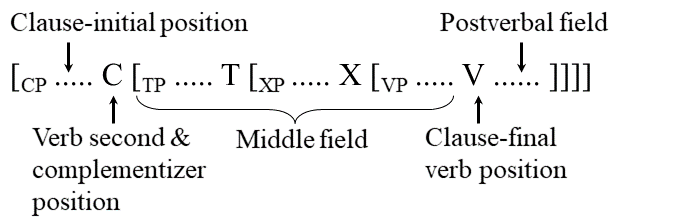
Since the position preceding the finite verb can contain at most one constituent, this position is often called the clause-initial position; accordingly, the position of the finite verb is often called the second position of the clause, to contrast it with the clause-final position occupied by the non-finite verbs. The examples in (15) show that the term clause-final position can be somewhat misleading, since verbs in this position can be followed by other elements. The examples in (16) show that this is easily possible in the case of PP-complements, and even obligatory in the case of clausal complements, and in many cases we can find more than one constituent there. The positions following the clause-final verbs are called postverbal positions.
| a. | Jan wil | Marie | <*of zij komt> | vragen <of zij komt>. | |
| Jan wants | Marie | whether she comes | ask | ||
| 'Jan wants to ask Marie whether she will come.' | |||||
| b. | Jan | wil | niet langer | <op Marie> | wachten <op Marie>. | |
| Jan | wants | no longer | for Marie | wait | ||
| 'Jan does not want to wait for Marie any longer.' | ||||||
Since the clause-initial position is usually filled by some constituent in declarative clauses and wh-questions, the term verb-second position is quite appropriate for such cases. However, there are also cases where the clause-initial position remains empty so that the verb ends up in first position, as in the yes/no
questions in (17).
| Heeft | Jan | Marie dit ansichtkaart | toegestuurd | vanuit China? | ||
| has | Jan | Marie this postcard | prt.-sent | from China | ||
| 'Has Jan sent Marie this postcard from China?' | ||||||
The examples in (18) show that an adverbial phrase in the form of a PP or a clause can also occur in a postverbal position. Note that clause adverbials differ from clausal complements in that they can occur both pre and postverbally.
| a. | Jan is | <nadat hij gesproken had> | snel | vertrokken <nadat hij gesproken had>. | |
| Jan is | after he spoken had | soon | left | ||
| 'Jan left soon after he had addressed the meeting.' | |||||
| b. | Jan is | <na de vergadering> | snel | vertrokken <na de vergadering>. | |
| Jan is | after the meeting | soon | left | ||
| 'Jan left quickly after the meeting.' | |||||
The postverbal field is usually occupied by PPs and clauses, but this does not exhaust the possibilities: some adverbs may also occur postverbally. This is illustrated in (19a) for the modal adverb waarschijnlijkprobably.
| a. | Jan zal | dat boek | <waarschijnlijk> | graag | lezen <waarschijnlijk>. | |
| Jan will | that book | probably | gladly | read | ||
| 'Jan will probably be eager to read that book.' | ||||||
Adverbial phrases indicating manner are special in that they categorically resist postverbal placement; the examples in (20) show that this is true not only for adjectival manner adverbs, but also for the corresponding prepositional forms.
| a. | Jan zal | dat boek | <aandachtig> | lezen <*aandachtig>. | |
| Jan will | that book | attentively | read | ||
| 'Jan will read that book closely.' | |||||
| b. | Jan zal | dat boek | <met aandacht> | lezen <*?met aandacht>. | |
| Jan will | that book | with attention | read | ||
| 'Jan will read that book closely.' | |||||
Note in passing that the examples in (21) show that the ungrammatical orders in (20) improve considerably when the postverbal phrases are preceded by an intonation break and given an emphatic accent. In such cases, the adverbials function as afterthoughts, which are often considered to be external to the main clause and thus belong to the class of elements to be discussed in Chapter C37.
| a. | Jan zal | dat boek | lezen, ... | aandachtig. | |
| Jan will | that book | read | attentively | ||
| 'Jan will read that book— closely.' | |||||
| b. | Jan zal | dat boek | lezen, ... | met aandacht. | |
| Jan will | that book | read | with attention | ||
| 'Jan will read that book—with care.' | |||||
The area between the verbs in second and clause-final position is often called the middle field of the clause. This part of the clause can contain virtually all constituent parts of the clause, with the notable exception of clausal arguments; cf. (16a) above.
The most striking property of main clauses is that they usually require their finite verb to be in second position; the examples in (22) show that the embedded counterparts of the main clauses in (14) require the finite verb to be in clause-final position, just like non-finite verbs.
| a. | Peter zei | [dat | Jan Marie dit boek | heeftfinite | toegestuurdpart | vanuit China]. | |
| Peter said | that | Jan Marie this book | has | prt.-sent | from China | ||
| 'Peter said that Jan has sent Marie this book from China.' | |||||||
| b. | Peter zei | [dat | Jan Marie dit boek | wildefinite | toestureninf | vanuit China]. | |
| Peter said | that | Jan Marie this book | wanted | prt.-sent | from China | ||
| 'Peter said that Jan wanted to send Marie this book from China.' | |||||||
| c. | Peter zei | [dat Jan Marie | dit boek | toestuurdefinite | vanuit China]. | |
| Peter said | that Jan Marie | this book | prt.-sent | from China | ||
| 'Peter said that Jan sent Marie this book from China.' | ||||||
This means that, in general, the examples in (14) cannot be embedded as such; the number sign indicates that the examples in (23) can only be interpreted as direct (i.e. quoted) speech. That these examples cannot be interpreted as indirect speech is not a trivial fact, since this is possible in German and, to a lesser extent, in some eastern Dutch dialects; cf. Haider (1985/2010) and Barbiers (2008: §1.3.1.8).
| a. | # | Peter zei | [Jan heeftfinite | Marie | dit boek | toegestuurdpart | vanuit China]. |
| Peter said | Jan has | Marie | this book | prt.-sent | from China |
| b. | # | Peter zei | [Jan wildefinite | Marie | dit boek | toestureninf | vanuit China]. |
| Peter said | Jan wanted | Marie | this book | prt.-sent | from China |
| c. | # | Peter zei | [Jan stuurdefinite | Marie dit boek | toe | vanuit China]. |
| Peter said | Jan sent | Marie this book | prt. | from China |
The examples in (24) show that the cases in (23) do not improve when we add the complementizer datthat. Again, this is not a trivial fact, since this is the natural way to form embedded declarative clauses in English; cf. John said that John has sent Mary the book from China.
| a. | * | Peter zei | [dat Jan heeftfinite | Marie | dit boek | toegestuurdpart | vanuit China]. |
| Peter said | that Jan has | Marie | this book | prt.-sent | from China |
| b. | * | Peter zei | [dat | Jan wildefinite | Marie | dit boek | toestureninf | vanuit China]. |
| Peter said | that | Jan wanted | Marie | this book | prt.-sent | from China |
| c. | * | Peter zei | [dat | Jan stuurdefinite | Marie dit boek | toe | vanuit China]. |
| Peter said | that | Jan sent | Marie this book | prt. | from China |
However, the requirement that the finite verb be clause-final is not absolute; there are a number of adverbial clauses that allow the verb to be in first/second position. The examples in (25) show, for instance, that conditional clauses can be introduced by the complementizer-like element alsif and have the finite verb in clause-final position, but they can also occur without als and then have the finite verb in first position. Such exceptions will be discussed in Section 10.3.
| a. | Als | hij | niet | komt, | dan | krijgt | hij | niets. | |
| if | he | not | comes | then | gets | he | nothing | ||
| 'If he does not come, he will not get anything.' | |||||||||
| b. | Komt | hij | niet, | dan | krijgt | hij | niets. | |
| comes | he | not | then | gets | he | nothing | ||
| 'If he does not come, he will not get anything.' | ||||||||
The discussion so far has shown that main and embedded clauses differ in the position of finite verbs: they appear in second position in main clauses, but in clause-final position in embedded clauses. The current standard analysis relates this difference to the distribution of complementizers: these are usually excluded in main clauses, but obligatory in embedded clauses. Paardekooper (1961) has shown that finite verbs in main clauses and complementizers in embedded clauses have the same position with respect to pronominal subjects. Leaving aside subject-initial main clauses, the examples in (26) show that such subject pronouns are always right-adjacent to the finite verb in main clauses and to the complementizer in embedded clauses.
| a. | Gisteren | was ik/je/hij | voor zaken | in Utrecht. | main clause | |
| yesterday | was I/you/he | on business | in Utrecht | |||
| 'Yesterday, I was/you were/he was in Utrecht on business.' | ||||||
| a'. | * | Gisteren was voor zaken ik/je/hij in Utrecht. |
| b. | dat | ik/je/hij | voor zaken | in Utrecht was. | embedded clause | |
| that | I/you/he | on business | in Utrecht was | |||
| 'that I was/you were/he was in Utrecht on business.' | ||||||
| b'. | * | dat voor zaken ik/je/hij in Utrecht was. |
Paardekooper concludes from this that finite verbs in main clauses have the same position as complementizers in embedded clauses. He suggests that this similarity of placement is related to the fact that complementizers and finite verbs have a similar relationship to the subject of the clause, as can be seen from the fact that in certain Dutch dialects (but not in standard Dutch) complementizers and finite verbs can agree in number and person with the subject of the clause. This is illustrated by the two examples in (27) from Van Haeringen (1939). Note that in these examples the complementizer aswhen introduces temporal adverbial clauses, but that we find similar agreement in complement clauses introduced by the declarative complementizer datthat or the interrogative complementizer ofwhether; cf. Haegeman (1992: §2.2), Hoekstra & Smit (1997), Zwart (1997), Van Koppen (2005/2017) and the references given there for examples and more information.
| a. | Assg | Wim | kompsg, | mot | jə | zorgə | dat | je | tuis | ben. | |
| when | Wim | comes | must | you | make.sure | that | you | at.home | are | ||
| 'When Wim comes, you must make sure to be at home.' | |||||||||||
| b. | Azzəpl | Kees en Wim | komməpl, | mot | jə | zorgə | dat | je | tuis | ben. | |
| when | Kees and Wim | come | must | you | make.sure | that | you | home | are | ||
| 'When Kees and Wim come, you must make sure to be at home.' | |||||||||||
Paardekooper did not discuss the relation between the two positions of the finite verb in main and embedded clauses. The nature of this relationship, however, became a pressing issue in early transformational grammar, in which the surface representations of sentences were assumed to be transformationally derived from more abstract underlying forms. The main question was: which word order is more basic, that in main clauses or that in embedded clauses? Koster (1975) argued convincingly that the order found in embedded clauses is more basic, on the basis of the following economy argument. If we assume that all verbs are base-generated in clause-final position, we only need a single verb-second rule that operates in main clauses and places the finite verb in second position: the rule in (28) simply expresses that finite verbs can be placed in second position in main clauses (X, Y and Z simply stand for an unspecified string of elements).
| X | Y Vfinite | Z ⇒ |
| X Vfinite | Y | Z |
However, if we assume that all verbs are base-generated in second position, we need at least two rules: (i) one rule that places all non-finite verbs in clause-final position, and (ii) another rule that places the finite verb in clause-final position in embedded clauses. In fact, we need many more word-order rules under this assumption; cf. Koster (1975) and Zwart (2011: Part III) for more detailed discussions.
Building on Paardekooper’s insight, Den Besten (1983) added that Koster’s verb-second rule can be formulated in such a way that we can appeal to independently needed positions, by assuming that the finite verb moves into the position normally occupied by the complementizer in embedded clauses; this was an important step, as it made the verb-second rule consistent with Emonds’ (1976) structure-preservation constraint, according to which movement cannot create a new position. The difference between main and embedded clauses is depicted in (29) on the basis of the more recently developed clause structure in (10). Note in passing that it is usually assumed that head movement cannot skip intervening heads like T or X (but moves through them in a successive cyclic fashion); we will not discuss this here, but will return to it in Section 9.3.
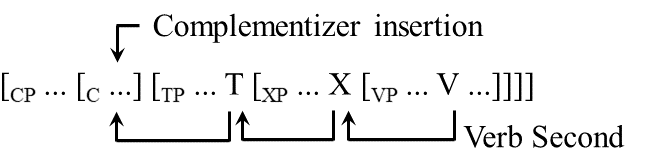 |
If we take the examples in (26) to show that subject pronouns obligatorily occupy the specifier of TP, i.e. the position left-adjacent to the T-head, this combination of the earlier findings by Paardekooper and Koster provides a simple formal account of the basic standard Dutch facts discussed so far.
This section has briefly discussed the placement of verbs in main clauses and embedded clauses. We have seen that verbs normally occur in clause-final position, with the exception of finite verbs in main clauses, which occur in second position. We argued that this second position is the same as that occupied by complementizers of embedded clauses. Verb-second position C and clause-final position V divide the clause into three parts, as shown in Figure (30). Sections 9.3 to 9.5 will discuss these parts in more detail.
 |
