- Dutch
- Frisian
- Saterfrisian
- Afrikaans
-
- Syntax
- Preface and acknowledgements
- Verbs and Verb Phrases
- 1 Verbs: Characterization and classification
- 2 Projection of verb phrases I: Argument structure
- 3 Projection of verb phrases IIIa: Selected clauses/verb phrases (introduction)
- 1.0. Introduction
- 1.1. Main types of verb-frame alternation
- 1.2. Alternations involving the external argument
- 1.3. Alternations of noun phrases and PPs
- 1.4. Some apparent cases of verb-frame alternation
- 1.5. Bibliographical notes
- 4 Projection of verb phrases IIIa: Selected clauses/verb phrases (introduction)
- 4.0. Introduction
- 4.1. Semantic types of finite argument clauses
- 4.2. Finite and infinitival argument clauses
- 4.3. Control properties of verbs selecting an infinitival clause
- 4.4. Three main types of infinitival argument clauses
- 4.5. Non-main verbs
- 4.6. The distinction between main and non-main verbs
- 4.7. Bibliographical notes
- 5 Projection of verb phrases IIIb: Argument and complementive clauses
- 5.0. Introduction
- 5.1. Finite argument clauses
- 5.2. Infinitival argument clauses
- 5.3. Complementive clauses
- 5.4. Bibliographical notes
- 6 Projection of verb phrases IIIc: Complements of non-main verbs
- 7 Projection of verb phrases IIId: Verb clustering
- 8 Projection of verb phrases IV: Adverbial modification
- 9 Word order in the clause I: General introduction
- 10 Word order in the clause II: Position of the finite verb (verb-first/second)
- 11 Word order in the clause III:Clause-initial position (wh-movement)
- 11.0. Introduction
- 11.1. The formation of V1 and V2-clauses
- 11.2. Clause-initial position remains (phonetically) empty
- 11.3. Clause-initial position is filled
- 11.4. Bibliographical notes
- 12 Word order in the clause IV: Postverbal field (extraposition)
- 13 Word order in the clause V: Middle field (scrambling)
- Nouns and Noun Phrases
- 14 Characterization and classification
- 15 Projection of noun phrases I: Complementation
- 15.0. Introduction
- 15.1. General observations
- 15.2. Prepositional and nominal complements
- 15.3. Clausal complements
- 15.4. Bibliographical notes
- 16 Projection of noun phrases II: Modification
- 16.0. Introduction
- 16.1. Restrictive and non-restrictive modifiers
- 16.2. Premodification
- 16.3. Postmodification
- 16.3.1. Adpositional phrases
- 16.3.2. Relative clauses
- 16.3.3. Infinitival clauses
- 16.3.4. A special case: clauses referring to a proposition
- 16.3.5. Adjectival phrases
- 16.3.6. Adverbial postmodification
- 16.4. Bibliographical notes
- 17 Projection of noun phrases III: Binominal constructions
- 17.0. Introduction
- 17.1. Binominal constructions without a preposition
- 17.2. Binominal constructions with a preposition
- 17.3. Bibliographical notes
- 18 Determiners: Articles and pronouns
- 18.0. Introduction
- 18.1. Articles
- 18.2. Pronouns
- 18.3. Bibliographical notes
- 19 Numerals and quantifiers
- 19.0. Introduction
- 19.1. Numerals
- 19.2. Quantifiers
- 19.2.1. Introduction
- 19.2.2. Universal quantifiers: ieder/elk ‘every’ and alle ‘all’
- 19.2.3. Existential quantifiers: sommige ‘some’ and enkele ‘some’
- 19.2.4. Degree quantifiers: veel ‘many/much’ and weinig ‘few/little’
- 19.2.5. Modification of quantifiers
- 19.2.6. A note on the adverbial use of degree quantifiers
- 19.3. Quantitative er constructions
- 19.4. Partitive and pseudo-partitive constructions
- 19.5. Bibliographical notes
- 20 Predeterminers
- 20.0. Introduction
- 20.1. The universal quantifier al ‘all’ and its alternants
- 20.2. The predeterminer heel ‘all/whole’
- 20.3. A note on focus particles
- 20.4. Bibliographical notes
- 21 Syntactic uses of noun phrases
- 22 Referential dependencies (binding)
- Adjectives and Adjective Phrases
- 23 Characteristics and classification
- 24 Projection of adjective phrases I: Complementation
- 25 Projection of adjective phrases II: Modification
- 26 Projection of adjective phrases III: Comparison
- 27 Attributive use of the adjective phrase
- 28 Predicative use of the adjective phrase
- 29 The partitive genitive construction
- 30 Adverbial use of the adjective phrase
- 31 Participles and infinitives: their adjectival use
- Adpositions and adpositional phrases
- 32 Characteristics and classification
- 32.0. Introduction
- 32.1. Characterization of the category adposition
- 32.2. A syntactic classification of adpositional phrases
- 32.3. A semantic classification of adpositional phrases
- 32.4. Borderline cases
- 32.5. Bibliographical notes
- 33 Projection of adpositional phrases: Complementation
- 34 Projection of adpositional phrases: Modification
- 35 Syntactic uses of adpositional phrases
- 36 R-pronominalization and R-words
- 32 Characteristics and classification
- Coordination and Ellipsis
- Syntax
-
- General
-
- General
- Morphology
- Morphology
- 1 Word formation
- 1.1 Compounding
- 1.1.1 Compounds and their heads
- 1.1.2 Special types of compounds
- 1.1.2.1 Affixoids
- 1.1.2.2 Coordinative compounds
- 1.1.2.3 Synthetic compounds and complex pseudo-participles
- 1.1.2.4 Reduplicative compounds
- 1.1.2.5 Phrase-based compounds
- 1.1.2.6 Elative compounds
- 1.1.2.7 Exocentric compounds
- 1.1.2.8 Linking elements
- 1.1.2.9 Separable Complex Verbs and Particle Verbs
- 1.1.2.10 Noun Incorporation Verbs
- 1.1.2.11 Gapping
- 1.2 Derivation
- 1.3 Minor patterns of word formation
- 1.1 Compounding
- 2 Inflection
- 1 Word formation
- Morphology
- Syntax
- Adjectives and adjective phrases (APs)
- 0 Introduction to the AP
- 1 Characteristics and classification of APs
- 2 Complementation of APs
- 3 Modification and degree quantification of APs
- 4 Comparison by comparative, superlative and equative
- 5 Attribution of APs
- 6 Predication of APs
- 7 The partitive adjective construction
- 8 Adverbial use of APs
- 9 Participles and infinitives as APs
- Nouns and Noun Phrases (NPs)
- 0 Introduction to the NP
- 1 Characteristics and Classification of NPs
- 2 Complementation of NPs
- 3 Modification of NPs
- 3.1 Modification of NP by Determiners and APs
- 3.2 Modification of NP by PP
- 3.3 Modification of NP by adverbial clauses
- 3.4 Modification of NP by possessors
- 3.5 Modification of NP by relative clauses
- 3.6 Modification of NP in a cleft construction
- 3.7 Free relative clauses and selected interrogative clauses
- 4 Partitive noun constructions and constructions related to them
- 4.1 The referential partitive construction
- 4.2 The partitive construction of abstract quantity
- 4.3 The numerical partitive construction
- 4.4 The partitive interrogative construction
- 4.5 Adjectival, nominal and nominalised partitive quantifiers
- 4.6 Kind partitives
- 4.7 Partitive predication with a preposition
- 4.8 Bare nominal attribution
- 5 Articles and names
- 6 Pronouns
- 7 Quantifiers, determiners and predeterminers
- 8 Interrogative pronouns
- 9 R-pronouns and the indefinite expletive
- 10 Syntactic functions of Noun Phrases
- Adpositions and Adpositional Phrases (PPs)
- 0 Introduction to the PP
- 1 Characteristics and classification of PPs
- 2 Complementation of PPs
- 3 Modification of PPs
- 4 Bare (intransitive) adpositions
- 5 Predication of PPs
- 6 Form and distribution of adpositions with respect to staticity and construction type
- 7 Adpositional complements and adverbials
- Verbs and Verb Phrases (VPs)
- 0 Introduction to the VP in Saterland Frisian
- 1 Characteristics and classification of verbs
- 2 Unergative and unaccusative subjects and the auxiliary of the perfect
- 3 Evidentiality in relation to perception and epistemicity
- 4 Types of to-infinitival constituents
- 5 Predication
- 5.1 The auxiliary of being and its selection restrictions
- 5.2 The auxiliary of going and its selection restrictions
- 5.3 The auxiliary of continuation and its selection restrictions
- 5.4 The auxiliary of coming and its selection restrictions
- 5.5 Modal auxiliaries and their selection restrictions
- 5.6 Auxiliaries of body posture and aspect and their selection restrictions
- 5.7 Transitive verbs of predication
- 5.8 The auxiliary of doing used as a semantically empty finite auxiliary
- 5.9 Supplementive predication
- 6 The verbal paradigm, irregularity and suppletion
- 7 Verb Second and the word order in main and embedded clauses
- 8 Various aspects of clause structure
- Adjectives and adjective phrases (APs)
Many semantic subdivisions have been proposed for the set-denoting adjectives, but most of them seem to be rather arbitrary. Nevertheless, some of these distinctions have been claimed to be syntactically relevant (especially in the realm of modification, which is discussed in detail in Chapter 25), which is why we will briefly discuss these distinctions in the following subsections. It should be noted, however, that in principle many other distinctions can be made for other purposes, and that there is considerable overlap between the classes discussed below; cf. Subsection III for more discussion.
- I. Scales and scalar adjectives
- II. Absolute (non-scalar) adjectives
- III. The distinction between gradable and scalar adjectives
- IV. Stage/individual-level adjectives
Many set-denoting adjectives are scalar. The primeless examples in (59) express that both Jan and Marie are part of the set denoted by the adjective ziekill, which will be clear from the fact that they imply the primed examples. The function of the degree adverbs vrijrather and erg/zeervery is to indicate that Jan and Marie do not have the property of being ill to the same degree. This means that the possibility of adding a degree modifier indicates that a scale is implied; the function of the degree adverbs is to place Jan’s illness and Marie’s illness at different places on this scale. This can be seen in the graphical representation in (59c).
| a. | Jan is vrij ziek. | ⇒ | |
| Jan is rather ill |
| a'. | Jan is ziek. | |
| Jan is ill |
| b. | Marie is erg ziek. | ⇒ | |
| Marie is very ill |
| b'. | Marie is ziek. | |
| Marie is ill |
| c. | Scale of illness |
 |
The graph in (59c) shows that Jan is less ill than Marie. It also indicates that there is a point to the left of Jan where we begin to talk about illness; the scale is bounded on the left. However, as long as the person involved is alive, there is no obvious point on the scale where we stop talking about illness; the scale is unbounded on the right. This subsection will discuss several types of scalar adjectives on the basis of the properties of the scales that they imply.
Many set-denoting adjectives come in antonym pairs that can be placed on a single scale. Some examples are given in (60). The following subsections will show, however, that the scales implied by these antonym pairs can differ in various ways.
| a. | slecht | ‘evil/bad’ |
| a'. | goed | ‘good’ |
| b. | klein | ‘small’ |
| b'. | groot | ‘big’ |
| c. | vroeg | ‘early’ |
| c'. | laat | ‘late’ |
| d. | gezond | ‘healthy’ |
| d'. | ziek | ‘ill’ |
| e. | leeg | ‘empty’ |
| e'. | vol | ‘full’ |
First, consider the scale implied by the pair goedgood and slechtevil/bad, given in (61). The two adjectives each indicate a certain range on the scale, i.e. they are both scalar. Furthermore, the implied scale is unbounded on both sides. However, between the two ranges denoted by goed and slecht there is a zone in which neither of the two adjectives applies, which we will call the neutral zone.
| Scale of goodness |
 |
That there is a neutral zone is clear from the fact that slechtevil/bad and niet goednot good are not fully equivalent. The difference can be made clear by looking at the logical implications in (62a&b). The fact that slecht implies niet goed, but that niet goed does not imply slecht, can be visualized in the scale of goodness in (61). As can be seen in (62c), niet goed covers a larger part of the scale than slecht: it includes the neutral zone.
| a. | Jan is slecht. | ⇒ | |
| Jan is evil |
| a'. | Jan is niet goed. | |
| Jan is not good |
| b. | Jan is niet goed. | ⇏ | |
| Jan is not good |
| b'. | Jan is slecht. | |
| Jan is evil |
| c. |  |
That we need to postulate a neutral zone is also clear from the fact that examples such as (63a) are not contradictory, but simply indicate that Jan’s goodness should be located somewhere in the neutral zone. This is shown in (63b).
| a. | Jan is niet goed, | maar | ook | niet | slecht. | |
| Jan is not good | but | also | not | bad | ||
| 'Jan isnʼt good, but he isnʼt bad either.' | ||||||
| b. | 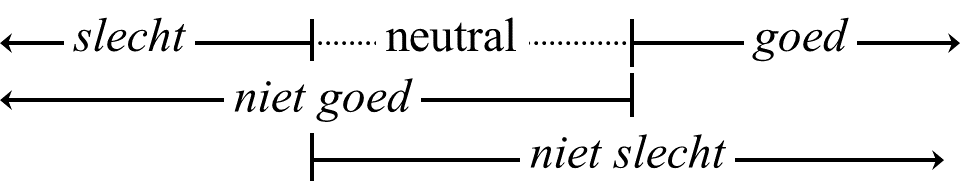 |
The scale of size in (64), implied by the measure adjectives kleinsmall and grootbig in (60b), is similar to the scale of goodness in most respects, but differs from it in that it is bounded on one side; the size of an entity cannot be less than zero. This means that the scale of size, unlike the scale of goodness, has a natural anchoring point. In this sense, adjectives like goed and slecht are more subjective than measure adjectives like klein and groot; cf. Subsection C below for more discussion.
| Scale of size |
 |
The implied scale can also be bounded on both sides. This is the case with the temporal scale implied by the adjectives vroegearly and laatlate in (60c). If we assert that Jan gets up early, this may be consistent with Jan getting up at 5:00 a.m., but it is probably not consistent with him getting up at 1:00 a.m. or at 11:00 p.m. Similarly, if we assert that Jan gets up late, this may be consistent with him getting up at 11:00 a.m. or even at 1:00 p.m., but it is probably not consistent with him getting up at 11:00 p.m. or at 1:00 a.m. Beyond a certain point (which may be vaguely defined, and which can perhaps be changed if the context provides information that favors it) the adjectives are simply no longer applicable, which is indicated by ### in (65).
| Temporal scale of vroeg and laat |
 |
In the examples in the previous subsections, the two antonyms are both gradable, but this need not be the case. For example, the adjective gezondhealthy in (60d) does not seem to be scalar itself; rather, it is absolute (cf. the discussion of (69)) and indicates one end of the scale. In other words, we can represent the scale of illness as in (66).
| Scale of illness |
 |
Many gradable adjectives that imply a scale bounded on one side are deverbal or pseudo-participles; cf. the primeless examples in (67) and (68). Their antonyms, which are located at the boundary of the scale, are often derived morphologically by on- prefixation. In the case of pseudo-participles, there is sometimes no antonym, so that we can only express the negative counterpart with the negative adverb nietnot.
| a. | brandbaar ‘combustible’ |
| a'. | onbrandbaar ‘incombustible’ |
| b. | bereikbaar ‘attainable’ |
| b'. | onbereikbaar ‘unattainable’ |
| c. | begroeid ‘overgrown’ |
| c'. | onbegroeid ‘without plants’ |
| d. | toegankelijk ‘accessible’ |
| d'. | ontoegankelijk ‘inaccessible’ |
| a. | bekend met ‘familiar with’ |
| a'. | onbekend met ‘unfamiliar with’ |
| b. | bestand tegen ‘resistant to’ |
| b'. | niet bestand tegen ‘not resistant to’ |
| c. | gewond ‘wounded’ |
| c'. | ongewond ‘unharmed’ |
| d. | opgewassen tegen ‘up to’ |
| d'. | niet opgewassen tegen ‘not up to’ |
| e. | verwant aan ‘related to’ |
| e'. | niet verwant aan ‘not related to’ |
That gezond and the adjectives in the primed examples in (67) and (68) are not scalar but absolute is clear from the fact that they can be modified by adverbial phrases like absoluutabsolutely, helemaalcompletely and vrijwelalmost, as in (69). We show these examples with topicalization of the AP in order to block the reading in which absoluut/vrijwel is interpreted as a clause adverbial. The examples are perhaps stylistically marked but at least the cases with absoluut and helemaal become fully acceptable if we add the negative adverb nietnot at the end of the clause.
| a. | Helemaal/Absoluut/Vrijwel | gezond | is Jan. | |
| completely/absolutely/almost | healthy | is Jan | ||
| 'Jan is completely/practically healthy.' | ||||
| b. | Absoluut/Vrijwel | onbrandbaar | is deze stof. | |
| absolutely/almost | incombustible | is this material | ||
| 'This material is completely/practically incombustible.' | ||||
| c. | Helemaal/Vrijwel | onbekend | met onze gewoontes | is Jan. | |
| completely/almost | unfamiliar | with our habits | is Jan | ||
| 'Jan is completely/virtually unfamiliar with our habits.' | |||||
The cases in (70) show that these adverbial phrases cannot be combined with scalar adjectives; cf. Section 23.3.2.2, sub II.
| a. | * | Helemaal/Absoluut/Vrijwel | goed/klein/ziek | is Jan. |
| completely/absolutely/almost | good/small/ill | is Jan |
| b. | * | Absoluut/Vrijwel | brandbaar | is deze stof. |
| absolutely/almost | combustible | is this material |
| c. | * | Helemaal/Vrijwel | bekend met onze gewoontes | is Jan. |
| completely/almost | familiar with our habits | is Jan |
For completeness’ sake, note that the adjective gezondhealthy can also be used as a scalar adjective, provided that it is the antonym of ongezondunhealthy. In this use, gezond cannot be modified by the adverbial phrases absoluut and vrijwel. This is shown in (71).
| a. | Spinazie is erg gezond/ongezond. | |
| spinach is very healthy/unhealthy |
| b. | * | Absoluut/Vrijwel | gezond/ongezond | is spinazie. |
| absolutely/almost | healthy/unhealthy | is spinach |
The fact that gezond (as the antonym of ziekill) is not scalar shows that placing an antonymous pair of adjectives on a scale is not sufficient to conclude that the adjectives are both scalar. In fact, they can both be absolute, as is the case with the adjectives leeg/volempty/full in (60e); both typically denote the boundaries of the implied scale. That leeg and vol are not scalar but absolute is clear from the fact that they can be modified by adverbial phrases like helemaaltotally, vrijwelalmost, etc.
| a. | Scale of fullness |
 |
| b. | Het glas | is helemaal/vrijwel | leeg/vol. | |
| the glass | is completely/almost | empty/full |
The scales in (61), (64), and (65) have a neutral zone to which neither adjective applies. This zone is often more or less fixed for the speaker in question. For some adjectives, however, the neutral zone is more flexible and can be determined by the entity of which the adjective is predicated or by the context in which the adjectives are used. This is especially true for measure adjectives of the kind in (73).
| a. | dik | ‘thick’ |
| a'. | dun | ‘thin’ |
| b. | oud | ‘old’ |
| b'. | jong | ‘young’ |
| c. | groot | ‘big’ |
| c'. | klein | ‘small’ |
| d. | lang | ‘tall’/‘long’ |
| d'. | kort | ‘short’/‘brief’ |
| e. | hoog | ‘high’ |
| e'. | laag | ‘low’ |
| f. | zwaar | ‘heavy’ |
| f'. | licht | ‘light’ |
| g. | breed | ‘wide’ |
| g'. | smal | ‘narrow’ |
The examples in (74) show that the placement of the neutral zone, i.e. the interpretation of the measure adjectives, depends on the argument of which the adjective is predicated. We will consider only the examples with the adjective groot, but the discussion is also applicable to klein.
| a. | Deze muis | is klein/groot. | |
| this mouse | is small/big |
| b. | Deze walvis | is klein/groot. | |
| the whale | is small/big |
Although groot can be predicated of the two noun phrases deze muisthis mouse and deze walvisthis whale, it is clear that the two entities to which these noun phrases refer cannot be assumed to be of similar size. Thus, the placement of the neutral zone on the implied scales of size will be different. In the case of mice, the scale is expressed in terms of centimeters, as in (75a), whereas in the case of whales, the scale is instead expressed in terms of meters, as in (75b).
| a. | Scale of size for mice in centimeters |
 |
| b. | Scale of size for whales in meters |
 |
This shows that the position of the neutral zone is at least partly determined by the argument of which the adjective is predicated; it indicates the “normal” or “average” size of mice/whales. In other words, examples such as (74) tacitly introduce a comparison class, namely the class of mice/whales, which determines the precise position of the neutral zone on the implied scale. Often a voor-PP is introduced to make the comparison class explicit and to clarify the intended neutral zone, as in (76).
| Jan is groot | voor een jongen | van zijn leeftijd. | ||
| Jan is big | for a boy | of his age | ||
| 'Jan is tall for a boy his age.' | ||||
The comparison class, and hence the neutral zone, is not always determined by the argument of which the adjective is predicated; the context may also play a decisive role. In a discussion of mammals in general, statement (77a) will be true, while the statement in (77b) will be false: since the comparison class consists of mammals, the neutral zone will be determined by the average size of mammals, and Indian elephants are definitely larger than that. However, if we discuss the different subspecies of elephants, statement (77b) can be considered true: the comparison class is formed by elephants, and the Indian elephant is indeed small compared to the African elephant. We can therefore conclude that the truth of (77b) depends on the comparison class evoked by the context.
| a. | De Indische olifant | is groot. | |
| the Indian elephant | is big |
| b. | De Indische olifant | is klein. | |
| the Indian elephant | is small |
Although the placement of the neutral zone on the scale implicit in the measure adjective depends on extra-linguistic information, the scale itself is objective once speakers have established the neutral zone, so that they can objectively determine whether a given statement is true or false. The fact that the scale implied by the measure adjectives is objective is also supported by the fact that (in some cases) the exact position on the scale can be indicated by nominal measure phrases like twee dagen and twintig meter in (78).
| a. | Dit poesje | is twee dagen | oud. | |
| this kitten | is two days | old |
| b. | De weg | is twintig meter | lang. | |
| the road | is twenty meters | long |
On the other hand, with adjectives like lelijk/mooiugly/beautiful and saai/boeiendboring/exciting, the exact position of the relevant entities on the implied scale is a more subjective matter. It may well depend entirely on the language user, which can be brought out by embedding the adjective under the verb vindenconsider, as in the (a)-examples in (79). Occasionally, the entity whose evaluation is assumed can be expressed syntactically by a voor-PP; this is illustrated in the (b)-examples.
| a. | Ik | vind | De Nachtwacht | lelijk/mooi. | |
| I | consider | The Night Watch | ugly/beautiful |
| a'. | Ik | vind | Shakespeares drama’s | saai/boeiend. | |
| I | consider | Shakespeare’s tragedies | boring/exciting |
| b. | Dit gereedschap | is handig | voor een timmerman. | |
| this tool | is handy | for a carpenter | ||
| 'These tools are handy for a carpenter.' | ||||
| b'. | Dit boek | is interessant | voor elke taalkundige. | |
| this book | is interesting | for each linguist | ||
| 'This book will be of interest to any linguist.' | ||||
The pairs of measure adjectives in (73) can be regarded as true antonyms: the two (a)-examples in (80) are fully equivalent. However, this equivalence does not seem to hold for the subjective adjectives in the (b)-examples, which suggests that the comparative forms mooiermore beautiful and lelijkeruglier are not true antonyms but quasi-antonyms.
| a. | Jan is groter dan Marie. | ⇔ | ||
| Jan is bigger than Marie | ||||
| 'Jan is taller than Marie' | ||||
| a'. | Marie is kleiner dan Jan. | |||
| Marie is smaller than Jan | ||||
| 'Marie is shorter than Jan.' | ||||
| b. | De Nachtwacht | is mooier dan | De anatomieles. | ⇎ | |
| The Night Watch | is more beautiful than | The Anatomy Lesson |
| b'. | De anatomieles | is lelijker dan | De Nachtwacht. | |
| The Anatomy Lesson | is uglier than | The Night Watch |
This difference may be related to the following observation. The use of the comparative form of objective adjectives like kleinsmall and grootbig in the (a)-examples of (80) does not necessarily imply that the argument of which the adjective is predicated is in fact small or big. The use of the comparative form of the subjective adjectives mooibeautiful and lelijkugly, on the other hand, suggests that the argument of which the adjective is predicated is in fact beautiful or ugly. Consequently, the true antonym of mooier is the comparative form minder mooiless beautiful, as is clear from the equivalence between (81a) and (81b).
| a. | De Nachtwacht | is mooier dan | De anatomieles. | ⇔ | |
| The Night Watch | is more beautiful than | The Anatomy Lesson |
| b. | De anatomieles | is minder mooi | dan | De Nachtwacht. | |
| The Anatomy Lesson | is less beautiful | than | The Night Watch |
Of course, the true antonymy relationship also holds between groterbigger and minder grootless big. The crucial point, however, is that minder groot is virtually synonymous with kleinersmaller, while minder mooiless beautiful and lelijkeruglier have distinctly different meanings. The difference between objective and subjective adjectives discussed in this subsection may be lexically encoded; reasons for assuming this will be given in Subsection F below.
The examples in (78) have already shown that the measure adjectives can be modified by nominal measure phrases; cf. Klooster (1972) and Corver (1990:ch.8). For each pair of antonyms in (73), however, this holds only for the adjective in the primeless example; some illustrations are given in (82). Of course, the use of two days old in (82a) does not express the fact that the kitten is old; it is in fact quite young, which can be emphasized by using the evaluative particle pasonly. Therefore, it is clear that the adjective oud has lost the antonymous part of its meaning; the same is true for the adjective lang in (82b). Since oud and lang do not need to express the antonymous part of their meaning, they can be seen as the neutral forms of the respective pairs; the adjectives jong and kort cannot be used in this neutral way, hence the use of the percentage sign.
| a. | Het poesje | is (pas) | twee dagen | oud/%jong. | |
| the kitten | is only | two days | old/young |
| b. | De weg | is (maar) | twintig meter | lang/%kort. | |
| the road | is only | twenty meters | long/short |
Similar conclusions can be drawn from the interrogative sentences in (83): the neutral form oud/lang gives rise to a perfectly natural question and does not imply that the subject of the clause should be characterized as old/long, whereas the non-neutral form jong/kort gives rise to a marked result and, to the extent that it is usable at all, seems to imply that the kitten is young and the road is short.
| a. | Hoe oud/%jong | is het poesje | |
| how old/young | is the kitten |
| b. | Hoe lang/%kort | is deze weg? | |
| how long/short | is this road |
The examples in (84) show that the two forms also seem to differ when it comes to the derivation of nouns from adjectives by suffixation with –te; the neutral forms of the measure adjectives seem to be preferred as input for this morphological rule, although it must be pointed out that the formations marked with a number sign can also be found on the internet, but with a much lower frequency. Note that the formation of *oudte in (84c) is probably blocked by the existing noun leeftijdage. We refer the reader to Section 25.1.2, sub II, for further discussion of measure adjectives.
| a. | breedte ‘width’ |
| a'. | # | smalte |
| b. | dikte ‘thickness’ |
| b'. | # | dunte |
| c. | * | oudte ‘age’ |
| c'. | * | jongte |
| d. | lengte ‘length’ |
| d'. | * | kortte |
| e. | hoogte ‘height’ |
| e'. | # | laagte |
| f. | zwaarte ‘weight’ |
| f'. | * | lichtte |
The adjectives in (85) seem to be similar to the measure adjectives in (83): the primeless examples are unmarked and do not presuppose that the property denoted by the adjective is applicable; the primed examples, on the other hand, are marked and strongly suggest that the property denoted by the adjective is applicable.
| a. | Hoe schoon | is de keuken? | |
| how clean | is the kitchen |
| a'. | % | Hoe vies | is de keuken? |
| how dirty | is the kitchen |
| b. | Hoe veilig | is die draaimolen? | |
| how safe | is that carousel |
| b'. | % | Hoe onveilig | is die draaimolen? |
| how unsafe | is that carousel |
Often the subjective adjectives not only imply a subjective scale, but also express a negative or positive evaluation. In the pair slechtbad/evil and goedgood, the first adjective denotes a negatively valued property, while the second denotes a positively valued property. The examples in (86) show that this distinction is also reflected in their modification possibilities: the primeless examples contain negatively valued adjectives, and modification by elements like knapquite and flinkquite is possible; the primed examples, on the other hand, contain positively valued adjectives, and modification by knap and flink is excluded.
| a. | knap | brutaal/moeilijk/lastig/ongehoorzaam | |
| quite | cheeky/difficult/troublesome/disobedient |
| a'. | * | knap | beleefd/makkelijk/eenvoudig/gehoorzaam |
| pretty | polite/easy/simple/obedient |
| b. | flink | brutaal/moeilijk/lastig/ongehoorzaam | |
| quite | cheeky/difficult/troublesome/disobedient |
| b'. | * | flink | beleefd/makkelijk/eenvoudig/gehoorzaam |
| quite | polite/easy/simple/obedient |
The examples in (87) show that litotes (the trope in literary and formal language by which one emphasizes a property by negating its antonym) prefers an adjective denoting a negatively valued property; when the adjective denotes a positively valued property, as in the primed examples, the desired interpretation usually does not arise; a notable exception is the colloquial expression Da’s niet goed!, in which the deictic power of the demonstrative has faded; cf. English That’s not good! (Carole Boster, p.c.).
| a. | Dat boek is niet slecht. | |||
| that book is not bad | ||||
| 'That book is quite good.' | ||||
| a'. | # | Dat boek | is niet goed. | |
| that book | is not good | |||
| Not: 'That book is very bad.' | ||||
| b. | Hij | is niet lelijk. | |||
| he | is not ugly | ||||
| 'He is quite handsome.' | |||||
| b'. | # | Hij | is niet knap. | ||
| he | is not handsome | ||||
| Not: 'He is quite ugly.' | |||||
The modifier welrather in (88), on the other hand, requires an adjective denoting a positively valued property; cf. van Riemsdijk (2005). Note that the primed examples are fully acceptable if wel is interpreted as the affirmative marker wel; the two forms differ in that the affirmative marker is accented while the modifier is not. The uses of niet and wel in (87) and (88) are discussed in more detail in Section 25.3, sub II.
| a. | Jan is wel | aardig. | |||
| Jan is wel | kind | ||||
| 'Jan is rather kind.' | |||||
| a'. | * | Jan is wel | onaardig. |
| Jan is wel | unkind |
| b. | Hij | is wel | knap. | ||||
| he | is wel | handsome | |||||
| 'He is rather handsome.' | |||||||
| b'. | * | Hij | is wel | lelijk. |
| he | is wel | ugly |
Occasionally, the modifier is sensitive to both the positive/negative value of the adjective and the syntactic environment. In declarative clauses, for example, the modifier een beetjea bit may prefer a negatively valued adjective (or an adjective that has no antonym, such as verliefdin love). In questions and imperatives, on the other hand, this modifier may prefer an adjective that denotes a positively valued property. The use of the percentage sign indicates that judgments on the degree of markedness of these examples vary from speaker to speaker.
| a. | Hij | is | een beetje | onaardig/%aardig. | |
| he | is | a bit | unkind/kind |
| b. | Is | hij | een beetje | aardig/%onaardig? | |
| is | he | a bit | kind/unkind |
| c. | Wees | een beetje | aardig/%onaardig! | |
| be | a bit | kind/unkind |
This subsection discusses the fact that negative polarity items can be licensed by the subset of antonymous adjectives that were called true antonyms in subsection C above. To do so, we will first discuss some logical properties of these adjectives. Subsection C has already shown that true antonyms have the defining property that they allow the inference in (90a), where A and A' are antonymous adjectives. Consider again example (80a), repeated here as (90b): if Jan is taller than Marie, we can conclude that Marie is shorter than Jan, and similarly, if Marie is shorter than Jan, we can conclude that Jan is taller than Marie. This equivalence does not hold for quasi-antonymous adjectives such as mooibeautiful and lelijkugly; cf. the earlier discussion of example (80b).
| a. | x is more A than y | ⇔ | y is more A'than x |
| b. | Jan is groter dan Marie. | ⇔ | Marie is kleiner dan Jan. | |
| Jan is taller than Marie | Marie is shorter than Jan |
True and quasi-antonymous adjectives are similar in that the implications in (91a) do not hold for either of them; in both cases the implied scale may have a neutral zone. This has already been discussed for the quasi-antonymous adjectives slechtbad and goedgood in Subsection A, so we limit ourselves here to giving similar examples for the true antonymous adjectives grootbig and kleinsmall.
| a. | not A ⇏A'; not A'⇏A |
| b. | Jan is niet groot. ⇏ | Jan is klein. | |
| Jan is not big | Jan is small |
| b'. | Jan is niet klein. ⇏ | Jan is groot. | |
| Jan is not good | Jan is evil |
Despite the fact that the implications in (91a) do not hold, we will show in this subsection that for the true antonyms above, the pair not A and A' as well as the pair not A' and A show certain similarities in semantic behavior that may be relevant when it comes to the licensing of negative polarity items like ook maar ietsanything. To demonstrate this, we have chosen the adjectives in (92) because they can take a clausal complement, which is crucial for our purposes below, since negative polarity items like ook maar iets are normally only possible in embedded clauses; cf. Section V13.3.1, sub III.
| a. | gemakkelijk | ‘easy’ |
| a'. | moeilijk | ‘difficult’ |
| b. | verstandig | ‘clever’ |
| b'. | onverstandig | ‘foolish’ |
| c. | veilig | ‘safe’ |
| c'. | gevaarlijk | ‘dangerous’ |
Consider the examples in (93). In the primeless examples, the complement clause refers to a broader set of eventualities than does the complement in the primed examples; the addition of an adverb in the latter cases makes the state of affairs to which the complement clause refers more specific, and thus applicable to a smaller number of situations. For example, there are many cases in which a problem is solved, but only in a subset of those cases is the problem solved quickly.
| . Upward and downward entailments |
| a. | Het | is gemakkelijk | om | dat probleem | op | te lossen. | |
| it | is easy | comp | that problem | prt. | to solve | ||
| 'It is easy to solve that problem.' | |||||||
| a'. | Het | is gemakkelijk | om | dat probleem | snel | op | te lossen. | |
| it | is easy | comp | that problem | quickly | prt. | to solve | ||
| 'It is easy to solve that problem fast.' | ||||||||
| b. | Het | is verstandig | om | een boek | voor Peter | te kopen. | |
| it | is clever | comp | a book | for Peter | to buy | ||
| 'It is sensible to buy a book for Peter.' | |||||||
| b'. | Het | is verstandig | om | hier | een boek | voor Peter | te kopen. | |
| it | is clever | comp | here | a book | for Peter | to buy | ||
| 'It is sensible to buy a book for Peter here.' | ||||||||
| c. | Het | is veilig | om | hier | over | te steken. | |
| it | is safe | comp | here | prt. | to cross | ||
| 'It is safe to cross the road here.' | |||||||
| c'. | Het | is veilig | om | hier | met je ogen dicht | over | te steken. | |
| it | is safe | comp | here | with your eyes closed | prt. | to cross | ||
| 'It is safe to cross the road here with your eyes closed.' | ||||||||
Now, it is important to note that one cannot conclude from the truth of the primeless examples that the primed examples are also true. However, one could conclude from the truth of the primed examples that the primeless ones are also true. The environments in (93), in which an expression like snel oplossento solve quickly can be replaced by a more general one like oplossento solve without changing the truth value of the expression, are known as upward entailing.
The inferences change radically if we replace the adjectives in (93) by their antonyms, as in (94). Now we can conclude from the truth of the primeless examples that the primed examples are also true, and not vice versa. The environments in (94), where an expression like oplossento solve can be replaced by a more specific one like snel oplossento solve quickly without changing the truth value of the expression, are called downward entailing.
| a. | Het | is moeilijk | om | dat probleem | op | te lossen. | |
| it | is difficult | comp | that problem | prt. | to solve | ||
| 'It is difficult to solve that problem.' | |||||||
| a'. | Het | is moeilijk | om | dat probleem | snel | op | te lossen. | |
| it | is difficult | comp | that problem | quickly | prt. | to solve | ||
| 'It is difficult to solve that problem fast.' | ||||||||
| b. | Het | is onverstandig | om | een boek | voor Peter | te kopen. | |
| it | is foolish | comp | a book | for Peter | to buy | ||
| 'It is foolish to buy a book for Peter.' | |||||||
| b'. | Het | is onverstandig | om | hier | een boek | voor Peter | te kopen. | |
| it | is foolish | comp | here | a book | for Peter | to buy | ||
| 'It is foolish to buy a book for Peter here.' | ||||||||
| c. | Het | is gevaarlijk | om | hier | over | te steken. | |
| it | is dangerous | comp | here | prt. | to cross | ||
| 'It is dangerous to cross the road here.' | |||||||
| c'. | Het | is gevaarlijk | om | hier | met je ogen dicht | over | te steken. | |
| it | is dangerous | comp | here | with your eyes closed | prt. | to cross | ||
| 'It is dangerous to cross the road here with your eyes closed.' | ||||||||
From the examples in (93) and (94) we can conclude that the adjectives in the primeless examples of (92) create upward entailing environments, whereas the adjectives in the primed examples of (92) create downward entailing environments. Negation can reverse this property. If we add the adverb nietnot to the examples in (93), the environments become downward entailing, and if we add niet to the examples in (94), the environments become upward entailing. For example, niet gemakkelijknot easy in (95a&a') behaves like moeilijkdifficult in (94a&a'), and niet moeilijknot difficult in (95b&b') behaves like gemakkelijkeasy in (93a&a') in this respect.
| a. | Het | is niet gemakkelijk | om | dat probleem | op | te lossen. | |
| it | is not easy | comp | that problem | prt. | to solve | ||
| 'It is not easy to solve that problem.' | |||||||
| a'. | Het | is niet gemakkelijk | om | dat probleem | snel | op | te lossen. | |
| it | is not easy | comp | that problem | quickly | prt. | to solve | ||
| 'It is not easy to solve that problem fast.' | ||||||||
| b. | Het | is niet moeilijk | om | dat probleem | op | te lossen. | |
| it | is not difficult | comp | that problem | prt. | to solve | ||
| 'It is not difficult to solve that problem.' | |||||||
| b'. | Het | is niet moeilijk | om | dat probleem | snel | op | te lossen. | |
| it | is not difficult | comp | that problem | quickly | prt. | to solve | ||
| 'It is not difficult to solve that problem fast.' | ||||||||
Another way in which niet gemakkelijk and moeilijk, and niet moeilijk and gemakkelijk behave similarly is in the licensing of negative polarity items such as ook maar ietsanything. These elements are only licensed in downward entailment environments. Therefore, they can occur in contexts like (96), but not in contexts like (97).
| a. | Het is moeilijk/niet gemakkelijk | om | ook maar iets | te zien | van de wedstrijd. | |
| it is difficult/not easy | comp | anything | to see | of the match | ||
| 'It is difficult/not easy to see anything of the match.' | ||||||
| b. | Het is onverstandig/niet verstandig | om | er | ook maar iets | over | te zeggen. | |
| it is foolish/not sensible | comp | there | anything | about | to say | ||
| 'It is foolish/not sensible to say anything about it.' | |||||||
| c. | Het | is gevaarlijk/niet veilig | om | ook maar | even | te aarzelen. | |
| it | is dangerous/not safe | comp | ook maar | a moment | to hesitate | ||
| 'It is dangerous/not safe to hesitate even for a second.' | |||||||
| a. | * | Het is gemakkelijk/niet moeilijk | om | ook maar iets | te zien | van de wedstrijd. |
| it is easy/not difficult | comp | anything | to see | of the match |
| b. | * | Het is verstandig/niet onverstandig | om | er | ook maar iets | over | te zeggen. |
| it is clever/not foolish | comp | there | anything | about | to say |
| c. | * | Het is veilig/niet gevaarlijk | om | ook maar | even | te aarzelen. |
| it is safe/not dangerous | comp | ook maar | a moment | to hesitate |
This means that although the phrase not A is not semantically equivalent to A', we can conclude from the above data that in the case of truly antonymous adjectives the two produce the same kind of environment: if A' produces a downward or upward entailment environment, then the same is true for not A.
Not all set-denoting adjectives are scalar. Typical examples of absolute adjectives are dooddead and levendalive, which denote complementary sets of entities that have the absolute property of being dead/alive. That these adjectives are not scalar is clear from the fact that they cannot be modified by degree adverbs like vrijrather or zeervery. Comparative/superlative formation is also excluded.
| a. | % | een | vrij | dode | plant |
| a | rather | dead | plant |
| b. | % | een | zeer | levende | hond |
| a | very | living | dog |
| a'. | * | een | dodere | plant |
| a | more.dead | plant |
| b'. | * | een | levender | hond |
| a | more.living | dog |
| a''. | * | de | doodste | plant |
| the | most.dead | plant |
| b''. | * | de | levendste | hond |
| the | most.living | dog |
However, this does not mean that modification is categorically excluded. Consider the examples in (99). The modifiers in (99a), which we can call approximatives, indicate that the argument of which the adjective dood is predicated has almost reached the state that can be denoted by the adjective. The approximatives differ from the degree modifiers in (99b) in that one can infer from (99a) that the plant is not (yet) dead, whereas one must infer from (99b) that the plant is beautiful. The approximatives in (99a) have the absolute counterpart helemaalcompletely in (99c), which emphasizes that the predicate is applicable.
| a. | Die plant is vrijwel/zo goed als | dood. | ⇒ | |
| that plant is almost/as good as | dead |
| a'. | Die plant is niet dood. | |
| that plant is not dead |
| b. | Die plant is vrij/zeer mooi. | ⇒ | |
| that plant is rather/very beautiful |
| b'. | Die plant is mooi. | |
| that plant is beautiful |
| c. | Die plant is helemaal dood. | ⇒ | |
| that plant is completely dead |
| c'. | Die plant is dood. | |
| that plant is dead |
The examples in (100) show that the approximative and absolute modifiers in (99) usually cannot be combined with scalar adjectives.
| a. | * | Die plant | is vrijwel/zo goed als/helemaal | mooi. |
| that plant | is almost/as good as/completely | beautiful |
| b. | * | Jan is vrijwel/zo goed als/helemaal | aardig. |
| Jan is almost/as good as/completely | nice |
It is not always crystal clear whether we should classify a particular adjective as absolute or scalar. The adjective volfull may be a good example of a case where the distinction is somewhat vague. The examples in (101) show that this adjective can be modified by approximative and absolute adverbs, suggesting that it should be considered an absolute adjective.
| a. | De fles | is vrijwel/zo goed als | vol. | |
| the bottle | is almost/as good as | full |
| b. | De fles | is helemaal | vol. | |
| the bottle | is completely | full |
In the examples in (102), on the other hand, the adjective vol can also be modified by degree modifiers like vrijquite or ergvery, which is a hallmark of scalar adjectives. This paradox may be due to the fact that vol is not commonly used in the sense of 100% full: a drinking cup is usually called vol if it is, say, 90% full; if it were filled to the brim, it would be called too full (since this might lead to spilling the contents). If so, it seems that degree modifiers can be used to specify the range between 90 and 100 percent full.
| a. | Dit kopje | is vol. | filled to 90% | |
| this cup | is full |
| b. | Dit kopje | is vrij vol. | filled to nearly 90% | |
| this cup | is quite full |
| c. | Dit kopje | is erg vol. | filled to more than 90% | |
| this cup | is very full |
| d. | Dit kopje | is te vol. | filled to much more than 90% | |
| this cup | is too full |
This shows that although vol is normally used as an absolute adjective, it can also be used as a scalar adjective when we are discussing the periphery of the implied scale.
This subsection argues that we should distinguish between gradable and scalar adjectives. A crucial role in this discussion will be played by absolute adjectives that do not occur in antonymous pairs, like the color adjectives roodred, geelyellow, blauwblue, and adjectives denoting geometric properties like vierkantsquare, rondround, and driehoekigtriangular. It will be shown that these adjectives are gradable but not scalar.
Gradable adjectives are generally defined as adjectives that can be modified by degree adverbs like vrijrather or zeervery and that can undergo comparative and superlative formation, as in (103). These are also typical properties of the class of scalar adjectives; example (59) in Section 23.3.2.2, sub I, has already shown that the degree modifiers determine the position of the logical subject of the adjective on the implied scale, and example (108) below will show that the comparative/superlative forms determine the relative position of the compared entities on the implied scale.
| a. | Deze hond | is vrij/zeer intelligent. | |
| this dog | is rather/very intelligent |
| a'. | Deze hond | is intelligenter/het intelligentst. | |
| this dog | is more/the most intelligent |
| b. | Deze ballon | is vrij/zeer groot. | |
| this balloon | is rather/very big |
| b'. | Deze ballon | is groter/het grootst. | |
| this balloon | is bigger/the biggest |
It is easy to show that this does not necessarily imply that the terms scalar and gradable adjectives are equivalent. Consider the examples in (104) with the geometric adjective rondround. Just like the adjective dooddead, the adjective rondround can be modified by the approximative adverb vrijwelalmost and the absolute adverb helemaalperfectly, from which we can conclude that rond is an absolute adjective; cf. the discussion of (99).
| a. | De tafel | is vrijwel | rond. | |
| the table | is almost | round | ||
| 'The table is almost round.' | ||||
| b. | De tafel | is helemaal | rond. | |
| the table | is perfectly | round | ||
| 'The table is perfectly round.' | ||||
However, example (105a) shows that the adverbs vrijrather and zeervery can also be used. If this is indeed a defining property of gradable adjectives, we can conclude that rond is gradable. The same would follow from (105b), which shows that rond is eligible for comparative and superlative formation. Consequently, if the terms scalar and gradable were identical, we would end up with a contradiction: the adjective rond would then be both scalar and absolute (non-scalar).
| a. | Jans gezicht | is vrij/zeer | rond. | |
| Jan’s face | is rather/very | round |
| b. | Jans gezicht | is ronder/het rondst. | |
| Jan’s face | is rounder/the roundest |
Suppose, for the sake of argument, that one nevertheless maintains that the terms scalar and gradable are the same. One could then argue that, despite appearances, we are not really dealing with degree adverbs in (105a). As we saw in (59c), degree modifiers are used to specify the place on (some range of) the scale implied by the scalar adjective. It follows that vrij/zeer A implies that A holds, which is shown in (106a) for example (103a). However, this implication does not hold for example (105a); on the contrary, the implication is that the geometric property denoted by rond does not hold: Jan’s face is not perfectly round, but rounder than would be expected for a human being.
| a. | Deze hond | is vrij/zeer | intelligent. | ⇒ | |
| this dog | is rather/very | intelligent |
| a'. | Deze hond | is intelligent. | |
| this dog | is intelligent |
| b. | Jans gezicht | is vrij/zeer | rond. | ⇒ | |
| Jan’s face | is rather/very | round |
| b'. | Jans gezicht | is niet rond. | |
| Jan’s face | is not round |
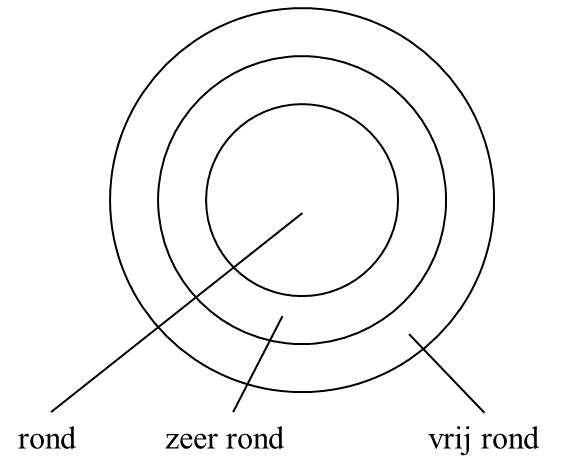
In this respect, the adverbs vrij and zeer in (106b) behave like the approximatives discussed in Section 23.3.2.2, sub II; they simply indicate that the shape of Jan’s face resembles a round shape. The adverb vrij indicates that Jan’s face vaguely resembles a round shape, and zeer indicates that it is close to being round. In other words, there is no scale of roundness implied, but we are dealing with several sets that properly include each other, as in Figure (107); to avoid confusion, note that the circles represent sets, as usual, and have nothing to do with the geometric shape denoted by the adjective rond.
 |
The discussion above has shown that, as far as the degree modifiers are concerned, we can in principle maintain the assumption that the terms scalar and gradable are interchangeable, provided that we assume that vrij and zeer can be used both as degree modifiers and as approximative adverbs. However, when we consider the comparative and superlative forms in (105b), things get more complicated. Consider the examples in (108).
| a. | Jan is groter dan Marie. ⇏ | Jan is groot/niet groot. | |
| Jan is taller than Marie | Jan is tall/not tall |
| b. | De eettafel | is ronder | dan de salontafel. ⇏ | De eettafel | is rond/niet rond. | |
| the dining table | is rounder | than the coffee table | the dining table | is round/not round |
Example (108) with the scalar adjective grootbig implies neither that Jan is tall nor that he is short: as long as Marie is to the left of Jan on the scale of size, the statement in (108a) is true. In other words, (108a) is true for all the situations given in (109).
| Scale of size |
 |
Similarly, example (108b) gives no indication of whether the dining table is round or not (although it does imply that the coffee table is not round). This can be illustrated by Figure (107). If the dining table is part of the set denoted by the adjective rondround, and the coffee table is only part of the larger set denoted by zeer rond, then the sentence in (108b) is true. But this is also true if the dining table is part of the set denoted by zeer rond and the coffee table is part of the set denoted by vrij rond. Consequently, no inference about the shape of the dining table can be made on the basis of (108b).
If we want to maintain that the terms scalar and gradable are the same, we have to assume that there are two kinds of comparatives (and superlatives, but we will not discuss that here), just as in the case of the adverbs vrij and zeer. Since we have just seen that we cannot appeal to logical implications to determine whether we are dealing with a gradable adjective or not, we have no choice but to claim that we are dealing with gradable adjectives if the comparison can be expressed by means of a scale. However, this would run into problems with absolute adjectives like leegempty and volfull. As discussed in Section 23.3.2.2, sub I, these adjectives denote the boundaries of the scale in (72), repeated here as (110).
| Scale of fullness |
|
Nevertheless, an example such as (111a) can be represented as in (111b), where the comparison is represented by a scale. As a result, we would have to conclude that the adjectives leeg and vol are gradable, contrary to fact.
| a. | Mijn fles | is leger | dan de jouwe. | |
| my bottle | is emptier | than the yours | ||
| 'My bottle is emptier than yours.' | ||||
| b. | Scale of fullness |
 |
The discussion above has shown that equating the terms scalar and gradable in the manner described above leads to terminological confusion. Therefore, from now on we will use the opposition between scalar and absolute adjectives. The term gradable adjective will be used in its traditional sense, i.e. for any adjective that can be combined with approximative adverbs such as vrijrather or zeervery and that can undergo comparative/superlative formation.
This subsection discusses a semantic distinction that is independent of the distinction between scalar and absolute adjectives. Some adjectives, such as boosangry or ziekill, express a stage-level (i.e. transitory) property of the entity they modify, whereas others, such as intelligent, denote an individual-level (i.e. more permanent) property. This distinction is syntactically relevant in several ways; cf. Kratzer (1995). Stage-level predicates, for example, (i) can be used in expletive, resultative and absolute met-constructions like (112a-c), (ii) allow the copula wordento become, and (iii) can be combined with a time adverb such as vandaagtoday. These patterns lead to strange results in the case of individual-level adjectives.
| a. | Er | is | iemand | ziek/??intelligent. | |
| there | is | someone | ill/intelligent |
| b. | De spaghetti | maakte | Jan | ziek/??intelligent. | |
| the spaghetti | made | Jan | ill/intelligent |
| c. | [Met Jan ziek/??intelligent] | kan de vergadering | niet | doorgaan. | |
| with Jan ill/intelligent | can the meeting | not | take.place |
| d. | Jan wordt | ziek/*?intelligent. | |
| Jan becomes | ill/intelligent |
| e. | Jan is vandaag | ziek/*intelligent. | |
| Jan is today | ill/intelligent |
The examples in (113) show that some individual-level adjectives are derived from (simple) stage-level adjectives by affixation with -(e)lijk. This is clear from the fact that these adjectives denote defining properties of the referents of the modified noun phrases.
| a. | Jan is arm. | ‘Jan is poor’ |
| a'. | Jan is armelijk. |
| b. | Jan is bang. | ‘Jan is afraid’ |
| b'. | Jan is bangelijk. |
| c. | Jan is ziek. | ‘Jan is ill’ |
| c'. | Jan is ziekelijk. |
| d. | Jan is zwak. | ‘Jan is feeble’ |
| d'. | Jan is zwakkelijk. |
Furthermore, the examples in (114) show that the derived adjectives in the primed examples behave just like the adjective intelligent in (112).
| a. | ?? | Er is iemand ziekelijk. |
| b. | ?? | De spaghetti maakte Jan ziekelijk. |
| c. | ?? | [met Jan ziekelijk] kan de vergadering niet doorgaan |
| d. | *? | Jan wordt ziekelijk. |
| e. | *? | Jan is vandaag ziekelijk. |
Note that affixation with -elijk sometimes leads to a change in the semantic selection properties of the adjective: whereas the simple adjective liefsweet typically denotes a property of animate beings, the derived adjective liefelijk is applied to inanimate objects like houses, landscapes, or paintings.
| a. | Jan/%Het huis | is lief. | |
| Jan/the house | is sweet |
| b. | Het huis/%Jan | is liefelijk. | |
| the house/Jan | is charming |
Note also that not all adjectives derived with -elijk are individual-level adjectives; this affix also derives adjectives that are used as adverbial phrases. An example is the adjective rijkelijk in (116), which is mainly used as a kind of degree adverb; it may sound a little marked in attributive position (although many instances of this use can be found on the internet) and gives rise to a degraded result when used in predicative position; cf. (116a&b). We refer the reader to Chapter 30 for more examples of derived adjectives used mainly as adverbs.
| a. | ? | een | rijkelijke | maaltijd |
| a | rich | meal |
| b. | * | De maaltijd | was rijkelijk. |
| the meal | was rich |
| c. | De tafel | was rijkelijk beladen | met heerlijke gerechten. | |
| the table | was richly loaded | with lovely dishes |
The stage/individual-level reading need not be an inherent property of the adjective itself, but can be determined by the context or by our knowledge of reality. Consider the primeless examples in (117). Since the adverb vandaagtoday can be added to the copular construction in (117a), the adjective grappigfunny in this example clearly expresses a stage-level property. In (117b), on the other hand, the addition of vandaag leads to a strange result, apparently because erg grappigvery funny is not regarded as a transitory property of a novel. Accordingly, the adjective grappig can be used in an expletive copular construction when the subject is [+animate], but not when it is [-animate], as shown in the primed examples in (117).
| a. | Jan was vandaag | erg grappig. | |
| Jan was today | very funny |
| a'. | Er | was iemand | erg grappig | (vandaag). | |
| there | was someone | very funny | today |
| b. | % | De roman | Bezorgde ouders | van Gerard Reve | was vandaag | erg grappig. |
| the novel | Worried Parents | by Gerard Reve | was today | very funny |
| b'. | % | Er | was een roman | erg grappig | (vandaag). |
| there | was a novel | very funny | today |
For completeness, note that example (118) is perfectly acceptable provided that we are discussing today’s episode of the comedy series Mr. Bean. However, this does not imply that being funny is a transitory property of a comedy; the adverbial phrase vandaagtoday functions to identify a particular episode and does not imply that we are dealing with a stage-level property; being funny can simply be seen as an individual-level property of the intended episode.
| De komedie Mr. Bean | was vandaag | erg grappig. | ||
| the comedy Mr. Bean | was today | very funny | ||
| 'Todayʼs episode of Mr. Bean was very funny.' | ||||
