- Dutch
- Frisian
- Saterfrisian
- Afrikaans
-
- Syntax
- Preface and acknowledgements
- Verbs and Verb Phrases
- 1 Verbs: Characterization and classification
- 2 Projection of verb phrases I: Argument structure
- 3 Projection of verb phrases IIIa: Selected clauses/verb phrases (introduction)
- 1.0. Introduction
- 1.1. Main types of verb-frame alternation
- 1.2. Alternations involving the external argument
- 1.3. Alternations of noun phrases and PPs
- 1.4. Some apparent cases of verb-frame alternation
- 1.5. Bibliographical notes
- 4 Projection of verb phrases IIIa: Selected clauses/verb phrases (introduction)
- 4.0. Introduction
- 4.1. Semantic types of finite argument clauses
- 4.2. Finite and infinitival argument clauses
- 4.3. Control properties of verbs selecting an infinitival clause
- 4.4. Three main types of infinitival argument clauses
- 4.5. Non-main verbs
- 4.6. The distinction between main and non-main verbs
- 4.7. Bibliographical notes
- 5 Projection of verb phrases IIIb: Argument and complementive clauses
- 5.0. Introduction
- 5.1. Finite argument clauses
- 5.2. Infinitival argument clauses
- 5.3. Complementive clauses
- 5.4. Bibliographical notes
- 6 Projection of verb phrases IIIc: Complements of non-main verbs
- 7 Projection of verb phrases IIId: Verb clustering
- 8 Projection of verb phrases IV: Adverbial modification
- 9 Word order in the clause I: General introduction
- 10 Word order in the clause II: Position of the finite verb (verb-first/second)
- 11 Word order in the clause III:Clause-initial position (wh-movement)
- 11.0. Introduction
- 11.1. The formation of V1 and V2-clauses
- 11.2. Clause-initial position remains (phonetically) empty
- 11.3. Clause-initial position is filled
- 11.4. Bibliographical notes
- 12 Word order in the clause IV: Postverbal field (extraposition)
- 13 Word order in the clause V: Middle field (scrambling)
- Nouns and Noun Phrases
- 14 Characterization and classification
- 15 Projection of noun phrases I: Complementation
- 15.0. Introduction
- 15.1. General observations
- 15.2. Prepositional and nominal complements
- 15.3. Clausal complements
- 15.4. Bibliographical notes
- 16 Projection of noun phrases II: Modification
- 16.0. Introduction
- 16.1. Restrictive and non-restrictive modifiers
- 16.2. Premodification
- 16.3. Postmodification
- 16.3.1. Adpositional phrases
- 16.3.2. Relative clauses
- 16.3.3. Infinitival clauses
- 16.3.4. A special case: clauses referring to a proposition
- 16.3.5. Adjectival phrases
- 16.3.6. Adverbial postmodification
- 16.4. Bibliographical notes
- 17 Projection of noun phrases III: Binominal constructions
- 17.0. Introduction
- 17.1. Binominal constructions without a preposition
- 17.2. Binominal constructions with a preposition
- 17.3. Bibliographical notes
- 18 Determiners: Articles and pronouns
- 18.0. Introduction
- 18.1. Articles
- 18.2. Pronouns
- 18.3. Bibliographical notes
- 19 Numerals and quantifiers
- 19.0. Introduction
- 19.1. Numerals
- 19.2. Quantifiers
- 19.2.1. Introduction
- 19.2.2. Universal quantifiers: ieder/elk ‘every’ and alle ‘all’
- 19.2.3. Existential quantifiers: sommige ‘some’ and enkele ‘some’
- 19.2.4. Degree quantifiers: veel ‘many/much’ and weinig ‘few/little’
- 19.2.5. Modification of quantifiers
- 19.2.6. A note on the adverbial use of degree quantifiers
- 19.3. Quantitative er constructions
- 19.4. Partitive and pseudo-partitive constructions
- 19.5. Bibliographical notes
- 20 Predeterminers
- 20.0. Introduction
- 20.1. The universal quantifier al ‘all’ and its alternants
- 20.2. The predeterminer heel ‘all/whole’
- 20.3. A note on focus particles
- 20.4. Bibliographical notes
- 21 Syntactic uses of noun phrases
- 22 Referential dependencies (binding)
- Adjectives and Adjective Phrases
- 23 Characteristics and classification
- 24 Projection of adjective phrases I: Complementation
- 25 Projection of adjective phrases II: Modification
- 26 Projection of adjective phrases III: Comparison
- 27 Attributive use of the adjective phrase
- 28 Predicative use of the adjective phrase
- 29 The partitive genitive construction
- 30 Adverbial use of the adjective phrase
- 31 Participles and infinitives: their adjectival use
- Adpositions and adpositional phrases
- 32 Characteristics and classification
- 32.0. Introduction
- 32.1. Characterization of the category adposition
- 32.2. A syntactic classification of adpositional phrases
- 32.3. A semantic classification of adpositional phrases
- 32.4. Borderline cases
- 32.5. Bibliographical notes
- 33 Projection of adpositional phrases: Complementation
- 34 Projection of adpositional phrases: Modification
- 35 Syntactic uses of adpositional phrases
- 36 R-pronominalization and R-words
- 32 Characteristics and classification
- Coordination and Ellipsis
- Syntax
-
- General
-
- General
- Morphology
- Morphology
- 1 Word formation
- 1.1 Compounding
- 1.1.1 Compounds and their heads
- 1.1.2 Special types of compounds
- 1.1.2.1 Affixoids
- 1.1.2.2 Coordinative compounds
- 1.1.2.3 Synthetic compounds and complex pseudo-participles
- 1.1.2.4 Reduplicative compounds
- 1.1.2.5 Phrase-based compounds
- 1.1.2.6 Elative compounds
- 1.1.2.7 Exocentric compounds
- 1.1.2.8 Linking elements
- 1.1.2.9 Separable Complex Verbs and Particle Verbs
- 1.1.2.10 Noun Incorporation Verbs
- 1.1.2.11 Gapping
- 1.2 Derivation
- 1.3 Minor patterns of word formation
- 1.1 Compounding
- 2 Inflection
- 1 Word formation
- Morphology
- Syntax
- Adjectives and adjective phrases (APs)
- 0 Introduction to the AP
- 1 Characteristics and classification of APs
- 2 Complementation of APs
- 3 Modification and degree quantification of APs
- 4 Comparison by comparative, superlative and equative
- 5 Attribution of APs
- 6 Predication of APs
- 7 The partitive adjective construction
- 8 Adverbial use of APs
- 9 Participles and infinitives as APs
- Nouns and Noun Phrases (NPs)
- 0 Introduction to the NP
- 1 Characteristics and Classification of NPs
- 2 Complementation of NPs
- 3 Modification of NPs
- 3.1 Modification of NP by Determiners and APs
- 3.2 Modification of NP by PP
- 3.3 Modification of NP by adverbial clauses
- 3.4 Modification of NP by possessors
- 3.5 Modification of NP by relative clauses
- 3.6 Modification of NP in a cleft construction
- 3.7 Free relative clauses and selected interrogative clauses
- 4 Partitive noun constructions and constructions related to them
- 4.1 The referential partitive construction
- 4.2 The partitive construction of abstract quantity
- 4.3 The numerical partitive construction
- 4.4 The partitive interrogative construction
- 4.5 Adjectival, nominal and nominalised partitive quantifiers
- 4.6 Kind partitives
- 4.7 Partitive predication with a preposition
- 4.8 Bare nominal attribution
- 5 Articles and names
- 6 Pronouns
- 7 Quantifiers, determiners and predeterminers
- 8 Interrogative pronouns
- 9 R-pronouns and the indefinite expletive
- 10 Syntactic functions of Noun Phrases
- Adpositions and Adpositional Phrases (PPs)
- 0 Introduction to the PP
- 1 Characteristics and classification of PPs
- 2 Complementation of PPs
- 3 Modification of PPs
- 4 Bare (intransitive) adpositions
- 5 Predication of PPs
- 6 Form and distribution of adpositions with respect to staticity and construction type
- 7 Adpositional complements and adverbials
- Verbs and Verb Phrases (VPs)
- 0 Introduction to the VP in Saterland Frisian
- 1 Characteristics and classification of verbs
- 2 Unergative and unaccusative subjects and the auxiliary of the perfect
- 3 Evidentiality in relation to perception and epistemicity
- 4 Types of to-infinitival constituents
- 5 Predication
- 5.1 The auxiliary of being and its selection restrictions
- 5.2 The auxiliary of going and its selection restrictions
- 5.3 The auxiliary of continuation and its selection restrictions
- 5.4 The auxiliary of coming and its selection restrictions
- 5.5 Modal auxiliaries and their selection restrictions
- 5.6 Auxiliaries of body posture and aspect and their selection restrictions
- 5.7 Transitive verbs of predication
- 5.8 The auxiliary of doing used as a semantically empty finite auxiliary
- 5.9 Supplementive predication
- 6 The verbal paradigm, irregularity and suppletion
- 7 Verb Second and the word order in main and embedded clauses
- 8 Various aspects of clause structure
- Adjectives and adjective phrases (APs)
Modality is used as a cover term for the various meanings that can be expressed by modal verbs and adverbs. For the Dutch modal verb moetenmust in example (307a), Barbiers (1995a: §5) has argued that it can have the four interpretations in (307b).
| a. | Jan | moet | schaatsen. | |
| Jan | must | skate |
| (i) | Dispositional: Jan definitely wants to skate. |
| (ii) | Directed deontic: Jan has the obligation to skate. |
| (iii) | Non-directed deontic: It is required that Jan skate. |
| (iv) | Epistemic: It must be the case that Jan skates. |
The first three interpretations of (307b) can be seen as subcases of event modality and stand in contrast to interpretation (iv), which can be seen as a subcase of propositional modality. The main difference is that event modality expresses the speaker’s view of the driving forces that favor the potential realization of the event referred to by the proposition expressed by the lexical projection of the embedded verb (e.g. obligation, volition, and ability). Epistemic modality, on the other hand, expresses the speaker’s view of the truth of that proposition (e.g. necessity, probability, and likelihood). The examples in (308) show that the two groups can be easily distinguished syntactically, since they behave differently in perfect-tense constructions referring to eventualities that precede speech time n (but not in perfect-tense constructions referring to future eventualities); dispositional/deontic modal verbs appear as non-finite forms in such constructions, while epistemic modal verbs usually appear as finite forms (cf. Section 5.2.3.2, sub III, for further discussion).
| a. | Jan heeft | gisteren | moeten | schaatsen. | event modality | |
| Jan has | yesterday | must | skate | |||
| 'Jan had to skate yesterday.' | ||||||
| b. | Jan moet | gisteren | hebben | geschaatst. | epistemic modality | |
| Jan must | yesterday | have | skated | |||
| 'It must be the case that Jan skated yesterday.' | ||||||
This section focuses on epistemic modality. Subsection I begins with a brief discussion of the epistemic modal verbs moetenmust and kunnencan. Subsection II argues that the verb zullen behaves in all relevant respects as an epistemic modal verb, and that the future reading usually attributed to this verb is a matter of pragmatics. Subsection III supports this conclusion by showing that we find the same pragmatic effect with other kinds of verbs.
Epistemic modality is concerned with the mental representation of the world of the language user, who may imagine states of affairs to be different from what they are in the actual world, states of affairs as they will be in the future, and so on. Consider the examples in (309).
| a. | Dat huis | stort | in. | |
| that house | collapses | prt. | ||
| 'It is the case that that house collapses.' | ||||
| b. | Dat huis | moet | instorten. | |
| that house | must | prt.-collapse | ||
| 'It must be the case that that house will collapse.' | ||||
| c. | Dat huis | kan | instorten. | |
| that house | may | prt.-collapse | ||
| 'It may be the case that that house will collapse.' | ||||
By uttering sentences like these, the speaker provides an assessment, based on the information available to him, of the likelihood that eventuality k will actually occur. In the default (non-future) reading of (309a), the speaker witnesses the collapse of the house. In the case of (309b&c) there is no collapse at speech time n, but the speaker asserts something about the likelihood of a future collapse. By uttering (309b) or (309c), the speaker is in a sense quantifying over a set of possible, i.e. not (yet) actualized, worlds: the modal verb moetenmust functions as a universal quantifier, used by the speaker to assert that the eventuality of the house collapsing will occur in all possible worlds; kunnenmay, on the other hand, functions as an existential quantifier, used by the speaker to assert that this eventuality will occur in at least one possible world. Note that the future reading triggered by these epistemic modal verbs need not be attributed to the modal verb itself, since example (309a) can also be used with a future reading; cf. Section 1.5.4.
We can represent the meaning of examples like (309b&c) with temporal diagrams of the type shown in Figure 19, which are essentially the same as those introduced in Section 1.5.1 with the addition of possible worlds. Again, n stands for the speech time, i for the present of the speaker/hearer, ia for the actualized part of this present, and i◊ for its non-actualized part. The index k stands for the event denoted by the lexical projection of the embedded main verb, and the solid line below it for the actual duration of k. Finally, the index j represents the present of k, i.e. the temporal domain in which k must be located. The possible worlds in Figure 19 can differ with respect to (i) whether eventuality k occurs or not, and (ii) the precise location of eventuality k on the time axis. Representations such as Figure 19 are, of course, simplifications in the sense that they select a number of possible worlds that suit our illustrative purposes from an in principle infinite set of such worlds.
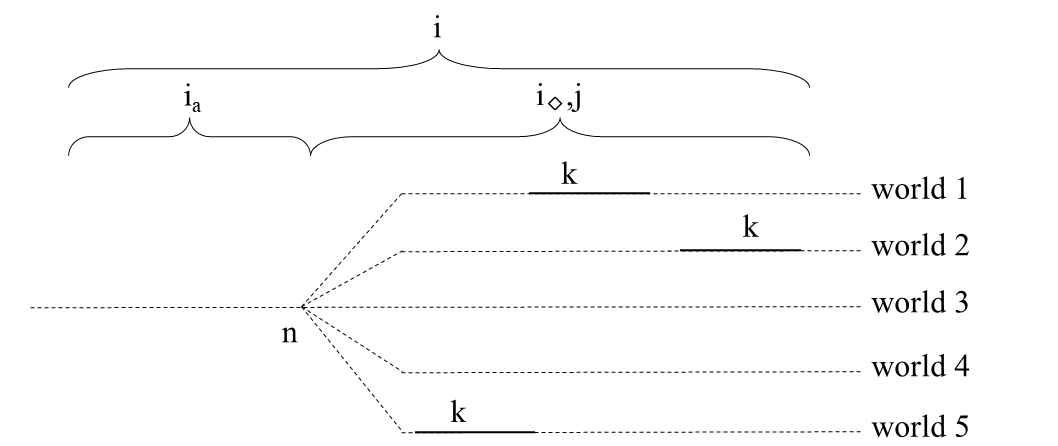
Figure 19 is a correct semantic representation of the assertion in example (309c) with existential kunnen, since there is at least one possible world in which the eventuality denoted by the lexical projection of the embedded main verb occurs, but it is an incorrect representation of the assertion in (309b) with universal moeten, because the eventuality does not occur in possible worlds 3 and 4.
The examples in (310) show that epistemic modal verbs can easily occur in the past tense. The addition of the particle/adverbial phrase in brackets will make these examples sound more natural in isolation, but they are also perfectly acceptable without it in a proper discourse.
| a. | Dat huis | moest | (wel) | instorten. | |
| that house | had. to | prt | prt.-collapse | ||
| 'That house was bound to collapse.' | |||||
| b. | Dat huis | kon | (elk moment) | instorten. | |
| that house | might | any moment | prt.-collapse | ||
| 'It might have been the case that that house would collapse any moment.' | |||||
Now consider the representation in Figure 20, where n' stands for the virtual speech-time-in-the past that serves as the point of perspective, and i stands for the relevant past-tense interval. Figure 20 is a correct representation of the assertion in (310b), given that there are possible worlds in which eventuality k occurs, but an incorrect representation of the assertion in (310a), given that there are possible worlds in which eventuality k does not occur. Figure 20 is again a simplification; it selects a number of possible worlds from an in principle infinite set of possible worlds that suit our illustrative purposes. From now on, our semantic representations will contain only the minimal selection of possible worlds needed to illustrate our point.
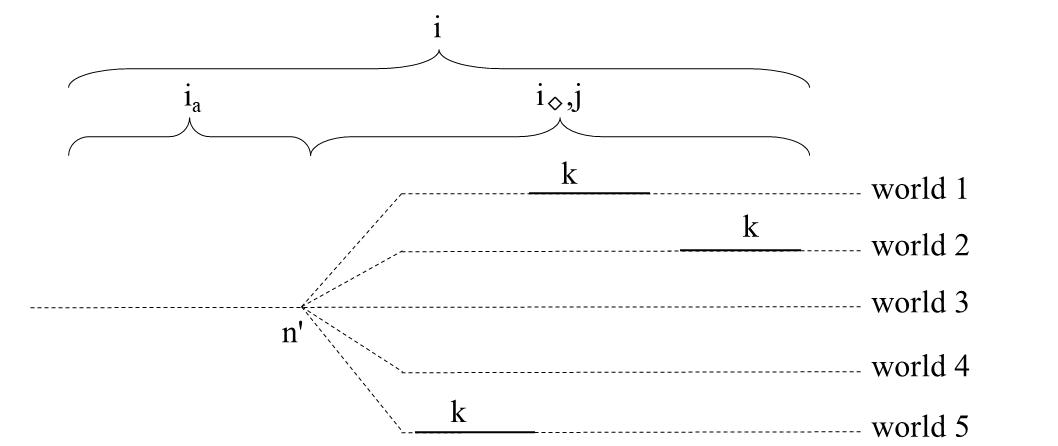
Note that examples like (310) are typically used when speech time n is not included in the past-tense interval. Examples such as (310a) are used when eventuality k occurred before n, to suggest that the occurrence of k was inevitable. Examples such as (310b), on the other hand, are used especially when eventuality k has not occurred in the actual world, to suggest that certain measures have prevented k from happening, that we are dealing with a lucky escape, etc. We will return to these restrictions on the use of examples like (310) in Section 1.5.2, sub IIC, and limit ourselves here to noting that the epistemic modals differ in this respect from their deontic counterparts, which usually do not carry such implications: the past-tense construction with deontic moeten in (311), for example, can refer to both factual and counterfactual situations.
| Jan moest | verleden week | dat boek | lezen, ... | ||
| Jan had. to | last week | that book | read | ||
| 'Jan was obliged to read that book last week, ...' | |||||
| a. | ... | maar | hij | heeft | het | niet | gedaan. | counterfactual | |
| ... | but | he | has | it | not | done | |||
| '... but he did not do it.' | |||||||||
| b. | ... | en | het | is hem | met veel moeite | gelukt. | factual | |
| ... | and | it | is him | with much trouble | succeeded | |||
| '... and he has managed to do it with a lot of difficulty.' | ||||||||
In Figure 19 and Figure 20, the splitting point into possible worlds (henceforth: split-off point) starts at n or n'. However, this is by no means necessary. Consider the following scenario. There was a storm last week and on Sunday the speaker inspected his weekend home and saw that it was badly damaged. Since it will remain stormy this week, the speaker is worried about what will happen to the house and on Tuesday he expresses his concern by uttering sentence (312).
| Mijn huis | moet | deze week | instorten. | ||
| my house | must | this week | prt.-collapse | ||
| 'It must be the case that my house will collapse this week.' | |||||
Because the speaker does not know whether the house is still standing at n, the utterance refers to the situation depicted in Figure 21, in which the split-off point is located at the moment when the speaker left the house on Sunday; the present j of eventuality k, which is specified by the adverbial phrase deze weekthis week, therefore begins on Monday and ends on Sunday next. In this situation it is irrelevant whether eventuality k precedes, overlaps or follows n.
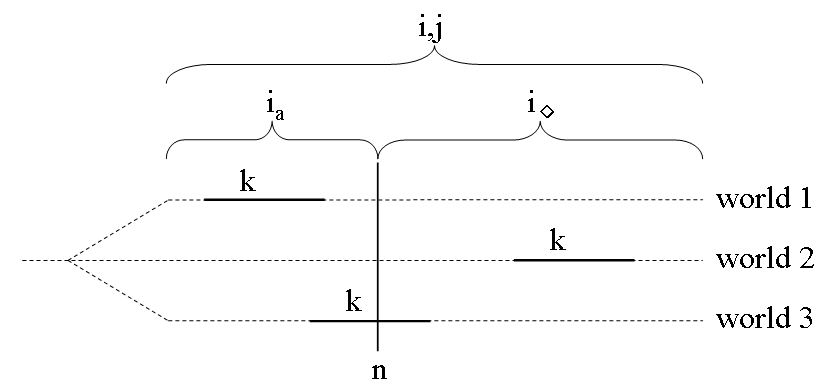
That k can be anywhere within time interval j is related to the fact that the speaker has a knowledge gap about his actual world; he simply does not know at n whether the house is still standing, i.e. in which possible world he actually lives. In fact, this is made explicit in (313) by the addition of a sentence that explicitly states that the collapse may have already occurred at speech time n.
| Mijn huis moet | deze week | instorten. | Mogelijk | is | het | al | gebeurd. | ||
| my house must | this week | prt.-collapse | possibly | is | it | already | happened | ||
| 'It must be the case that my house will collapse this week. Possibly it has already happened.' | |||||||||
The situation is quite different when the knowledge of the speaker is up-to-date. Suppose that the speaker is looking at the house with someone on Tuesday and that he utters the sentence in (314).
| Dit huis | moet | deze week | instorten. | ||
| this house | must | this week | prt.-collapse | ||
| 'This house has got to collapse this week. It's got to be!' | |||||
We now conclude that the house is still standing at speech time n, and infer from this that the collapse of the house is claimed to take place in the non-actualized part of the present-tense interval i◊; this is not a matter of semantics, but of pragmatics. The infelicity of utterance (314) in a world where the speaker already knows that the house has collapsed follows from Grice’s (1975) maxim of quantity, because the speaker could have described this situation more accurately by using the perfect-tense construction in (315), which places the eventuality in the actualized part of the present-tense interval ia; cf. Section 1.5.4.2.
| Dit huis | is | deze week | ingestort. | ||
| this house | has | this week | prt.-collapsed | ||
| 'This house has collapsed this week.' | |||||
The observations on (314) and (315) show that the simple present can only be used to refer to an eventuality preceding speech time n if the speaker is underinformed about the actual situation at n. If he has more specific information about the location of the eventuality, he will use the tense that most aptly describes that location. As a result, example (313) does not primarily provide temporal information about the eventuality of a collapse, but information about the necessity of this eventuality.
We conclude with a closely related observation. The past-tense counterpart of (312) can also be followed by a sentence that explicitly states that the collapse can already have taken place at speech time n. We assume here the same situation as in (313): the sentence uttered on Tuesday looks back to some virtual speech-time-in-the-past n', at which it was said that the house would collapse during the time interval referred to by the adverbial phrase deze weekthis week, i.e. a time interval that includes speech time n. Since the speaker is underinformed about the actual state of his house, what counts is not the actual eventuality of a collapse but the necessity of this eventuality.
| Mijn huis moest | deze week | instorten. | Mogelijk | is | het | al | gebeurd. | ||
| my house must | this week | prt.-collapse | possibly | is | it | already | happened | ||
| 'It had to be the case that my house would collapse this week. Possibly it has already happened.' | |||||||||
The observations in (313) and (316) show that the use of an epistemic modal shifts attention from the actual location of eventuality k within the interval j to epistemic information; the speaker focuses primarily on the necessity, probability, likelihood, etc. of the occurrence of eventuality k within j. Information about the exact location of k is of a secondary nature and depends on contextual information that determines the split-off point of possible worlds as well as information about the speaker’s knowledge state. Our findings are summarized in (317).
| Temporal interpretation of epistemic modal, simple present/past constructions: |
| a. | If the split-off point of the possible worlds is located at speech time n, eventuality k cannot be located in the actualized part ia of the present/past-tense interval, because the maxim of quantity would then favor a present/past perfect-tense construction. |
| b. | If the split-off point of the possible worlds precedes speech time n, the temporal interpretation depends on the speaker’s knowledge state: |
| (i) | if the speaker is underinformed, i.e. not able to observe immediately whether eventuality k has occurred, eventuality k may be located before speech time n. |
| (ii) | if the speaker is not underinformed, i.e. able to observe immediately whether eventuality k has occurred, eventuality k cannot be located before speech time n, because the maxim of quantity would then favor a present/past perfect-tense construction. |
The binary tense system discussed in Section 1.5.1 takes zullen as a future auxiliary in examples such as (318a). However, it is also claimed that zullen can be used as an epistemic modal verb in examples such as (318b); cf. Haeseryn et al. (1997:944). On this view, there are two verbs zullen, one temporal and the other modal.
| a. | Marie zal | dat boek | morgen | versturen. | temporal: future | |
| Marie will | that book | tomorrow | send | |||
| 'Marie will send that book tomorrow.' | ||||||
| b. | Marie zal | dat boek | wel | versturen. | modal: probability | |
| Marie will | that book | prt | send | |||
| 'It is very likely that Marie will send that book.' | ||||||
That zullenwill need not be a future auxiliary can also be seen from the fact that the example with zullen in (319b) behaves similarly to the example with the epistemic verbs moeten/kunnenmust/may in (319a), in that they both refer to an eventuality k that overlaps speech time n, as is clear from the use of the adverb nunow.
| a. | Het | is vier uur. | Marie moet/kan | nu | wel | thuis | zijn. | |
| it | is 4.00 p.m. | Marie must/may | now | prt | at.home | be | ||
| 'It is 4.00 p.m. Marie must/may be at home now.' | ||||||||
| b. | Het | is vier uur. | Marie zal | nu | wel | thuis | zijn. | |
| it | is 4.00 p.m. | Marie will | now | prt | at.home | now | ||
| 'It is 4.00 p.m. Marie will be at home now.' | ||||||||
The examples in (318) and (319) do not necessarily lead to the conclusion that zullen is homonymous, because Subsection I has shown that epistemic modals like moeten/kunnen can also be used in examples with a future interpretation. In fact, this behavioral agreement suggests that zullen functions consistently as an epistemic modal; cf. Janssen (1983/1989), and Erb (2001) for the same conclusion for German werdenwill. The following subsections will further support this conclusion.
The claim that zullen is homonymous is often motivated by the interpretation given to sentences such as (318). Example (318a) is interpreted to mean that the eventuality of Marie sending that book will occur tomorrow; the information is primarily about the location of the eventuality relative to speech time n, and this suggests that zullen is essentially temporal. Example (318b) is about whether or not Marie will send that book, i.e. whether the speaker thinks it probable that she will: this would suggest that zullen essentially expresses an epistemic modality, and that temporality is not at issue.
A contrast between a temporal and a probability reading should result from the addition ... maar je weet het natuurlijk nooit echt zeker... but one never knows for sure, of course, since this should only lead to an acceptable result with sentences expressing probability; in sentences expressing future the result should be semantically incoherent, because the added clause contradicts the supposed core meaning of the first clause. That this does not come true is shown by the fact that both examples in (320) are perfectly acceptable.
| a. | Marie zal | dat boek | morgen | versturen ... | (maar | je | weet | het | natuurlijk | nooit | echt | zeker | bij haar). | ||||||||||
| Marie will | that book | tomorrow | send | but | you | know | it | of.course | never | really | certain | with her | |||||||||||
| 'Marie will send that book tomorrow (although one never knows for certain with her, of course).' | |||||||||||||||||||||||
| b. | Marie zal | dat boek | wel | versturen .... | (maar | je | weet | het | natuurlijk | nooit | echt | zeker | bij haar). | ||||||||||
| Marie will | that book | prt | send | but | you | know | it | of.course | never | really | certain | with her | |||||||||||
| 'It is very likely that Marie will send that book (although one never knows for sure with her, of course).' | |||||||||||||||||||||||
Haeseryn et al. (1997:994) notes that examples with a probability reading usually include the modal particle wel, which raises the possibility that the probability reading is not part of the meaning of the verb zullen, but should be attributed to the particle. This proposal is supported by the fact that examples such as (321) receive a probability reading without the help of the verb zullen, and it is also consistent with the fact that Van Dale’s dictionary simply classifies wel as a modal adverb that can express a conjecture or doubt.
| Marie stuurt | dat boek | wel. | ||
| Marie sends | that book | prt | ||
| 'It is very likely that Marie will send that book.' | ||||
If wel is indeed responsible for the probability meaning of examples such as (318b), it is no longer clear that the two occurrences of zullen in (318) differ in meaning. That these occurrences may have identical meanings might find support in the fact that the two examples in (318) receive similar quantificational force when we add modal adverbs like zekercertainly or misschienmaybe, as in (322).
| a. | Marie zal | dat boek | morgen | zeker/misschien | sturen. | |
| Marie will | that book | today | certainly/maybe | send | ||
| 'It will certainly/maybe be the case that Marie will send that book tomorrow.' | ||||||
| b. | Marie zal | dat boek | zeker/misschien | wel | sturen. | |
| Marie will | that book | certainly/maybe | prt | send | ||
| 'It will certainly/maybe be the case that Marie will send that book.' | ||||||
The acceptability of (322b) would be surprising if the meaning aspect “probably” of (318b) were due to the meaning of zullen. First, this presumed meaning of zullen is inconsistent with the meaning “certainly” expressed by the adverb zeker, and we would therefore wrongly predict example (322b) to be semantically incoherent with that adverb. Second, this presumed meaning aspect of zullen is very similar to the meaning expressed by the adverb misschienmaybe, and therefore one would expect example (322b) to have the feel of a tautology with that adverb. The fact that this is not borne out again suggests that the epistemic meaning aspect of (318b) should be attributed to the modal particle wel; this can be supported by the fact, illustrated in (323), that the combinations zeker wel and misschien wel can also be used to express epistemic modality in constructions without zullen. We therefore conclude that the two occurrences of zullen in (318) are semantically more similar, if not identical, than is often assumed, if not identical.
| a. | Marie stuurt | dat boek | zeker | wel. | |
| Marie sends | that book | certainly | prt | ||
| 'It is virtually certain that Marie will send the book.' | |||||
| a'. | Stuurt | Marie | dat boek? | ja, | zeker | wel. | |
| sends | Marie | that book | yes | certainly | prt | ||
| 'Will Marie send the book? Yes, definitely.' | |||||||
| b. | Marie stuurt | dat boek | misschien | wel. | |
| Marie sends | that book | maybe | prt | ||
| 'Marie may send the book.' | |||||
| b'. | Stuurt | Marie | dat boek? | ja, | misschien | wel. | |
| sends | Marie | that book | yes | maybe | prt | ||
| 'Will Marie send the book? Yes, maybe.' | |||||||
On the basis of their morphosyntactic behavior, it is less easy to establish that the two occurrences of zullen in (318) are similar. At first glance, the primeless sentences in (324) seem to show that, like the epistemic modals moeten and kunnen, the two occurrences of zullen appear as the finite verb in the corresponding perfect-tense constructions referring to eventualities preceding speech time n, whereas the primed examples seem to show that they do not allow the syntactic format usually found with deontic modals; cf. the examples in (308) in the introduction to Section 1.5.2. The problem with this argument, however, is that some readers will reject the idea that the (a)-examples with gisterenyesterday involve temporal zullen simply because we are dealing with an eventuality preceding n in this case. Nevertheless, we include this argument because it should be valid for readers who follow Hornstein’s (1990) implementation of Reichenbach’s tense system, which predicts that the future perfect can refer to eventualities preceding speech time n.
| a. | Marie | zal | dat boek | gisteren | hebben | verstuurd. | |
| Marie | will | that book | yesterday | have | sent | ||
| 'Marie will have sent that book yesterday.' | |||||||
| a'. | * | Marie heeft | dat boek | gisteren | zullen | versturen. |
| Marie has | that book | yesterday | will | sent |
| b. | Marie | zal | het boek | gisteren | wel | verstuurd | hebben. | |
| Marie | will | the book | yesterday | probably | sent | have | ||
| 'Marie will probably have sent the book yesterday.' | ||||||||
| b'. | * | Marie heeft | het boek | gisteren | wel | zullen | versturen. |
| Marie has | the book | yesterday | probably | will | send |
We will not pursue this argument further, and conclude this subsection by noting that the past-tense counterpart of example (324a') seems perfectly acceptable. However, examples such as (325) are irrealis constructions of a special kind, in which hebben does not seem to function as a perfect auxiliary (cf. Section 1.4.3, sub II), so we will ignore these irrealis constructions here.
| Marie had dat boek | gisteren | zullen | versturen | (maar | ze had geen tijd). | ||
| Marie had that book | yesterday | will | send | but | she had no time | ||
| 'Marie would have sent that book yesterday (but she could not find the time).' | |||||||
If the two occurrences of zullen in (318) are not homonymous, but representatives of a single category, we need to determine whether we are dealing with a future auxiliary or an epistemic modal. If zullen is a future auxiliary, we would expect the use of its present-tense forms to have the effect of locating eventuality k in the non-actualized part i◊ of the present-tense interval, as in Figure 22, where we take n to be the split-off point for the possible worlds. Note that we saw earlier that zullen does not imply that eventuality k occurs in all possible worlds, but we ignore this for the moment for the sake of simplicity.
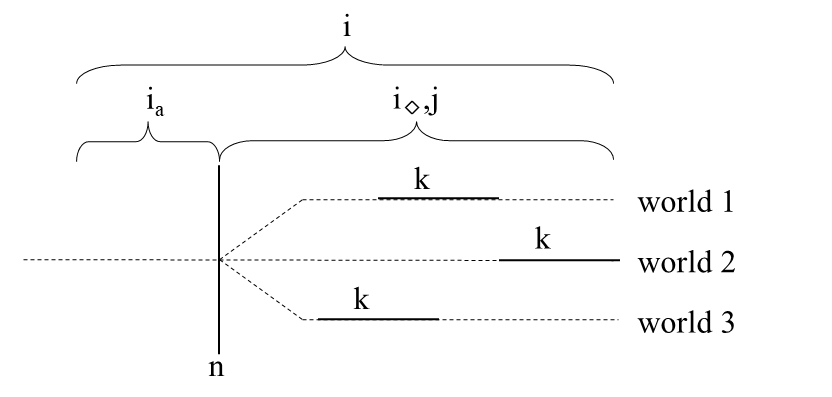
Figure 22: Future reading of zullenwill
If zullen is an epistemic modal, on the other hand, we would expect that its present-tense forms are also possible when the split-off point precedes n and eventuality k is located in the actualized part ia of the present-tense interval, as in Figure 23. Since the examples in (319) in the introduction to this subsection have already shown that in certain examples with zullen eventuality k can overlap with speech time n, the discussion below will focus on whether k can also precede n.
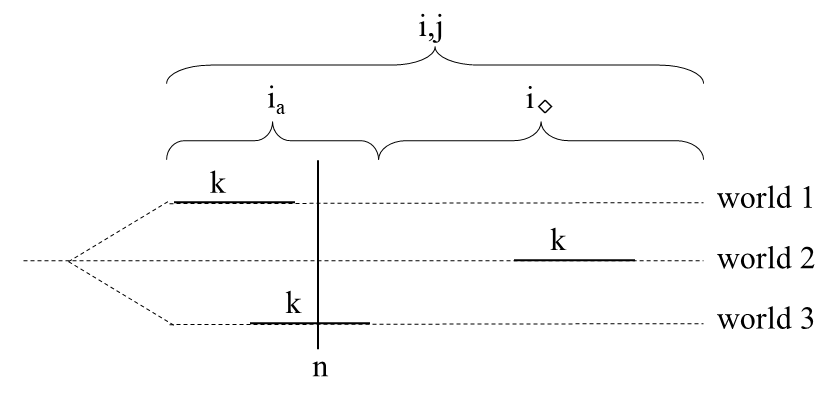
The representation in Figure 23 is essentially the one we gave in Figure 21 for example (313) with epistemic moetenmust; the main difference is the fact, not indicated here, that while moeten is a universal quantifier, the use of zullen does not imply that the speaker asserts that eventuality k will occur in all possible worlds. This means that we can easily test whether zullen can be used epistemically by considering the result of replacing moeten in (313) by zullen, as in (326).
| Mijn huis | zal | deze week | instorten. | Mogelijk | is | het | al | gebeurd. | ||
| my house | will | this week | prt.-collapse | possibly | is | it | already | happened | ||
| 'My house will collapse this week. Possibly, it has already happened.' | ||||||||||
Now suppose the same context as for (313): there was a storm last week, and on Sunday the speaker inspected his weekend home and saw that it was badly damaged. Since the weather has continued to be stormy, the speaker is worried about the house, and on Tuesday he expresses his concern by uttering sentence (326). In the given context, this sentence would be considered true if the house had already collapsed on Monday, as in world 1 of Figure 23: we can therefore conclude that zullen does indeed exhibit the semantic hallmark of epistemic modals.
As in the case of moeten and kunnen, the unambiguous future readings in Figure 22 should be seen as the result of pragmatics. This becomes clear when we replace the modal moeten in example (314) by zullen, as in (327a). The proximate demonstrative dit in dit huisthis house suggests that the speaker is able to evaluate the actual state of the house at speech time n. It now follows from Grice’s (1975) maxim of quantity that (327a) can only be used if the house is still standing: if the house is already in ruins at n, the speaker could, and therefore would, have expressed this more accurately by using the perfect-tense construction in (327b).
| a. | Dit huis | zal | deze week | instorten. | |
| this house | will | this week | prt.-collapse | ||
| 'This house will collapse this week.' | |||||
| b. | Dit huis | is | deze week | ingestort. | |
| this house | has | this week | prt.-collapse | ||
| 'This house has collapsed this week.' | |||||
In the situation just described, a simple present sentence such as (328) would also receive a future interpretation for the same pragmatic reason; if the house is already in ruins at n, the speaker could again have expressed this more accurately by the perfect-tense construction in (327b). This shows that the future reading of (328) is independent of the use of the verb zullen.
| Dit huis | stort | deze week | in. | ||
| this house | collapses | this week | prt. | ||
| 'This house will collapse this week.' | |||||
Finally, note that the speaker who uttered sentence (326) could also have used the sentence in (329), since the two examples express virtually identical meanings; cf. the discussion of moeten in sentences like (313) and (316).
| Mijn huis zou | deze week | instorten. | Mogelijk | is | het | al | gebeurd. | ||
| my house would | this week | prt.-collapse | maybe | is | it | already | happened | ||
| 'My house would collapse this week. Maybe it has already happened.' | |||||||||
The possibility that the house is still standing at speech time n is left open not only in (326), but also in (329), because speech time n can be included in the past-tense interval i; cf. the definition of [+past] in Section 1.5.1, sub C, example (280b). However, the two examples differ in the perspective from which the information about eventuality k is presented. In (326) the information is presented from the perspective of the actual speech time n of the speaker/hearer, since it can be followed by the present-tense clause ... zo is mij verteldso I am told. In (329), on the other hand, the information is presented from the perspective of the virtual speech-time-in-the past n', since it can only be followed by a past-tense clause: ... zo werd mij verteldso I was told. This suggests that the choice between present and past tense is determined by the desire to speak about eventuality k on the basis of information available within a given present-tense interval or within a given past-tense interval i, respectively.
That eventuality k can precede speech time n in sentences with zullen can also be illustrated by non-telic predicates; cf. Janssen (1983). An example such as (330) is threefold ambiguous regarding the location of eventuality k. First, if the speaker and hearer know that Jan has already departed, the speaker can use (330) to express his expectation that Jan has already traveled for three hours at the moment of speech (k < n). Second, if the speaker and hearer know that Jan left one hour earlier, the speaker can use (330) to express his expectation that Jan will arrive in two hours (n is included in k). Third, if the speaker and hearer know that Jan has not yet left, (330) can be used to express the speaker’s expectation that Jan will make a future journey that will take three hours (n < k).
| Jan zal | in totaal | drie uur | onderweg | zijn. | ||
| Jan will | in total | three hours | on.the.road | be | ||
| 'Jan will be on the road for three hours.' | ||||||
Note, however, that the three readings of (330) differ in their implications for the duration of Jan’s journey. The first reading (k < n) can be used if the speaker knows that the entire journey will take longer than three hours, whereas in the second and third readings the speaker expresses that the journey will take three hours. We assume that this is a side effect of the fact that the first reading implies some evaluation time that is identical to the speech time, which could be made explicit by the adverb nunow. If we override this default evaluation time by adding an adverbial phrase such as morgenmiddag om drie uurat 3 p.m. tomorrow, the future reading (n < k) of this example will also allow the reading that the journey will take longer than three hours. Leaving aside this effect, we can conclude that the triple ambiguity of (330) with respect to the position of k shows that examples with zullen can have the temporal representation in Figure 23, and thus that zullen is not a future auxiliary.
This subsection has shown that the interpretation of simple present/past-tense constructions with the verb zullen is similar to the interpretation of simple present/past constructions with the epistemic modals moetenmust and kunnenmay. This means in particular that in both cases inferences about the exact position of eventuality k (i.e. whether it is located before or after speech time n) are made along the lines sketched in (317) in Subsection I. We take this as a conclusive argument for the assumption that zullen is not a future auxiliary; cf. Janssen (1983) for a similar line of reasoning.
Now that we have established that zullen is not a future auxiliary, we can conclude that it is an epistemic modal verb. In this subsection we will try to establish more precisely what its meaning contribution is.
It seems that zullenwill differs from epistemic modal verbs like moetenmust and kunnenmay in that it has no intrinsic quantificational force. This will be clear from the examples in (331), in which the quantificational force must be attributed to the modal adverbs: zekercertainly expresses universal quantification over possible worlds, mogelijk/misschienpossibly expresses a low degree of probability, and waarschijnlijkprobably expresses a high degree of probability.
| a. | Dit huis | zal | deze week | zeker | instorten. | universal | |
| this house | will | this week | certainly | prt.-collapse | |||
| 'This house will certainly collapse this week.' | |||||||
| b. | Dit huis | zal | deze week | mogelijk/misschien | instorten. | low degree | |
| this house | will | this week | possibly/maybe | prt.-collapse | |||
| 'Possibly/Maybe, this house will collapse this week.' | |||||||
| c. | Dit huis | zal | deze week | waarschijnlijk | instorten. | high degree | |
| this house | will | this week | probably | prt.-collapse | |||
| 'This house will probably collapse this week.' | |||||||
If zullen were inherently quantificational, we would expect the examples in (331) to be degraded or to produce certain special effects (which is indeed the case to varying degrees when we replace zullen with moeten or kunnen). For example, if zullen by itself expressed universal quantification, the modal adverb zeker in (331a) would be tautological and the adverbs mogelijk and waarschijnlijk in (331b&c) would be contradictory; if zullen by itself expressed existential quantification, the reverse would hold. Nevertheless, it should be noted that examples like (326) and (327a), which do not contain any element with quantificational force, are typically used when the speaker has strong reason to believe that eventuality k will occur in all possible worlds; high degree quantification therefore seems to be the default reading of sentences with zullen.
In order to describe the semantic contribution of zullenwill, we need to discuss a semantic aspect of epistemic modality that has only been mentioned in passing. Epistemic modality stands in contrast to what is known as metaphysical modality. The latter is concerned with objective truth and is part of a very long philosophical tradition concerned with the reliability of scientific knowledge. Epistemic modality, on the other hand, is concerned with the degree of certainty that an individual assigns to the truth of a proposition on the basis of his knowledge (cf. Greek epistemeknowledge). Epistemic modal verbs like moetenmust and kunnencan, for example, do not express a degree of probability that is objectively given, but one that results from an individual’s assessment of the situation based on the knowledge available to him. Hence, the difference between the declarative clause without a modal verb in (332a) and the declarative clause with a modal verb in (332b) is that in the former the proposition that Marie is at home is merely asserted “without indicating the reasons for that assertion or the speaker’s commitment to it” (Palmer 2001:64), while in the latter the modal verb indicates “that a judgment has been made or that there is evidence for the proposition” (Palmer 2001:68).
| a. | Marie is nu | thuis. | |
| Marie is now | at.home | ||
| 'Marie is at home now.' | |||
| b. | Marie moet/kan | nu | thuis | zijn. | |
| Marie must/may | now | at.home | be | ||
| 'Marie must/may be at home now.' | |||||
In his Kritik der reinen Vernunft (1781), Immanuel Kant already distinguished three types of epistemic modality, which he called problematic, apodeictic, and assertoric modality. Palmer (2001) makes essentially the same distinctions in Section 2.1; he refers to the three types as speculative, deductive and assumptive modality. Illustrations are given in (333).
| a. | Marie kan | nu | thuis | zijn. | problematic/speculative | |
| Marie may | now | at.home | be |
| b. | Marie moet | nu | thuis | zijn. | apodeictic/deductive | |
| Marie must | now | at.home | be |
| c. | Marie zal | nu | thuis | zijn. | assertoric/assumptive | |
| Marie will | now | at.home | be |
By uttering examples such as (333), the speaker provides three different epistemic judgments about (his commitment to the truth of) the proposition that Marie is at home. The use of kunnenmay in (333a) presents the proposition as a possible conclusion: the speaker is uncertain whether the proposition is true, but on the basis of the information available to him he cannot exclude it. The use of moetenmust in (333b) presents the proposition as the only possible conclusion: on the basis of the information available the speaker concludes that it is true. Finally, the use of zullenwill in (333c) presents the proposition as a reasonable but uncertain conclusion on the basis of the available evidence; cf. also Droste (1958:311) and Janssen (1983/1989). Palmer (2001) further suggests that the evidence may include experience and generally accepted knowledge as in Het is vier uur; Marie kan/moet/zal nu thuis zijnIt is 4.00 p.m.; Marie may/must/will be home now. Contrary to Palmer (2001: §2.1.2), we think that (at least in Dutch) this holds not only for assumptive, but for all kinds of epistemic modality.
The claim that epistemic modality involves some subjective evaluation is fully compatible with our earlier claim that epistemic modality introduces a set of possible worlds. Indeed, the notion of a possible world only makes sense if such a world is accessible in the sense that it can be entered from the world that is taken as the starting point. Thus, the creation of a point of view, however metaphorically expressed, is an essential part of the notion of a possible world; “Suppose now that someone living in w1 is asked whether a certain proposition p is possible (whether p might be true). He will regard this as the question as to whether in some conceivable world (conceivable, that is, from the point of view of his world, w1), p would be true …” (Hughes & Cresswell 1968:77).
That we are dealing with subjective assessments is clear: examples such as (334a) are definitely strange. The modals moeten and kunnen express that the suggested probability of the sun rising is only the result of an assessment by the speaker, who thereby suggests that the alternative view that the sun will not rise tomorrow could in principle also be viable. Example (334b) shows that the modal zullen also leads to an odd result; such examples are only possible if stating the obvious has some rhetorical function, as in Maak je niet druk, de zon zal morgen heus wel opkomenDo not get upset, the sun will still rise tomorrow. Janssen (1983) suggests that the markedness of the examples in (334) follows from Grice’s maxim of quantity: the expression of doubt makes the utterances more informative than necessary.
| a. | $ | De zon | moet/kan | morgen | op | komen. |
| the sun | must/may | tomorrow | up | come | ||
| 'The sun must/may rise tomorrow.' | ||||||
| b. | $ | De zon | zal | morgen | op | komen. |
| the sun | will | tomorrow | up | come | ||
| 'The sun will rise tomorrow.' | ||||||
That epistemic modals entail an assessment by an individual may also receive support from the fact that examples like (335a&b) are perfectly acceptable when uttered by an amateur astronomer who has calculated the time at which the sun will rise on a given day for the first time in his life; in these cases the possibility that the sun will rise at a different time than stated is viable indeed, since the speaker may have made some miscalculation. The expression of doubt in these examples is thus consistent with the maxim of quantity.
| a. | De zon | moet | morgen | om 6.13 | op | komen. | |
| the sun | must | tomorrow | at 6:13 | up | come | ||
| 'The sun must rise at 6:13 a.m. tomorrow.' | |||||||
| b. | De zon | zal | morgen | om 6:13 | op | komen. | |
| the sun | will | tomorrow | at 6.13 | up | come | ||
| 'The sun will rise at 6:13 a.m. tomorrow.' | |||||||
Subjective assessment constitutes an essential part of the meaning of epistemic modal verbs. This is perhaps clearer in English than in Dutch, since epistemic clauses require the use of a modal verb in the English simple present, but not in Dutch. This difference can be formulated as in (336): English obeys the material implication in (336a), from which we can deduce (336a') by modus tollens (i.e. the valid inference: if P → Q ∧ ¬Q, than ¬P); Dutch, on the other hand, has the material implication in (336b), from which we cannot deduce (336b'), since that would be a formal fallacy.
| a. | English: | subjective assessment → modal present |
| a'. | no modal present → no subjective assessment | valid inference |
| b. | Dutch: | modal present → subjective assessment |
| b'. | no modal present → no subjective assessment | invalid inference |
It follows from this difference that the Dutch simple present can be used in a wider range of “future” constructions than the English simple present. Comrie (1985:118) has claimed that, under normal interpretations, the English simple present construction can only be used to refer to future states of affairs if we are dealing with what he calls scheduled events (such as the rising of the sun, the departure of a train, etc.); the number sign in (337a) is used to indicate that this example may be more acceptable if it is part of a planned series of events, as in Jan leaves tomorrow, Betty the day after and the rest of the family over the weekend. Under the reasonable assumption that scheduled events do not involve subjective assessment, this is correctly predicted by the valid inference in (336a'). However, see Quirk et al. (1985/1991: §4.9) for some syntactic contexts that also allow the future use of the simple present in English.
| a. | # | Jan leaves tomorrow. |
| b. | The train leaves at 8.25 a.m. |
The invalidity of the inference in (336b'), on the other hand, expresses that Dutch is not restricted in the same way as English, but can freely use clauses in the simple present to refer to any future event; cf. Section 1.5.4 for further discussion.
| a. | Jan | vertrekt | morgen. | |
| Jan | leaves | tomorrow | ||
| 'Jan will leave tomorrow.' | ||||
| b. | De trein | vertrekt | om 8.25 uur. | |
| the train | leaves | om 8.25 hour | ||
| 'The train leaves at 8.25 a.m.' | ||||
Although the presence of an epistemic modal is not mandatory in contexts of subjective assessment in Dutch, the discussion above has shown that subjective assessment is an inherent part of the meaning of epistemic modals. Note that the person whose assessment is given can be made explicit by an adverbial PP. In accordance with the generalizations in (336) such PPs normally require an epistemic modal verb to be present in English present-tense constructions (Carole Boster, p.c.), while in Dutch they can be used both with and without such a modal.
| a. | Volgens Jan | komt | de zon | morgen | om 6.13 uur | op. | |
| according.to Jan | comes | the sun | tomorrow | at 6.13 hour | up | ||
| 'According to Jan the sun will rise at 6.13 a.m. tomorrow.' | |||||||
| a'. | *? | According to John the sun rises at 6.13 a.m. tomorrow. |
| b. | Volgens Jan | zal | de zon | morgen | om 6.13 uur | op | komen. | |
| according.to Jan | will | the sun | tomorrow | at 6.13 hour | up | come | ||
| 'According to Jan the sun will rise at 6.13 a.m. tomorrow.' | ||||||||
| b'. | According to John the sun will rise at 6.13 a.m. tomorrow. |
The previous subsection has shown that epistemic modals are used to provide a subjective assessment of the degree of probability that the proposition expressed by the lexical projection of the embedded verb is true. The person making this assessment will henceforth be referred to as the source. Since the source does not need to be syntactically expressed by an adverbial volgens-PP, and does not even need to be identified by the context, it looks as if language users assign certain default values to the source. When uttered “out of the blue”, the assessment expressed by epistemic modals in present tense sentences such as (340a) is attributed to the speaker (who may of course rely either on his own judgment or on some other source). A default interpretation can only be overridden by explicitly assigning a value to the source by adding a volgens-PP, as in (340b). Note that it is also possible for speakers to explicitly present themselves as the source.
| a. | Dit huis | moet/kan/zal | instorten. | |
| this house | must/may/will | prt.-collapse |
| b. | Volgens Els/mij | moet/kan/zal | dit huis | instorten. | |
| according.to Els/me | must/may/will | this house | prt.-collapse |
In past-tense constructions with the universal modal verb moetenmust, the default interpretation of the source again seems to be the speaker. As in the present tense, the default interpretation can be overridden or made explicit by adding a volgens-PP.
| a. | Dit huis | moest | (toen wel) | instorten. | |
| this house | must | then prt | prt.-collapse |
| b. | Volgens Els/mij | moest | dit huis | instorten. | |
| according.to Els/me | must | this house | prt.-collapse |
Recall from Subsection I that examples such as (341a) are typically used to indicate that a certain eventuality that occurred before speech time n was inevitable. Furthermore, example (342) shows that it is impossible to cancel the universal quantification expressed by the modal. The reason is that the first and the second conjunct in (342) have the same source, the speaker, so that the usual interpretation that the past-tense interval precedes speech time n leads to a contradiction: according to the first conjunct the eventuality occurs in all possible worlds in the past-tense interval, but according to the second conjunct the eventuality did not occur in the actualized part of the present-tense interval.
| $ | Dit huis | moest | (toen wel) | instorten, | maar | het | is | niet | gebeurd. | |
| this house | must | then prt | prt.-collapse | but | it | is | not | happened | ||
| 'This house had to collapse, but it did not happen.' | ||||||||||
A possible problem for this account is that the past-tense interval can in principle include speech time n; cf. Section 1.5.1, sub I. Consequently, the first conjunct of (342) should be true if the collapse of the house takes place after speech time n. However, this reading of (342) is blocked by Grice’s maxim of quantity, since the speaker can express this situation more accurately by using the present-tense counterpart of (341a): Dit huis moet (wel) instortenThis house needs to collapse.
Cases like in (343), which explicitly mention the source by using a volgens-PP, are different in that they do not imply that the eventuality denoted by the lexical projection of the embedded main verb occurred before speech time n; this is clear from the fact that examples such as (343a) do not lead to a contradiction, but are perfectly acceptable. This is because the sources of the first and the second conjunct have different values: the former has Els as source and the latter has the speaker as source. This leads to the coherent interpretation that Els’ previous assessment has been proven wrong. In fact, example (343b) can receive a similar interpretation, provided that we interpret the pronoun mij as referring to the speaker-in-the-past; in (343b) the speaker claims that his earlier assessment was wrong. If we interpret the pronoun as referring to the speaker-in-the-present, the example becomes incoherent again.
| a. | Volgens | Els moest | dit huis | instorten, | maar | het | is | niet | gebeurd. | |
| according.to | Els must | this house | prt.-collapse | but | it | is | not | happened | ||
| 'According to Els, this house had to collapse, but it did not happen.' | ||||||||||
| b. | Volgens | mij moest | dit huis | instorten, | maar | het | is | niet | gebeurd. | |
| according.to | me must | this house | prt.-collapse | but | it | is | not | happened | ||
| 'According to me, this house had to collapse, but it did not happen.' | ||||||||||
In the past-tense example with the existential modal verb kunnen in (344a), the default interpretation of the source is again the speaker; as usual, this default interpretation can be overridden or made explicit by adding a volgens-PP.
| a. | Dit huis | kon | (elk moment) | instorten. | |
| this house | might | any moment | prt.-collapse | ||
| 'It might have been the case that this house would collapse any moment.' | |||||
| b. | Volgens | Els/mij | kon | dit huis | (elk moment) | instorten. | |
| according.to | Els/me | might | this house | any moment | prt.-collapse |
Subsection I has shown that examples such as (344a) are typically used when the event denoted by the lexical projection of the embedded main verb has not yet taken place in the actual world; (344a) suggests that certain measures have prevented the eventuality from happening, that we have had a lucky escape, etc. The source of this example is the speaker, as is clear from the fact that the addition of ... maar dat was onzin, as in (345a), leads to an incoherent result. The reason for this is that the first conjunct asserts the speaker’s currently held belief that there are possible worlds, accessible from a point in time in the present-tense interval, in which the house would have collapsed (e.g. if the measures that prevented the eventuality from occurring in the speaker’s actual world had not been taken), and in the second conjunct the speaker characterizes this belief as nonsense. Of course, example (345b) does not suffer from this defect, because it is perfectly coherent to characterize as nonsense a belief held by someone else or by the speaker-in-the-past.
| a. | $ | Dit huis | kon | (elk moment) | instorten, | maar | dat | was | onzin. |
| this house | might | any moment | prt.-collapse | but | that | was | nonsense | ||
| 'It might have been the case that this house would collapse any moment, but that was nonsense.' | |||||||||
| b. | Volgens | Els/mij | kon | dit huis | (elk moment) | instorten, | maar | dat | was onzin. | ||||
| according.to | Els/me | might | this house | any moment | prt.-collapse | but | that | was nonsense | |||||
| 'According to Els/me, it might have been the case that this house would collapse any moment, but that turned out to be nonsense.' | |||||||||||||
The discussion above might lead to the expectation that in past-tense examples with zullen, the default interpretation of the source is again the speaker, but this is not confirmed: such examples typically involve some other source, as will be clear from the fact that the examples in (346) are both fully coherent: (346a) expresses that the prediction from some source did not come true, and (346b) expresses that someone’s belief was badly motivated.
| a. | Dit huis | zou | instorten, | maar | het | is | niet | gebeurd. | |
| this house | would | prt.-collapse | but | it | is | not | happened | ||
| 'This house was predicted to collapse, but it did not happen.' | |||||||||
| b. | Dit huis | zou | (elk moment) | instorten, | maar | dat | was onzin. | |
| this house | would | any moment | prt.-collapse | but | that | was nonsense | ||
| 'It was said that this house would collapse any moment, but that was/turned out to be nonsense.' | ||||||||
That past-tense examples with zullen have a default interpretation in which the source is not the speaker may explain why constructions with zullen are frequently found in counterfactuals such as (346a) and conditionals such as (347). We will return to such constructions in Section 1.5.4.2.
| a. | Als | hij | al zijn geld | in aandelen | belegd | had, | dan | zou | hij | nu | straatarm | zijn. | |||||||
| if | he | all his money | in shares | invested | had, | then | would | he | now | penniless | be | ||||||||
| 'If he had invested all his money in shares, he would be penniless by now.' | |||||||||||||||||||
| b. | Als | hij | niet | al zijn geld | in aandelen | belegd | zou hebben, | dan | was hij | nu | schatrijk. | |||||
| if | he | not | all his money | in shares | invested | would have | then | was he | now | immensely.rich | ||||||
| 'If he had not invested all his money in shares, he would be rich by now.' | ||||||||||||||||
The verb zullen differs from moeten and kunnen in that the speaker is the default value of the source in the present tense but not in the past tense. This contrast in interpretation can also be brought to the fore by the contrast between (348) and (349). The fact that the speaker is the default value of the source in present-tense examples with zullen accounts for the fact that the examples (348) are usually interpreted as promises made by the speaker, who can be held responsible for the truth of the assertions.
| a. | Ik | zal | u | het boek | deze week | toesturen. | |
| I | will | you | the book | this week | prt.-send | ||
| 'I will send you the book this week.' | |||||||
| b. | Het boek | zal | u | deze week | toegestuurd | worden. | |
| the book | will | you | this week | prt.-sent | be | ||
| 'The book will be sent to you this week.' | |||||||
The fact that the default value of the source in past-tense examples with zullen is someone other than the speaker explains why examples such as (349) are interpreted as promises made by the (explicit or implicit) agent of the clause, who can of course also be the speaker-in-the-past. Examples like (349) often have a counterfactual interpretation: they suggest that, to the knowledge of the speaker-in-the-present, the promise has not been fulfilled, which is also clear from the fact that they are typically followed by a conjunct connected with the adversative coordinator maarbut.
| a. | Els | zou | u/me | het boek | vorige week | toesturen | (maar ...). | |
| Els | would | you/me | the book | last week | prt.-send | but | ||
| 'Els would have sent you/me the book last week (but ...).' | ||||||||
| b. | Het boek | zou | u/me | vorige week | toegestuurd | worden | (maar ...). | |
| the book | would | you/me | last week | prt.-sent | be | but | ||
| 'The book would have been sent to you/me last week (but ...).' | ||||||||
Subsection II has shown that the future reading of the modal verb zullen is triggered by pragmatics and is therefore not an inherent part of the meaning of the verb. Present tense sentences with zullen can be felicitously used to refer to the situation depicted in Figure 22 from Subsection I, repeated below, where the split-off point of the possible worlds is located at speech time n; the reason why such examples cannot refer to a situation in which the eventuality k is located in time interval ia lies in Grice’s maxim of quantity, because such a situation could be expressed more accurately without zullen by using the present perfect.
If this pragmatic account is correct, we would expect future readings to occur also with other (non-main) verbs in situations such as Figure 22. It has already been shown Subsection I that this is indeed the case with the epistemic modals moeten and kunnen. However, it is important to emphasize that we can find the same effect outside the domain of epistemic modal verbs. Consider the examples in (350).
| a. | Ik | ga/kom | vandaag | vissen. | |
| I | go/come | today | fish | ||
| 'I (will) go/come fishing today.' | |||||
| b. | Ik | ga | slapen. | |
| I | go | sleep | ||
| 'I am going to sleep.' | ||||
The semantics of the verbs in (350) is quite complex. In some cases, they seem to have retained the lexical meaning of the main verb and thus imply movement of the subject of the clause: example (350a) with gaanto go can express that the speaker is leaving his default location (e.g. his home), whereas the same example with komento come can express that the speaker is going to the default location of the addressee; cf. Section 6.4.1, sub I, for discussion. However, this change-of-location reading can also be completely absent with gaan; for instance, example (350b) can be uttered when the speaker is already in bed and thus does not need to change location in order to go to sleep. The verb gaan in (350b) is only used to express inchoative aspect, a meaning aspect that can also be seen in (350a); cf. Haeseryn et al. (1997: §5.4.3).
The future reading of the examples in (350) can again be derived by appealing to Grice’s maxim of quantity: if the eventuality denoted by the lexical projection of the main verb had already started at speech time n, the speaker could have described the situation more precisely by using the simple present or the present perfect (depending on whether the eventuality is presented as ongoing or completed). Again, things are different when the split-off point of the possible worlds precedes speech time n, as in Figure 21 in Subsection I. Consider the examples in (351) and suppose that the speaker does not know anything about Els’ movement as of a contextually determined moment prior to speech time n.
| a. | Els gaat | vandaag | vissen. | |
| Els goes | today | fish | ||
| 'Els goes fishing today.' | ||||
| b. | Els komt | vandaag | vissen. | |
| Els comes | today | fish | ||
| 'Els will come fishing today.' | ||||
In the situation sketched, example (351a) does not imply anything about the temporal location of the eventuality denoted by the lexical projection of the main verb within the present-tense interval; it may precede, overlap, or follow speech time n. In (351b) a future reading is favored because this example strongly suggests that the agent of the clause is moving to the speaker’s default location; if Els had already joined the speaker, the speaker could have expressed the situation more precisely by using the present perfect: Els is vandaag komen vissenEls has come fishing today.
Finally, note that we find similar facts with the verb blijven, which as a main verb means “to stay”, i.e. denotes a lack of movement. In examples such as (352a), the meaning of the main verb is retained and the sentence is interpreted as referring to a future event. In examples such as (352b) the locational interpretation has disappeared completely, and only a durative (non-terminative) aspect remains, and the eventuality denoted by the lexical projection of the main verb is therefore interpreted as occurring at speech time n.
| a. | Jan blijft | eten. | |
| Jan stays | eat | ||
| 'Jan will stay for dinner.' | |||
| b. | Jan blijft twijfelen. | |
| Jan stays doubt | ||
| 'Jan continues to doubt.' |
Subsection I examined the epistemic use of modal verbs like moetenmust and kunnenmay, i.e. their use in which they quantify over possible worlds. Traditional grammar correctly claims that the verb zullenwill is also an epistemic modal, but at the same time maintains that zullen can also be used as a future auxiliary. The discussion in Subsection II suggests that the latter claim is incorrect and that the future reading of examples with zullen is triggered by a specific knowledge state of the speaker and is therefore not a matter of semantics but of pragmatics. Subsection III supports this conclusion by showing that similar pragmatic considerations can force a future reading on utterances with the aspectual verbs gaan, komen, and blijven. If the conclusion that zullen is not a future auxiliary is indeed correct, this has important consequences for the description of the Dutch tense system, because only two of the three binary features [±past], [±posterior] and [±perfect] discussed in Section 1.5.1 are expressed in the verbal system, i.e. [±posterior] is not expressed by morphosyntactic means. We will return to this issue in Section 1.5.4.
