- Dutch
- Frisian
- Saterfrisian
- Afrikaans
-
- Syntax
- Preface and acknowledgements
- Verbs and Verb Phrases
- 1 Verbs: Characterization and classification
- 2 Projection of verb phrases I: Argument structure
- 3 Projection of verb phrases IIIa: Selected clauses/verb phrases (introduction)
- 1.0. Introduction
- 1.1. Main types of verb-frame alternation
- 1.2. Alternations involving the external argument
- 1.3. Alternations of noun phrases and PPs
- 1.4. Some apparent cases of verb-frame alternation
- 1.5. Bibliographical notes
- 4 Projection of verb phrases IIIa: Selected clauses/verb phrases (introduction)
- 4.0. Introduction
- 4.1. Semantic types of finite argument clauses
- 4.2. Finite and infinitival argument clauses
- 4.3. Control properties of verbs selecting an infinitival clause
- 4.4. Three main types of infinitival argument clauses
- 4.5. Non-main verbs
- 4.6. The distinction between main and non-main verbs
- 4.7. Bibliographical notes
- 5 Projection of verb phrases IIIb: Argument and complementive clauses
- 5.0. Introduction
- 5.1. Finite argument clauses
- 5.2. Infinitival argument clauses
- 5.3. Complementive clauses
- 5.4. Bibliographical notes
- 6 Projection of verb phrases IIIc: Complements of non-main verbs
- 7 Projection of verb phrases IIId: Verb clustering
- 8 Projection of verb phrases IV: Adverbial modification
- 9 Word order in the clause I: General introduction
- 10 Word order in the clause II: Position of the finite verb (verb-first/second)
- 11 Word order in the clause III:Clause-initial position (wh-movement)
- 11.0. Introduction
- 11.1. The formation of V1 and V2-clauses
- 11.2. Clause-initial position remains (phonetically) empty
- 11.3. Clause-initial position is filled
- 11.4. Bibliographical notes
- 12 Word order in the clause IV: Postverbal field (extraposition)
- 13 Word order in the clause V: Middle field (scrambling)
- Nouns and Noun Phrases
- 14 Characterization and classification
- 15 Projection of noun phrases I: Complementation
- 15.0. Introduction
- 15.1. General observations
- 15.2. Prepositional and nominal complements
- 15.3. Clausal complements
- 15.4. Bibliographical notes
- 16 Projection of noun phrases II: Modification
- 16.0. Introduction
- 16.1. Restrictive and non-restrictive modifiers
- 16.2. Premodification
- 16.3. Postmodification
- 16.3.1. Adpositional phrases
- 16.3.2. Relative clauses
- 16.3.3. Infinitival clauses
- 16.3.4. A special case: clauses referring to a proposition
- 16.3.5. Adjectival phrases
- 16.3.6. Adverbial postmodification
- 16.4. Bibliographical notes
- 17 Projection of noun phrases III: Binominal constructions
- 17.0. Introduction
- 17.1. Binominal constructions without a preposition
- 17.2. Binominal constructions with a preposition
- 17.3. Bibliographical notes
- 18 Determiners: Articles and pronouns
- 18.0. Introduction
- 18.1. Articles
- 18.2. Pronouns
- 18.3. Bibliographical notes
- 19 Numerals and quantifiers
- 19.0. Introduction
- 19.1. Numerals
- 19.2. Quantifiers
- 19.2.1. Introduction
- 19.2.2. Universal quantifiers: ieder/elk ‘every’ and alle ‘all’
- 19.2.3. Existential quantifiers: sommige ‘some’ and enkele ‘some’
- 19.2.4. Degree quantifiers: veel ‘many/much’ and weinig ‘few/little’
- 19.2.5. Modification of quantifiers
- 19.2.6. A note on the adverbial use of degree quantifiers
- 19.3. Quantitative er constructions
- 19.4. Partitive and pseudo-partitive constructions
- 19.5. Bibliographical notes
- 20 Predeterminers
- 20.0. Introduction
- 20.1. The universal quantifier al ‘all’ and its alternants
- 20.2. The predeterminer heel ‘all/whole’
- 20.3. A note on focus particles
- 20.4. Bibliographical notes
- 21 Syntactic uses of noun phrases
- 22 Referential dependencies (binding)
- Adjectives and Adjective Phrases
- 23 Characteristics and classification
- 24 Projection of adjective phrases I: Complementation
- 25 Projection of adjective phrases II: Modification
- 26 Projection of adjective phrases III: Comparison
- 27 Attributive use of the adjective phrase
- 28 Predicative use of the adjective phrase
- 29 The partitive genitive construction
- 30 Adverbial use of the adjective phrase
- 31 Participles and infinitives: their adjectival use
- Adpositions and adpositional phrases
- 32 Characteristics and classification
- 32.0. Introduction
- 32.1. Characterization of the category adposition
- 32.2. A syntactic classification of adpositional phrases
- 32.3. A semantic classification of adpositional phrases
- 32.4. Borderline cases
- 32.5. Bibliographical notes
- 33 Projection of adpositional phrases: Complementation
- 34 Projection of adpositional phrases: Modification
- 35 Syntactic uses of adpositional phrases
- 36 R-pronominalization and R-words
- 32 Characteristics and classification
- Coordination and Ellipsis
- Syntax
-
- General
-
- General
- Morphology
- Morphology
- 1 Word formation
- 1.1 Compounding
- 1.1.1 Compounds and their heads
- 1.1.2 Special types of compounds
- 1.1.2.1 Affixoids
- 1.1.2.2 Coordinative compounds
- 1.1.2.3 Synthetic compounds and complex pseudo-participles
- 1.1.2.4 Reduplicative compounds
- 1.1.2.5 Phrase-based compounds
- 1.1.2.6 Elative compounds
- 1.1.2.7 Exocentric compounds
- 1.1.2.8 Linking elements
- 1.1.2.9 Separable Complex Verbs and Particle Verbs
- 1.1.2.10 Noun Incorporation Verbs
- 1.1.2.11 Gapping
- 1.2 Derivation
- 1.3 Minor patterns of word formation
- 1.1 Compounding
- 2 Inflection
- 1 Word formation
- Morphology
- Syntax
- Adjectives and adjective phrases (APs)
- 0 Introduction to the AP
- 1 Characteristics and classification of APs
- 2 Complementation of APs
- 3 Modification and degree quantification of APs
- 4 Comparison by comparative, superlative and equative
- 5 Attribution of APs
- 6 Predication of APs
- 7 The partitive adjective construction
- 8 Adverbial use of APs
- 9 Participles and infinitives as APs
- Nouns and Noun Phrases (NPs)
- 0 Introduction to the NP
- 1 Characteristics and Classification of NPs
- 2 Complementation of NPs
- 3 Modification of NPs
- 3.1 Modification of NP by Determiners and APs
- 3.2 Modification of NP by PP
- 3.3 Modification of NP by adverbial clauses
- 3.4 Modification of NP by possessors
- 3.5 Modification of NP by relative clauses
- 3.6 Modification of NP in a cleft construction
- 3.7 Free relative clauses and selected interrogative clauses
- 4 Partitive noun constructions and constructions related to them
- 4.1 The referential partitive construction
- 4.2 The partitive construction of abstract quantity
- 4.3 The numerical partitive construction
- 4.4 The partitive interrogative construction
- 4.5 Adjectival, nominal and nominalised partitive quantifiers
- 4.6 Kind partitives
- 4.7 Partitive predication with a preposition
- 4.8 Bare nominal attribution
- 5 Articles and names
- 6 Pronouns
- 7 Quantifiers, determiners and predeterminers
- 8 Interrogative pronouns
- 9 R-pronouns and the indefinite expletive
- 10 Syntactic functions of Noun Phrases
- Adpositions and Adpositional Phrases (PPs)
- 0 Introduction to the PP
- 1 Characteristics and classification of PPs
- 2 Complementation of PPs
- 3 Modification of PPs
- 4 Bare (intransitive) adpositions
- 5 Predication of PPs
- 6 Form and distribution of adpositions with respect to staticity and construction type
- 7 Adpositional complements and adverbials
- Verbs and Verb Phrases (VPs)
- 0 Introduction to the VP in Saterland Frisian
- 1 Characteristics and classification of verbs
- 2 Unergative and unaccusative subjects and the auxiliary of the perfect
- 3 Evidentiality in relation to perception and epistemicity
- 4 Types of to-infinitival constituents
- 5 Predication
- 5.1 The auxiliary of being and its selection restrictions
- 5.2 The auxiliary of going and its selection restrictions
- 5.3 The auxiliary of continuation and its selection restrictions
- 5.4 The auxiliary of coming and its selection restrictions
- 5.5 Modal auxiliaries and their selection restrictions
- 5.6 Auxiliaries of body posture and aspect and their selection restrictions
- 5.7 Transitive verbs of predication
- 5.8 The auxiliary of doing used as a semantically empty finite auxiliary
- 5.9 Supplementive predication
- 6 The verbal paradigm, irregularity and suppletion
- 7 Verb Second and the word order in main and embedded clauses
- 8 Various aspects of clause structure
- Adjectives and adjective phrases (APs)
This section discusses a number of tendencies concerning word order in the postverbal field. We will limit our attention to the order of arguments and adverbial modifiers, and refer the reader to Section N16.3.2 for a more detailed discussion of word-order restrictions on extraposed relative clauses.
This subsection discusses the placement of argument clauses with respect to other extraposed phrases. Since Koster (1974) it has been generally assumed that extraposed phrases exhibit a mirror effect; their order in the postverbal field is the inverse of what we find in the middle field of the clause. We first illustrate this effect for the order of argument clauses and other arguments. We then discuss this effect for the order of argument clauses and adverbial phrases; here a problem arises in the sense that although the mirror effect occurs with adverbial clauses, it does not seem to occur obligatorily in the case of adverbial PPs.
Clausal arguments usually follow other postverbal arguments. This is illustrated in (124) for a direct object clause: it follows the prepositional indirect object aan Peter and the PP-complement tegen Peter. The relative orders of the arguments in these examples clearly illustrate the mirror effect, as they are the inverse of the order in the middle field of the clause, where the direct object usually precedes the prepositional object; cf. Jan heeft dat verhaal aan Peter verteldJan has told that story to Peter and Jan heeft die dingen tegen Peter gezegdJan has said those things to Peter.
| a. | Jan heeft | <aan Peter> | verteld <aan Peter> | [dat Marie zal komen]. | |
| Jan has | to Peter | told | that Marie will come | ||
| 'Jan has told to Peter that Marie will come.' | |||||
| a'. | *? | Jan heeft verteld [dat Marie zou komen] aan Peter. |
| b. | Jan heeft | <tegen Peter> | gezegd <tegen Peter> | [dat Marie zal komen]. | |
| Jan has | to Peter | said | that Marie will come | ||
| 'Jan has said to Peter that Marie will come.' | |||||
| b'. | *? | dat Jan zei [dat Marie zou komen] tegen Peter. |
That argument clauses follow prepositional objects is not only true for object clauses but also for subject clauses, which resemble object clauses in that they originate as internal arguments; cf. Section 5.1.3, where it is shown that subject clauses do not normally occur in intransitive constructions. We illustrate this with the passive counterparts of the (a)-examples in (124); cf. Dit verhaal werd aan Peter verteldthis story was told to Peter and Die dingen werden tegen Peter gezegdthese things were said to Peter.
| a. | Er | werd | <aan Peter> | verteld <aan Peter> | [dat Marie zou komen]. | |
| there | was | Peter | told | that Marie would come | ||
| 'Peter was told that Marie would come.' | ||||||
| a'. | * | Er werd verteld [dat Marie zou komen] aan Peter. |
| b. | Er | werd | <tegen Peter> | gezegd <tegen Peter> | [dat Marie zou komen]. | |
| there | was | to Peter | said | that Marie would come | ||
| 'They said to Peter that Marie would come.' | ||||||
| b'. | * | Er werd gezegd [dat Marie zou komen] tegen Peter. |
Because subject and object clauses usually originate as internal arguments, there are few cases in which they co-occur. In the rare cases where this happens, it is not easy to determine the relative order of the subject and the object, because De Haan (1974) has shown that the subject clause then tends to be placed in clause-initial position, as in (126a). He even claims that the subject clause cannot occur in postverbal position, which may be an overstatement, since the sharp contrast between the two (b)-examples suggests that the primeless example is relatively well-formed.
| a. | [Dat hij niet klaagt] | zal | wel | betekenen | [dat | hij | gelukkig | is]. | |
| that he not complains | will | prt | mean | that | he | happy | is | ||
| 'that he does not complain probably means that he is happy.' | |||||||||
| b. | % | Het | zal | wel | betekenen | [dat | hij | gelukkig | is], | [dat | hij | niet | klaagt]. |
| it | will | prt | mean | that | he | happy | is | that | he | not | complains |
| b'. | * | Het | zal | wel | betekenen | [dat hij niet klaagt], | [dat | hij | gelukkig | is]. |
| it | will | prt | mean | that he not complains | that | he | happy | is |
The contrast between the two (b)-examples could be seen as another instantiation of the mirror effect, but it should be noted that the postverbal placement of the subject clause requires that the subject position be filled by the anticipatory pronoun hetit. This suggests that the subject clause is not really an argument of the verb, but an apposition in right-dislocated position; cf. Section 12.1, sub IB. This suggests that we should leave cases such as (126b) aside from our present discussion. Another reason for doing so is that the subject may actually be nominal in nature, since the clause can easily be replaced by the noun phrase het feit dat hij niet klaagtthe fact that he does not complain.
Argument clauses usually precede adverbial clauses. This is illustrated in (127) for adverbial clauses expressing time and reason, respectively; the primed examples are marked with a number sign because they are possible if the adverbial clause is interpreted parenthetically, in which case it must be preceded and followed by an intonation break. Note that the strings in the primeless examples are ambiguous in speech, as the adverbial clauses need not be interpreted as part of the main clause, but can also be interpreted as part of the object clause, in which case they refer to the time/reason of the resignation.
| a. | Jan zal | ons | vertellen | [dat hij zal aftreden] | [zodra | hij hier is]. | |
| Jan will | us | tell | that he will prt.-resign | as.soon.as | he here is | ||
| 'Jan will tell us that he will resign as soon as he is here.' | |||||||
| a'. | # | Jan zal ons vertellen [zodra hij hier is] [dat hij zal aftreden]. |
| b. | Jan zal | ons | vertellen | [dat hij zal aftreden] | [omdat | hij | integer | is]. | |
| Jan will | us | tell | that he will prt.-resign | because | he | honest | is | ||
| 'Jan will tell us that he will resign because he is honest.' | |||||||||
| b'. | # | Jan zal ons vertellen [omdat hij integer is] [dat hij zal aftreden]. |
The order restriction illustrated in (127) is again an instantiation of the mirror effect. This becomes clear as soon as one realizes that object clauses are normally part of the focus (new information) of the clause, and that adverbial clauses tend to precede the focus of the clause when they are in the middle field of the clause; we illustrate this in (128) with the non-specific indefinite nominal object iets belangrijkssomething important. The mirror effect thus correctly predicts the primed examples in (127) to be excluded.
| a. | Jan zal ons | [zodra | hij | hier | is] | iets belangrijks | vertellen. | |
| Jan will us | as.soon.as | he | here | is | something important | tell | ||
| 'Jan will tell us something important as soon as he is here.' | ||||||||
| a'. | * | Jan zal ons iets belangrijks [zodra hij hier is] vertellen. |
| b. | Jan zal ons | [omdat | hij | ons | waardeert] | iets belangrijks | vertellen. | |
| Jan will us | because | he | us | appreciates | something important | tell | ||
| 'Jan will tell us something important because he appreciates us.' | ||||||||
| b'. | * | Jan zal ons iets belangrijks [omdat hij ons waardeert] vertellen. |
Subject clauses behave in a similar way to object clauses, and for the same reasons as before. The examples in (129) illustrate this with the passive counterparts of the (a)-examples in (127) and (128). Note that the strings in the primeless examples are again ambiguous in speech, as the adverbial clauses can also be interpreted as part of the object clause.
| a. | Ons | zal | verteld | worden | [dat | hij | zal | aftreden] | [zodra | hij hier is]. | |
| us | will | told | be | that | he | will | prt.-resign | as.soon.as | he here is | ||
| 'We will be told that he will resign as soon as he is here.' | |||||||||||
| a'. | # | Ons zal verteld worden [zodra hij hier is] [dat hij zal aftreden]. |
| b. | Ons | zal | [zodra | hij | hier | is] | iets belangrijks | verteld | worden. | |
| us | will | as.soon.as | he | here | is | something important | told | be | ||
| 'We will be told something important as soon as he is here.' | ||||||||||
| b'. | * | Ons zal iets belangrijks [zodra hij hier is] verteld worden. |
The examples in (130) provide similar cases to those in (127), but now with a temporal and a locational PP instead of a clause. However, the judgments here are less clear: the primed examples in (130) all seem acceptable, with a preference for the order in the doubly primed examples, where the adverbial PPs precede the object clauses. This may be related to the fact that in speech the PP in the singly-primed examples tends to be interpreted as part of the object clause. The best order seems to be those in the primeless examples, where the PPs are in preverbal position.
| a. | dat | Jan [na het gesprek] | dacht | [dat | hij | de baan | zou | krijgen]. | |
| that | Jan after the interview | thought | that | he | the job | would | get | ||
| 'that Jan thought after the interview that he would get the job.' | |||||||||
| a'. | dat Jan dacht [dat hij de baan zou krijgen] [na het gesprek]. |
| a''. | dat Jan dacht [na het gesprek] [dat hij de baan zou krijgen]. |
| b. | dat | Jan | [in de bus] | vreesde | [dat hij | ziek | werd]. | |
| that | Jan | in the bus | feared | that he | ill | became | ||
| 'that Jan was afraid in the bus that he would become ill.' | ||||||||
| b'. | dat Jan vreesde [dat hij ziek werd] [in de bus]. |
| b''. | dat Jan vreesde [in de bus] [dat hij ziek werd]. |
We see that the examples in (130) do not exhibit the mirror effect found in the earlier examples. This is perhaps not surprising given that direct object clauses also tend to follow adverbial phrases of other categories. For instance, example (131b) is only acceptable with an afterthought intonation contour; the modal adverb waarschijnlijk must be preceded by a distinct intonation break and bear accent.
| a. | dat | Jan | ons | waarschijnlijk | zal | vertellen | [dat | hij | zal | aftreden]. | |
| that | Jan | us | probably | will | tell | that | he | will | prt.-resign | ||
| 'that Jan will probably tell us that is going to resign.' | |||||||||||
| b. | # | dat Jan ons zal vertellen dat hij zal aftreden waarschijnlijk. |
| b'. | dat Jan ons zal vertellen waarschijnlijk [dat hij zal aftreden]. |
The same may be true for example (132b), although the more prominent interpretation is that the adverb morgentomorrow is interpreted with the object clause as a backgrounded right-dislocated phrase: it is not the telling but the resignation that will take place tomorrow.
| a. | dat | Jan | ons | morgen | zal | vertellen | [dat | hij | zal | aftreden]. | |
| that | Jan | us | tomorrow | will | tell | that | he | will | prt.-resign | ||
| 'that Jan will tell us tomorrow that he will resign.' | |||||||||||
| b. | # | dat Jan ons zal vertellen dat hij zal aftreden morgen. |
| b'. | dat Jan ons zal vertellen morgen [dat hij zal aftreden]. |
Note, however, that Section 12.3 has shown that postverbal adverbs like waarschijnlijk and morgen are also right-dislocated. If this is correct, we have to conclude that the object clauses in the primed (b)-examples in (131) and (132) are not extraposed, but also right-dislocated. This seems to be confirmed by the fact that VP-topicalization cannot pied-pipe the object clause when the adverb is present.
| a. | [Vertellen | (*waarschijnlijk) | dat | hij | zal | aftreden] | zal | Jan ons | morgen. | |
| tell | probably | that | he | will | prt.-resign | will | Jan us | tomorrow |
| b. | [Vertellen | (*morgen) | dat | hij | zal | aftreden] | zal | Jan ons | niet. | |
| tell | tomorrow | that | he | will | prt.-resign | will | Jan us | not |
This, in turn, makes it plausible that the doubly-primed examples in (130) also involve right dislocation and should therefore be ignored for our present purposes. The discussion above has shown that the determination of the relative order of extraposed argument clauses is not a trivial matter and should be given more attention than it has received so far.
Prepositional objects typically occur in preverbal or postverbal position, but they can also occur in scrambled or topicalized position. Some examples illustrating this are given in the examples in (134).
| a. | Jan heeft | niet | naar | de post | gekeken. | preverbal | |
| Jan has | not | at | the mail | watched | |||
| 'Jan has not checked the mail.' | |||||||
| b. | Jan heeft niet gekeken naar de post. | extraposition |
| c. | Jan heeft naar de post niet gekeken | A'-scrambling |
| d. | Naar de post heeft Jan niet gekeken. | topicalization |
Hoeksema (2014) investigated the frequency of the four construction types in (134).
From written and online sources from 1950 to 2014, he manually collected a corpus of 718 “closed” main clauses (i.e. main clauses with at least a verb or a verbal particle in clause-final position) with a PP-complement and the negative adverbial nietnot. Below, we start a discussion of PP-complements adjacent to the verb.
The plot graph in Figure 1, taken from Hoeksema (2014), shows that PP-complements usually occur left or right adjacent to the verb/particle in clause-final position; PP-complements in scrambled and topicalized positions are less common; they make up only about 20% of all cases.
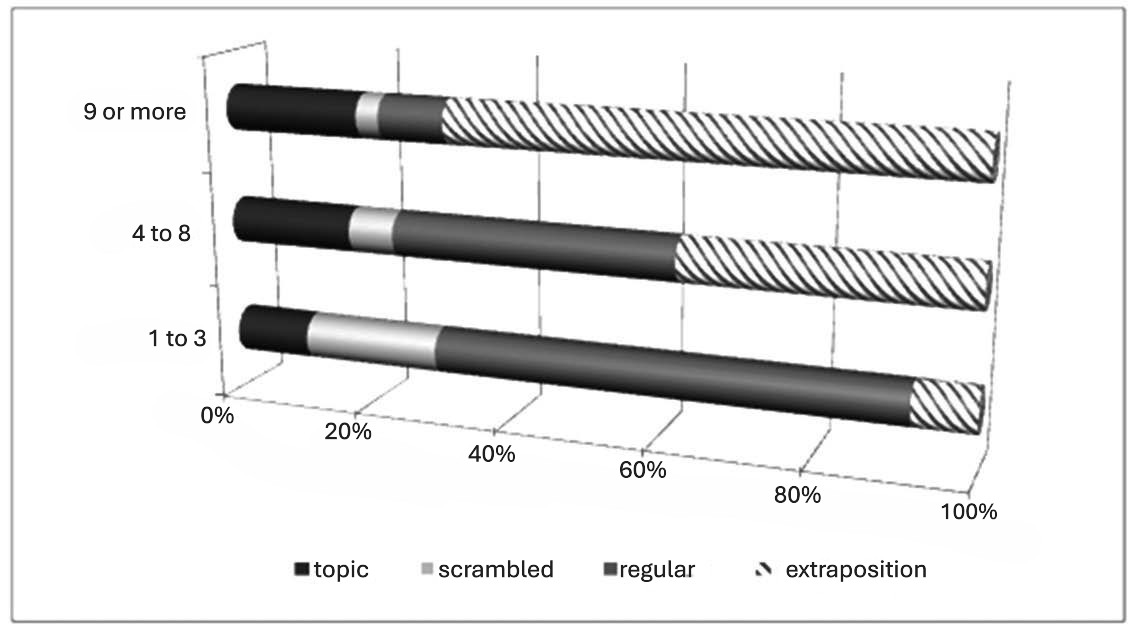
The choice between examples with preverbal and extraposed PP-complements, as in (134a&b), is influenced by two factors in particular. The first factor is the weight of the PP: shorter PPs in terms of the number of syllables are less frequent in extraposed position than longer PPs. This is also visualized in Figure 1, which shows the correlation between the weight of PP-complements and their distribution in topicalized, A'-scrambled, regular and extraposed position; here our concern is with the last two cases. The second factor is related to the status of the nominal complement of the PPs. One of the striking findings in Figure 2 is that PPs with a pronominal complement hardly ever extrapose, while this seems to be easily possible in all other (i.e. non-pronominal) cases; note that for various reasons about 50 cases were removed from the earlier set when compiling this plot graph.

One of the reasons why extraposition of complement-PP with a pronominal complement is rare might be that pronouns are simply less weighty in the sense discussed earlier, since with the exception of the plural object pronoun jullieyou they are all monosyllabic. They are also lighter in the sense that they are not usually accented; to our ear, extraposition is much better when the pronoun is accented, as shown in (135), but the effect of this can of course only be studied in a spoken corpus.
| dat | Els <op hem/’m> | wacht <op hem/??’m>. | ||
| that | Els for him/him | waits | ||
| 'that Els is waiting for him.' | ||||
The corpus does not include cases with pronominalized PP-complements such as erop in (136a), which are clearly unacceptable in extraposed position. This is probably not due to their weight but rather to the fact, illustrated in (136b), that such PP-complements are usually split and that the resulting stranded prepositions must occur left-adjacent to the clause-final verbs; cf. Section P36.3.4.
| a. | dat | Els | <erop> | wacht <*erop>. | |
| that | Els | for.it | waits | ||
| 'that Els is waiting for it.' | |||||
| b'. | dat | Els | <er> | nog | steeds <?er> | op | wacht. | |
| that | Els | there | yet | still | for | waits | ||
| 'That Els is still waiting for it.' | ||||||||
Figure 2 also shows that the definiteness of the nominal complement of the PP does not really affect the choice between preverbal and postverbal position. Proper/bare nouns, on the other hand, seem to occur more often in preverbal position, but it does not seem too far-fetched to say that this is related to the fact that they are often lighter; cf. Hoeksema (2014:234-5). If so, perhaps the two factors can be reduced to one, the weight of the PP (an option not considered in Hoeksema. Hoeksema also notes that an effect of the lexical combinations themselves (i.e. V + PP) may manifest itself: certain combinations favor the PP in preverbal position while others favor it in postverbal position. He leaves this as a suggestion for future research. For completeness’ sake, note that Hoeksema’s data also shows that extraposition of PP-complements has become more frequent since about 1800, which may be partly explained by the fact that the average length of PP-complements has also increased since then. To conclude, we can say that extraposition is quite a common phenomenon for PP-complements, provided they are not too light.
Note that extraposed PP-complements are usually adjacent to the clause-final verb position. This leads to the so-called mirror effect (Koster 1974); elements that in the unmarked case are left-adjacent to the clause-final verbs in the middle field of the clause occur right-adjacent to these verbs when extraposed. Subsection IA has already illustrated this for the order of postverbal prepositional objects and argument clauses. The examples in (137) show that the mirror effect also occurs in the case of adverbial clauses/PPs.
| a. | Jan heeft | [voordat | hij | vertrok] | toch | nog | [naar de post] | gekeken. | |
| Jan has | before | he | left | yet | still | at the post | looked | ||
| 'Before he left, Jan had looked at the mail after all.' | |||||||||
| a'. | Jan heeft toch nog gekeken [naar de post] [voordat hij vertrok]. |
| a''. | * | Jan heeft toch nog gekeken [voordat hij vertrok] [naar de post]. |
| b. | Jan heeft | [voor zijn vertrek] | toch | nog | [naar de post] | gekeken. | |
| Jan has | before his departure | yet | still | at the post | looked | ||
| 'Before his departure, Jan had looked at the mail after all.' | |||||||
| b'. | Jan heeft toch nog gekeken [naar de post] [voor zijn vertrek]. |
| b''. | * | Jan heeft toch nog gekeken [voor zijn vertrek] [naar de post]. |
However, prepositional object clauses introduced by the anticipatory PP erop differ from postverbal PP-complements in that they tend to follow postverbal adverbial phrases; an example such as (138b') is acceptable only with an intonation contour associated with afterthoughts, i.e. with a distinct intonation break before the adverbial phrase, which receives a contrastive accent. This finding is not surprising in view of our conclusion in Section 12.1, sub IB, that clauses introduced by an anticipatory pronominal element are not extraposed but right-dislocated.
| a. | dat | Jan er | [in het buitenland] | al | snel | naar | verlangt | [dat | hij | naar huis | kan]. | |||||
| that | Jan there | in the foreign.countries | already | quickly | for | longs | that | he | to home | can | ||||||
| 'that, when abroad, Jan soon looks forward to going home.' | ||||||||||||||||
| b. | dat Jan er al snel naar verlangt [in het buitenland] [dat | hij | naar huis | kan]. |
| b'. | dat Jan er al snel naar verlangt [dat | hij | naar huis | kan] *(,) [in het buitenland]. |
That prepositional object clauses introduced by an anticipatory PP are not extraposed but right-dislocated is also clear from the fact, illustrated in (139), that they obligatorily follow postverbal adjectival and nominal adverbial phrases like waarschijnlijkprobably and morgentomorrow, which were shown to be right-dislocated in Section 12.3.
| a. | dat | Jan erop | wacht | waarschijnlijk | [dat het bericht | vrij | komt]. | |
| that | Jan for.it | waits | probably | that the news | free | comes | ||
| 'that Jan is probably waiting for the release of the news.' | ||||||||
| b. | dat | Jan erop | zal wachten | morgen | [dat het bericht | vrij | komt]. | |
| that | Jan for.it | will wait | tomorrow | that the news | free | comes | ||
| 'that Jan will wait tomorrow for the release of the news.' | ||||||||
A'-scrambling and topicalization of PP-complements lead to a marked information structure of a clause: Sections 11.3.3 and 13.3.2 show that topicalization and A'-scrambling generally have an effect on the information structure of a clause: they involve leftward movement of e.g. foci and topics. This implies that they can only apply to phrases that have these discourse functions. Figure 2 shows that leftward movement of PP-complements is possible, regardless of the nature of the nominal complement. However, there seems to be a contrast in the case of topicalization and scrambling: while pronouns, definite noun phrases and proper nouns allow both topicalization and A'-scrambling, the latter is rare in the case of indefinite noun phrases and bare noun phrases (i.e. without a determiner).
Hoeksema (2014) found that complement-PPs with indefinite noun phrases do not scramble at all, and claims that this is to be expected in view of the fact that indefinite objects also resist scrambling. This sort of proposal overlooks the fact that object scrambling and PP-complement scrambling are distinct: the first is A-scrambling while the second is A'-movement; cf. Section 9.5, sub IIIA, for more detailed discussion. The reason for this restriction in scrambling of complement-PPs must therefore lie in the fact that indefinite objects are typically used to introduce a new entity into the domain of discourse and thus cannot be used as contrastive foci or topics: these are typically found in the middle field of the clause. Something similar may hold for bare nouns, given that they are often non-referential; cf. Section N18.1.2.3. We will not digress further and leave this issue to future research.
This section discusses the relative order of adverbial phrases. Example (140b) shows that it is possible for a temporal and a locational PP to co-occur in the postverbal field; the question mark between parentheses is used to indicate that the best results are obtained with at most one adverbial phrase in postverbal position. The examples in (140) further show that we find the mirror effect here; while the temporal adverbial phrase preferably precedes the locational adverbial phrase in the middle field of the clause, it preferably follows it in the postverbal field. Note that the use of a non-neutral (i.e. contrastive) intonation or intonation breaks can improve the judgements on the degraded orders; we ignore such cases here.
| a. | Jan heeft | waarschijnlijk | [tot drie uur] | [in de tuin] | gewerkt. | |
| Jan has | probably | until 3 o'clock | in the garden | worked | ||
| 'Jan has probably worked in the garden until 3 o'clock.' | ||||||
| a'. | * | Jan heeft waarschijnlijk [in de tuin] [tot drie uur] gewerkt. |
| b. | (?) | Jan heeft waarschijnlijk gewerkt [in de tuin] [tot drie uur]. |
| b'. | *? | Jan heeft waarschijnlijk gewerkt [tot drie uur] [in de tuin]. |
In (141) we give similar examples with the adverbial phrase ondanks de hittedespite the heat and a locational adverbial phrase: while the former must precede the locational adverbial phrase in the middle field of the clause (under a neutral intonation pattern), it follows it in the postverbal field.
| a. | Jan heeft | [ondanks de hitte] | [in de tuin] | gewerkt. | |
| Jan has | despite the heat | in the garden | worked | ||
| 'Jan has worked in the garden despite the heat.' | |||||
| a'. | * | Jan heeft [in de tuin] [ondanks de hitte] gewerkt. |
| b. | (?) | Jan heeft gewerkt [in de tuin] [ondanks de hitte]. |
| b'. | * | Jan heeft gewerkt [ondanks de hitte] [in de tuin]. |
Note that the linear string in (141b') is acceptable under the irrelevant reading in which the PP in de tuinin the garden modifies the noun hitteheat, as in (142a); this example differs from (141a) in meaning and intonation.
| a. | Jan heeft | [ondanks de hitte | [in de tuin]] | gewerkt. | |
| Jan has | in.spite.of the heat | in the garden | worked | ||
| 'Jan has worked in spite of the heat in the garden.' | |||||
| b. | Jan heeft gewerkt [ondanks de hitte [in de tuin]]. |
This subsection has discussed a number of restrictions on word order in the postverbal field. We have seen that PP-complements precede direct object clauses, while adverbial clauses come last, as in (143b). This order is the inverse of the order found in the middle field of the clause, as in (143a), which has motivated the assumption of a mirror effect: extraposition inverts the order. Note in passing that the order in (143b) is identical to the one found in English (which is probably not a coincidence).
| a. | ... adverbial clause – object clause – PP‑complement – Vfinal |
| b. | ... Vfinal – PP‑complement – object clause – adverbial clause |
Prepositional adverbial phrases seem at first to exhibit a somewhat deviant behavior in that they can precede object clauses. However, we have seen that this may be due to the fact that object clauses need not be extraposed, but can also be right-dislocated, which can be supported by the fact, illustrated again in (144), that object clauses can also follow postverbal adverbial phrases like waarschijnlijkprobably and gisterenyesterday, which were argued to be right-dislocated in Section 12.3
| a. | dat | Jan vertelde | aan Marie | gisteren | dat hij zou komen. | |
| that | Jan told | to Marie | yesterday | that he would come | ||
| 'that Jan told Marie yesterday that he would come.' | ||||||
| b. | dat | Jan zei | tegen Peter | vanmorgen | dat hij zou komen. | |
| that | Jan said | to Peter | this.morning | that he would come | ||
| 'that Jan said to Peter this morning that he would come.' | ||||||
This mirror effect was first noted in Koster (1974) for PPs, and it is often tacitly assumed that it is restricted to phrases of this type; cf. Barbiers (1995a: §4) for an interesting analysis based on this assumption. The examples given in this section show, however, that the effect is also found with clauses, although there are complications that obscure the general picture.
