- Dutch
- Frisian
- Saterfrisian
- Afrikaans
-
- Syntax
- Preface and acknowledgements
- Verbs and Verb Phrases
- 1 Verbs: Characterization and classification
- 2 Projection of verb phrases I: Argument structure
- 3 Projection of verb phrases IIIa: Selected clauses/verb phrases (introduction)
- 1.0. Introduction
- 1.1. Main types of verb-frame alternation
- 1.2. Alternations involving the external argument
- 1.3. Alternations of noun phrases and PPs
- 1.4. Some apparent cases of verb-frame alternation
- 1.5. Bibliographical notes
- 4 Projection of verb phrases IIIa: Selected clauses/verb phrases (introduction)
- 4.0. Introduction
- 4.1. Semantic types of finite argument clauses
- 4.2. Finite and infinitival argument clauses
- 4.3. Control properties of verbs selecting an infinitival clause
- 4.4. Three main types of infinitival argument clauses
- 4.5. Non-main verbs
- 4.6. The distinction between main and non-main verbs
- 4.7. Bibliographical notes
- 5 Projection of verb phrases IIIb: Argument and complementive clauses
- 5.0. Introduction
- 5.1. Finite argument clauses
- 5.2. Infinitival argument clauses
- 5.3. Complementive clauses
- 5.4. Bibliographical notes
- 6 Projection of verb phrases IIIc: Complements of non-main verbs
- 7 Projection of verb phrases IIId: Verb clustering
- 8 Projection of verb phrases IV: Adverbial modification
- 9 Word order in the clause I: General introduction
- 10 Word order in the clause II: Position of the finite verb (verb-first/second)
- 11 Word order in the clause III:Clause-initial position (wh-movement)
- 11.0. Introduction
- 11.1. The formation of V1 and V2-clauses
- 11.2. Clause-initial position remains (phonetically) empty
- 11.3. Clause-initial position is filled
- 11.4. Bibliographical notes
- 12 Word order in the clause IV: Postverbal field (extraposition)
- 13 Word order in the clause V: Middle field (scrambling)
- Nouns and Noun Phrases
- 14 Characterization and classification
- 15 Projection of noun phrases I: Complementation
- 15.0. Introduction
- 15.1. General observations
- 15.2. Prepositional and nominal complements
- 15.3. Clausal complements
- 15.4. Bibliographical notes
- 16 Projection of noun phrases II: Modification
- 16.0. Introduction
- 16.1. Restrictive and non-restrictive modifiers
- 16.2. Premodification
- 16.3. Postmodification
- 16.3.1. Adpositional phrases
- 16.3.2. Relative clauses
- 16.3.3. Infinitival clauses
- 16.3.4. A special case: clauses referring to a proposition
- 16.3.5. Adjectival phrases
- 16.3.6. Adverbial postmodification
- 16.4. Bibliographical notes
- 17 Projection of noun phrases III: Binominal constructions
- 17.0. Introduction
- 17.1. Binominal constructions without a preposition
- 17.2. Binominal constructions with a preposition
- 17.3. Bibliographical notes
- 18 Determiners: Articles and pronouns
- 18.0. Introduction
- 18.1. Articles
- 18.2. Pronouns
- 18.3. Bibliographical notes
- 19 Numerals and quantifiers
- 19.0. Introduction
- 19.1. Numerals
- 19.2. Quantifiers
- 19.2.1. Introduction
- 19.2.2. Universal quantifiers: ieder/elk ‘every’ and alle ‘all’
- 19.2.3. Existential quantifiers: sommige ‘some’ and enkele ‘some’
- 19.2.4. Degree quantifiers: veel ‘many/much’ and weinig ‘few/little’
- 19.2.5. Modification of quantifiers
- 19.2.6. A note on the adverbial use of degree quantifiers
- 19.3. Quantitative er constructions
- 19.4. Partitive and pseudo-partitive constructions
- 19.5. Bibliographical notes
- 20 Predeterminers
- 20.0. Introduction
- 20.1. The universal quantifier al ‘all’ and its alternants
- 20.2. The predeterminer heel ‘all/whole’
- 20.3. A note on focus particles
- 20.4. Bibliographical notes
- 21 Syntactic uses of noun phrases
- 22 Referential dependencies (binding)
- Adjectives and Adjective Phrases
- 23 Characteristics and classification
- 24 Projection of adjective phrases I: Complementation
- 25 Projection of adjective phrases II: Modification
- 26 Projection of adjective phrases III: Comparison
- 27 Attributive use of the adjective phrase
- 28 Predicative use of the adjective phrase
- 29 The partitive genitive construction
- 30 Adverbial use of the adjective phrase
- 31 Participles and infinitives: their adjectival use
- Adpositions and adpositional phrases
- 32 Characteristics and classification
- 32.0. Introduction
- 32.1. Characterization of the category adposition
- 32.2. A syntactic classification of adpositional phrases
- 32.3. A semantic classification of adpositional phrases
- 32.4. Borderline cases
- 32.5. Bibliographical notes
- 33 Projection of adpositional phrases: Complementation
- 34 Projection of adpositional phrases: Modification
- 35 Syntactic uses of adpositional phrases
- 36 R-pronominalization and R-words
- 32 Characteristics and classification
- Coordination and Ellipsis
- Syntax
-
- General
-
- General
- Morphology
- Morphology
- 1 Word formation
- 1.1 Compounding
- 1.1.1 Compounds and their heads
- 1.1.2 Special types of compounds
- 1.1.2.1 Affixoids
- 1.1.2.2 Coordinative compounds
- 1.1.2.3 Synthetic compounds and complex pseudo-participles
- 1.1.2.4 Reduplicative compounds
- 1.1.2.5 Phrase-based compounds
- 1.1.2.6 Elative compounds
- 1.1.2.7 Exocentric compounds
- 1.1.2.8 Linking elements
- 1.1.2.9 Separable Complex Verbs and Particle Verbs
- 1.1.2.10 Noun Incorporation Verbs
- 1.1.2.11 Gapping
- 1.2 Derivation
- 1.3 Minor patterns of word formation
- 1.1 Compounding
- 2 Inflection
- 1 Word formation
- Morphology
- Syntax
- Adjectives and adjective phrases (APs)
- 0 Introduction to the AP
- 1 Characteristics and classification of APs
- 2 Complementation of APs
- 3 Modification and degree quantification of APs
- 4 Comparison by comparative, superlative and equative
- 5 Attribution of APs
- 6 Predication of APs
- 7 The partitive adjective construction
- 8 Adverbial use of APs
- 9 Participles and infinitives as APs
- Nouns and Noun Phrases (NPs)
- 0 Introduction to the NP
- 1 Characteristics and Classification of NPs
- 2 Complementation of NPs
- 3 Modification of NPs
- 3.1 Modification of NP by Determiners and APs
- 3.2 Modification of NP by PP
- 3.3 Modification of NP by adverbial clauses
- 3.4 Modification of NP by possessors
- 3.5 Modification of NP by relative clauses
- 3.6 Modification of NP in a cleft construction
- 3.7 Free relative clauses and selected interrogative clauses
- 4 Partitive noun constructions and constructions related to them
- 4.1 The referential partitive construction
- 4.2 The partitive construction of abstract quantity
- 4.3 The numerical partitive construction
- 4.4 The partitive interrogative construction
- 4.5 Adjectival, nominal and nominalised partitive quantifiers
- 4.6 Kind partitives
- 4.7 Partitive predication with a preposition
- 4.8 Bare nominal attribution
- 5 Articles and names
- 6 Pronouns
- 7 Quantifiers, determiners and predeterminers
- 8 Interrogative pronouns
- 9 R-pronouns and the indefinite expletive
- 10 Syntactic functions of Noun Phrases
- Adpositions and Adpositional Phrases (PPs)
- 0 Introduction to the PP
- 1 Characteristics and classification of PPs
- 2 Complementation of PPs
- 3 Modification of PPs
- 4 Bare (intransitive) adpositions
- 5 Predication of PPs
- 6 Form and distribution of adpositions with respect to staticity and construction type
- 7 Adpositional complements and adverbials
- Verbs and Verb Phrases (VPs)
- 0 Introduction to the VP in Saterland Frisian
- 1 Characteristics and classification of verbs
- 2 Unergative and unaccusative subjects and the auxiliary of the perfect
- 3 Evidentiality in relation to perception and epistemicity
- 4 Types of to-infinitival constituents
- 5 Predication
- 5.1 The auxiliary of being and its selection restrictions
- 5.2 The auxiliary of going and its selection restrictions
- 5.3 The auxiliary of continuation and its selection restrictions
- 5.4 The auxiliary of coming and its selection restrictions
- 5.5 Modal auxiliaries and their selection restrictions
- 5.6 Auxiliaries of body posture and aspect and their selection restrictions
- 5.7 Transitive verbs of predication
- 5.8 The auxiliary of doing used as a semantically empty finite auxiliary
- 5.9 Supplementive predication
- 6 The verbal paradigm, irregularity and suppletion
- 7 Verb Second and the word order in main and embedded clauses
- 8 Various aspects of clause structure
- Adjectives and adjective phrases (APs)
This chapter takes as its starting point the discussion in Section V9.2, which has shown that finite verbs can be found in basically two positions: the clause-final position in embedded clauses and the verb-first/second position in main clauses; the latter position is usually occupied by a complementizer in embedded clauses.
| a. | Op dit moment | leest | Jan het boek. | main clause | |
| at this moment | reads | Jan the book | |||
| 'At this moment, Jan is reading the book.' | |||||
| b. | Marie zegt | [dat | Jan | het boek | op dit moment | leest]. | embedded clause | |
| Marie says | that | Jan | the book | at this moment | reads | |||
| 'Marie says that Jan is reading the book at this moment.' | ||||||||
On the basis of these two positions, the clause can be divided into three topological fields: the clause-initial position, the middle field and the postverbal field; cf. representation (2).
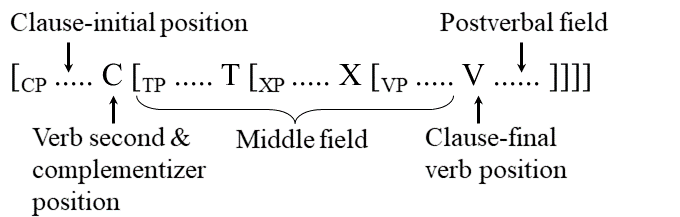 |
Chapter V11 has shown that the C-position can be preceded by at most one constituent. However, there are cases, like those given in example (3), where this position is preceded by a second phrase. If the structure of the clause in (2) is indeed correct, we must conclude that the italicized phrases preceding the clause-initial position are clause-external. This seems to be supported by the fact that these phrases can be separated from the main clause by a distinct intonation break, indicated by a comma.
| a. | Ja, | dat | wist | ik | al. | polar yes/no | |
| yes | that | knew | I | already | |||
| 'Yes, I already knew that.' | |||||||
| b. | Jan, | er | is telefoon | voor je. | vocative | |
| Jan | there | is phone.call | for you | |||
| 'Jan, there is a phone call for you.' | ||||||
| c. | Lieve help, | hij is ziek. | interjection | |
| good grief, | he is ill | |||
| 'Good grief, he is ill!' | ||||
That the italicized phrases in (3) are clause-external is also suggested by the fact that they occur only in root contexts; cf. Van Riemsdijk & Zwarts (1997). For instance, the examples in (4) are excluded on the intended reading; the number signs indicate that vocatives and interjections can sometimes be used as parentheticals (if preceded and followed by an intonation break), but such cases are equivalent to cases where they precede the main clause, showing that they should be construed with the main clause, not the embedded clause.
| a. | Hij | hoorde | <*ja> | dat <*ja> | ik | dat | al | wist. | |
| he | heard | yes | that | I | that | already | knew | ||
| 'He heard that I knew that already.' | |||||||||
| b. | Ik | vermoed | <#Jan> | dat <*Jan> | er | telefoon | voor je | is. | |
| I | suspect | Jan | that | there | phone.call | for you | is | ||
| 'I suspect that there is a phone call for you.' | |||||||||
| c. | Marie ontkende | <#lieve help> | dat <*lieve help> | hij | ziek | is. | |
| Marie denied | good grief | that | he | ill | is | ||
| 'Marie denied that he is ill.' | |||||||
The examples in (3) and (4) suggest that polar ja/nee, vocatives and interjections are not only extra-clausal but possibly even extra-sentential: this is supported by the fact that they also occur without an accompanying clause under the right extra-linguistic circumstances: ja/nee suffices as an answer to a yes/no question, vocatives can simply be used to attract attention, and interjections such as Lieve help! can be used in response to the occurrence of eventualities with certain undesirable qualities.
| a. | Heb | je | even | tijd | voor me? | Nee. | answer to yes/no question | |
| have | you | a.moment | time | for me | no | |||
| 'Do you have a moment for me? No.' | ||||||||
| b. | Jan! | call for attention |
| c. | Lieve help! | exclamation |
Since the italicized phrases in (3) are possibly extra-sentential, it is not clear whether they should treated in a work on syntax. Instead, these elements seem to play an important role in the discourse, e.g. by attracting the attention of the discourse participants (vocatives and certain interjections) and by expressing emotions (the exclamative Lieve help!). Discourse chunks such as (6) further show that such elements play an important role in structuring discourse by regulating turn-taking; the main-clause external element toch is used to request feedback and ja provides a response to this request. The main-clause external elements discussed so far are often referred to as pragmatic markers to indicate that they are generally assumed to be the subject of theories of language use.
| Jan is | al | weg, | toch? | Ja, | dat | klopt. | turn-taking | ||
| Jan is | already | away | prt | yes | that | is.right | |||
| 'Jan has left, hasnʼt he? Yes, that is right.' | |||||||||
Note, however, that certain main-clause external elements have long been considered by syntacticians. This is especially true for so-called left-dislocation constructions, as in the (a)-examples in (7), in which a main-clause external phrase is resumed by a demonstrative in clause-initial position or a referential pronoun in the middle field of the clause; the intended reading is indicated by indices. The same is true for phrases following the clause: these are often not discussed in syntactic work, except for right-dislocated phrases, as in (7b), which have a correlate in the preceding clause.
| a. | Peteri, | diei | heb | ik | gisteren | gezien. | left dislocation | |
| Peter | dem | have | I | yesterday | seen | |||
| 'Peter, I saw him yesterday.' | ||||||||
| a'. | Peteri, | ik | heb | hemi | gisteren | gezien. | left dislocation | |
| Peter | I | have | him | yesterday | seen | |||
| 'Peter, I saw him yesterday.' | ||||||||
| b. | Ik | heb | hemi | gisteren | gezien, | Peteri. | right dislocation | |
| I | have | him | yesterday | seen | Peter | |||
| 'I saw him yesterday, Peter.' | ||||||||
Left and right-dislocated phrases differ from the possibly extra-sentential phrases of the type mentioned above in that they do not primarily have a pragmatic function, but instead play an important role in shaping the information structure of utterances. Since this work is not concerned with the actual use of utterances, the focus of this chapter will be on left and right-dislocated phrases, which will be discussed in Sections 37.2 and 37.2, respectively. For the sake of completeness, however, Section 37.1 briefly discusses a number of main-clause external pragmatic markers.
