- Dutch
- Frisian
- Saterfrisian
- Afrikaans
-
- Syntax
- Preface and acknowledgements
- Verbs and Verb Phrases
- 1 Verbs: Characterization and classification
- 2 Projection of verb phrases I: Argument structure
- 3 Projection of verb phrases IIIa: Selected clauses/verb phrases (introduction)
- 1.0. Introduction
- 1.1. Main types of verb-frame alternation
- 1.2. Alternations involving the external argument
- 1.3. Alternations of noun phrases and PPs
- 1.4. Some apparent cases of verb-frame alternation
- 1.5. Bibliographical notes
- 4 Projection of verb phrases IIIa: Selected clauses/verb phrases (introduction)
- 4.0. Introduction
- 4.1. Semantic types of finite argument clauses
- 4.2. Finite and infinitival argument clauses
- 4.3. Control properties of verbs selecting an infinitival clause
- 4.4. Three main types of infinitival argument clauses
- 4.5. Non-main verbs
- 4.6. The distinction between main and non-main verbs
- 4.7. Bibliographical notes
- 5 Projection of verb phrases IIIb: Argument and complementive clauses
- 5.0. Introduction
- 5.1. Finite argument clauses
- 5.2. Infinitival argument clauses
- 5.3. Complementive clauses
- 5.4. Bibliographical notes
- 6 Projection of verb phrases IIIc: Complements of non-main verbs
- 7 Projection of verb phrases IIId: Verb clustering
- 8 Projection of verb phrases IV: Adverbial modification
- 9 Word order in the clause I: General introduction
- 10 Word order in the clause II: Position of the finite verb (verb-first/second)
- 11 Word order in the clause III:Clause-initial position (wh-movement)
- 11.0. Introduction
- 11.1. The formation of V1 and V2-clauses
- 11.2. Clause-initial position remains (phonetically) empty
- 11.3. Clause-initial position is filled
- 11.4. Bibliographical notes
- 12 Word order in the clause IV: Postverbal field (extraposition)
- 13 Word order in the clause V: Middle field (scrambling)
- Nouns and Noun Phrases
- 14 Characterization and classification
- 15 Projection of noun phrases I: Complementation
- 15.0. Introduction
- 15.1. General observations
- 15.2. Prepositional and nominal complements
- 15.3. Clausal complements
- 15.4. Bibliographical notes
- 16 Projection of noun phrases II: Modification
- 16.0. Introduction
- 16.1. Restrictive and non-restrictive modifiers
- 16.2. Premodification
- 16.3. Postmodification
- 16.3.1. Adpositional phrases
- 16.3.2. Relative clauses
- 16.3.3. Infinitival clauses
- 16.3.4. A special case: clauses referring to a proposition
- 16.3.5. Adjectival phrases
- 16.3.6. Adverbial postmodification
- 16.4. Bibliographical notes
- 17 Projection of noun phrases III: Binominal constructions
- 17.0. Introduction
- 17.1. Binominal constructions without a preposition
- 17.2. Binominal constructions with a preposition
- 17.3. Bibliographical notes
- 18 Determiners: Articles and pronouns
- 18.0. Introduction
- 18.1. Articles
- 18.2. Pronouns
- 18.3. Bibliographical notes
- 19 Numerals and quantifiers
- 19.0. Introduction
- 19.1. Numerals
- 19.2. Quantifiers
- 19.2.1. Introduction
- 19.2.2. Universal quantifiers: ieder/elk ‘every’ and alle ‘all’
- 19.2.3. Existential quantifiers: sommige ‘some’ and enkele ‘some’
- 19.2.4. Degree quantifiers: veel ‘many/much’ and weinig ‘few/little’
- 19.2.5. Modification of quantifiers
- 19.2.6. A note on the adverbial use of degree quantifiers
- 19.3. Quantitative er constructions
- 19.4. Partitive and pseudo-partitive constructions
- 19.5. Bibliographical notes
- 20 Predeterminers
- 20.0. Introduction
- 20.1. The universal quantifier al ‘all’ and its alternants
- 20.2. The predeterminer heel ‘all/whole’
- 20.3. A note on focus particles
- 20.4. Bibliographical notes
- 21 Syntactic uses of noun phrases
- 22 Referential dependencies (binding)
- Adjectives and Adjective Phrases
- 23 Characteristics and classification
- 24 Projection of adjective phrases I: Complementation
- 25 Projection of adjective phrases II: Modification
- 26 Projection of adjective phrases III: Comparison
- 27 Attributive use of the adjective phrase
- 28 Predicative use of the adjective phrase
- 29 The partitive genitive construction
- 30 Adverbial use of the adjective phrase
- 31 Participles and infinitives: their adjectival use
- Adpositions and adpositional phrases
- 32 Characteristics and classification
- 32.0. Introduction
- 32.1. Characterization of the category adposition
- 32.2. A syntactic classification of adpositional phrases
- 32.3. A semantic classification of adpositional phrases
- 32.4. Borderline cases
- 32.5. Bibliographical notes
- 33 Projection of adpositional phrases: Complementation
- 34 Projection of adpositional phrases: Modification
- 35 Syntactic uses of adpositional phrases
- 36 R-pronominalization and R-words
- 32 Characteristics and classification
- Coordination and Ellipsis
- Syntax
-
- General
-
- General
- Morphology
- Morphology
- 1 Word formation
- 1.1 Compounding
- 1.1.1 Compounds and their heads
- 1.1.2 Special types of compounds
- 1.1.2.1 Affixoids
- 1.1.2.2 Coordinative compounds
- 1.1.2.3 Synthetic compounds and complex pseudo-participles
- 1.1.2.4 Reduplicative compounds
- 1.1.2.5 Phrase-based compounds
- 1.1.2.6 Elative compounds
- 1.1.2.7 Exocentric compounds
- 1.1.2.8 Linking elements
- 1.1.2.9 Separable Complex Verbs and Particle Verbs
- 1.1.2.10 Noun Incorporation Verbs
- 1.1.2.11 Gapping
- 1.2 Derivation
- 1.3 Minor patterns of word formation
- 1.1 Compounding
- 2 Inflection
- 1 Word formation
- Morphology
- Syntax
- Adjectives and adjective phrases (APs)
- 0 Introduction to the AP
- 1 Characteristics and classification of APs
- 2 Complementation of APs
- 3 Modification and degree quantification of APs
- 4 Comparison by comparative, superlative and equative
- 5 Attribution of APs
- 6 Predication of APs
- 7 The partitive adjective construction
- 8 Adverbial use of APs
- 9 Participles and infinitives as APs
- Nouns and Noun Phrases (NPs)
- 0 Introduction to the NP
- 1 Characteristics and Classification of NPs
- 2 Complementation of NPs
- 3 Modification of NPs
- 3.1 Modification of NP by Determiners and APs
- 3.2 Modification of NP by PP
- 3.3 Modification of NP by adverbial clauses
- 3.4 Modification of NP by possessors
- 3.5 Modification of NP by relative clauses
- 3.6 Modification of NP in a cleft construction
- 3.7 Free relative clauses and selected interrogative clauses
- 4 Partitive noun constructions and constructions related to them
- 4.1 The referential partitive construction
- 4.2 The partitive construction of abstract quantity
- 4.3 The numerical partitive construction
- 4.4 The partitive interrogative construction
- 4.5 Adjectival, nominal and nominalised partitive quantifiers
- 4.6 Kind partitives
- 4.7 Partitive predication with a preposition
- 4.8 Bare nominal attribution
- 5 Articles and names
- 6 Pronouns
- 7 Quantifiers, determiners and predeterminers
- 8 Interrogative pronouns
- 9 R-pronouns and the indefinite expletive
- 10 Syntactic functions of Noun Phrases
- Adpositions and Adpositional Phrases (PPs)
- 0 Introduction to the PP
- 1 Characteristics and classification of PPs
- 2 Complementation of PPs
- 3 Modification of PPs
- 4 Bare (intransitive) adpositions
- 5 Predication of PPs
- 6 Form and distribution of adpositions with respect to staticity and construction type
- 7 Adpositional complements and adverbials
- Verbs and Verb Phrases (VPs)
- 0 Introduction to the VP in Saterland Frisian
- 1 Characteristics and classification of verbs
- 2 Unergative and unaccusative subjects and the auxiliary of the perfect
- 3 Evidentiality in relation to perception and epistemicity
- 4 Types of to-infinitival constituents
- 5 Predication
- 5.1 The auxiliary of being and its selection restrictions
- 5.2 The auxiliary of going and its selection restrictions
- 5.3 The auxiliary of continuation and its selection restrictions
- 5.4 The auxiliary of coming and its selection restrictions
- 5.5 Modal auxiliaries and their selection restrictions
- 5.6 Auxiliaries of body posture and aspect and their selection restrictions
- 5.7 Transitive verbs of predication
- 5.8 The auxiliary of doing used as a semantically empty finite auxiliary
- 5.9 Supplementive predication
- 6 The verbal paradigm, irregularity and suppletion
- 7 Verb Second and the word order in main and embedded clauses
- 8 Various aspects of clause structure
- Adjectives and adjective phrases (APs)
The core meaning of the cardinal numerals in prenominal position can be easily explained by using Figure 1 from Section 14.1.2, sub IIA, repeated below. It represents the subject-predicate relation in a clause: set A represents the denotation set of the lexical part (i.e. the NP-part) of the subject, and set B represents the denotation set of the verb phrase, where A and B are both contextually determined, i.e. dependent on the domain of discourse (domain D). The intersection A ∩ B denotes the set of entities for which the proposition expressed by the clause is claimed to be true. For instance, in an example such as De jongen wandelt op straatthe boy is walking in the street, it is claimed that the set denoted by the noun jongenboy is included in set B, which consists of the people walking in the street. In other words, it is asserted that A - (A ∩ B) is empty.
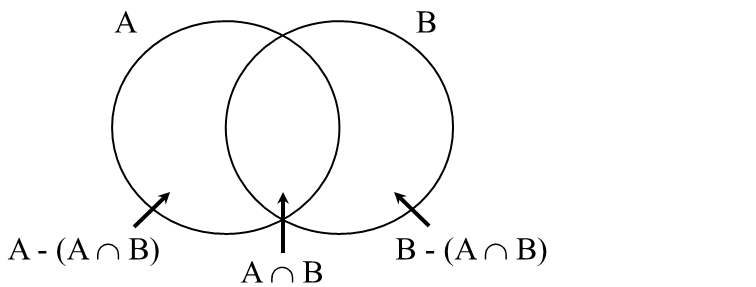
The semantic function of the cardinals is to indicate the size or cardinality of the intersection of A and B. For example, in (31a) the cardinal tweetwo indicates that the cardinality of the intersection A ∩ B is 2; recall that ∅ in (31b) stands for the phonetically empty indefinite article.
| a. | Er | lopen | twee jongens | op straat. | |
| there | walk | two boys | in the.street | ||
| 'Two boys are walking in the street.' | |||||
| b. | ∅ twee NPpl: |A ∩ B| = 2 |
The cardinals do not give any information about the remainder of set A, that is, A - (A ∩ B) may or may not be empty. Such information is usually expressed by the determiners: in addition to the information expressed by the cardinal that the cardinality of the intersection A ∩ B is 2, the definite article de in (32a) expresses that A - (A ∩ B) is empty.
| a. | De twee jongens | lopen | op straat. | |
| the two boys | walk | in the.street | ||
| 'The two boys are walking in the street.' | ||||
| b. | de twee NPpl: |A ∩ B| = 2 & |A ‑ (A ∩ B)| = 0 |
In the absence of the definite determiner, it is the sentence type that provides additional information about the cardinality of A - (A ∩ B). In (31a), for example, the sentence contains the expletive er and is therefore presentative; the subject introduces a set of new entities into the domain of discourse, and from this we can conclude that there was no mention of boys in the domain of discourse before the sentence was uttered. The most plausible reading is therefore one according to which A - (A ∩ B) is empty.
This interpretation of the indefinite noun phrase twee jongens does not seem to be syntactically or lexically encoded, but to result from a conversational implicature (Grice 1975). The first reason for this assumption is that the implication that A - (A ∩ B) is empty is clearly not part of the meaning of the indefinite noun phrase in non-representative clauses. In (33a), for example, the subject is interpreted as specific, i.e. at least known to the speaker, and now the implication that all boys in the domain of discourse are part of the intersection A ∩ B is missing.
| a. | Twee jongens | lopen | op straat. | |
| two boys | walk | in the.street | ||
| 'Two boys are walking in the street.' | ||||
| b. | ∅ twee NPpl: |A ∩ B| = 2 & |A ‑ (A ∩ B)| ≥ 0 |
An even more compelling reason is that the implication in expletive constructions such as (31a) that A - (A ∩ B) is empty can be cancelled if the context provides sufficient evidence that set A is not exhausted by the intersection A ∩ B. This is illustrated by the discourse chunk in (34). Since the context leaves no doubt that many students were involved in the protest, neither (34b) nor (34b') implies that the two arrested students exhaust the complete set of protesting students.
| a. | Er | was | gisteren | een grote demonstratie | op de universiteit. | |
| there | was | yesterday | a big demonstration | at the university | ||
| 'There was a big demonstration at the university yesterday.' | ||||||
| b. | Er | werden | twee studenten | gearresteerd. | |
| there | were | two students | arrested | ||
| 'Two students were arrested.' | |||||
| b'. | Twee studenten | werden | gearresteerd. | |
| two students | were | arrested |
The difference between (31a) and (33a) is usually discussed in terms of the purely quantificational versus partitive reading of indefinite noun phrases (cf. De Hoop 1992): the former is supposed to express only the quantificational meaning of the cardinal, whereas the latter additionally expresses that we are dealing with only a subset of the denotation set of the NP. In the latter case, the noun phrase twee studententwo students is treated as essentially synonymous with the true partitive construction in (35a), in which the partitive van-PP explicitly refers to the superset from which the entities referred to by the complete noun phrase are taken; cf. Section 19.4 for further discussion of this construction.
| Twee van de studenten | werden | gearresteerd. | ||
| two of the students | were | arrested |
However, the interpretation of the examples in (34b&b') has shown that this one-to-one correspondence cannot be maintained. This does not mean that we cannot make a distinction between purely quantificational and partitive indefinite noun phrases, since we should keep in mind that the distinction may not be semantico-syntactic in nature, but rather forced upon us by the context in which the indefinite noun phrase is used. For now, we can simply conclude that the meaning expressed by the cardinal is limited to indicating the cardinality of the intersection A ∩ B in Figure 1.
