- Dutch
- Frisian
- Saterfrisian
- Afrikaans
-
- Syntax
- Preface and acknowledgements
- Verbs and Verb Phrases
- 1 Verbs: Characterization and classification
- 2 Projection of verb phrases I: Argument structure
- 3 Projection of verb phrases IIIa: Selected clauses/verb phrases (introduction)
- 1.0. Introduction
- 1.1. Main types of verb-frame alternation
- 1.2. Alternations involving the external argument
- 1.3. Alternations of noun phrases and PPs
- 1.4. Some apparent cases of verb-frame alternation
- 1.5. Bibliographical notes
- 4 Projection of verb phrases IIIa: Selected clauses/verb phrases (introduction)
- 4.0. Introduction
- 4.1. Semantic types of finite argument clauses
- 4.2. Finite and infinitival argument clauses
- 4.3. Control properties of verbs selecting an infinitival clause
- 4.4. Three main types of infinitival argument clauses
- 4.5. Non-main verbs
- 4.6. The distinction between main and non-main verbs
- 4.7. Bibliographical notes
- 5 Projection of verb phrases IIIb: Argument and complementive clauses
- 5.0. Introduction
- 5.1. Finite argument clauses
- 5.2. Infinitival argument clauses
- 5.3. Complementive clauses
- 5.4. Bibliographical notes
- 6 Projection of verb phrases IIIc: Complements of non-main verbs
- 7 Projection of verb phrases IIId: Verb clustering
- 8 Projection of verb phrases IV: Adverbial modification
- 9 Word order in the clause I: General introduction
- 10 Word order in the clause II: Position of the finite verb (verb-first/second)
- 11 Word order in the clause III:Clause-initial position (wh-movement)
- 11.0. Introduction
- 11.1. The formation of V1 and V2-clauses
- 11.2. Clause-initial position remains (phonetically) empty
- 11.3. Clause-initial position is filled
- 11.4. Bibliographical notes
- 12 Word order in the clause IV: Postverbal field (extraposition)
- 13 Word order in the clause V: Middle field (scrambling)
- Nouns and Noun Phrases
- 14 Characterization and classification
- 15 Projection of noun phrases I: Complementation
- 15.0. Introduction
- 15.1. General observations
- 15.2. Prepositional and nominal complements
- 15.3. Clausal complements
- 15.4. Bibliographical notes
- 16 Projection of noun phrases II: Modification
- 16.0. Introduction
- 16.1. Restrictive and non-restrictive modifiers
- 16.2. Premodification
- 16.3. Postmodification
- 16.3.1. Adpositional phrases
- 16.3.2. Relative clauses
- 16.3.3. Infinitival clauses
- 16.3.4. A special case: clauses referring to a proposition
- 16.3.5. Adjectival phrases
- 16.3.6. Adverbial postmodification
- 16.4. Bibliographical notes
- 17 Projection of noun phrases III: Binominal constructions
- 17.0. Introduction
- 17.1. Binominal constructions without a preposition
- 17.2. Binominal constructions with a preposition
- 17.3. Bibliographical notes
- 18 Determiners: Articles and pronouns
- 18.0. Introduction
- 18.1. Articles
- 18.2. Pronouns
- 18.3. Bibliographical notes
- 19 Numerals and quantifiers
- 19.0. Introduction
- 19.1. Numerals
- 19.2. Quantifiers
- 19.2.1. Introduction
- 19.2.2. Universal quantifiers: ieder/elk ‘every’ and alle ‘all’
- 19.2.3. Existential quantifiers: sommige ‘some’ and enkele ‘some’
- 19.2.4. Degree quantifiers: veel ‘many/much’ and weinig ‘few/little’
- 19.2.5. Modification of quantifiers
- 19.2.6. A note on the adverbial use of degree quantifiers
- 19.3. Quantitative er constructions
- 19.4. Partitive and pseudo-partitive constructions
- 19.5. Bibliographical notes
- 20 Predeterminers
- 20.0. Introduction
- 20.1. The universal quantifier al ‘all’ and its alternants
- 20.2. The predeterminer heel ‘all/whole’
- 20.3. A note on focus particles
- 20.4. Bibliographical notes
- 21 Syntactic uses of noun phrases
- 22 Referential dependencies (binding)
- Adjectives and Adjective Phrases
- 23 Characteristics and classification
- 24 Projection of adjective phrases I: Complementation
- 25 Projection of adjective phrases II: Modification
- 26 Projection of adjective phrases III: Comparison
- 27 Attributive use of the adjective phrase
- 28 Predicative use of the adjective phrase
- 29 The partitive genitive construction
- 30 Adverbial use of the adjective phrase
- 31 Participles and infinitives: their adjectival use
- Adpositions and adpositional phrases
- 32 Characteristics and classification
- 32.0. Introduction
- 32.1. Characterization of the category adposition
- 32.2. A syntactic classification of adpositional phrases
- 32.3. A semantic classification of adpositional phrases
- 32.4. Borderline cases
- 32.5. Bibliographical notes
- 33 Projection of adpositional phrases: Complementation
- 34 Projection of adpositional phrases: Modification
- 35 Syntactic uses of adpositional phrases
- 36 R-pronominalization and R-words
- 32 Characteristics and classification
- Coordination and Ellipsis
- Syntax
-
- General
-
- General
- Morphology
- Morphology
- 1 Word formation
- 1.1 Compounding
- 1.1.1 Compounds and their heads
- 1.1.2 Special types of compounds
- 1.1.2.1 Affixoids
- 1.1.2.2 Coordinative compounds
- 1.1.2.3 Synthetic compounds and complex pseudo-participles
- 1.1.2.4 Reduplicative compounds
- 1.1.2.5 Phrase-based compounds
- 1.1.2.6 Elative compounds
- 1.1.2.7 Exocentric compounds
- 1.1.2.8 Linking elements
- 1.1.2.9 Separable Complex Verbs and Particle Verbs
- 1.1.2.10 Noun Incorporation Verbs
- 1.1.2.11 Gapping
- 1.2 Derivation
- 1.3 Minor patterns of word formation
- 1.1 Compounding
- 2 Inflection
- 1 Word formation
- Morphology
- Syntax
- Adjectives and adjective phrases (APs)
- 0 Introduction to the AP
- 1 Characteristics and classification of APs
- 2 Complementation of APs
- 3 Modification and degree quantification of APs
- 4 Comparison by comparative, superlative and equative
- 5 Attribution of APs
- 6 Predication of APs
- 7 The partitive adjective construction
- 8 Adverbial use of APs
- 9 Participles and infinitives as APs
- Nouns and Noun Phrases (NPs)
- 0 Introduction to the NP
- 1 Characteristics and Classification of NPs
- 2 Complementation of NPs
- 3 Modification of NPs
- 3.1 Modification of NP by Determiners and APs
- 3.2 Modification of NP by PP
- 3.3 Modification of NP by adverbial clauses
- 3.4 Modification of NP by possessors
- 3.5 Modification of NP by relative clauses
- 3.6 Modification of NP in a cleft construction
- 3.7 Free relative clauses and selected interrogative clauses
- 4 Partitive noun constructions and constructions related to them
- 4.1 The referential partitive construction
- 4.2 The partitive construction of abstract quantity
- 4.3 The numerical partitive construction
- 4.4 The partitive interrogative construction
- 4.5 Adjectival, nominal and nominalised partitive quantifiers
- 4.6 Kind partitives
- 4.7 Partitive predication with a preposition
- 4.8 Bare nominal attribution
- 5 Articles and names
- 6 Pronouns
- 7 Quantifiers, determiners and predeterminers
- 8 Interrogative pronouns
- 9 R-pronouns and the indefinite expletive
- 10 Syntactic functions of Noun Phrases
- Adpositions and Adpositional Phrases (PPs)
- 0 Introduction to the PP
- 1 Characteristics and classification of PPs
- 2 Complementation of PPs
- 3 Modification of PPs
- 4 Bare (intransitive) adpositions
- 5 Predication of PPs
- 6 Form and distribution of adpositions with respect to staticity and construction type
- 7 Adpositional complements and adverbials
- Verbs and Verb Phrases (VPs)
- 0 Introduction to the VP in Saterland Frisian
- 1 Characteristics and classification of verbs
- 2 Unergative and unaccusative subjects and the auxiliary of the perfect
- 3 Evidentiality in relation to perception and epistemicity
- 4 Types of to-infinitival constituents
- 5 Predication
- 5.1 The auxiliary of being and its selection restrictions
- 5.2 The auxiliary of going and its selection restrictions
- 5.3 The auxiliary of continuation and its selection restrictions
- 5.4 The auxiliary of coming and its selection restrictions
- 5.5 Modal auxiliaries and their selection restrictions
- 5.6 Auxiliaries of body posture and aspect and their selection restrictions
- 5.7 Transitive verbs of predication
- 5.8 The auxiliary of doing used as a semantically empty finite auxiliary
- 5.9 Supplementive predication
- 6 The verbal paradigm, irregularity and suppletion
- 7 Verb Second and the word order in main and embedded clauses
- 8 Various aspects of clause structure
- Adjectives and adjective phrases (APs)
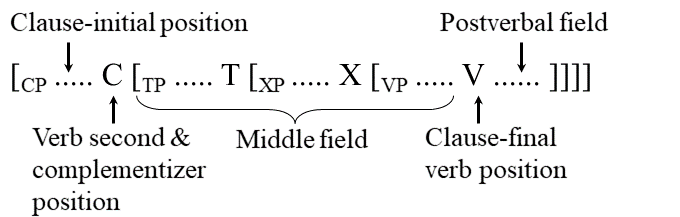
The first four parts of Syntax of Dutch (SoD) deal with the internal structure of verb phrases (including clauses) and nominal, adjectival and adpositional phrases. This fifth and final part of SoD deals with phenomena that go beyond the main clause in the technical sense discussed in Chapter V9. Clauses are CPs with the structure in (1): the C(omplementizer ) head is filled with a subordinator like datthat and ofif/whether in embedded clauses and, in Dutch and German (but not necessarily in English), with the finite verb in main clauses. Since the specifier of the CP is like the specifier of all projections in that it can contain at most one constituent, this accounts for the fact that Dutch and German (but not English) main clauses are verb-second: the finite verb must be in the second position (unless the specifier of the CP remains phonetically empty, as in yes/no-questions); cf. Chapter V10 for discussion.
 |
Syntax deals mainly with phenomena in the CP, but there are phenomena within an utterance that involve structures larger than main clauses in the technical sense. This part of SoD will deal with three such phenomena: (i) main-clause external elements, (ii) coordination (since coordinate structures may have full main clauses as coordinands), and (iii) ellipsis phenomena found in coordinate structures. We will conclude that the treatment of these phenomena in SoD is justified, as they often go hand in hand with the application of specific core syntactic phenomena within CPs, such as movement.
We start with a discussion of elements in an utterance that can be assumed to be external to the main clause in the technical sense. The clearest cases are those elements that precede the main-clause initial position like discourse particles, vocatives and left-dislocated elements.
| a. | Hé, [main clause | wat | doe | jij | daar]? | discourse particle | |
| hey | what | do | you | there | |||
| 'Hey, what are you doing?' | |||||||
| b. | Jan, [main clause | kom | alsjeblieft | even | hier]! | vocative | |
| Jan | come | please | for.a.moment | here | |||
| 'Jan, please, come here for a moment!' | |||||||
| c. | Mariei, [main clause | ik | heb | haari | niet | gezien]. | left-dislocated element | |
| Marie | I | have | here | not | seen | |||
| 'Marie, I have not seen her.' | ||||||||
Main-clause external elements at the right edge of the utterance are more difficult to identify; apart from clear cases like discourse particles and vocatives, we come across e.g. right-dislocated elements and afterthoughts, which often look very similar to extraposed phrases (cf. Chapter V12).
| a. | [main clause | Ik | heb | haari | niet | gezien], Mariei. | right-dislocated element | |
| [main clause | I | have | here | not | seen | |||
| 'I have not seen her, Marie.' | ||||||||
| b. | [main clause | Ik | heb | Mariei | niet | gezien]; | mijn zusi. | afterthought | |
| [main clause | I | have | Marie | not | seen | my sister | |||
| 'I have not seen Marie—my sister.' | |||||||||
Although structures resulting from coordination prototypically involve a single coordinator such as enand or ofor, it cannot be said that such coordinators select certain internal or external arguments. It implies that coordinate structures differ from other syntactic structures in that they are not (extended) projections of an argument-taking lexical head. Instead, coordinators typically combine two or more similar phrases (called coordinands) into a larger phrase of the same kind. Some illustrations are given in (4) with the coordinator enand: example (4a) involves coordination of two main clauses and (4b&c) coordination of two nominal phrases. Section 38.1 begins by discussing some more general properties of coordinate structures. Sections 38.2 to 38.4 discuss in detail the different types of coordinate structures and their constituent parts, i.e. coordinators and their coordinands.
| a. | [CP [CP | Jan | leest | het boek] | en [CP | Peter | leest | het artikel]]. | |
| [CP [CP | Jan | reads | the book | and | Peter | reads | the article | ||
| 'Jan reads the book and Peter reads the article.' | |||||||||
| b. | Jan leest [NP [NP | het boek] | en [NP | het artikel]]. | |
| Jan reads | the book | and | the article | ||
| 'Jan reads the book and the article.' | |||||
| c. | [NP [NP | Jan] | en [NP | Peter]] | lezen | het boek. | |
| [NP [NP | Jan | and | Peter | read | the book | ||
| 'Jan and Peter read the book.' | |||||||
Clausal coordinate structures are prone to reduction; the examples in (5) show that identical elements in the coordinands tend to be left unpronounced, which is indicated by strikethrough. We will focus on two main types of ellipsis. Example (5a) is a case of backward conjunction reduction: right-peripheral material in the left clausal coordinand is usually left unpronounced to the extent that it is identical to that of the right coordinand. Example (5b) is a case of gapping: the right clausal coordinand of the coordination is reduced by non-pronunciation of (at least) the finite verb.
| a. | [CP [CP | Jan | leest | het boek | over coördinatie] | en | |
| [CP [CP | Jan | reads | the book | about coordination | and |
| [CP | Peter | leest | het artikel | over coördinatie]]. | ||
| [CP | Peter | reads | the article | about coordination | ||
| 'Jan reads the book and Peter reads the article on coordination.' | ||||||
| b. | [CP [CP | Jan | leest | het boek] | en [CP | Peter | leest | het artikel]]. | |
| [CP [CP | Jan | reads | the book | and | Peter | reads | the article | ||
| 'Jan reads the book and Peter the article.' | |||||||||
The literature also discusses cases such as (6a) of so-called forward conjunction reduction, with ellipsis of left-peripheral material in the second coordinand. However, we will argue that such an ellipsis process does not exist (which we have indicated here with an asterisk), and propose an alternative analysis involving the coordination of smaller verbal projections (which we will call VP for convenience).
| a. | * | [CP [CP | Jan | leest | het boek] | en [CP | Jan bespreekt | het artikel]]. |
| * | [CP [CP | Jan | reads | the book | and | Jan reviews | the article |
| b. | [CP | Jan [VP | leest | het boek] | en [VP | bespreekt | het artikel]]. | |
| [CP | Jan | reads | the book | and | reviews | the article | ||
| 'Jan reads the book and reviews the article.' | ||||||||
Although coordinate structures are usually relatively easy to recognize, Chapter 39 concludes with a number of cases which are sometimes claimed to exhibit some but not all of the properties of coordination. The forms discussed are alsas and danthan in comparative constructions, behalveexcept/besides, in plaats vaninstead of and laat staanlet alone. We will argue that we are not dealing here with borderline cases of coordination but with run-of-the-mill subordination; the claim that these forms exhibit borderline behavior and should therefore be analyzed as coordinator-like elements is mainly due to the misconception that co-called gapping is only possible in coordinate structures.
