- Dutch
- Frisian
- Saterfrisian
- Afrikaans
-
- Syntax
- Preface and acknowledgements
- Verbs and Verb Phrases
- 1 Verbs: Characterization and classification
- 2 Projection of verb phrases I: Argument structure
- 3 Projection of verb phrases IIIa: Selected clauses/verb phrases (introduction)
- 1.0. Introduction
- 1.1. Main types of verb-frame alternation
- 1.2. Alternations involving the external argument
- 1.3. Alternations of noun phrases and PPs
- 1.4. Some apparent cases of verb-frame alternation
- 1.5. Bibliographical notes
- 4 Projection of verb phrases IIIa: Selected clauses/verb phrases (introduction)
- 4.0. Introduction
- 4.1. Semantic types of finite argument clauses
- 4.2. Finite and infinitival argument clauses
- 4.3. Control properties of verbs selecting an infinitival clause
- 4.4. Three main types of infinitival argument clauses
- 4.5. Non-main verbs
- 4.6. The distinction between main and non-main verbs
- 4.7. Bibliographical notes
- 5 Projection of verb phrases IIIb: Argument and complementive clauses
- 5.0. Introduction
- 5.1. Finite argument clauses
- 5.2. Infinitival argument clauses
- 5.3. Complementive clauses
- 5.4. Bibliographical notes
- 6 Projection of verb phrases IIIc: Complements of non-main verbs
- 7 Projection of verb phrases IIId: Verb clustering
- 8 Projection of verb phrases IV: Adverbial modification
- 9 Word order in the clause I: General introduction
- 10 Word order in the clause II: Position of the finite verb (verb-first/second)
- 11 Word order in the clause III:Clause-initial position (wh-movement)
- 11.0. Introduction
- 11.1. The formation of V1 and V2-clauses
- 11.2. Clause-initial position remains (phonetically) empty
- 11.3. Clause-initial position is filled
- 11.4. Bibliographical notes
- 12 Word order in the clause IV: Postverbal field (extraposition)
- 13 Word order in the clause V: Middle field (scrambling)
- Nouns and Noun Phrases
- 14 Characterization and classification
- 15 Projection of noun phrases I: Complementation
- 15.0. Introduction
- 15.1. General observations
- 15.2. Prepositional and nominal complements
- 15.3. Clausal complements
- 15.4. Bibliographical notes
- 16 Projection of noun phrases II: Modification
- 16.0. Introduction
- 16.1. Restrictive and non-restrictive modifiers
- 16.2. Premodification
- 16.3. Postmodification
- 16.3.1. Adpositional phrases
- 16.3.2. Relative clauses
- 16.3.3. Infinitival clauses
- 16.3.4. A special case: clauses referring to a proposition
- 16.3.5. Adjectival phrases
- 16.3.6. Adverbial postmodification
- 16.4. Bibliographical notes
- 17 Projection of noun phrases III: Binominal constructions
- 17.0. Introduction
- 17.1. Binominal constructions without a preposition
- 17.2. Binominal constructions with a preposition
- 17.3. Bibliographical notes
- 18 Determiners: Articles and pronouns
- 18.0. Introduction
- 18.1. Articles
- 18.2. Pronouns
- 18.3. Bibliographical notes
- 19 Numerals and quantifiers
- 19.0. Introduction
- 19.1. Numerals
- 19.2. Quantifiers
- 19.2.1. Introduction
- 19.2.2. Universal quantifiers: ieder/elk ‘every’ and alle ‘all’
- 19.2.3. Existential quantifiers: sommige ‘some’ and enkele ‘some’
- 19.2.4. Degree quantifiers: veel ‘many/much’ and weinig ‘few/little’
- 19.2.5. Modification of quantifiers
- 19.2.6. A note on the adverbial use of degree quantifiers
- 19.3. Quantitative er constructions
- 19.4. Partitive and pseudo-partitive constructions
- 19.5. Bibliographical notes
- 20 Predeterminers
- 20.0. Introduction
- 20.1. The universal quantifier al ‘all’ and its alternants
- 20.2. The predeterminer heel ‘all/whole’
- 20.3. A note on focus particles
- 20.4. Bibliographical notes
- 21 Syntactic uses of noun phrases
- 22 Referential dependencies (binding)
- Adjectives and Adjective Phrases
- 23 Characteristics and classification
- 24 Projection of adjective phrases I: Complementation
- 25 Projection of adjective phrases II: Modification
- 26 Projection of adjective phrases III: Comparison
- 27 Attributive use of the adjective phrase
- 28 Predicative use of the adjective phrase
- 29 The partitive genitive construction
- 30 Adverbial use of the adjective phrase
- 31 Participles and infinitives: their adjectival use
- Adpositions and adpositional phrases
- 32 Characteristics and classification
- 32.0. Introduction
- 32.1. Characterization of the category adposition
- 32.2. A syntactic classification of adpositional phrases
- 32.3. A semantic classification of adpositional phrases
- 32.4. Borderline cases
- 32.5. Bibliographical notes
- 33 Projection of adpositional phrases: Complementation
- 34 Projection of adpositional phrases: Modification
- 35 Syntactic uses of adpositional phrases
- 36 R-pronominalization and R-words
- 32 Characteristics and classification
- Coordination and Ellipsis
- Syntax
-
- General
-
- General
- Morphology
- Morphology
- 1 Word formation
- 1.1 Compounding
- 1.1.1 Compounds and their heads
- 1.1.2 Special types of compounds
- 1.1.2.1 Affixoids
- 1.1.2.2 Coordinative compounds
- 1.1.2.3 Synthetic compounds and complex pseudo-participles
- 1.1.2.4 Reduplicative compounds
- 1.1.2.5 Phrase-based compounds
- 1.1.2.6 Elative compounds
- 1.1.2.7 Exocentric compounds
- 1.1.2.8 Linking elements
- 1.1.2.9 Separable Complex Verbs and Particle Verbs
- 1.1.2.10 Noun Incorporation Verbs
- 1.1.2.11 Gapping
- 1.2 Derivation
- 1.3 Minor patterns of word formation
- 1.1 Compounding
- 2 Inflection
- 1 Word formation
- Morphology
- Syntax
- Adjectives and adjective phrases (APs)
- 0 Introduction to the AP
- 1 Characteristics and classification of APs
- 2 Complementation of APs
- 3 Modification and degree quantification of APs
- 4 Comparison by comparative, superlative and equative
- 5 Attribution of APs
- 6 Predication of APs
- 7 The partitive adjective construction
- 8 Adverbial use of APs
- 9 Participles and infinitives as APs
- Nouns and Noun Phrases (NPs)
- 0 Introduction to the NP
- 1 Characteristics and Classification of NPs
- 2 Complementation of NPs
- 3 Modification of NPs
- 3.1 Modification of NP by Determiners and APs
- 3.2 Modification of NP by PP
- 3.3 Modification of NP by adverbial clauses
- 3.4 Modification of NP by possessors
- 3.5 Modification of NP by relative clauses
- 3.6 Modification of NP in a cleft construction
- 3.7 Free relative clauses and selected interrogative clauses
- 4 Partitive noun constructions and constructions related to them
- 4.1 The referential partitive construction
- 4.2 The partitive construction of abstract quantity
- 4.3 The numerical partitive construction
- 4.4 The partitive interrogative construction
- 4.5 Adjectival, nominal and nominalised partitive quantifiers
- 4.6 Kind partitives
- 4.7 Partitive predication with a preposition
- 4.8 Bare nominal attribution
- 5 Articles and names
- 6 Pronouns
- 7 Quantifiers, determiners and predeterminers
- 8 Interrogative pronouns
- 9 R-pronouns and the indefinite expletive
- 10 Syntactic functions of Noun Phrases
- Adpositions and Adpositional Phrases (PPs)
- 0 Introduction to the PP
- 1 Characteristics and classification of PPs
- 2 Complementation of PPs
- 3 Modification of PPs
- 4 Bare (intransitive) adpositions
- 5 Predication of PPs
- 6 Form and distribution of adpositions with respect to staticity and construction type
- 7 Adpositional complements and adverbials
- Verbs and Verb Phrases (VPs)
- 0 Introduction to the VP in Saterland Frisian
- 1 Characteristics and classification of verbs
- 2 Unergative and unaccusative subjects and the auxiliary of the perfect
- 3 Evidentiality in relation to perception and epistemicity
- 4 Types of to-infinitival constituents
- 5 Predication
- 5.1 The auxiliary of being and its selection restrictions
- 5.2 The auxiliary of going and its selection restrictions
- 5.3 The auxiliary of continuation and its selection restrictions
- 5.4 The auxiliary of coming and its selection restrictions
- 5.5 Modal auxiliaries and their selection restrictions
- 5.6 Auxiliaries of body posture and aspect and their selection restrictions
- 5.7 Transitive verbs of predication
- 5.8 The auxiliary of doing used as a semantically empty finite auxiliary
- 5.9 Supplementive predication
- 6 The verbal paradigm, irregularity and suppletion
- 7 Verb Second and the word order in main and embedded clauses
- 8 Various aspects of clause structure
- Adjectives and adjective phrases (APs)
Verbs (V), nouns (N), adjectives (A) and prepositions (P) constitute the four major word classes. The Syntax of Dutch is organized around these so-called lexical heads; the remaining word classes, the so-called functional heads (such as complementizers and determiners), are discussed in relation to these lexical heads. The first part deals with verbs and their projections, i.e. verb phrases and clauses, and is organized as in the following subsections.
Section 1.1 provides a brief survey of some salient syntactic, morphological, and semantic characteristics of verbs. Section 1.2 reviews a number of semantic and syntactic classifications of verbs and proposes a partly novel classification that combines some of these proposals; this classification will be the starting point for the detailed discussion of nominal complementation of main verbs in Chapter 2. Section 1.3 discusses verbal inflection, while Sections 1.4 and 1.5 discuss a number of semantic notions related to verbs: tense, mood/modality, and aspect.
Main verbs project in the sense that they can take arguments (cf. Chapter 2 to Chapter 5) and that the resulting projections can be modified by a large set of adverbial phrases (Chapter 8). We will begin the discussion of argument structure by focusing on the adicity of verbs, i.e. the number and type of arguments they can take. The traditional classification is usually based on the number of nominal arguments that verbs take, i.e. whether a verb is intransitive, transitive or ditransitive.
| a. | Jan lacht. | intransitive | |
| Jan laughs |
| b. | Jan leest een boek. | transitive | |
| Jan reads a book |
| c. | Jan biedt | Peter een baan | aan. | ditransitive | |
| Jan offers | Peter a job | prt. |
Chapter 2, however, provides evidence that a satisfactory classification must take into account not only the number but also the type of arguments: we need to distinguish between what has become known as unergative and unaccusative verbs, which exhibit systematic differences in syntactic behavior. Since the distinction is relatively new (it was first proposed in Perlmutter, 1978, and received wider recognition after Burzio, 1981/1986) but plays an important role throughout this study, we will briefly introduce it below (although we will use the term intransitive verb instead of unergative verb for reasons that will become clear in Section 2.1).
Unaccusative verbs never take an accusative object. The subjects of these verbs have a similar semantic relationship with the unaccusative verb as direct objects have with transitive verbs; both are assigned the thematic role of theme. This is illustrated by the minimal pair in (2); the nominative noun phrase het glasthe glass in the unaccusative construction (2b) has the same relation to the verb as the accusative noun phrase het glas in the transitive construction in (2a). Therefore, it is generally assumed that the subject in (2b) originates in the regular direct object position, but is not assigned accusative case by the verb, so that it must be realized as a subject, for which reason we will call the subject of an unaccusative verb a theme-subject. The fact that (2b) has a transitive alternant is an accidental property of the verb brekento break. Some verbs, such as arriverento arrive, occur only in an unaccusative frame.
| a. | JanAgent | breekt het glasTheme. | |
| Jan | breaks the glass |
| a'. | * | Janagent | arriveert | het boekTheme. | transitive |
| Jan | arrives | the book |
| b. | Het glasTheme | breekt. | |
| the glass | breaks |
| b'. | Het boekTheme | arriveert. | unaccusative | |
| the book | arrives |
Hoekstra (1984a) has argued that regular intransitive and unaccusative verbs have three distinguishing properties: (a) intransitives take the perfect auxiliary hebbento have, whereas unaccusatives take the auxiliary zijnto be; (b) the past/passive participle of unaccusatives can be used attributively to modify a head noun that corresponds to the subject of the verbal construction, whereas this is not possible with intransitive verbs; (c) the impersonal passive is only possible with intransitive verbs. These properties are illustrated in (3) by the intransitive verb lachento laugh and the unaccusative arriverento arrive.
| a. | Jan heeft/*is | gelachen. | |
| Jan has/is | laughed |
| b. | Jan is/*heeft | gearriveerd. | |
| Jan is/has | arrived |
| a'. | * | de | gelachen | jongen |
| the | laughed | boy |
| b'. | de | gearriveerde | jongen | |
| the | arrived | boy |
| a''. | Er | werd | gelachen. | |
| there | was | laughed |
| b''. | * | Er | werd | gearriveerd. |
| there | was | arrived |
However, Mulder & Wehrmann (1989) argued that only a subset of unaccusative verbs exhibits all the properties in (3). For example, location verbs such as hangen in (4) enter into a similar alternation as the verb breken in (2), but nevertheless the verb in (4b) does not fully exhibit the behavior of the verb arriveren, as evidenced by the fact that it takes the auxiliary hebben in the perfect tense. Mulder & Wehrmann suggested that this is due to the fact that there is an aspectual difference between the verbs arriveren and hangen: the former is telic whereas the latter is not.
| a. | Jan hangt | de jas | in de kast. | transitive | |
| Jan hangs | the coat | in the wardrobe |
| b. | De jas | hangt | in de kast. | intransitive | |
| the coat | hangs | in the wardrobe |
The examples in (5) show that we can make a similar distinction for dyadic verbs. A verb such as bevallento please in the (b)-examples behaves like an unaccusative verb in the sense that it selects the auxiliary zijn and cannot be passivized. Since in languages with morphological case the object would appear with dative case (cf. the German verb gefallento please), such verbs have become known as nominative-dative (nom-dat) verbs. A verb such as onderzoekento examine in the (a)-examples behaves like a traditional transitive verb in that it selects the auxiliary hebben and can be passivized, and in a language with morphological case the object would be given accusative case (cf. the German verb besuchento visit).
| a. | De dokter | heeft/*is | Marie gisteren | onderzocht. | |
| the physician | has/*is | Marie yesterday | examined |
| a'. | Marie is | gisteren | (door de dokter) | onderzocht. | |
| Marie has.been | yesterday | by the physician | examined |
| b. | De nieuwe voorzitter | is/*heeft | mij | goed | bevallen. | |
| the new chairman | is/has | me | well | pleased |
| b'. | * | Ik | ben | goed | bevallen | (door de nieuwe voorzitter). |
| I | have.been | well | pleased | by the new chairman |
Since unaccusative verbs have a theme-subject, i.e. a subject that occupies an underlying VP-internal (“object”) position, we correctly predict that unaccusative triadic verbs do not exist. Consequently, if the distinction between verbs with an “underlying” subject and unaccusative verbs with a “derived” theme-subject is on the right track, we have to extend the traditional classification of verbs as in Figure 1. Sections 1.2 and 2.1 will argue that there are reasons to extend the classification in Figure 1 even further, but we will not discuss this here.
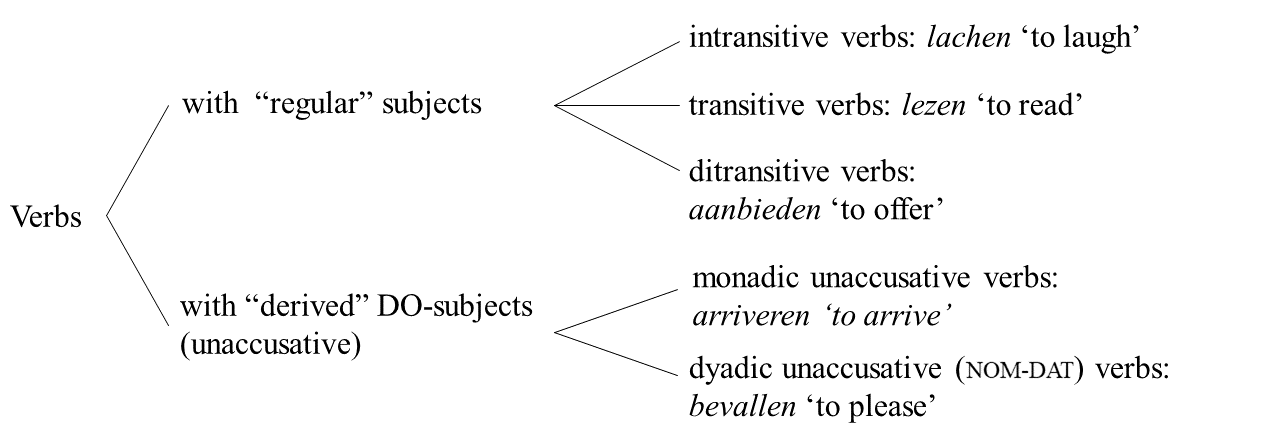
Section 2.2 discusses verbs with different types of predicative complements. Examples are the copulas, the verb vindento consider and a large set of verbs that can be combined with a resultative phrase.
| a. | Jan is aardig. | copular construction | |
| Jan is nice |
| b. | Ik | vind | Jan aardig. | vinden-construction | |
| I | consider | Jan nice |
| c. | Jan slaat | Peter dood. | resultative construction | |
| Jan hits | Peter dead |
We will also see that verbs entering the resultative construction can shift from one verb class to another by (apparently) changing their adicity, as in the (a)-examples in (7), where the intransitive verb lopen becomes transitive, or their selection properties, as in the (b)-examples.
| a. | Jan loopt | (*het gras). | adicity | |
| Jan walks | the grass |
| a'. | Jan loopt | *(het gras) | plat. | |
| Jan walks | the grass | flat |
| b. | Jan veegt | de vloer/$bezem. | selection | |
| Jan brushes | the floor/broom |
| b'. | Jan veegt | de bezem/$vloer | kapot. | |
| Jan brushes | the broom/floor | broken |
Sections 2.3 and 2.4 discuss verbs that take a PP-complement, such as wachtento wait in (8a), and the somewhat more special cases, such as wegento weigh in (8b), that take an obligatory adjectival phrase. The discussion of complements in the form of a clause is postponed until Chapter 5.
| a. | Jan wacht op vader. | PP-complements | |
| Jan waits for father |
| b. | Jan weegt | veel te zwaar. | AP-complements | |
| Jan weighs | much too heavy |
Finally, Section 2.5 discusses a number of more special verb types, like inherently reflexive verbs and so-called psychological verbs, i.e. verbs with a subject or object that have the thematic role of experiencer instead of agent/theme.
| a. | Jan vergist | zich. | inherently reflexive verb | |
| Jan be.mistaken | refl |
| b. | Die opmerking | irriteert | Jan/hem. | object-experiencer verb | |
| that remark | annoys | Jan/him |
The previous subsection has already shown that it is not always possible to say that a particular verb belongs categorically to a single class: examples (2) and (4), for instance, show that the verbs brekento break and hangento hang can be used as transitive as well as unaccusative verbs. And the examples in (7) show that the class of the verb can also depend on other elements in the clause. The phenomenon that verbs can be the head of more than one type of syntactic frame is known as verb-frame alternation and will be discussed in Chapter 3. Another well-known type of alternation, known as dative shift, is illustrated in (10).
| a. | Marie geeft | het boek | aan Peter. | dative shift | |
| Marie gives | the book | to Peter |
| b. | Marie geeft | Peter | het boek. | |
| Marie gives | Peter | the book |
We will take a broad view of the term verb-frame alternation and include voice alternations, such as the alternation between active and passive clauses in the (a)-examples in (11), as well as alternations that are the result of derivational morphology, such as the so-called locative alternation in the (b)-examples in (11), which is triggered by the affixation of the prefix be-.
| a. | Jan leest | het boek. | passivization | |
| Jan reads | the book |
| a'. | Het boek | wordt | door Jan | gelezen. | |
| the book | is | by Jan | read |
| b. | Jan plakt | een foto | op zijn computer. | locative alternation | |
| Jan pastes | a picture | on his computer |
| b'. | Jan beplakt | zijn computer | met foto’s. | |
| Jan be-pastes | his computer | with pictures |
In a sense, these chapters continue the discussion in Chapter 2 on argument structure by discussing cases where verbs take a verbal dependent, i.e. a clause or a smaller (extended) projection of another verb. The reason for not discussing this type of complementation in Chapter 2 is that it does not substantially alter the syntactic verb classification developed there: for example, many of the verbs that take an internal argument have the option of choosing between a nominal and a clausal complement. The reason for devoting a separate chapter to clausal/verbal arguments is that such arguments have many special properties and introduce a number of complicating factors that have been studied extensively in the literature. Even a brief discussion of these special properties and complicating factors would have seriously hampered the main line of argument in Chapter 2, and it is therefore better to discuss these properties in their own right.
Chapter 5 provides an exhaustive discussion of dependent clauses that function as arguments or complementives. Section 5.1 begins with finite argument clauses; we will discuss subject, direct object and prepositional clauses. This section also includes a discussion of fragment clauses and wh-extraction.
| a. | dat | duidelijk | is | [dat | Marie de nieuwe voorzitter | wordt]. | subject | |
| that | clear | is | that | Marie the new chair | becomes | |||
| 'that it is clear that Marie will be the new Chair.' | ||||||||
| b. | dat | Jan niet | gemeld | heeft | [dat | hij | weg | zou | zijn]. | direct object | |
| that | Jan not | reported | has | that | he | away | would | be | |||
| 'that Jan did not report that he would be away.' | |||||||||||
| c. | dat | Peter erover | klaagt | [dat het regent]. | PP-complement | |
| that | Peter about.it | complains | that it rains | |||
| 'that Peter is complaining about it that it is raining.' | ||||||
A typical example of fragment clauses is given in (13b); such constructions are arguably derived by a partial deletion of the phonetic content of a finite clause, which is indicated here by strikethrough.
| a. | Jan heeft | gisteren | iemand | bezocht. | speaker A | |
| Jan has | yesterday | someone | visited | |||
| 'Jan visited someone yesterday.' | ||||||
| b. | Kan je | me ook | zeggen | wie | Jan gisteren | bezocht | heeft? | speaker B | |
| can you | me also | tell | who | Jan yesterday | visited | has | |||
| 'Can you tell me who (Jan visited yesterday)?' | |||||||||
Wh-extraction is illustrated in (14b) by wh-movement of the direct object of a complement clause into the main-clause initial position. In such constructions, the wh-phrase arguably originates in the same position as the direct object dit boek in (14a), i.e. the embedded clause in (14b) contains an interpretive gap, which we have indicated by a horizontal line.
| a. | Ik | denk [Clause | dat | Marie | dit boek | morgen | zal | kopen]. | |
| I | think | that | Marie | this book | tomorrow | will | buy |
| b. | Wat | denk | je [Clause | dat | Marie __ | morgen | zal | kopen]? | |
| what | think | you | that | Marie | tomorrow | will | buy | ||
| 'What do you think that Marie will buy tomorrow?' | |||||||||
Section 5.2 considers three types of formally distinct types of infinitival clauses: om + te-infinitivals, te-infinitivals, and bare infinitivals. The examples in (15) are control constructions, which are characterized by the fact that they typically have an implicit (phonetically empty) subject pronoun, represented as PRO. It seems that the construal of PRO, called control, is subject to a number of context-sensitive conditions. In certain specific environments, PRO is obligatorily controlled in the sense that it has an (i) overt, (ii) unique, (iii) local, and (iv) c-commanding antecedent, whereas in other environments it need not satisfy these four criteria.
| a. | Jan beloofde | [om PRO | het boek naar Els | te sturen]. | om + te-infinitival | |
| Jan promised | comp | the book to Els | to send | |||
| 'Jan promised to send the book to Els.' | ||||||
| b. | Jan beweerde [PRO | het boek | naar Els | te sturen]. | te-infinitival | |
| Jan claimed | the book | to Els | to send | |||
| 'Jan claimed to send the book to Els.' | ||||||
| c. | Jan wilde [PRO | het boek | naar Els | sturen]. | bare infinitival | |
| Jan wanted | the book | to Els | send | |||
| 'Jan wanted to send the book to Els.' | ||||||
In addition to the control infinitivals in (15), there are also subject-raising and accusativus-cum-infinitivo infinitivals. An example of the first type is given in (16b). The fact that the matrix verb schijnen in (16a) cannot take a referential subject such as Jan suggests that the same is true for the verb schijnen in (16b). This has led to the hypothesis that the noun phrase Jan in (16b) is base-generated as the subject of the infinitival clause and subsequently becomes the subject of the matrix clause, similar to how the underlying object of a passive clause becomes the subject. Subject raising is restricted to te-infinitivals and bare infinitivals, and we will show that this can be accounted for by appealing to a widely assumed locality restriction on this kind of passive-like phenomena.
| a. | Het | schijnt | [dat | Jan een nieuwe auto | koopt]. | |
| it | seems | that | Jan a new car | buys | ||
| 'It seems that Jan is buying a new car.' | ||||||
| b. | Jani | schijnt [ti | een nieuwe auto | te kopen]. | |
| Jan | seems | a new car | to buy | ||
| 'Jan seems to be buying a new car.' | |||||
Accusativus-cum-infinitivo (lit. accusative with infinitive) constructions are characterized by the fact that the subject of the infinitival clause is phonetically expressed by an accusative noun phrase. In Dutch, this construction only occurs with bare infinitivals headed by a causative or perception verb; cf. example (17).
| a. | Marie | liet | [hemacc | dansen]. | |
| Marie | make/let | him | dance | ||
| 'Marie made him dance.' | |||||
| b. | Els hoorde | [henacc | een liedje | zingen]. | |
| Els heard | them | a song | sing | ||
| 'Els heard them sing a song.' | |||||
Section 5.3 concludes with a discussion of complementives, i.e. clauses that function as secondary predicates; the copular constructions in (18) are sometimes analyzed as complementives.
| a. | Een feit | is | [dat | hij | te lui | is]. | |
| a fact | is | that | he | too lazy | is | ||
| 'A fact is that he is too lazy.' | |||||||
| b. | dat boek | is moeilijk | [(om) | te lezen]. | |
| that book | is hard/not | comp | to read | ||
| 'that book is difficult to read.' | |||||
Since the complementive use of clauses is extremely rare, it seems advisable not to commit ourselves immediately to the complementive analysis. In fact, closer examination will show that there is reason to doubt this analysis in at least some cases: for instance, we will argue that example (18b) should be analyzed as a construction with a complementive AP modified by an infinitival clause.
Non-main verbs differ from main verbs in that they do not denote states of affairs, but express additional (e.g. aspectual) information about the state of affairs denoted by the main verb. This implies that non-main verbs do not have an argument structure and thus cannot semantically select a clausal/verbal complement. Nevertheless, the use of the term selection is still appropriate in this case, since non-main verbs impose selection restrictions on the verb they are accompanied by: the examples in (19) show that perfect auxiliaries such as hebbento have select past participles, semi-aspectual verbs such as zittento sit select te-infinitives, and aspectual verbs such as gaanto go select bare infinitives. Chapter 6will review a number of characteristic properties of non-main verbs and discuss the three subtypes illustrated in (19).
| a. | Jan heeft | dat boek | gelezen. | perfect auxiliary | |
| Jan has | that book | read | |||
| 'Jan has read that book.' | |||||
| b. | Jan zit | dat boek | te lezen. | semi-aspectual verb | |
| Jan sits | that book | to read | |||
| 'Jan is reading that book.' | |||||
| c. | Jan gaat | dat boek | kopen. | aspectual verb | |
| Jan goes | that book | buy | |||
| 'Jan is going to buy that book.' | |||||
Verb clustering is probably one of the most discussed topics in the syntactic literature on Dutch and German; the subject is certainly complex enough to warrant its own chapter. Verb clustering refers to the phenomenon that verbs that are in a selection relation tend to cluster together at the right periphery of the clause (with the exception of finite verbs of main clauses, which must be in second position). This phenomenon is illustrated in (20) by the embedded counterparts of the main clauses in (19).
| a. | dat | Jan dat boek | heeft | gelezen. | perfect auxiliary | |
| that | Jan that book | has | read | |||
| 'that Jan has read that book.' | ||||||
| b. | dat | Jan dat boek | zit | te lezen. | semi-aspectual verb | |
| that | Jan that book | sits | to read | |||
| 'that Jan is reading that book.' | ||||||
| c. | dat | Jan dat boek | gaat kopen. | aspectual verb | |
| that | Jan that book | goes buy | |||
| 'that Jan is going to buy that book.' | |||||
The examples in (20) show that verb clusters can occur if a non-main verb selects a past/passive participle, a te-infinitive, or a bare infinitive as its complement. Verb clusters can actually consist of more than two verbs, as shown in (21) by the perfect-tense counterparts of (20b&c).
| a. | dat | Jan dat boek | heeft | zitten | te lezen. | |
| that | Jan that book | has | sit | to read | ||
| 'that Jan has been reading that book.' | ||||||
| b. | dat | Jan dat boek | is | gaan | kopen. | |
| that | Jan that book | is | go | buy | ||
| 'that Jan has gone to buy that book.' | ||||||
Furthermore, verb clustering is not restricted to non-main verbs: it is also possible with main verbs that select a te-infinitival or a bare infinitival (but not with main verbs that select an om + te-infinitival). Example (22) provides some examples based on the (b)-examples in (16) and (17), repeated here in a slightly different form for convenience.
| a. | Jan | schijnt | een nieuwe auto | te kopen. | |
| Jan | seems | a new car | to buy | ||
| 'Jan seems to be buying a new car.' | |||||
| a'. | dat | Jan een nieuwe auto | schijnt | te kopen. | |
| that | Jan a new car | seems | to buy |
| b. | Els hoorde | hen | een liedje | zingen. | |
| Els heard | them | a song | sing | ||
| 'Els heard them sing a song.' | |||||
| b'. | dat | Els hen | een liedje | hoorde | zingen. | |
| that | Els them | a song | heard | sing |
In the examples in (20) and (22) verb clustering is obligatory, but this does not hold across the board. In some examples, verb clustering is (or seems to be) optional, and in other cases it is forbidden:
| a. | dat | Jan | <dat boek> | probeerde <dat boek> | te lezen. | |
| that | Jan | that book | tried | to read | ||
| 'that Jan tried to read that book.' | ||||||
| b. | dat | Jan Marie | <??dat boek> | aanbood <dat boek> | te lezen. | |
| that | Jan Marie | that book | prt.-offered | to read | ||
| 'that Jan offered to Marie to read that book.' | ||||||
Some descriptions of verb clustering take it more or less for granted that any string of verbs (or rather: verb-like elements) in clause-final position can be analyzed as a verb cluster. Section 5.2.2 and Chapter 6 argue that many of these cases should in fact be analyzed differently: for example, we may be dealing with deverbal adjectives or nominalizations. These findings are important because they allow us to present a much simpler description of verb clustering than is found in more descriptive grammars such as Haeseryn et al. (1997). Section 7.1 will therefore first provide some diagnostics that may help us to identify genuine verb clusters. Sections 7.2 and 7.3 then discuss the intricate relationship between hierarchical and linear ordering of verb clusters. Section 7.4 concludes with a discussion of the permeation of verb clusters by clausal constituents, a phenomenon that is particularly pervasive in the variety of standard Dutch spoken in Flanders.
This chapter discusses adverbial modification of clauses/verbal projections. We will begin by discussing the different semantic types of adverbial phrases: Section 8.1 will first discuss the basic distinction between adverbial phrases modifying the VP, like manner and certain spatiotemporal modifiers, and adverbial phrases modifying a larger part of the clause, like negation and modal modifiers. After this, Section 8.2 proposes a further subdivision of these two main classes. Section 8.3 discusses the categorial status of adverbial phrases and shows that there are often several possibilities: temporal modifiers, for example, can be APs (vroegearly), PPs (na de wedstrijdafter the game), NPs (de hele wedstrijdduring the whole game) and clauses (nadat Ajax verloren hadafter Ajax had lost the game). Section 8.4 concludes with word-order restrictions related to adverbial clauses. These word-order restrictions can be related to the semantic type of adverbial modifiers (e.g. clausal modifiers precede predicate modifiers in the middle field of the clause), but also to their categorial type (e.g. adverbial clauses tend to occur in extraposed position).
These chapters discuss the word order in the clause. Chapter 9 begins by providing a bird’s-eye view of the overall internal organization of the clause. It starts by characterizing the positions in which the verbs normally occur (the so-called second and clause-final position of the clause), and then defines three topological fields in the clause that often enter the description: clause-initial position, middle field, postverbal position. It will also introduce the main movement operations that can affect the word order in the clause: wh-movement, extraposition, various forms of scrambling, etc.
Note that readers unfamiliar with Dutch syntax may find it useful to read this chapter as a general introduction to Dutch syntax: it presents a number of issues that the reader will encounter throughout this work. Chapter 10 through Chapter 13 provide more detailed discussions of the various topics introduced in Chapter 9.
The three parts on noun phrases, adjective phrases, and adpositional phrases include separate chapters on the syntactic uses of these phrases, i.e. their use as arguments, modifiers and predicates. This may seem a bit odd in the case of verb phrases; the use of clauses as arguments and complementives is already discussed in Chapter 5, and their adverbial use is discussed in Section 8.3. Clauses can also be used as modifiers of nouns, but these relative clauses are discussed in detail in Section N16.3. Furthermore, the attributive and predicative use of past/passive participles and so-called modal infinitives is discussed in detail in Section A31. In short, since a separate discussion of the syntactic uses of verb phrases would simply lead to unnecessary redundancy, we do not include this discussion here, but simply refer the reader to the above-mentioned sections for relevant discussion.
References
