- Dutch
- Frisian
- Saterfrisian
- Afrikaans
-
- Syntax
- Preface and acknowledgements
- Verbs and Verb Phrases
- 1 Verbs: Characterization and classification
- 2 Projection of verb phrases I: Argument structure
- 3 Projection of verb phrases IIIa: Selected clauses/verb phrases (introduction)
- 1.0. Introduction
- 1.1. Main types of verb-frame alternation
- 1.2. Alternations involving the external argument
- 1.3. Alternations of noun phrases and PPs
- 1.4. Some apparent cases of verb-frame alternation
- 1.5. Bibliographical notes
- 4 Projection of verb phrases IIIa: Selected clauses/verb phrases (introduction)
- 4.0. Introduction
- 4.1. Semantic types of finite argument clauses
- 4.2. Finite and infinitival argument clauses
- 4.3. Control properties of verbs selecting an infinitival clause
- 4.4. Three main types of infinitival argument clauses
- 4.5. Non-main verbs
- 4.6. The distinction between main and non-main verbs
- 4.7. Bibliographical notes
- 5 Projection of verb phrases IIIb: Argument and complementive clauses
- 5.0. Introduction
- 5.1. Finite argument clauses
- 5.2. Infinitival argument clauses
- 5.3. Complementive clauses
- 5.4. Bibliographical notes
- 6 Projection of verb phrases IIIc: Complements of non-main verbs
- 7 Projection of verb phrases IIId: Verb clustering
- 8 Projection of verb phrases IV: Adverbial modification
- 9 Word order in the clause I: General introduction
- 10 Word order in the clause II: Position of the finite verb (verb-first/second)
- 11 Word order in the clause III:Clause-initial position (wh-movement)
- 11.0. Introduction
- 11.1. The formation of V1 and V2-clauses
- 11.2. Clause-initial position remains (phonetically) empty
- 11.3. Clause-initial position is filled
- 11.4. Bibliographical notes
- 12 Word order in the clause IV: Postverbal field (extraposition)
- 13 Word order in the clause V: Middle field (scrambling)
- Nouns and Noun Phrases
- 14 Characterization and classification
- 15 Projection of noun phrases I: Complementation
- 15.0. Introduction
- 15.1. General observations
- 15.2. Prepositional and nominal complements
- 15.3. Clausal complements
- 15.4. Bibliographical notes
- 16 Projection of noun phrases II: Modification
- 16.0. Introduction
- 16.1. Restrictive and non-restrictive modifiers
- 16.2. Premodification
- 16.3. Postmodification
- 16.3.1. Adpositional phrases
- 16.3.2. Relative clauses
- 16.3.3. Infinitival clauses
- 16.3.4. A special case: clauses referring to a proposition
- 16.3.5. Adjectival phrases
- 16.3.6. Adverbial postmodification
- 16.4. Bibliographical notes
- 17 Projection of noun phrases III: Binominal constructions
- 17.0. Introduction
- 17.1. Binominal constructions without a preposition
- 17.2. Binominal constructions with a preposition
- 17.3. Bibliographical notes
- 18 Determiners: Articles and pronouns
- 18.0. Introduction
- 18.1. Articles
- 18.2. Pronouns
- 18.3. Bibliographical notes
- 19 Numerals and quantifiers
- 19.0. Introduction
- 19.1. Numerals
- 19.2. Quantifiers
- 19.2.1. Introduction
- 19.2.2. Universal quantifiers: ieder/elk ‘every’ and alle ‘all’
- 19.2.3. Existential quantifiers: sommige ‘some’ and enkele ‘some’
- 19.2.4. Degree quantifiers: veel ‘many/much’ and weinig ‘few/little’
- 19.2.5. Modification of quantifiers
- 19.2.6. A note on the adverbial use of degree quantifiers
- 19.3. Quantitative er constructions
- 19.4. Partitive and pseudo-partitive constructions
- 19.5. Bibliographical notes
- 20 Predeterminers
- 20.0. Introduction
- 20.1. The universal quantifier al ‘all’ and its alternants
- 20.2. The predeterminer heel ‘all/whole’
- 20.3. A note on focus particles
- 20.4. Bibliographical notes
- 21 Syntactic uses of noun phrases
- 22 Referential dependencies (binding)
- Adjectives and Adjective Phrases
- 23 Characteristics and classification
- 24 Projection of adjective phrases I: Complementation
- 25 Projection of adjective phrases II: Modification
- 26 Projection of adjective phrases III: Comparison
- 27 Attributive use of the adjective phrase
- 28 Predicative use of the adjective phrase
- 29 The partitive genitive construction
- 30 Adverbial use of the adjective phrase
- 31 Participles and infinitives: their adjectival use
- Adpositions and adpositional phrases
- 32 Characteristics and classification
- 32.0. Introduction
- 32.1. Characterization of the category adposition
- 32.2. A syntactic classification of adpositional phrases
- 32.3. A semantic classification of adpositional phrases
- 32.4. Borderline cases
- 32.5. Bibliographical notes
- 33 Projection of adpositional phrases: Complementation
- 34 Projection of adpositional phrases: Modification
- 35 Syntactic uses of adpositional phrases
- 36 R-pronominalization and R-words
- 32 Characteristics and classification
- Coordination and Ellipsis
- Syntax
-
- General
-
- General
- Morphology
- Morphology
- 1 Word formation
- 1.1 Compounding
- 1.1.1 Compounds and their heads
- 1.1.2 Special types of compounds
- 1.1.2.1 Affixoids
- 1.1.2.2 Coordinative compounds
- 1.1.2.3 Synthetic compounds and complex pseudo-participles
- 1.1.2.4 Reduplicative compounds
- 1.1.2.5 Phrase-based compounds
- 1.1.2.6 Elative compounds
- 1.1.2.7 Exocentric compounds
- 1.1.2.8 Linking elements
- 1.1.2.9 Separable Complex Verbs and Particle Verbs
- 1.1.2.10 Noun Incorporation Verbs
- 1.1.2.11 Gapping
- 1.2 Derivation
- 1.3 Minor patterns of word formation
- 1.1 Compounding
- 2 Inflection
- 1 Word formation
- Morphology
- Syntax
- Adjectives and adjective phrases (APs)
- 0 Introduction to the AP
- 1 Characteristics and classification of APs
- 2 Complementation of APs
- 3 Modification and degree quantification of APs
- 4 Comparison by comparative, superlative and equative
- 5 Attribution of APs
- 6 Predication of APs
- 7 The partitive adjective construction
- 8 Adverbial use of APs
- 9 Participles and infinitives as APs
- Nouns and Noun Phrases (NPs)
- 0 Introduction to the NP
- 1 Characteristics and Classification of NPs
- 2 Complementation of NPs
- 3 Modification of NPs
- 3.1 Modification of NP by Determiners and APs
- 3.2 Modification of NP by PP
- 3.3 Modification of NP by adverbial clauses
- 3.4 Modification of NP by possessors
- 3.5 Modification of NP by relative clauses
- 3.6 Modification of NP in a cleft construction
- 3.7 Free relative clauses and selected interrogative clauses
- 4 Partitive noun constructions and constructions related to them
- 4.1 The referential partitive construction
- 4.2 The partitive construction of abstract quantity
- 4.3 The numerical partitive construction
- 4.4 The partitive interrogative construction
- 4.5 Adjectival, nominal and nominalised partitive quantifiers
- 4.6 Kind partitives
- 4.7 Partitive predication with a preposition
- 4.8 Bare nominal attribution
- 5 Articles and names
- 6 Pronouns
- 7 Quantifiers, determiners and predeterminers
- 8 Interrogative pronouns
- 9 R-pronouns and the indefinite expletive
- 10 Syntactic functions of Noun Phrases
- Adpositions and Adpositional Phrases (PPs)
- 0 Introduction to the PP
- 1 Characteristics and classification of PPs
- 2 Complementation of PPs
- 3 Modification of PPs
- 4 Bare (intransitive) adpositions
- 5 Predication of PPs
- 6 Form and distribution of adpositions with respect to staticity and construction type
- 7 Adpositional complements and adverbials
- Verbs and Verb Phrases (VPs)
- 0 Introduction to the VP in Saterland Frisian
- 1 Characteristics and classification of verbs
- 2 Unergative and unaccusative subjects and the auxiliary of the perfect
- 3 Evidentiality in relation to perception and epistemicity
- 4 Types of to-infinitival constituents
- 5 Predication
- 5.1 The auxiliary of being and its selection restrictions
- 5.2 The auxiliary of going and its selection restrictions
- 5.3 The auxiliary of continuation and its selection restrictions
- 5.4 The auxiliary of coming and its selection restrictions
- 5.5 Modal auxiliaries and their selection restrictions
- 5.6 Auxiliaries of body posture and aspect and their selection restrictions
- 5.7 Transitive verbs of predication
- 5.8 The auxiliary of doing used as a semantically empty finite auxiliary
- 5.9 Supplementive predication
- 6 The verbal paradigm, irregularity and suppletion
- 7 Verb Second and the word order in main and embedded clauses
- 8 Various aspects of clause structure
- Adjectives and adjective phrases (APs)
It is to be expected that locational PPs referring to the null vector cannot be modified by modifiers of orientation or distance; the magnitude of the null vector is zero, and consequently it has no orientation either. As is shown in (37) for the preposition binnen, this expectation is usually borne out.
| a. | * | Het huis | staat | twee kilometer | binnen de stadsmuur. | length |
| the house | stands | two kilometer | within the city wall |
| b. | * | Het huis | staat | recht/schuin | binnen de stadsmuur. | orientation |
| the house | stands | straight/diagonally | within the city walls |
However, Subsection I will show that there are a number of potential counterexamples to the claim that PPs referring to the null vector cannot be modified by modifiers of orientation and distance. Subsection II discusses some other types of modification of these PPs.
This subsection discusses several examples that at first glance seem to involve modification for orientation or distance. However, we will show that these examples are not true counterexamples to the claim that PPs referring to the null vector cannot be modified by modifiers of orientation or distance.
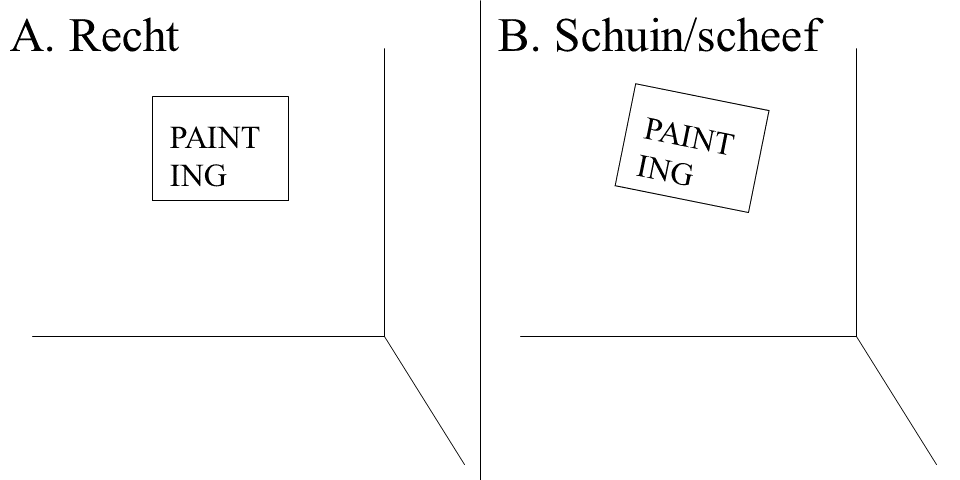
Example (38a) is fully acceptable, but the meaning of recht and schuin seems to be different from the intended modification meaning (viz. orientation); recht and schuin do not modify the position of the located object het schilderij with respect to the reference object de muur, but appear to refer to the way the painting is placed on the wall, as in Figure 5. In other words, the adjectives recht and schuin are predicated of the noun phrase het schilderijthe painting and must therefore be analyzed as supplementives, just like the adjectives in (38b). That recht and schuin do not function as modifiers of the locational PP aan de muur is supported by the fact that they can also occur in the absence of the PP.
| a. | Het schilderij | hangt | recht/schuin | (aan de muur). | |
| the painting | hangs | straight/diagonal | on the wall |
| b. | Het schilderij | hangt | netjes/scheef/slordig | (aan de muur). | |
| the painting | hangs | properly/diagonal/untidy | on the wall |
Rechtsright and linksleft in (39a) also seem to lack the intended modification meaning: these prepositions indicate the place of attachment of the flashing blue light, and do not modify the orientation of the (null) vector denoted by the preposition opon. In this respect, they resemble elements like midden/voor/achterin the middle/front/rear of in (39b).
| a. | Het zwaailicht | zit | rechts/links | op de auto. | |
| the flashlight | sits | right/left | on the car | ||
| 'The flashing light is attached to the right/left side of the car.' | |||||
| b. | Het zwaailicht | zit | midden/voor/achter | op de auto. | |
| the flashlight | sits | middle/in.front.of/behind | on the car | ||
| 'The flashing light is attached to the center/front/rear of the car.' | |||||
Other elements that can be used in a similar way to links/rechts, midden and achter/voor in (39) are boven/onderabove/under, which are in a paradigm with midden, as shown in (40).
| a. | Jan staat | midden | op de ladder. | |
| Jan stands | middle | on the ladder | ||
| 'Jan stands in the middle of the ladder.' | ||||
| b. | Jan staat | boven/onder | op de ladder. | |
| Jan stands | above/under | on the ladder | ||
| 'Jan is at the top/bottom of the ladder.' | ||||
The copular clauses in (39) and (40) involve some kind of modification of the locational PP op de auto/ladder, which functions as their predicate. This is most obvious in the cases of midden and onder, since dropping the PP causes the relevant examples in (40) to become ungrammatical, as is shown in (41a). It is less obvious in the other cases, because the resulting structures are acceptable. However, the meaning of the clauses changes considerably, as shown in (41b) for boven in (40b), which now takes on the meaning of “upstairs”. Note that in accordance with this, example (40b) with boven is actually ambiguous: it can be translated not only as “Jan is standing on top of the ladder”, but also as “Jan is standing upstairs on the ladder”. In the latter case, it does not act as the antonym of onder, but as the antonym of benedendownstairs; we will discuss this kind of ambiguity in more detail in Section 34.5.
| a. | * | Jan zit | midden/onder. |
| Jan sits | middle/under |
| b. | Jan zit | boven. | |
| Jan sits | above | ||
| 'Jan is sitting upstairs.' | |||
The question we want to address in the remainder of this subsection is whether the examples in (39) and (40) involve adverbial modification of the locational PP or some other kind of relation. Although it is difficult to give a conclusive answer, the discussion will show that there are reasons for assuming that we are not dealing with adverbial modification but with compounding.
The examples in (33), repeated here as (42), have made it clear that it is not the preposition itself that is modified by an adverbial phrase but the full PP: this follows from the fact that in the case of R-pronominalization, the R-word er can intervene between the modifier and the preposition.
| a. | De boom | stond | dicht/vlak | bij het huis. | |
| the tree | stood | close | near the house | ||
| 'The tree stood close to the house.' | |||||
| b. | De boom | stond [dicht/vlak [PP | er | bij]]. | |
| the tree | stood close | there | near | ||
| 'The tree stood close to it.' | |||||
However, if we look at cases with the elements links/rechts, achter/voor/midden and boven/onder, it looks as if the R-pronoun cannot intervene between most of these elements and the PP. This is shown in the primed examples in (43).
| a. | Het zwaailicht | zit | links/rechts | op de auto. | |
| the flashlight | sits | left/right | on the car | ||
| 'The flashing light is attached to the left/right (side) of the car.' | |||||
| a'. | * | Het zwaailicht | zit | links/rechts | er | op. |
| the flashlight | sits | left/right | there | on |
| b. | Het grote orgel | staat | voor/achter/midden | in de kerk. | |
| the large organ | stands | in.front.of/behind/middle | in the church | ||
| 'The main organ stands in the front/back/middle of the church.' | |||||
| b'. | * | Het grote orgel | staat | voor/achter/midden | er | in. |
| the large organ | stands | in.front.of/behind/middle | there | in |
| c. | De productiedatum | staat | boven/onder | op het blikje. | |
| the production.date | stands | above/under | on the can | ||
| 'The manufacturing date can be found on top/the bottom of the can.' | |||||
| c'. | * | De productiedatum | staat | boven/onder | er | op. |
| the production.date | stands | above/under | there | on |
It is not immediately clear how decisive the primed examples in (43a&b) are for the hypothesis that the preposition and the element preceding it form a complex PP, because what we see in (44a&b) brings out that the order in which the R-pronoun precedes the supposed complex preposition is also marked. However, the hypothesis is supported by the fact that this order is acceptable in (44b'&c).
| a. | ?? | Het zwaailicht | zit | er | links/rechts | op. |
| the flashlight | sits | there | left/right | on |
| b. | ?? | Het grote orgel | staat | er | voor/achter | in. |
| the large organ | stands | there | in.front.of/behind | in |
| b'. | Het grote orgel | staat | er | midden | in. | |
| the large organ | stands | there | middle | in | ||
| 'The main organ stands in the middle of it.' | ||||||
| c. | De productiedatum | staat | er | boven/onder | op. | |
| the production.date | stands | there | above/under | on | ||
| 'The manufacturing date can be found on top/the bottom of it.' | ||||||
The acceptability of (44b'&c) thus shows that the cause of the unacceptability of the primed examples in (43) is not that R-pronominalization is impossible; it rather suggests that the sequence of the modifier and the preposition is impenetrable, which would be consistent with a compound analysis; cf. 32.2.1, sub 2. This raises the question as to why (44a&b) are marked/unacceptable. A possible answer might be that these constructions compete with the shorter and thus more economical expressions in (45a&b) without the locational PP. This appeal to blocking would be supported by the acceptability of (44b'&c), given that (45b'&c) are not acceptable.
| a. | Het zwaailicht | zit | links/rechts. | |
| the flashlight | sits | left/right | ||
| 'The flashing light is on the left/right side.' | ||||
| b. | Het grote orgel | staat | voor/achter. | |
| the large organ | stands | in.front.of/behind | ||
| 'The large organ is in the front/rear.' | ||||
| b'. | * | Het grote orgel | staat | midden. |
| the large organ | stands | middle |
| c. | * | De productiedatum | staat | boven/onder. |
| the production.date | stands | above/under |
We conclude from the discussion above that the adverbial modification analysis of the primeless example in (43) is highly problematic, and that the proposed compound analysis fares much better. Note that we have ignored a possible (and quite plausible) alternative analysis of the (a) and (b)-examples in (43)/(44), namely one in which the PP acts as a modifier of the element preceding it. This would explain the acceptability judgments in (43)/(44), as well as those in (45), while preserving our conclusions for the analysis of the (c) and (d)-examples. We refer the reader to Section 34.5 for further discussion of this type of analysis.
There are cases in which the complex forms can be used as intransitive adpositions, while the simple forms cannot. If achter acts as a modifier of the preposition op in (46a), then the unacceptability of (46a') with op as an intransitive adposition would of course be highly surprising. In (46b), we give similar examples with bovenin.
| a. | Jan zit | achterop | (de fiets). | |
| Jan sits | on.the.back.of | the bike | ||
| 'Jan is sitting on the back of the bike.' | ||||
| a'. | Jan zit | op | *(de fiets). | |
| Jan sits | on | the bike |
| b. | Het geld | ligt | bovenin | (de kast). | |
| the money | lies | in.the.upper.part.of | the cupboard |
| b'. | Het geld | ligt | in | *(de kast). | |
| the money | lies | in | the cupboard |
If we are dealing with compounds, on the other hand, the difference in acceptability between the primeless and primed examples could simply be explained by appealing to a difference in syntactic valence of the simple and complex prepositions.
Section 34.1.5 has shown that modified intransitive adpositions cannot permeate the clause-final verb cluster; the complex forms under discussion, on the other hand, can, as is shown in (47).
| a. | dat | Marie de hele tijd | voorop | heeft | gelopen. | |
| that | Marie the whole time | in.front | has | walked | ||
| 'that Marie walked in front all the time.' | ||||||
| b. | dat Marie de hele tijd heeft voorop gelopen. |
This again favors a compound analysis of the complex forms; the complex preposition voorop functions as a verbal particle, which can thus permeate the verbal cluster; cf. Section 32.2.4, sub III, for discussion.
The discussion in the previous subsections suggests that elements like links/rechts, midden, voor/achter and boven/onder in (39) and (40) are not adverbial modifiers but the first members of a compound. Table 5 shows the possible combinations of these elements with prepositions that denote the null vector. The fact that there are so many question marks in this table indicates that more research is needed.
| preposition | links/rechts | midden | achter/voor | boven/onder |
| in ‘in/into’ | + | + | + | + |
| uit ‘out/out of’ | ? | ? | + | + |
| door ‘through’ | — | ? | — | — |
| aan ‘on’ | ? | ? | + | + |
| op ‘on’ | + | + | + | + |
| over ‘over’ | ? | ? | — | — |
| tegen ‘against’ | + | + | — | — |
| binnen ‘inside’ | — | — | — | — |
It is important to note that the “—” mark does not necessarily mean that the pertinent sequence cannot be found, but rather that the intended modification relation is not present. The examples in (48) do not involve modification of the PP by the elements achter/voor, as will be clear from the paraphrases.
| a. | De ladder | stond | achter | tegen de muur. | |
| the ladder | stood | back | against the wall | ||
| 'At the back (of the house), the ladder was against the wall.' | |||||
| b. | Jan liep | voor | door de deur. | |
| Jan walked | front | through the door | ||
| 'At the front (of the house), Jan walked through the door.' | ||||
That we are not dealing with modification of the PPs is also supported by the following two facts. First, the PPs need not be present: without them, the examples simply express that the ladder was at the back and that Jan walked (e.g. up and down) in front of the house. Second, the examples in (49) show that voor and achter cannot pied-pipe the PP under topicalization but must be fronted in isolation; this shows that they are independent constituents, comparable to the more common element boven with the meaning “upstairs”; cf. Section 34.5.
| a. | * | Achter tegen de muur stond de ladder. |
| a'. | Achter | stond | de ladder tegen de muur. | |
| back | stood | the ladder against the wall | ||
| 'At the back (of the house), the ladder was against the wall.' | ||||
| b. | * | Voor | door de deur | liep | Jan. |
| b'. | Voor | liep | Jan | door de deur. | |
| front | walked | Jan | through the door | ||
| 'At the front (of the house), Jan walked through the door.' | |||||
The fact that the combinations in Table 6 may occur with a relation other than the modification relation discussed in this subsection may perhaps also account for at least some of the question marks in this table. The fact mentioned earlier that there are grounds for positing that links and rechts do not function as the first member of a compound but rather as independent constituents in their own right, may also be responsible for some of the unclear cases.
Up to now we have not encountered any clear cases of adverbial modification of locational PPs headed by a preposition denoting the null vector, so perhaps we should conclude that such modification is not possible. However, there are several cases that might involve modification, which we will examine in the following subsections: we will see that the options, if any, are limited.
The elements preciesexactly, netjust and bijnanearly seem to be common as modifiers of PPs headed by the prepositions inin and opon. Some examples with the change-of-location verbs schietento shoot and gooiento throw are given in (50). In these examples, we are not dealing with modifiers of orientation or distance, but with modifiers of the (target) position of the located object: the use of precies emphasizes that the located object has actually reached the reference object (i.e. the bull’s-eye), while bijna implies that this was almost the case.
| a. | Hij | schoot | de pijl | precies/bijna | in | de roos. | |
| he | shot | the arrow | exactly/nearly | into | the bull’s-eye |
| b. | Zij | gooide | de bal | precies/bijna | op Peters neus. | |
| she | threw | the ball | exactly/nearly | on Peter’s nose |
The (a)-examples in (51) show that precies acts as a modifier of the PP: the phrase precies in de roos must be topicalized as a whole. However, it is not so clear whether bijna acts as a modifier of the PP: the (b)-examples show that topicalization of the string bijna in de roos yields a marked result; the option of moving bijna in isolation is much preferred.
| a. | Precies in de roos schoot hij de pijl. |
| a'. | * | Precies schoot hij de pijl in de roos. |
| b. | ?? | Bijna in de roos schoot hij de pijl. |
| b'. | Bijna schoot hij de pijl in de roos. |
Although this suggests that bijna does not act as a modifier of the PP but of the clause, drawing a conclusion like this would be premature since topicalization of bijna sometimes results in a change of meaning. This is perhaps not so clear in the case of the (b)-examples in (51), but the shift of meaning can be made more conspicuous by using the examples in (52).
| a. | Jan viel | bijna | in het water. | |
| Jan fell | nearly | into the water |
| b. | Bijna | viel | Jan in het water. | |
| nearly | fell | Jan into the water |
Example (52a) has two readings. The first reading involves modification of the eventuality; it asserts that Jan was about to fall into the water, but was eventually prevented from doing so. The second reading involves modification of the location: the speaker claims that Jan did fall, and that as a result he ended up in a position near the water. If we now consider the topicalization construction in (52b), it turns out that only the first reading survives. This seems to indicate that in its second reading, bijna behaves more like a modifier of the PP than of the clause. However, if this is indeed the case, the markedness of topicalization constructions like (51b) remains a mystery.
The examples in (53) seem to suggest that PPs headed by in and uit constitute counterexamples to the claim that PPs referring to the null vector cannot be modified by modifiers of distance and orientation; at first sight, the adjectival and nominal phrases in the primeless examples seem to act as modifiers of distance, and the adjectives in the primed examples as modifiers of orientation.
| a. | De spijker | zit | diep/drie cm | in de muur. | |
| the nail | sits | deep/three cm | in the wall |
| a'. | De spijker | zit | schuin | in de muur. | |
| the nail | sits | diagonally | in the wall |
| b. | De spijker | steekt | drie cm | uit | de muur. | |
| the nail | sticks | three cm | out.of | the wall |
| b'. | De spijker | steekt | schuin | uit | de muur. | |
| the nail | sticks | diagonally | out.of | the wall |
However, the following subsections will show that it is not so obvious that we are really dealing with modifiers of the PP.
The meaning expressed by the putative modifiers in (53) is of a completely different nature than that of PPs denoting a set of vectors. This is most obvious in the case of the putative modifiers of distance. In the case of PPs denoting a set of vectors, these modifiers indicate the distance between the reference object and the located object. In the case of in/uit, on the other hand, the modifier indicates how deep/far the located object penetrates/protrudes from the wall; this is shown in Figure 6A&B. Similarly, in the primed examples, schuin indicates the way (i.e. direction) in which the nail penetrates or protrudes from the wall; this is shown in Figure 6A'&B'.
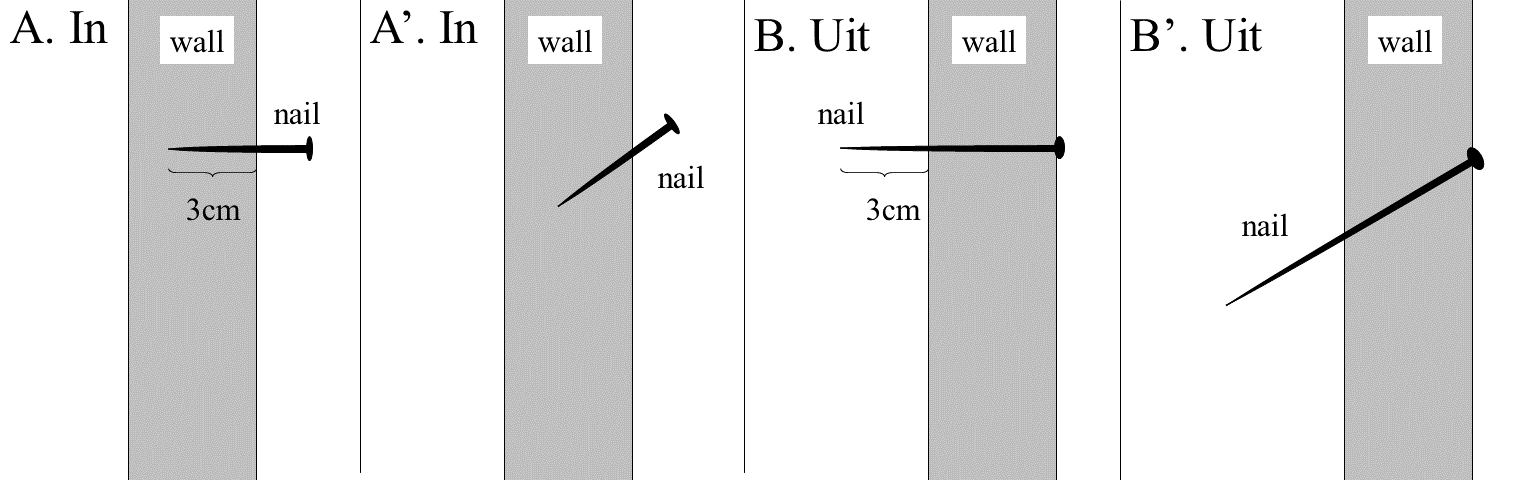
If the PPs headed by in and uit involve vectors, these should differ from the vectors discussed earlier in that they are not necessarily directed outwards with respect to the reference object, but can also be directed inwards. Note, however, that the nominal measure phrases in (53a&b) above are in a paradigm with gedeeltelijkpartly, helemaalentirely, and voor de helfthalf (lit: for the half), which seem to modify (or be predicated of) the located object rather than modifying the PP, so that it is not a priori clear whether we are really dealing with PP modification.
| a. | De spijker | zit | gedeeltelijk/helemaal/voor de helft | in de muur. | |
| the nail | sits | partly/entirely/half | in the wall |
| b. | De spijker | steekt | gedeeltelijk/helemaal/voor de helft | uit de muur. | |
| the nail | sticks | partly/entirely/half | out.of the wall |
The elements discussed above can be used not only in the locational constructions in (53), but also in constructions involving a change of location, as in (55). Observe that uit differs from in in that it (marginally) takes the adjectival verfar as its (putative) modifier of distance, not diepdeep.
| a. | Jan sloeg | de spijker | drie cm/diep/helemaal | in de muur. | |
| Jan hit | the nail | three cm/deep/entirely | into the wall |
| b. | Jan trok | de spijker | drie cm/?ver/helemaal | uit de muur. | |
| Jan pulled | the nail | three cm/far/entirely | out.of the wall |
The unacceptability of the examples in (56) shows that these modifiers can only occur with PPs denoting the null vector if some physical contact between the reference and the located object is implied. This is consistent with the suggestion above that the modifiers in question do not actually modify an (inwardly directed) vector, but the located object itself: if there is no physical contact, the located object cannot penetrate or protrude from the reference object and so modification is excluded. If this is true, the notion of an “inwardly directed vector” can be discarded, and we should conclude that modification of adpositional phrases denoting the null vector is not possible. Example (56b) is given a number sign because it (marginally) allows a reading in which schuin/recht refer to Jan’s posture, which is not relevant here.
| a. | * | Jan stond | 3 meter/diep/ver | binnen de muur. |
| Jan stood | 3 meters/deep/far | within the wall |
| b. | # | Jan stond | schuin/recht | binnen de muur. |
| Jan stood | diagonally/straight | within the wall |
Nevertheless, it should be noted that examples like (57), where the distance of the located object from the outer boundary of the reference object seems to be measured, are acceptable. Perhaps this is because these examples do not actually involve multidimensional space. For example, if the budget is one million euros, example (57a) simply expresses that the estimate is less. If the time limit is two hours, (57b) expresses that it took the athlete less time to finish. And if the transmitter has a range of 100 km, (57c) expresses that Jan lives less than 100 km from it; so, only the distance between Jan’s house and the transmitter is relevant in this example.
| a. | De begroting | bleef | ruim/net | binnen de grenzen | van het budget. | |
| the estimate | remained | amply/just | within the boundaries | of the budget | ||
| 'The budget remained well/just within budget limits.' | ||||||
| b. | De atleet | kwam | ruim/net | binnen de gestelde tijd | binnen. | |
| the athlete | came | amply/just | within the set time | inside | ||
| 'The athlete remained well/just within the time limit.' | ||||||
| c. | Jan woont | ruim/net | binnen | het bereik | van de zender. | |
| Jan lives | amply/just | within | the range | of the transmitter | ||
| 'Jan lives well/just within range of the transmitter.' | ||||||
In other words, we are not dealing with an outer boundary in multidimensional space, but with an upper limit on a (one-dimensional) scale; this means that the PPs in (57) cannot be described in terms of vector theory.
Another reason to doubt that the examples in (53) involve modification of the PPs is that topicalization of the allegedly modified PPs gives rise to a marked result. This is clearest for the examples with the preposition uit in the (b)-examples in (53): the examples in (58) seem unacceptable. This is suspicious, because in cases where we are unambiguously dealing with modification, topicalization of the entire modified PP is easily possible: Een meter boven de deur hangt een schilderijA painting hangs one meter above the door.
| a. | * | Drie cm | uit de muur | steekt | de spijker. |
| three cm | out.of the wall | sticks | the nail |
| b. | * | Schuin | uit de muur | steekt | de spijker. |
| diagonally | out.of the wall | sticks | the nail |
Leftward movement of the noun/adjective phrase in isolation gives rise to significantly better results: topicalization, as in the primeless examples in (59), may still be a bit marked, but wh-movement, as in the primed examples, is perfectly acceptable. Unfortunately, however, this does not tell us much, since we have seen that it is also possible to extract nominal and adjectival modifiers from the PP.
| a. | ? | Drie cm | steekt | de spijker | uit de muur. |
| three cm | sticks | the nail | out.of the wall |
| a'. | Hoeveel cm | steekt | de spijker | uit de muur? | |
| how.many cm | sticks | the nail | out.of the wall | ||
| 'How many cm does the nail stick out of the wall?' | |||||
| b. | ?? | Schuin | steekt | de spijker | uit de muur. |
| diagonally | sticks | the nail | out.of the wall |
| b'. | Hoe | steekt | de spijker | uit de muur, | schuin of recht? | |
| how | sticks | the nail | out.of the wall | diagonally or straight | ||
| 'How does the nail stick out of the wall, angled or straight?' | ||||||
Example (60a) appears to be slightly better than (58a). However, the interpretation of this example differs from that of example (53a); it can no longer express the situation in Figure 6A, but suggests that the nail has completely entered the wall and is now located at a distance of three centimeters from the surface of the wall. The other examples in (60) do not receive such a deviant interpretation, and the judgments are more or less similar to those in (58) and (59).
| a. | ?? | Drie cm | in de muur | zit | de spijker. |
| three cm | in the wall | sits | the nail |
| a'. | ? | Drie cm | zit | de spijker | in de muur. |
| three cm | sits | the nail | in the wall |
| a''. | Hoeveel cm | zit | de spijker | in de muur? | |
| how.many cm | sits | the nail | in the wall |
| b. | * | Schuin | in de muur | zit | de spijker. |
| diagonally | in the wall | sits | the nail |
| b'. | ? | Schuin | zit | de spijker | in de muur. |
| diagonally | sits | the nail | in the wall |
| b''. | Hoe | zit | de spijker | in de muur? | |
| how | sits | the nail | in the wall |
The topicalization data discussed in this subsection at least suggest that example (53) does not involve modification of the PP. We will defer postpone discussion of this issue to Section 34.1.4, sub III, where we will examine the modification of directional adpositional phrases.
The previous subsections have shown that the modification possibilities of PPs referring to the null vector are very limited, possibly restricted to modifiers of the type preciesexactly, netjust and bijnanearly discussed in Subsection A. In all likelihood, nominal measure phrases such as drie cmthree cm and the adjectival phrases recht/schuinstraight/diagonally in the examples discussed in Subsection B do not function as modifiers of the locational PP at all.
