- Dutch
- Frisian
- Saterfrisian
- Afrikaans
-
- Syntax
- Preface and acknowledgements
- Verbs and Verb Phrases
- 1 Verbs: Characterization and classification
- 2 Projection of verb phrases I: Argument structure
- 3 Projection of verb phrases IIIa: Selected clauses/verb phrases (introduction)
- 1.0. Introduction
- 1.1. Main types of verb-frame alternation
- 1.2. Alternations involving the external argument
- 1.3. Alternations of noun phrases and PPs
- 1.4. Some apparent cases of verb-frame alternation
- 1.5. Bibliographical notes
- 4 Projection of verb phrases IIIa: Selected clauses/verb phrases (introduction)
- 4.0. Introduction
- 4.1. Semantic types of finite argument clauses
- 4.2. Finite and infinitival argument clauses
- 4.3. Control properties of verbs selecting an infinitival clause
- 4.4. Three main types of infinitival argument clauses
- 4.5. Non-main verbs
- 4.6. The distinction between main and non-main verbs
- 4.7. Bibliographical notes
- 5 Projection of verb phrases IIIb: Argument and complementive clauses
- 5.0. Introduction
- 5.1. Finite argument clauses
- 5.2. Infinitival argument clauses
- 5.3. Complementive clauses
- 5.4. Bibliographical notes
- 6 Projection of verb phrases IIIc: Complements of non-main verbs
- 7 Projection of verb phrases IIId: Verb clustering
- 8 Projection of verb phrases IV: Adverbial modification
- 9 Word order in the clause I: General introduction
- 10 Word order in the clause II: Position of the finite verb (verb-first/second)
- 11 Word order in the clause III:Clause-initial position (wh-movement)
- 11.0. Introduction
- 11.1. The formation of V1 and V2-clauses
- 11.2. Clause-initial position remains (phonetically) empty
- 11.3. Clause-initial position is filled
- 11.4. Bibliographical notes
- 12 Word order in the clause IV: Postverbal field (extraposition)
- 13 Word order in the clause V: Middle field (scrambling)
- Nouns and Noun Phrases
- 14 Characterization and classification
- 15 Projection of noun phrases I: Complementation
- 15.0. Introduction
- 15.1. General observations
- 15.2. Prepositional and nominal complements
- 15.3. Clausal complements
- 15.4. Bibliographical notes
- 16 Projection of noun phrases II: Modification
- 16.0. Introduction
- 16.1. Restrictive and non-restrictive modifiers
- 16.2. Premodification
- 16.3. Postmodification
- 16.3.1. Adpositional phrases
- 16.3.2. Relative clauses
- 16.3.3. Infinitival clauses
- 16.3.4. A special case: clauses referring to a proposition
- 16.3.5. Adjectival phrases
- 16.3.6. Adverbial postmodification
- 16.4. Bibliographical notes
- 17 Projection of noun phrases III: Binominal constructions
- 17.0. Introduction
- 17.1. Binominal constructions without a preposition
- 17.2. Binominal constructions with a preposition
- 17.3. Bibliographical notes
- 18 Determiners: Articles and pronouns
- 18.0. Introduction
- 18.1. Articles
- 18.2. Pronouns
- 18.3. Bibliographical notes
- 19 Numerals and quantifiers
- 19.0. Introduction
- 19.1. Numerals
- 19.2. Quantifiers
- 19.2.1. Introduction
- 19.2.2. Universal quantifiers: ieder/elk ‘every’ and alle ‘all’
- 19.2.3. Existential quantifiers: sommige ‘some’ and enkele ‘some’
- 19.2.4. Degree quantifiers: veel ‘many/much’ and weinig ‘few/little’
- 19.2.5. Modification of quantifiers
- 19.2.6. A note on the adverbial use of degree quantifiers
- 19.3. Quantitative er constructions
- 19.4. Partitive and pseudo-partitive constructions
- 19.5. Bibliographical notes
- 20 Predeterminers
- 20.0. Introduction
- 20.1. The universal quantifier al ‘all’ and its alternants
- 20.2. The predeterminer heel ‘all/whole’
- 20.3. A note on focus particles
- 20.4. Bibliographical notes
- 21 Syntactic uses of noun phrases
- 22 Referential dependencies (binding)
- Adjectives and Adjective Phrases
- 23 Characteristics and classification
- 24 Projection of adjective phrases I: Complementation
- 25 Projection of adjective phrases II: Modification
- 26 Projection of adjective phrases III: Comparison
- 27 Attributive use of the adjective phrase
- 28 Predicative use of the adjective phrase
- 29 The partitive genitive construction
- 30 Adverbial use of the adjective phrase
- 31 Participles and infinitives: their adjectival use
- Adpositions and adpositional phrases
- 32 Characteristics and classification
- 32.0. Introduction
- 32.1. Characterization of the category adposition
- 32.2. A syntactic classification of adpositional phrases
- 32.3. A semantic classification of adpositional phrases
- 32.4. Borderline cases
- 32.5. Bibliographical notes
- 33 Projection of adpositional phrases: Complementation
- 34 Projection of adpositional phrases: Modification
- 35 Syntactic uses of adpositional phrases
- 36 R-pronominalization and R-words
- 32 Characteristics and classification
- Coordination and Ellipsis
- Syntax
-
- General
-
- General
- Morphology
- Morphology
- 1 Word formation
- 1.1 Compounding
- 1.1.1 Compounds and their heads
- 1.1.2 Special types of compounds
- 1.1.2.1 Affixoids
- 1.1.2.2 Coordinative compounds
- 1.1.2.3 Synthetic compounds and complex pseudo-participles
- 1.1.2.4 Reduplicative compounds
- 1.1.2.5 Phrase-based compounds
- 1.1.2.6 Elative compounds
- 1.1.2.7 Exocentric compounds
- 1.1.2.8 Linking elements
- 1.1.2.9 Separable Complex Verbs and Particle Verbs
- 1.1.2.10 Noun Incorporation Verbs
- 1.1.2.11 Gapping
- 1.2 Derivation
- 1.3 Minor patterns of word formation
- 1.1 Compounding
- 2 Inflection
- 1 Word formation
- Morphology
- Syntax
- Adjectives and adjective phrases (APs)
- 0 Introduction to the AP
- 1 Characteristics and classification of APs
- 2 Complementation of APs
- 3 Modification and degree quantification of APs
- 4 Comparison by comparative, superlative and equative
- 5 Attribution of APs
- 6 Predication of APs
- 7 The partitive adjective construction
- 8 Adverbial use of APs
- 9 Participles and infinitives as APs
- Nouns and Noun Phrases (NPs)
- 0 Introduction to the NP
- 1 Characteristics and Classification of NPs
- 2 Complementation of NPs
- 3 Modification of NPs
- 3.1 Modification of NP by Determiners and APs
- 3.2 Modification of NP by PP
- 3.3 Modification of NP by adverbial clauses
- 3.4 Modification of NP by possessors
- 3.5 Modification of NP by relative clauses
- 3.6 Modification of NP in a cleft construction
- 3.7 Free relative clauses and selected interrogative clauses
- 4 Partitive noun constructions and constructions related to them
- 4.1 The referential partitive construction
- 4.2 The partitive construction of abstract quantity
- 4.3 The numerical partitive construction
- 4.4 The partitive interrogative construction
- 4.5 Adjectival, nominal and nominalised partitive quantifiers
- 4.6 Kind partitives
- 4.7 Partitive predication with a preposition
- 4.8 Bare nominal attribution
- 5 Articles and names
- 6 Pronouns
- 7 Quantifiers, determiners and predeterminers
- 8 Interrogative pronouns
- 9 R-pronouns and the indefinite expletive
- 10 Syntactic functions of Noun Phrases
- Adpositions and Adpositional Phrases (PPs)
- 0 Introduction to the PP
- 1 Characteristics and classification of PPs
- 2 Complementation of PPs
- 3 Modification of PPs
- 4 Bare (intransitive) adpositions
- 5 Predication of PPs
- 6 Form and distribution of adpositions with respect to staticity and construction type
- 7 Adpositional complements and adverbials
- Verbs and Verb Phrases (VPs)
- 0 Introduction to the VP in Saterland Frisian
- 1 Characteristics and classification of verbs
- 2 Unergative and unaccusative subjects and the auxiliary of the perfect
- 3 Evidentiality in relation to perception and epistemicity
- 4 Types of to-infinitival constituents
- 5 Predication
- 5.1 The auxiliary of being and its selection restrictions
- 5.2 The auxiliary of going and its selection restrictions
- 5.3 The auxiliary of continuation and its selection restrictions
- 5.4 The auxiliary of coming and its selection restrictions
- 5.5 Modal auxiliaries and their selection restrictions
- 5.6 Auxiliaries of body posture and aspect and their selection restrictions
- 5.7 Transitive verbs of predication
- 5.8 The auxiliary of doing used as a semantically empty finite auxiliary
- 5.9 Supplementive predication
- 6 The verbal paradigm, irregularity and suppletion
- 7 Verb Second and the word order in main and embedded clauses
- 8 Various aspects of clause structure
- Adjectives and adjective phrases (APs)
This section briefly discusses the so-called middle field of the clause, i.e. the part of the clause bounded on the right by the clause-final verbs (if present) and on the left by the complementizer in an embedded clause or the finite verb in a main clause. The middle field of the examples in (67) is italicized.
| a. | Gisteren | heeft | Jan | met plezier | dat boek | gelezen. | main clause | |
| yesterday | has | Jan | with pleasure | that book | read | |||
| 'Jan enjoyed reading that book yesterday.' | ||||||||
| b. | Ik | denk | [dat Jan met plezier | dat boek | gelezen | heeft]. | embedded clause | |
| I | think | that Jan with pleasure | that book | read | has | |||
| 'I think that Jan enjoyed reading that book.' | ||||||||
The middle field of a clause is not a constituent and not even a phrase, but refers to a set of positions within the clause. If we adopt the representation in (60b) and assume that C is the position of the complementizer or the finite verb in second position and that the clause-final verb occupies V, the middle field is as indicated in (68).
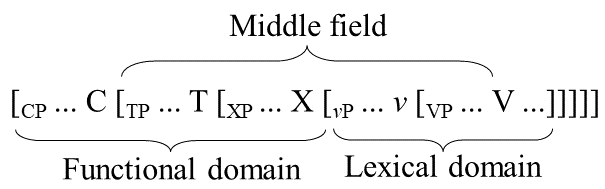 |
The fact that the middle field does not refer to a discrete entity in the clausal domain makes it immediately clear that we are dealing with a pre-theoretical notion. This is also evident from the fact that it refers to a slightly smaller domain in subject-initial sentences, such as Jan heeft met plezier dat boek gelezen, if such sentences are not CPs but TPs, as suggested by the data discussed in Section 9.3, sub IV.
| a. | Jan heeft | met plezier | dat boek | gelezen. | |
| Jan has | with pleasure | that book | read |
| b. |  |
Recall that X in the structures in (68) and (69) stands for an unspecified number of functional heads that may be needed to provide a full description of the structure of the clause. More specifically, just as the specifier of C serves as the landing site for wh-movement in questions and topicalization constructions, the lower functional heads may also introduce specifiers that can serve as landing sites for various other types of movement; we will provide a first overview in this section.
 |
Whether the postulation of such functional heads is really necessary, or whether there are alternative ways of expressing the same theoretical intuition, is a matter of debate, but it is clear that Dutch exhibits considerable freedom in word order in the middle field of the clause (compared to many other languages). For instance, example (71a) shows that a direct object can be left-adjacent to the clause-final verbs, but it can also occur further to the left. Similarly, example (71b) shows that although the subject is usually right-adjacent to the complementizer or the finite verb in second position, it can also occur further to the right.
| a. | dat | Jan | <het boek> | waarschijnlijk <het boek> | koopt. | |
| that | Jan | the book | probably | buys | ||
| 'that Jan will probably buy the book.' | ||||||
| b. | dat | <die jongen> | waarschijnlijk <die jongen> | het boek koopt. | |
| that | that boy | probably | the book buys | ||
| 'that that boy will probably buy the book.' | |||||
The following subsections discuss a number of cases of word-order variation in the middle field of the clause in terms of leftward movement, without being too specific about the functional heads that may be involved (if any). However, we will show that these movements may have semantic effects and/or be related to certain semantic features of the moved elements. But first, we will discuss a number of elements that typically appear at the right edge of the middle field; this is important because such elements can be used to determine whether other elements should be considered part of the middle or postverbal field in the absence of clause-final verbs.
Complementives (i.e. predicative complements) usually precede clause-final verbs regardless of their category, as shown in (74) for nominal, adjectival, and prepositional complementives. This word-order restriction is particularly striking in the case of predicative PPs such as op het bed in (72c), since PP-complements can normally easily appear in postverbal position; cf. Section 9.4.
| a. | dat | ik | hem | <een schat> | vind <*een schat>. | nominal | |
| that | I | him | a dear | consider | |||
| 'that I believe him to be a darling.' | |||||||
| b. | dat | Peter Marie | <erg kwaad> | maakt <*erg kwaad>. | adjectival | |
| that | Peter Marie | very angry | makes | |||
| 'that Peter makes Marie very angry.' | ||||||
| c. | dat | Jan zijn kleren | <op het bed> | gooit <*op het bed>. | prepositional | |
| that | Jan his clothes | on the bed | throws | |||
| 'that Jan throws his clothes on the bed.' | ||||||
Complementives can easily be moved into the clause-initial position by wh-movement in topicalization constructions and questions, but in the middle field they are usually left-adjacent to the clause-final verbs, as shown in (73). We will see in Subsection IIID, however, that they can sometimes be moved to the left when they receive a contrastive accent.
| a. | dat | ik | hem | <*een schat> | nog steeds | <een schat> vind. | nominal | |
| that | I | him | a dear | yet still | consider | |||
| 'that I still believe him to be a darling.' | ||||||||
| b. | dat | Peter Marie | <*erg kwaad> | vaak <erg kwaad> | maakt. | adjectival | |
| that | Peter Marie | very angry | often | makes | |||
| 'that Peter often makes Marie very angry.' | |||||||
| c. | dat | Jan zijn kleren | <*op het bed> | meestal <op het bed> | gooit. | prep. | |
| that | Jan his clothes | on the bed | normally | throws | |||
| 'that Jan normally throws his clothes on the bed.' | |||||||
The tendency of complementives to immediately precede the clause-final verbs makes it possible to use them as a diagnostic for extraposition when there is no clause-final verb, as in main clauses with only a main verb. This is illustrated in the primed examples in (74), where the mark <*> indicates positions that cannot accommodate the nominal/clausal complementive; we see that the nominal direct object (here the logical subject of the complementive itself) must precede the adjectival complementive duidelijkclear, while the clausal direct object must follow it, just as in the case of clause-final verbs in the primeless examples.
| a. | dat | Jan | <het probleem> | duidelijk | <*> maakte <*>. | |
| that | Jan | the problem | clear | made | ||
| 'that Jan clarified the problem.' | ||||||
| a'. | Jan maakte | <het probleem> | duidelijk <*>. | |
| Jan made | the problem | clear | ||
| 'Jan clarified the problem.' | ||||
| b. | dat | Jan <*> | duidelijk <*> | maakte | <dat | het | onmogelijk | was>. | |
| that | Jan | clear | made | that | it | impossible | was | ||
| 'that Jan made clear that it was impossible.' | |||||||||
| b'. | Jan maakte <*> | duidelijk | <dat | het | onmogelijk | was>. | |
| Jan made | clear | that | it | impossible | was | ||
| 'Jan made clear that it was impossible.' | |||||||
Verbal particles are even more reliable indicators of extraposition; they are similar to complementives in that they are usually left-adjacent to the clause-final verbs, but they differ from them in that they cannot be placed further left in the middle field because they cannot easily be assigned a contrastive accent. The primed examples in (75) with the particle verb aanbiedento offer show that the particle aan follows the nominal object but precedes the clausal object. Again, this is exactly what we find with the clause-final verbs in the primeless examples; cf. Subsection I.
| a. | dat | Els hem | <haar hulp> | aan <*> | bood <*>. | |
| that | Els him | her help | prt. | offered | ||
| 'that Els offered him her help.' | ||||||
| a'. | Els bood | hem | <haar hulp> | aan <*>. | |
| Els offered him | her help | p | rt. | ||
| 'Els offered him her help.' | |||||
| b. | dat | Els hem <*> | aan <*> | bood | <om | te helpen>. | |
| that | Els him | prt. | offered | comp | to help | ||
| 'that Els offered him to help.' | |||||||
| b'. | Els bood | hem <*> | aan | <om | te helpen>. | |
| Els offered | him | prt. | comp | to help | ||
| 'Els offered him to help.' | ||||||
The examples in (74) and (75) show that in clauses without clause-final verbs, complementives and verbal particles can be used as reliable indicators of the right boundary of the middle field.
Dutch allows a wide variety of word orders in the middle field of the clause. This subsection discusses the relative order of nominal arguments and clause adverbials such as waarschijnlijkprobably. All nominal arguments of the verb can either precede or follow such adverbs, as shown in (76) for a subject and a direct object. The word-order variation in (76) is not completely free, but limited by information-structural considerations, more precisely by the division between presupposition (discourse-old information) and focus (discourse-new information); cf. Verhagen (1986) for a review of the older Dutch literature on this topic, and Broekhuis (2008) for placing this observation in a broader Germanic context.
| a. | dat | waarschijnlijk | Marie | dat boek | wil | kopen. | subject | |
| that | probably | Marie | that book | wants | buy |
| a'. | dat | Marie waarschijnlijk | dat boek | wil | kopen. | |
| that | Marie probably | that book | wants | buy | ||
| 'that Marie probably wants to buy that book.' | ||||||
| b. | Marie | heeft | waarschijnlijk | dat boek | gekocht. | object | |
| Marie | has | probably | that book | bought |
| b'. | Marie | heeft | dat boek | waarschijnlijk | gekocht. | |
| Marie | has | that book | probably | bought | ||
| 'Marie has probably bought that book.' | ||||||
The distinction between presupposition and focus is particularly clear in question-answer contexts; this will be illustrated below for the cases of object movement in the (b)-examples. A question such as (77a) introduces the referent of dat boek as a topic of discussion, and therefore the answer preferably has the noun phrase before the adverb, i.e. presents the noun phrase as discourse-old information; in actual speech this is made even clearer by replacing the noun phrase dat boek with the personal pronoun het, which typically refers to discourse-old information.
| a. | Wat | heeft | Marie | met | dat boek | gedaan? | question | |
| what | has | Marie | with | that book | done |
| b. | ?? | Zij | heeft | waarschijnlijk | dat boek | gekocht. | answer = (76b) |
| she | has | probably | that book | bought |
| b'. | Zij | heeft | dat boek | waarschijnlijk | gekocht. | answer = (76b') | |
| she | has | th t book | probably | bought |
A question such as (78a), on the other hand, clearly does not presuppose that the referent of the noun phrase dat boek is be a topic of discourse, and now the preferred answer has the noun phrase after the adverb. The judgment on the answer in (78b') with the nominal object preceding the adverbial holds only out of context; this answer may be perfectly acceptable if the context provides more information, e.g. if the discourse participants know that Marie had the choice between buying a certain book or a certain CD.
| a. | Wat | heeft | Marie | gekocht? | question | |
| what | has | Jan | bought |
| b. | Zij | heeft | waarschijnlijk | dat boek | gekocht. | answer = (76b) | |
| she | has | probably | that book | bought |
| b'. | *? | Zij | heeft | dat boek | waarschijnlijk | gekocht. | answer = (76b') |
| she | has | that book | probably | bought |
There are several different analyses of the word-order variations in (76); cf. the overviews in the introduction in Corver & Van Riemsdijk (1994) and Broekhuis (2007/2008: §2.1). For example, it has been claimed that the orders in (76) are simply base-generated, and that the word-order variation should be accounted for either by assuming variable base positions for the nominal arguments, as in Neeleman (1994a/1994b), or by assuming variable base positions for the adverbial phrase, as in Vanden Wyngaerd (1989). Here we opt for a movement analysis, according to which the nominal argument is generated to the right of the clause adverbial and optionally shifts to a more leftward position, as indicated in (79).
 |
The optional subject shift in (79) is probably due to the same kind of movement we find in passive constructions such as (80b). Since this movement places the subject in the position where nominative case is assigned, it has been suggested that the landing site of the optional object shift in (79) is a designated position where accusative case is assigned; cf. Broekhuis (2008: §3) and the references cited there.
| a. | Gisteren | heeft | JanSubject | MarieIO | de boekenDO | aangeboden. | |
| yesterday | has | Jan | Marie | the books | prt.-offered | ||
| 'Yesterday Jan offered Marie the books.' | |||||||
| b. | Gisteren | werden | <de boeken> | MarieIO <de boeken> | aangeboden. | |
| yesterday | were | the books | Marie | prt.-offered | ||
| 'Yesterday the books were offered to Marie (by Jan).' | ||||||
The claim that subject and object shift target the nominative and accusative case positions implies that we are dealing with so-called A-movement. This is supported by the fact, discussed in Subsection IIIA, that this movement is restricted to nominal arguments; Section 13.2 will argue that nominal argument shift has more features of A-movement.
Subsection II has shown that nominal arguments can take different positions relative to certain clause adverbials; this was illustrated by the placement of subjects and direct objects relative to the modal adverb waarschijnlijkprobably. We proposed that the word-order variation is due to optional movement of the subject/object into a designated case position in the functional domain of the clause. If this proposal is on the right track, we predict that this kind of movement will be restricted to nominal arguments: for example, PP-complements of the verb are not assigned case and thus are not associated with a designated position in which case could be assigned. This raises the question of how such PPs can occupy different positions in the middle field of the clause. Subsection A will show that the movement involved differs in non-trivial ways from nominal argument shift. The remaining subsections will further show that there are several other types of movement that affect the word order in the middle field of the clause, which are called negation, focus, and topic movement. As their names suggest, these movements are related to certain semantic properties of the moved elements.
That PP-complements can occupy different surface positions in the clause is illustrated by the examples in (81), taken from Neeleman (1994a).
| a. | dat | Jan nauwelijks | op mijn opmerking | reageerde. | |
| that | Jan hardly | on my remark | reacted | ||
| 'that Jan hardly reacted to my remark.' | |||||
| b. | dat | Jan op mijn opmerking | nauwelijks | reageerde. | |
| that | Jan on my remark | hardly | reacted |
That the difference in placement is the result of movement is supported by the fact, illustrated in (82), that R-extraction from the PP is possible only when the stranded preposition follows the clause adverbial (in this case nauwelijkshardly); if the (b)-examples in (81) and (82) are derived from the (a)-examples by leftward movement of the PP, the impossibility of R-extraction can be explained by appealing to the freezing effect. Note that we have added the time adverb toenthen in (82) in order to make the split of the pronominal PP daaropto that visible.
| a. | dat | Jan daar | toen | nauwelijks | op | reageerde. | |
| that | Jan there | then | hardly | on | reacted | ||
| 'that Jan hardly reacted to that then.' | |||||||
| b. | * | dat | Jan daar | toen | op | nauwelijks | reageerde. |
| that | Jan there | then | on | hardly | reacted |
An important reason for assuming that the movement deriving the order in (81b) is different from nominal argument shift has to do with the distribution of PPs containing a definite pronoun. Subsection II has already mentioned that definite subject/object pronouns must normally undergo nominal argument shift: example (83a) would only be acceptable if the pronoun hem is given a contrastive accent: Jan nodigt waarschijnlijk hem uit (niet haar) Jan will probably invite him (not her).
| a. | * | Jan nodigt waarschijnlijk | hem/ʼm | uit. |
| Jan invites probably | him/him | prt |
| b. | Jan nodigt | hem/ʼm | waarschijnlijk | uit. | |
| Jan invites | him/him | probably | prt. | ||
| 'Jan will probably invite him.' | |||||
The examples in (84) show that this is not the case for PP-complements: if the nominal part of the PP is a definite pronoun, leftward movement of the PP is optional, and even excluded if the pronoun is phonetically reduced. This shows that the division between discourse-old and discourse-new information has no (or a very different) effect on the leftward movement of PP-complements.
| a. | dat | Jan nauwelijks | naar hem/ʼm | luisterde. | |
| that | Jan hardly | to him/him | listened | ||
| 'that Jan hardly listened to him/him.' | |||||
| a'. | dat Jan naar hem/*ʼm nauwelijks luisterde. |
| b. | dat | Jan nauwelijks | naar haar/ʼr | keek. | |
| that | Jan hardly | at her/her | looked | ||
| 'that Jan hardly looked at her/her.' | |||||
| b'. | dat Jan naar haar/*ʼr nauwelijks keek. |
The unacceptability of the reduced pronouns in the primed examples is especially remarkable in view of the fact that nominal argument shift typically has the effect of deaccenting the moved element; cf. also Ruys (2008). In fact, some speakers report that they accept examples such as (81b) only when the nominal complement of the PP is contrastively stressed. That the moved PPs must be stressed can be seen from the fact that the pronouns in the primed examples of (84) differ from the shifted pronoun in (83b) in that they cannot be phonetically reduced; cf . All in all, this suggests that we are dealing with focus movement, which will be the topic of Subsection C.
Another reason for assuming that the movement in (81b) is different from nominal argument shift is that leftward movement of a complement PP under a neutral (i.e. non-contrastive) intonation pattern is only possible with a limited set of adverbial phrases. If we replace the negative adverbial phrase nauwelijkshardly in (81b) with the adverbial phrase gisterenyesterday, leftward movement of the PP leads to a degraded result (which can only be improved by giving the PP an emphatic or contrastive stress). This is illustrated in (85) for three different PP-complements.
| a. | Jan heeft | nauwelijks/gisteren | op mijn opmerkingen | gereageerd. | |
| Jan has | hardly/yesterday | on my remarks | reacted |
| a'. | Jan heeft op mijn opmerkingen nauwelijks/*gisteren gereageerd. |
| b. | Jan heeft | nauwelijks/gisteren | naar Marie | gekeken. | |
| Jan has | hardly/yesterday | at Marie | looked |
| b'. | Jan heeft naar Marie nauwelijks/*gisteren gekeken. |
| c. | Jan heeft | gisteren | op vader | gewacht. | |
| Jan has | yesterday | for father | waited |
| c'. | * | Jan heeft op vader gisteren gewacht. |
The primed examples in (85) with the adverb gisteren contrast sharply with similar examples with object shift, which can easily cross adverbs such as gisteren: Ik heb <dat boek> gisteren <dat boek> gelezenI read that book yesterday. For completeness, note that some speakers report that the acceptability of the primed examples in (85) improves when gisteren is given an emphatic accent.
Finally, the (a)-examples in (86) show that leftward movement of a PP-complement across an adverbial PP is always blocked, whereas object shift across such an adverbial PP is easily possible. Note that the unacceptability of leftward movement in (86a) cannot be explained by assuming a constraint that prohibits movement of a complement of a certain categorial type across an adverbial phrase of the same categorial type, since such a constraint would incorrectly exclude object shift across the adverbially used noun phrase deze middagthis afternoon in (86b); cf. Verhagen (1986:78).
| a. | dat | Jan <*op Marie> | na de vergadering <op Marie> | wachtte. | |
| that | Jan for Marie | after the meeting | waited | ||
| 'that Jan waited for Marie after the meeting.' | |||||
| a'. | dat | Jan <het boek> | na de vergadering <het boek> | wegbracht. | |
| that | Jan the book | after the meeting | away-brought | ||
| 'that Jan delivered the book after the meeting.' | |||||
| b. | dat | Jan <dat boek> | deze middag <dat boek> | zal wegbrengen. | |
| that | Jan that book | this afternoon | will away-bring | ||
| 'that Jan will deliver that book this afternoon.' | |||||
The above discussion has shown (contrary to Neeleman 1994a and Haeberli 2002) that the leftward movement of PP-complements exhibits a different behavior from nominal argument shift, which in turn suggests that it is a different type of movement. The following subsections will show that there are indeed other types of leftward movement, not restricted to nominal arguments, which can affect the word order in the middle field of the clause.
Haegeman (1995) has argued for West Flemish that negative phrases expressing sentence negation undergo an obligatory leftward movement into the specifier of a functional head Neg; she further claims that this functional head can optionally be expressed morphologically by the negative clitic en: da Valère niemand (en-)kent that Valère does not know anyone. Although standard Dutch does not have this negative clitic, it can be shown that it has the same kind of leftward movement of negative phrases; cf. Klooster (1994). At first sight, the claim that standard Dutch has negation movement may seem surprising, since negative direct objects as well as PP-complements with a negative nominal part are normally left-adjacent to the clause-final verbs.
| a. | Jan heeft | <*niets> | waarschijnlijk <niets> | gezien. | |
| Jan has | nothing | probably | seen | ||
| 'Jan has probably not seen anything.' | |||||
| b. | Jan zal | <*op niemand> | waarschijnlijk <op niemand> | wachten. | |
| Jan will | for nobody | probably | waited | ||
| 'Jan will probably not wait for anyone.' | |||||
That standard Dutch has obligatory negation movement becomes clear, however, when we consider somewhat more complex examples. First, consider the examples in (88) with the adjectival complementive tevredencontent/pleased, which takes a PP-complement headed by the preposition overabout. Although example (88a) shows that the PP-complement can either precede or follow the adjective, example (88b) strongly suggests that the A-PP order is the base order: leftward movement of the PP across the adjectival head produces a freezing effect.
| a. | Jan is <over Peter> | erg tevreden <over Peter>. | |
| Jan is with Peter | very content | ||
| 'Jan is very content with Peter.' | |||
| b. | de jongen | waar | Jan <*over> | erg tevreden <over> | is | |
| the boy | where | Jan with | very content | is | ||
| 'the boy whom Jan is very content with' | ||||||
Example (89) further shows that the PP-complement moves obligatorily to the left when its nominal part expresses sentence negation. The number sign in (89a) is used to indicate that examples in this order are acceptable, but only with a constituent negation reading: e.g. Jan is tevreden met nietsJan is content with anything does not mean that Jan is not satisfied with anything, but on the contrary that he is satisfied with very little (Haegeman 1995:130-1).
| a. | # | Jan is erg tevreden | over niemand. |
| Jan is very content | about no.one |
| b. | Jan is over niemand | erg tevreden. | |
| Jan is about no.one | very content | ||
| 'Jan is not quite content about anyone.' | |||
The reason why negation movement is usually not visible in standard Dutch is that the landing site of this movement is a relatively low position in the middle field of the clause and therefore often applies string-vacuously. This will be clear from the fact, illustrated in (90a), that the negative phrase from (89) preferably follows the clause adverbial waarschijnlijkprobably under neutral intonation (the unacceptable order improves somewhat when the negative noun phrase is given a contrastive accent). We have added example (90b) to show that it is no coincidence that the PP-complement of the adjective is moved to this position following waarschijnlijk: the negative adverb nietnot seems to be base-generated in this position.
| a. | Jan is <*over niemand> | waarschijnlijk <over niemand> | erg tevreden. | |
| Jan is about no.one | probably | very content | ||
| 'Jan is probably not quite content about anyone.' | ||||
| b. | Jan is <*niet> | waarschijnlijk <niet> | erg tevreden. | |
| Jan is not | probably | very content | ||
| 'Jan is probably not quite content.' | ||||
That we are dealing with an obligatory leftward movement is also supported by the examples in (91); example (91a) shows again that PP-complements can normally either precede or follow the clause-final verb. However, when the nominal part of the PP-complement expresses sentence negation, the PP-complement must precede the verb; this immediately follows if it must undergo leftward negation movement.
| a. | Jan wil | <op zijn vader> | wachten <op zijn vader>. | |
| Jan wants | for his father | wait | ||
| 'Jan wants to wait for his father.' | ||||
| b. | Jan wil | <op niemand> | wachten <*op niemand>. | |
| Jan wants | for nobody | wait | ||
| 'Jan does not want to wait for anyone.' | ||||
This subsection has shown that phrases expressing sentence negation obligatorily move into a designated position to the right of the modal adverbial waarschijnlijkprobably. This shows that there are movement operations that affect the word order of the constituents in the middle field of the clause that are different from nominal argument shift, since the latter movement typically crosses the modal adverb.
The notion of focus used here refers to elements in the clause that are phonetically emphasized by means of accent, i.e. emphatic or contrastive focus. Emphatic focus highlights one of the constituents in the clause, as in (92a). Contrastive focus is normally used to express that a certain predicate applies exclusively to a certain entity or to deny a certain presupposition on the part of the hearer, as in (92b).
| a. | Ik | heb | hem | een boek | gegeven. | |
| I | have | him | a book | given | ||
| 'I have given him a book.' | ||||||
| b. | Nee, | ik | heb | hem | een boek | gegeven | (en geen plaat). | |
| no, | I | have | him | a book | given | and not a record | ||
| 'No, I gave him a book (and not a record).' | ||||||||
Although example (93a) strongly suggests that focused phrases can remain in their base position, while example (93b) shows that they can also occur in clause-initial position.
| a. | dat | Jan erg trots | op zijn boek | is | (maar niet op zijn artikel). | |
| that | Jan very proud | of his book | is | but not of his article | ||
| 'that Jan is very proud of his book (but not of his article)' | ||||||
| b. | Op zijn boek | is Jan erg trots | (maar niet op zijn artikel). | |
| of his book | is Jan very proud | but not of his article |
That focus phrases can occur in clause-initial position is not surprising, since they behave cross-linguistically very much like wh-phrases. In the Gbe languages (e.g. Kwa), both types of phrases must occupy the clause-initial position and are obligatorily marked with the focus particle wε∃, as shown in the examples in (94) taken from Aboh (2004: §7). The same is shown by Hungarian, where interrogative and focused phrases are placed in the same position left-adjacent to the finite verb; cf. É. Kiss (2002: §4) for examples.
| a. | wémà | wε∃ | Sέnà | xìá. | |
| book | focus | Sena | readperfective | ||
| 'Sena read a book.' | |||||
| b. | étε | wε∃ | Sέnà | xìá? | |
| what | focus | Sena | readperfective | ||
| 'What did Sena read?' | |||||
Given that focus phrases have a fixed position in languages like Kwa and Hungarian, it may be somewhat puzzling that in standard Dutch focus phrases can also occupy different positions in the middle field of the clause. The examples in (95) illustrate this with the PP-complement of the adjective trotsproud in (93).
| a. | dat Jan waarschijnlijk | op zijn boek | erg trots | is | (maar niet op zijn artikel). | |
| that Jan probably | of his book | very proud | is | but not on his article | ||
| 'that Jan is probably very proud of his book (but not of his article).' | ||||||
| b. | dat Jan | op zijn boek | waarschijnlijk | erg trots | is | (maar niet op zijn artikel). | |
| that Jan | of his book | probably | very proud | is | but not on his article | ||
| 'that Jan is probably very proud of his book (but not of his article).' | |||||||
The fact that focused phrases can occupy a variety of surface positions in the clause has challenged the standard assumption that there is a unique position to which such phrases can move, and has led to proposals for a more flexible approach; cf. Neeleman & Van de Koot (2008). We will not take a position on this issue here, but simply conclude that the examples in this subsection show that focused phrases can optionally undergo leftward movement within the middle field of the clause.
The term topic is used here quite broadly as aboutness topic; it refers to the entity that the sentence is about. Typical examples are given in (96); they show that aboutness topics are accented and can precede the subject if the latter is focused (which we have forced in (96) by combining the subject with the focus particle alleenonly).
| a. | dat dit boek | alleen Jan | gelezen | heeft. | |
| that this book | only Jan | read | has | ||
| 'that this book only Jan has read.' | |||||
| b. | dat zulke boeken | alleen Jan | wil | lezen. | |
| that such books | only Jan | wants | read | ||
| 'that such books only Jan wants to read.' | |||||
The fact that leftward movement of aboutness topics can change the underlying order of the arguments in the middle field (a property that, according to some, also holds for focus movement) shows that we are again dealing with a different kind of movement than the nominal argument shift discussed in Subsection II, which typically leaves this order intact. This is also shown by the fact, illustrated in (97), that aboutness topics need not be nominal in nature, but can also be PPs or (complementive) APs.
| a. | dat op die beslissing | alleen Jan | wil | wachten. | |
| that for that decision | only Jan | wants | wait | ||
| 'that only Jan wants to wait for that decision.' | |||||
| b. | dat | zo stom | alleen Jan | kan | zijn. | |
| that | that stupid | only Jan | can | be | ||
| 'that only Jan can be that stupid.' | ||||||
This section has shown that in standard Dutch the word order in the middle field of the clause is relatively free. Although in older versions of generative grammar this was accounted for by a generic stylistic scrambling rule, the discussion has shown that the attested word-order variation is derived by means of a wider set of movement types. The first type is referred to as nominal argument shift: nominal arguments can move from the lexical domain of the clause into a number of designated case positions in the middle field, provided that they express discourse-old information. There are a number of additional conditions on this kind of movement which have been ignored here, but which will be discussed in Section 13.2. Besides nominal argument shift, there are a number of movement types that typically target constituents with a specific semantic property: constituents that express sentence negation, that are contrastively focused, or that function as the aboutness topic of the clause. We have seen that these movements all have their own peculiarities in terms of their landing site: negative phrases obligatorily target a position to the right of modal clause adverbials such as waarschijnlijkprobably; focus movement is optional and relatively free in its choice of landing site; and aboutness topics are special in that they can easily precede the subject of the clause if the latter is contrastively focused.
